
Key Takeaways
- U of T Scarborough researchers are developing an architecture that separates concepts to reduce AI hallucinations.
- The approach could make AI systems easier to inspect by helping researchers trace concepts behind outputs.
- The team says its models can be up to 100 times smaller and faster, though it is not yet a ChatGPT replacement.
AI has an awkward habit.
It can explain complicated science, write computer code and analyze mountains of information — then confidently tell you something that simply isn't true.
These convincing but incorrect or fabricated outputs are known as AI hallucinations. Researchers at the University of Toronto Scarborough think one possible reason may be surprisingly fundamental: AI can become messy inside.
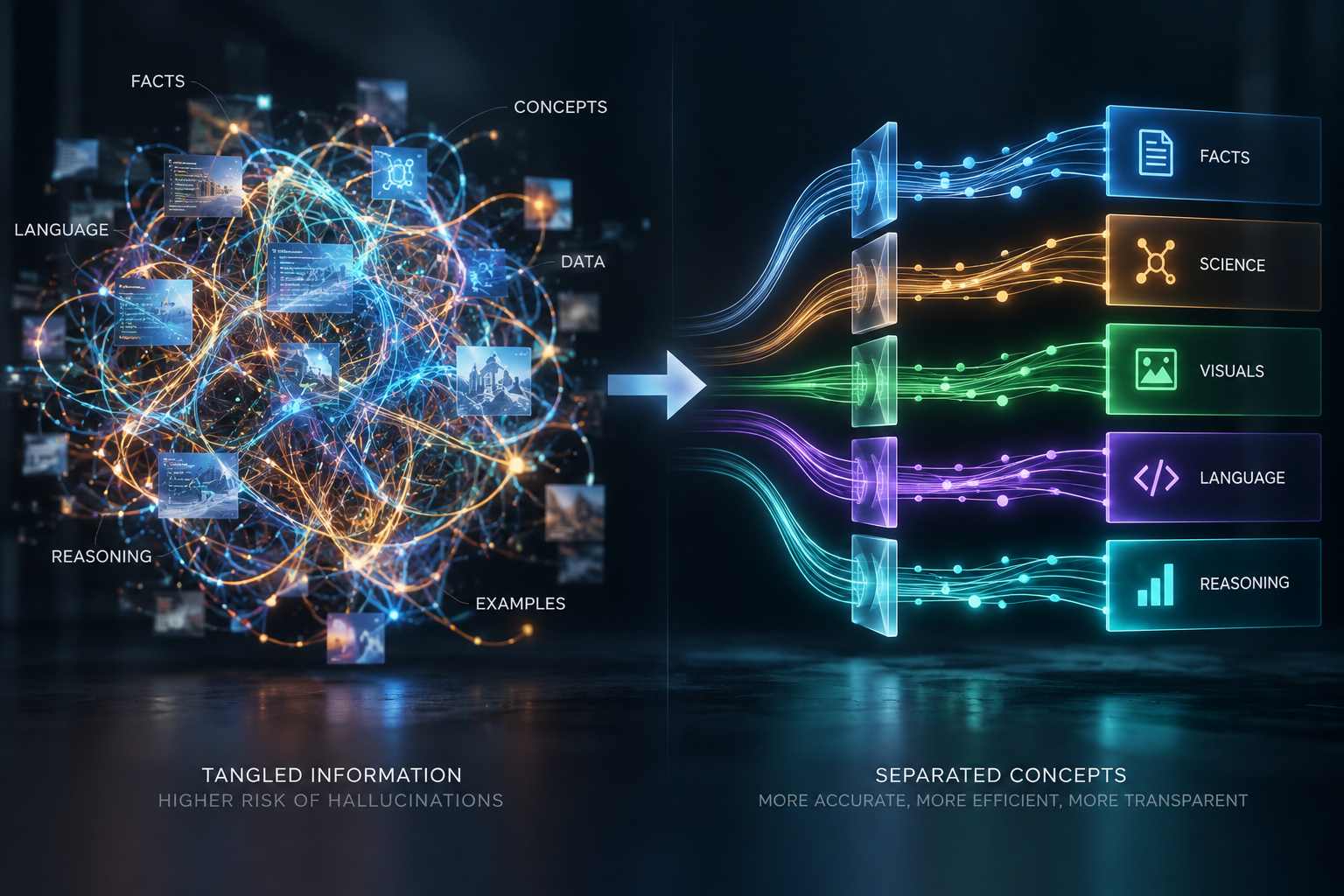
Different concepts can get tangled together.
Researchers at U of T Scarborough's Clean Energy Lab are developing a new AI-training architecture designed to organize those concepts differently. The team says the approach could reduce hallucinations while potentially making some AI systems dramatically smaller, faster and easier for humans to inspect.
And although the work started with scientific AI rather than ChatGPT-style systems, the researchers believe the underlying idea could eventually extend to large language models.
Why Can AI Sound So Sure When It's Wrong?
When an AI produces a polished answer, that doesn't necessarily mean it checked a database and confirmed every fact before responding.
Modern AI learns patterns from enormous amounts of training data.
Oleksandr Voznyy, an associate professor and principal investigator at the Clean Energy Lab, explains that conventional neural networks can store many different concepts within the same artificial neurons.
Imagine having thousands of drawers, except somebody has thrown pieces of completely different subjects into the same ones.
One drawer might contain a little chemistry, some language patterns, a scientific relationship and several unrelated concepts.
The AI learns how those pieces relate statistically. But when information overlaps in complicated ways, it can produce connections that sound plausible without being properly supported.
The Canadian researchers are essentially asking:
What if AI's filing system needs to be redesigned?
Their Idea: Stop Making AI Share Drawers
The concept behind the architecture is called monosemanticity.
The word sounds intimidating. The basic idea isn't.
Instead of having an artificial neuron represent multiple overlapping concepts, the architecture attempts to make individual neurons represent individual concepts more clearly.
Think of an enormous warehouse.
Conventional AI might have pieces belonging to hundreds of products scattered across thousands of shelves. The new approach tries to give individual concepts clearly defined places.
Voznyy says that when a concept isn't supported by the available data, the architecture can shut off that pathway rather than allowing unsupported connections to emerge.
That could potentially make it harder for an AI system to confidently assemble an answer from pieces that don't actually belong together.
It Could Also Make AI Less Mysterious
Hallucinations aren't AI's only uncomfortable problem.
There's also the question that occasionally follows an impressive AI answer:
How did it actually reach that conclusion?
With today's sophisticated neural networks, the answer can be extraordinarily difficult to determine.
The U of T researchers say their architecture could make models easier to inspect because concepts would be more clearly separated internally.
If researchers found that a particular neuron was associated with an error or bias, Voznyy says they could potentially disable it instead of retraining the entire model.
That's much more important than simply being able to peek under AI's hood.
If AI is going to play a larger role in medicine, chemistry and other scientific fields, researchers may need to understand not only what a system concluded, but why it reached that conclusion.
Then There's the 100× Claim
The project comes with another attention-grabbing possibility.
Much smaller AI.
Today's biggest models can require enormous amounts of computing infrastructure. The researchers' architecture is designed to avoid performing unnecessary calculations across pathways that aren't useful for a particular problem.
Voznyy says models using the approach can become up to 100 times smaller and faster.
That's a huge number, but it needs an equally huge asterisk.
This does not mean the researchers have built a ChatGPT competitor that's suddenly 100 times smaller and faster.
Their work currently centres on scientific AI applications. Applying the architecture to large-scale language models remains a potential future direction rather than a finished replacement for today's leading AI systems.
Still, the possibility is intriguing.
Smaller and more efficient AI could eventually mean sophisticated models running on devices with less computing power instead of always requiring giant data centres.
This Didn't Start Because ChatGPT Invented Something
The story becomes more interesting when you look at why the researchers started working on the problem.
They weren't trying to stop a chatbot from inventing a movie, a historical quote or a suspiciously confident fake citation.
They were trying to make AI useful for science.
AI systems often thrive on enormous datasets.
Scientific researchers don't always have that luxury.
Chemistry experiments can be expensive. Medical studies may involve relatively limited numbers of patients. Biological measurements can contain enormous amounts of noise.
In those situations, an AI system that learns the wrong pattern isn't merely annoying.
It can send researchers in the wrong direction.
The Clean Energy Lab wanted models capable of finding genuine patterns inside smaller, messy datasets without simply memorizing the noise.
The architecture is now being applied to several scientific problems, including blood metabolomics research involving ME/CFS — myalgic encephalomyelitis/chronic fatigue syndrome — where researchers are investigating molecular biomarkers hidden inside complicated biological data.
The team is also exploring applications involving simulations of atomic systems and clean-energy research into materials and catalysts.
So the hallucination problem suddenly looks a little different.
It's no longer:
“Why did my chatbot make that up?”
It's:
“Can we trust AI to tell the difference between a genuine scientific signal and something that merely looks convincing?”
That's a much bigger question.
Could This Eventually Work With ChatGPT-Like AI?
That's where things get especially interesting — and where the caveat matters most.
Voznyy argues that large language models face a related problem because facts, language and other learned concepts can become distributed and entangled throughout enormous networks.
The researchers believe their architecture could potentially bring greater separation to those concepts, making future AI systems easier to inspect and reducing unsupported connections.
Imagine an AI producing a questionable medical statement.
Instead of engineers knowing only that something somewhere inside billions of parameters went wrong, a more interpretable architecture could potentially help them identify which internal concept contributed to the problem.
That's the ambition.
It isn't something that has already been demonstrated across today's major language models.
The University of Toronto team's work does not establish that AI hallucinations have been eliminated from ChatGPT, Gemini, Claude or other current large language models. The Clean Energy Lab is seeking a patent for its approach, and applying the architecture at that scale remains a potential direction for the technology.
So this isn't a story about Canadian researchers suddenly “fixing ChatGPT.”
The question they're asking may actually be more interesting:
What if one of AI's biggest weaknesses isn't simply that it needs more data or more computing power — but that it needs a better way to organize what it already knows?
TwikUp Insight
For years, the AI race has largely followed a familiar formula: bigger models, more data, more chips and more computing power.
The University of Toronto team's work points in another direction.
Maybe smarter AI doesn't always need more.
Maybe it needs to be less messy.
Making AI smaller and faster would be valuable. Making its reasoning easier for humans to inspect could be even more important.
But if researchers can eventually build systems that are better at distinguishing between what their data actually supports and what merely sounds plausible, they could be tackling something far more valuable than computing efficiency.
They could be tackling trust.