
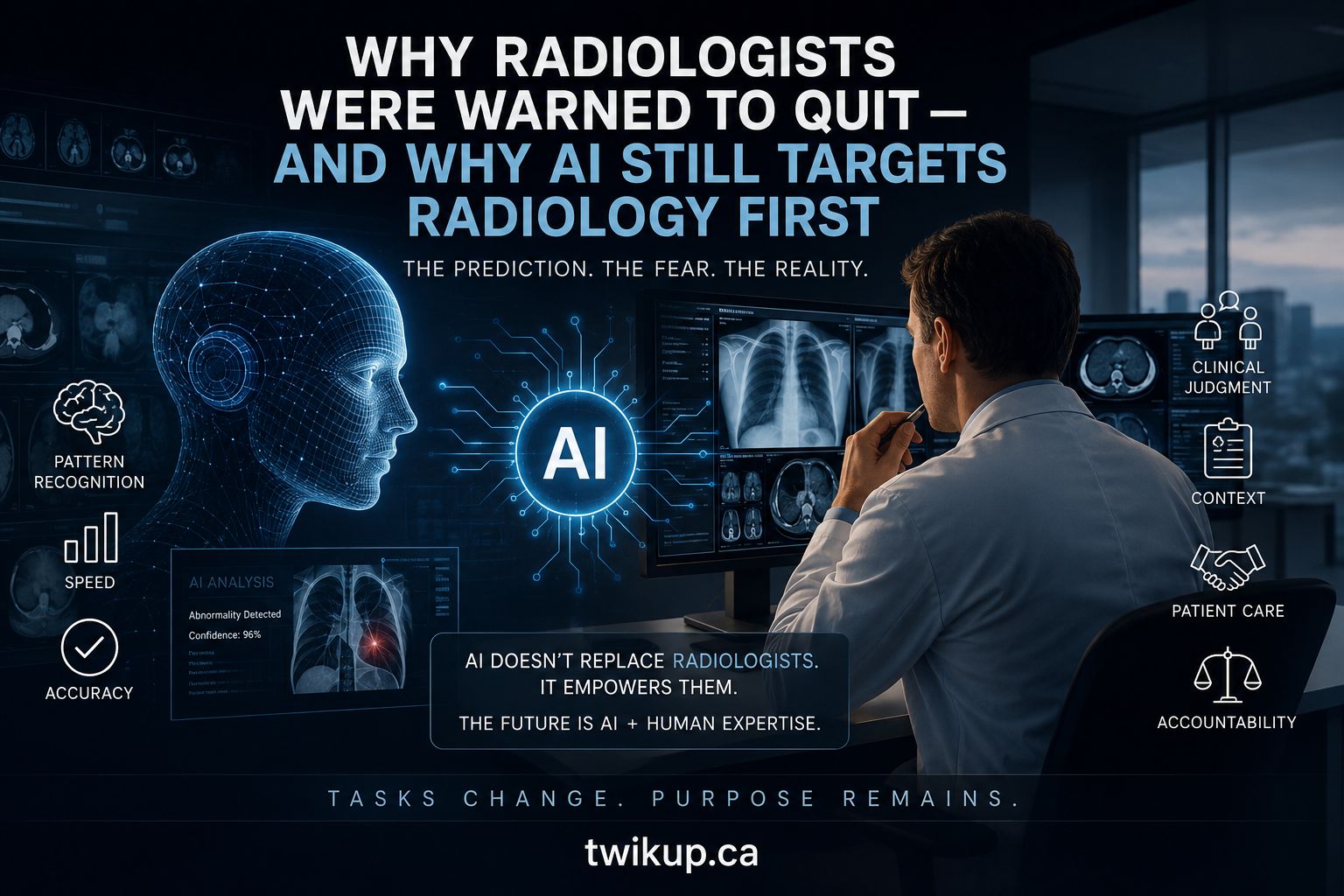
Why Radiologists Were Warned to Quit — And Why AI Still Targets Radiology First
Part of Twikup's Future of Work & AI Series
Before reading this article, read:
➡️ Will AI Create More Jobs Than It Eliminates? https://twikup.ca/technology/artificial-intelligence/will-ai-create-more-jobs-than-it-eliminates
Why Did AI Experts Single Out Radiology?
In 2016, several prominent AI researchers argued that radiology could become one of the first highly paid professions disrupted by artificial intelligence.
The reasoning seemed simple:
Radiologists spend much of their day examining:
- X-rays
- CT scans
- MRI scans
- Mammograms
- Ultrasound images
At its core, this is a pattern-recognition task.
Modern AI systems are exceptionally good at finding patterns in large image datasets, making radiology a natural target for automation.
The fear was straightforward:
If a computer can analyze millions of scans and learn from every diagnosis ever recorded, why would hospitals still need thousands of human radiologists?
The Scary Prediction That Grabbed Headlines
The prediction generated global attention because radiology seemed uniquely vulnerable.
Unlike surgeons, nurses, or family doctors, radiologists spend much of their time interacting with digital images rather than directly treating patients.
That meant AI did not need to master physical tasks or bedside communication to become useful.
It only needed to become very good at image analysis.
For many observers, radiology looked like the perfect profession for AI replacement.
What NVIDIA's CEO Says About Radiology Today
One of the most interesting developments in the AI debate comes from NVIDIA CEO Jensen Huang.
During a conversation on The Joe Rogan Experience, Huang discussed a famous prediction made by Geoffrey Hinton, often referred to as the "Godfather of AI."
In 2016, Hinton suggested that people should stop training as radiologists because AI would soon become better than humans at image recognition.
Nearly a decade later, the outcome has been very different.
According to Huang, the number of radiologists has actually increased rather than declined.
Why?
Because AI improved one specific task inside the profession: image analysis.
Huang explained that many people misunderstood the purpose of a radiologist's job.
"The purpose of a radiologist is to diagnose disease, not to study the image. The image studying is simply a task in service of diagnosing the disease."
As AI became better at helping analyze medical images, radiologists became more productive.
Hospitals could process more scans.
Patients received results faster.
Healthcare systems handled greater demand.
As a result, many organizations needed more radiologists, not fewer.
The lesson is powerful:
AI often automates tasks rather than entire professions.
Jobs that combine expertise, judgment, communication, and accountability are far harder to replace than jobs built entirely around repetitive activities.
The Numbers Behind the Debate
One reason radiologists have not disappeared is that medical imaging demand continues to grow rapidly.
Healthcare systems worldwide are facing:
- Aging populations
- Increased cancer screening
- More preventive healthcare testing
- Higher demand for diagnostic imaging
Many healthcare organizations report radiologist shortages despite advances in AI technology.
In other words, AI is arriving at the same time demand for radiology services is increasing.
This has created a situation where AI often helps radiologists handle more work rather than replacing them.
Why Radiology Is More Vulnerable Than Many Other Careers
Not all jobs are equally exposed to automation.
Radiology has several characteristics that make it attractive for AI deployment.
1. Massive Amounts of Digital Data
AI learns from data.
Radiology generates enormous volumes of standardized digital images every day.
The more data available, the better AI systems generally perform.
A plumber may encounter thousands of unique situations during a career.
A radiology AI can learn from millions of scans.
That creates a significant advantage.
2. Pattern Recognition Is AI's Strength
Modern AI systems can identify:
- Lung nodules
- Bone fractures
- Breast cancer indicators
- Stroke markers
- Internal bleeding
Many of these tasks involve recognizing visual patterns that may be difficult for humans to spot consistently.
In some narrow imaging tasks, AI can match or even exceed average human performance.
3. Growing Workloads
Healthcare systems worldwide face radiologist shortages.
At the same time:
- Populations are aging
- More scans are being ordered
- Healthcare demand continues to grow
Hospitals are searching for technologies that can help specialists review more scans without compromising patient care.
AI appears to be an ideal solution.
4. Repetitive Tasks Exist Within the Job
Radiologists perform many high-value activities.
However, portions of the workflow are repetitive:
- Measuring lesions
- Comparing previous scans
- Prioritizing urgent cases
- Drafting reports
These are exactly the types of tasks AI handles well.
Real-World Examples of AI in Radiology
The future of radiology is already visible in major healthcare systems.
Mayo Clinic
Healthcare researchers and clinicians are increasingly using AI tools to help identify abnormalities, improve workflow efficiency, and support diagnostic decisions.
NHS England
Several NHS programs have explored AI-assisted imaging systems to help prioritize scans and reduce reporting delays, particularly in areas facing staffing shortages.
Large Cancer Screening Programs
AI-assisted breast cancer screening programs in multiple countries have demonstrated that AI can help identify suspicious findings and reduce workloads for radiologists.
These examples show a consistent trend:
AI is being deployed as an assistant, not as a replacement.
The Prediction That Didn't Come True
Something unexpected happened.
AI improved dramatically.
Yet radiologists did not disappear.
In fact, demand for radiologists remained strong.
Training programs continued.
Salaries remained attractive.
Healthcare systems still needed more imaging specialists.
This surprised many people who expected AI to replace large numbers of radiologists.
What AI Actually Does Today
The reality inside modern hospitals looks very different from the headlines.
AI is increasingly used to assist radiologists rather than replace them.
Triage Cases
AI can identify scans that may contain urgent findings and move them to the front of the queue.
This helps doctors focus on the most critical patients first.
Highlight Suspicious Areas
AI can point out regions that deserve closer attention.
This acts like a second set of eyes.
Automate Measurements
AI can perform repetitive calculations that previously consumed valuable physician time.
Assist With Reports
Newer AI systems can help create draft reports and summarize findings.
The radiologist still reviews and approves the final report.
The Problem AI Still Cannot Solve
Suppose AI detects a shadow on a lung scan.
The image itself is only part of the story.
A physician must still determine:
- Is it cancer?
- Is it an infection?
- Is it scar tissue?
- Does the patient's history matter?
- What follow-up testing is needed?
- What treatment options should be considered?
Medical decisions require context.
Context remains one of AI's biggest weaknesses.
Radiologists do far more than identify shapes on a screen.
They combine imaging findings with:
- Medical history
- Symptoms
- Laboratory results
- Risk factors
- Treatment plans
This broader clinical judgment remains extremely difficult to automate.
The Legal Reality Nobody Talks About
There is another reason radiologists remain essential.
If an AI system misses a life-threatening condition:
Who is responsible?
- The software company?
- The hospital?
- The physician?
Today, legal accountability still rests primarily with human medical professionals.
As long as society expects humans to take responsibility for diagnoses, doctors remain central to the process.
The Real Future of Radiology
The most likely future is not:
AI vs Radiologists
The future is:
AI + Radiologists
AI is becoming a powerful assistant.
Radiologists are becoming more productive.
Hospitals are handling more scans.
Patients are receiving faster results.
This is not replacement.
It is augmentation.
What Other Professionals Should Learn From Radiology
Radiology may be the most important real-world case study in the future of work.
It teaches a powerful lesson:
AI rarely replaces an entire profession. It replaces specific tasks within a profession.
The same principle applies to:
- Lawyers
- Accountants
- Engineers
- Software developers
- Financial analysts
- Project managers
The jobs most at risk are those built almost entirely around repetitive tasks.
The jobs most protected are those requiring:
- Judgment
- Responsibility
- Communication
- Creativity
- Leadership
- Decision-making
Could Radiologists Eventually Be Replaced?
Nobody knows with certainty.
Technology will continue improving.
However, most experts now believe the profession will evolve rather than disappear.
Future radiologists will likely:
- Review AI-generated findings
- Validate automated diagnoses
- Manage larger workloads
- Focus on complex cases
- Spend less time on repetitive tasks
The profession may look very different by 2040.
But it is unlikely to vanish.
Frequently Asked Questions
Will AI replace radiologists?
Most experts believe AI will augment radiologists rather than fully replace them. AI excels at image analysis, but diagnosis, accountability, communication, and clinical judgment remain human responsibilities.
Why is radiology more vulnerable than other medical professions?
Radiology relies heavily on digital images and pattern recognition, making it one of the most suitable medical specialties for AI-assisted workflows.
Is radiology still a good career?
Yes. Demand for medical imaging continues to grow globally, and many healthcare systems still report shortages of qualified radiologists.
What medical careers are least vulnerable to AI?
Nursing, surgery, emergency medicine, physical therapy, occupational therapy, and mental health professions are generally considered more resistant to automation because they require physical interaction, empathy, and complex human judgment.
Twikup Insight: The Radiology Lesson Every Professional Should Learn
The biggest mistake workers make is assuming AI replaces jobs.
History suggests AI first replaces tasks.
Radiologists didn't disappear when AI learned to read images.
Instead, they became more productive.
The same pattern may emerge for engineers, accountants, lawyers, software developers, project managers, financial analysts, and many other knowledge workers.
The winners of the AI era may not be AI itself.
They may be professionals who learn how to use AI better than their competitors.
Those who learn to work with AI may become significantly more productive.
Those who ignore AI may eventually find themselves competing against people who use AI effectively.
The future is unlikely to belong to humans alone or machines alone.
It will belong to humans who know how to use machines better than everyone else.
sources Mayoclinic-https://www.mayoclinic.org/departments-centers/radiology/sections/doctors/drc-20469698
NHS England - https://www.england.nhs.uk