
For decades, workers were told that machines would come for repetitive factory jobs first.
Then generative AI changed the conversation.
Today, software can write an email, summarize a 100-page document, generate computer code, create an advertisement, translate languages, analyze spreadsheets and produce images in seconds.
That has created an uncomfortable question for millions of workers:
If AI can already do part of my job, how long before it can do all of it?
But that may be the wrong question.
AI does not necessarily need your entire job.
It only needs enough of your Monday morning.
If an employee spends 40% of the week producing reports, organizing information, answering routine questions or writing predictable digital content, an AI system that dramatically reduces that workload can change how many people a company needs — even if the occupation itself never disappears.
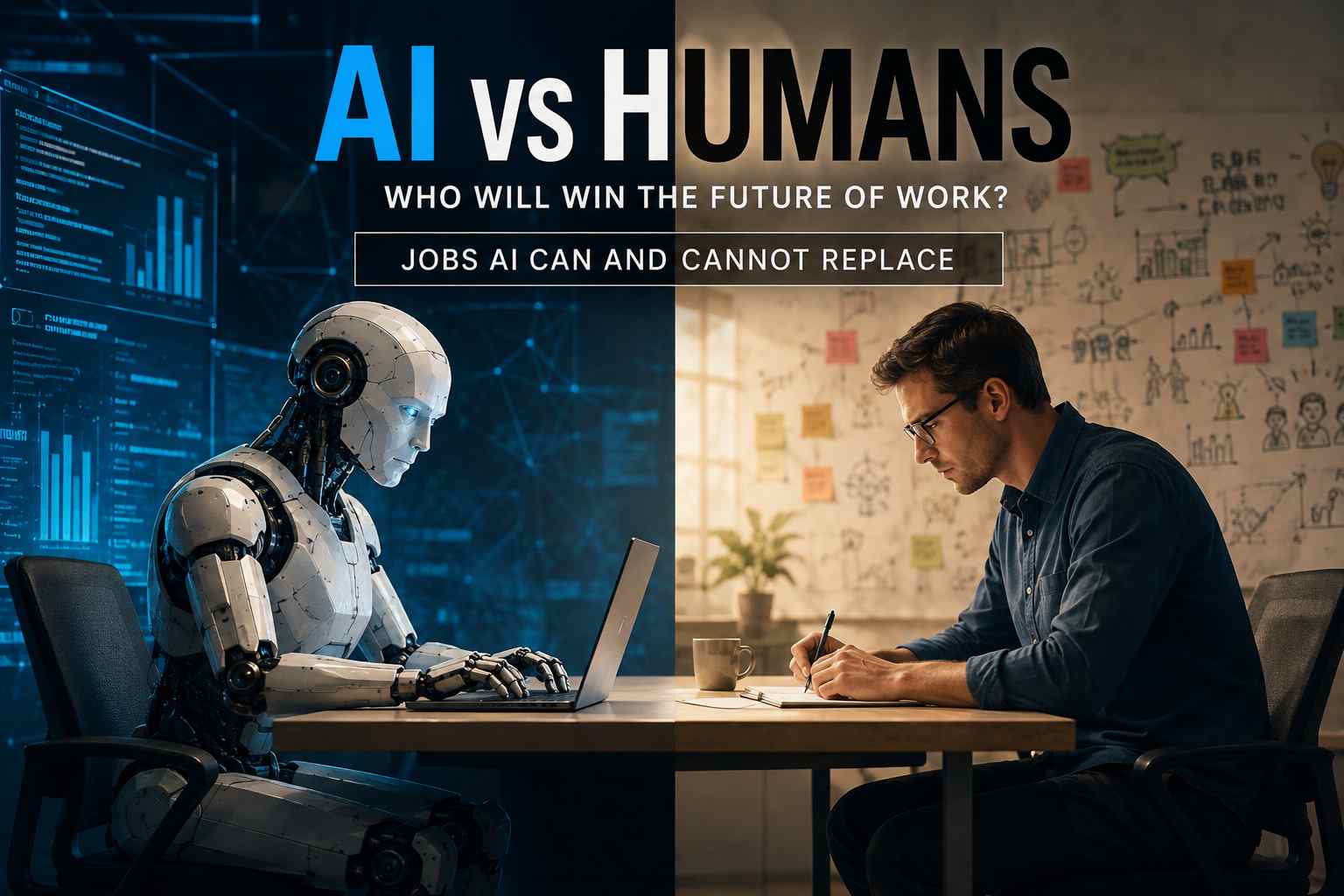
That is why the future of work is unlikely to be a simple contest of AI vs humans.
It may increasingly become a contest between people who use AI to become dramatically more productive and people whose work can be standardized enough for AI to perform a growing share of it.
And the first major disruption may not even arrive through mass layoffs.
It could arrive much more quietly.
Companies may simply stop hiring as many people.
Quick Answer
AI is unlikely to replace humans across the entire workforce, but it can automate individual tasks inside millions of jobs — potentially allowing fewer workers to produce the same amount of work.
The International Labour Organization estimates that one in four workers globally is in an occupation with some exposure to generative AI, while only 3.3% of global employment falls into its highest exposure category.
Its central conclusion is important:
Job transformation is more likely than widespread complete job replacement.
Canada's early evidence is similarly complicated.
Statistics Canada found that employment generally continued to grow between November 2022 and December 2025 across occupations with different levels of AI exposure. There was no clear evidence that highly exposed occupations as a whole had already entered persistent employment decline.
But that does not mean every worker is safe.
One of the most important warning signs may be appearing at the beginning of careers.
Among coding-intensive occupations, Statistics Canada found stronger employment growth among workers aged 30 to 49 while employment among coding professionals younger than 30 stagnated.
That does not prove AI caused the difference.
But it raises a much bigger question:
What happens if AI does not eliminate the senior developer, analyst, accountant or lawyer — but starts performing the work traditionally given to the junior employee trying to become one?
The biggest AI employment story may ultimately be about jobs that disappear.
But it could also be about jobs that are never created.
Key Takeaways
- AI is currently better positioned to replace tasks than entire occupations.
- Clerical and highly digitized office work has some of the greatest exposure to generative AI.
- Data entry, routine administration, basic content production and standardized digital tasks face particularly strong automation pressure.
- Entry-level white-collar jobs could face disproportionate pressure because many junior tasks are exactly the kind of structured digital work AI performs well.
- Physical work in unpredictable environments remains considerably harder to automate with generative AI.
- Jobs involving human trust, accountability, empathy, leadership, negotiation and complex physical interaction have stronger protection from complete automation.
- High-skilled workers are not automatically protected. Programmers, analysts and other digital professionals can also have significant AI exposure.
- Canada has not yet experienced clear economy-wide employment destruction attributable to generative AI.
- The biggest effect could eventually be job compression: companies producing more while employing fewer people per unit of output.
- The strongest position in the future labour market may belong neither to AI nor humans alone, but to humans who know how to work effectively with AI.
AI May Not Take Your Job — It May Stop the Next Person From Getting One
Imagine an accounting firm with 20 employees.
Business is growing.
Five years ago, management might have responded by hiring another five people.
But now its existing employees have AI tools that can summarize documents, classify transactions, prepare preliminary reports, search large datasets and automate parts of routine administrative work.
The company may still grow.
Its employees may still receive raises.
Nobody necessarily gets fired.
But instead of hiring five additional people, perhaps it hires two.
Three jobs were not technically "lost."
They simply never appeared.
There is no termination letter.
No dramatic announcement.
No headline saying:
AI eliminates three accounting jobs.
Yet the labour market has changed.
Scale that effect across thousands of companies and the consequences become much larger.
This is one reason measuring AI's effect only by counting layoffs could miss an important part of the story.
The Entry-Level Problem Could Be Bigger Than the Job-Loss Problem
There is another complication.
Think about how people traditionally become experts.
A junior analyst does basic research.
A junior developer writes simpler code.
A new lawyer reviews documents.
A marketing assistant prepares first drafts.
A junior accountant reconciles information.
Eventually, those workers acquire enough experience to handle more complicated decisions.
But many of those beginner tasks overlap with the work AI is becoming increasingly capable of performing.
That creates a strange possibility.
Companies could need fewer junior workers today while still desperately needing experienced workers tomorrow.
Where, then, will tomorrow's senior employees acquire their experience?
A profession does not have to disappear for its career ladder to break.
That could become one of AI's most important long-term labour-market effects.
Statistics Canada's early evidence around coding occupations makes the question particularly interesting.
Between November 2022 and December 2025, coding-intensive employment overall did not collapse.
But underneath that headline, growth was concentrated among workers aged 30 to 49, while the number of coding professionals younger than 30 stagnated.
Statistics Canada cautions that many economic and demographic forces were operating simultaneously, so this cannot simply be attributed to AI.
Still, the pattern illustrates exactly what researchers, employers and young workers need to watch.
The senior developer may not be the first person threatened by AI.
The person trying to become a senior developer might face the bigger adjustment.
Which Jobs Face the Most AI Pressure?
There is no credible list of occupations guaranteed to disappear.
AI capabilities are changing too quickly, and an occupation can contain dozens of different tasks.
A better approach is to ask how much of a job consists of predictable digital work.
Here is a practical way to think about current exposure:
| Type of work | Current AI pressure | Why |
|---|---|---|
| Data entry | 🔴 Very high | Structured, repetitive digital information |
| Routine clerical work | 🔴 Very high | Documents, forms and standardized processes |
| Basic customer support | 🔴 Very high | Repetitive questions and predictable responses |
| Basic content production | 🔴 Very high | Standardized digital output is easy to generate |
| Junior coding tasks | 🟠 High | AI can increasingly generate, test and explain code |
| Financial analysis | 🟠 High | Research and information processing can be accelerated |
| Accounting | 🟠 High | Many tasks can be automated, while judgment remains important |
| Teaching | 🟡 Moderate | Information delivery can be automated; classroom leadership cannot |
| Healthcare | 🟡 Moderate | Administrative work is exposed; physical care and judgment are harder |
| Skilled trades | 🟢 Lower current replacement risk | Physical, unpredictable environments remain difficult to automate |
These are not predictions that particular professions will disappear.
They illustrate a broader principle:
The more predictable, digital and standardized your work is, the easier it becomes to automate parts of it.
1. Data Entry and Routine Clerical Work
This is one of the clearest areas of exposure.
Generative AI and traditional automation systems can increasingly:
- classify information,
- extract data from documents,
- populate databases,
- summarize records,
- organize files,
- process standardized forms,
- and identify basic inconsistencies.
The ILO's 2025 research found that clerical occupations continue to have the highest levels of generative-AI exposure.
That does not mean every administrative assistant disappears.
It means employers may need fewer human hours to complete the same administrative workload.
And that distinction is crucial.
2. Basic Customer Support
Consider a customer asking:
"Where is my order?"
If an AI system can identify the customer, access the order, determine its location and explain what happens next, human intervention may add little value.
The same applies to repetitive questions involving:
- account information,
- appointment scheduling,
- product instructions,
- returns,
- basic troubleshooting,
- and company policies.
But now imagine the customer is furious because the package contains medication needed tomorrow.
Suddenly the situation involves urgency, judgment, exceptions and potentially human reassurance.
That illustrates where the boundary currently sits.
AI can increasingly handle the ordinary conversation.
Humans become more valuable when the ordinary conversation stops being ordinary.
3. Routine Content Production
AI can already produce enormous quantities of text.
That puts pressure on work involving highly standardized:
- product descriptions,
- basic marketing copy,
- repetitive SEO pages,
- summaries,
- templated emails,
- social captions,
- internal documentation,
- and simple reports.
But producing words and producing valuable information are different problems.
AI can generate a plausible article extraordinarily quickly.
Determining what is actually worth investigating, which source should be trusted, what question nobody is asking and what the information means is considerably harder.
As producing information becomes cheaper, the premium may increasingly shift toward:
original reporting, verification, expertise, judgment and trust.
4. Some Junior Coding Tasks
Software development may become one of the most important tests of the AI-replacement argument.
AI coding systems can already:
- generate functions,
- explain existing code,
- identify bugs,
- write tests,
- create documentation,
- refactor code,
- and rapidly prototype applications.
That does not mean software developers suddenly become unnecessary.
Building reliable software involves architecture, security, product requirements, debugging, infrastructure, trade-offs and understanding why something should be built in the first place.
But the amount of routine code one developer can produce may change dramatically.
And that leads directly to the larger issue:
If one developer equipped with AI can accomplish substantially more work, how many developers does a company need for the same project?
That may matter more than whether AI can independently hold the title "software developer."
The Biggest Misunderstanding About AI and Jobs
Consider an accountant.
Their job might involve:
- gathering financial information,
- entering data,
- checking transactions,
- preparing spreadsheets,
- identifying anomalies,
- explaining results,
- communicating with clients,
- interpreting regulations,
- exercising professional judgment,
- and taking responsibility for the final work.
AI does not have to become an accountant to disrupt accounting.
It only has to become good enough to perform several of those tasks.
Suppose a company previously needed 10 employees to process a particular volume of work.
After introducing AI, those 10 employees might become substantially more productive.
The company could expand without hiring as many additional workers.
Nine employees might eventually handle work that previously required 10.
Or the same 10 employees might spend dramatically less time processing information and more time advising clients.
All three outcomes represent AI changing employment.
That is why asking whether accountants, programmers or analysts will "still exist" in 2030 misses much of what could happen.
Of course they may exist.
The more important question is:
How many people will be required to produce the same amount of work?
What AI Still Struggles With
The jobs with stronger protection are not necessarily those requiring the most education.
They often have something else in common:
The real world is messy.
Generative AI is extraordinarily powerful when information can be represented digitally.
A leaking pipe inside a 40-year-old house is different.
So is comforting a frightened patient.
Managing 25 children in a classroom is different.
So is negotiating with an angry customer, repairing unfamiliar machinery or leading a team through a crisis nobody predicted.
Several human advantages remain particularly important.
Physical Unpredictability
Consider an electrician arriving at a house where half the kitchen has suddenly lost power.
The electrician must inspect the environment, understand previous modifications, identify hazards, manipulate physical equipment and make decisions where mistakes can have serious consequences.
AI might help diagnose the problem.
It could retrieve electrical codes.
It could suggest troubleshooting steps.
But actually completing the job requires physical dexterity, situational awareness and responsibility.
Similar advantages currently exist across jobs such as:
- plumbers,
- HVAC technicians,
- mechanics,
- construction workers,
- equipment technicians,
- and maintenance professionals.
Robotics may eventually automate more physical work.
But manipulating an unpredictable physical environment is a very different technological problem from generating text on a screen.
Trust and Human Relationships
AI can explain calculus.
It can generate a quiz.
It can rewrite a lesson for a different reading level.
It can tutor someone at 2 a.m.
But a teacher does more than transfer information.
Teachers recognize when students are confused, distracted, discouraged or disengaged.
The same principle applies elsewhere.
Healthcare workers communicate with frightened patients and families.
Salespeople read clients.
Managers resolve conflicts.
Advisers build relationships over years.
The more important human trust becomes to the outcome, the harder it is to reduce the job entirely to software.
Accountability
AI can recommend a decision.
Someone still needs to own it.
Consider healthcare.
AI may increasingly assist with documentation, information retrieval, scheduling, pattern recognition and analytical work.
But healthcare also involves:
- physical examinations,
- clinical judgment,
- patient communication,
- ethical decisions,
- physical procedures,
- and responsibility when something goes wrong.
A nurse does not simply process medical information.
A nurse observes a patient, notices subtle changes, communicates with families and reacts when reality stops following the expected script.
The same accountability problem exists in law, engineering, finance, management and government.
For consequential decisions, organizations and the public may continue demanding a human answer to a simple question:
Who is responsible?
High-Paying White-Collar Jobs Are Not Automatically Safe
One of the most surprising aspects of the AI revolution is that education alone does not provide protection.
The ILO's updated research found growing exposure among highly digitized professional and technical occupations, including financial analysts, web and multimedia developers, application programmers and investment advisers.
The IMF has similarly estimated that roughly 60% of employment in advanced economies could be exposed to AI, although exposure does not mean replacement.
Some workers may benefit enormously because AI complements their abilities.
Others could face weaker labour demand where AI can perform significant portions of their existing work.
That turns the old automation assumption upside down.
For decades, many people assumed automation would primarily threaten physical and repetitive work.
Generative AI has demonstrated something different.
A highly educated employee spending eight hours moving predictable information between digital systems could potentially have greater AI exposure than a tradesperson working in unpredictable physical environments.
Canada Is Already Becoming an AI Workplace
For Canadians, this debate is no longer theoretical.
Statistics Canada found workplace use of generative AI rose significantly as the technology became more accessible.
The share of Canadian workers reporting generative-AI use increased from approximately 17% in September 2024 to 30% in July 2025.
By March 2026, adoption was particularly high in occupations where AI had both high exposure and strong potential to complement human workers.
53.8% of workers in high-exposure, high-complementarity occupations reported using generative AI at work.
Among workers in high-exposure but low-complementarity occupations, the figure was 45.9%.
Only 14.2% of workers in low-exposure occupations reported workplace generative-AI use.
That reveals something important.
AI is not standing outside Canadian workplaces preparing to enter.
Workers are already bringing it inside.
Has AI Already Destroyed Jobs in Canada?
Not at an economy-wide scale that can clearly be demonstrated from the available evidence.
Statistics Canada's analysis of Canadian employment following the widespread arrival of generative AI found that from November 2022 to December 2025, employment generally increased regardless of occupations' potential exposure to AI.
There was no clear evidence of persistent employment decline across highly exposed, low-complementarity occupations as a group.
Job vacancies declined substantially after their pandemic-era peak.
But Statistics Canada cautioned against simply blaming AI.
Vacancies also declined in occupations with relatively low AI exposure, suggesting post-pandemic labour-market normalization and other economic forces were also important.
That distinction matters.
Claims that AI has already eliminated entire categories of Canadian employment go beyond what the evidence currently demonstrates.
But this is still an extremely young technology cycle.
Early labour-market evidence cannot tell us what happens after another five or 10 years of increasingly capable AI systems.
AI Could Create Jobs Too
There is another side to the story.
Technology rarely changes only one side of the labour market.
The World Economic Forum's Future of Jobs Report 2025 estimates that broad structural changes could create 170 million jobs by 2030 while displacing 92 million, producing a net increase of approximately 78 million jobs.
Those numbers are not an estimate of AI alone.
They incorporate several major forces reshaping employment, including technological change, demographic shifts, economic pressures and the green transition.
The fastest-growing roles by percentage include areas such as:
- AI and machine-learning specialists,
- big-data specialists,
- fintech engineers,
- software and application developers,
- renewable-energy engineers,
- and environmental engineers.
Meanwhile, large absolute employment gains are expected in areas including care, education, construction, delivery and agriculture.
That combination is revealing.
The future economy may simultaneously require more sophisticated technology workers and more workers operating in deeply human and physical environments.
The Real AI Threat Could Be Job Compression
Mass unemployment is the most dramatic AI scenario.
But another outcome may be easier to imagine.
Job compression.
Suppose a company once needed 20 people to produce a particular amount of work.
AI tools improve.
The company eventually discovers that 12 or 15 highly productive employees supported by AI can produce similar — or greater — output.
The profession has not disappeared.
The company still employs people.
Revenue may even increase.
But fewer human workers are required for each unit of output.
That distinction matters enormously.
Productivity growth is generally good for economies.
It can reduce costs, create new businesses, increase output and free people from repetitive work.
But productivity improvements can also create painful transitions for workers whose tasks become easier to automate.
This means two labour markets could develop simultaneously:
one in which AI reduces the number of humans required for existing work, and another in which AI creates products, businesses and occupations that previously did not exist.
Which force becomes stronger will vary enormously by industry.
The Skills That Become More Valuable When AI Gets Better
If AI makes routine cognitive work cheaper, certain human abilities could become more valuable.
Judgment
AI can generate five possible answers.
Someone still has to determine which one makes sense.
Verification
Generating information is becoming extraordinarily cheap.
Determining whether that information is true becomes more valuable.
Communication
AI can produce language.
Winning another person's trust is different.
Creativity
The advantage may increasingly come from deciding what should be created, rather than merely executing the first draft.
Domain Expertise
Knowing how to prompt an AI system is useful.
Knowing when its answer is dangerously wrong is more valuable.
Leadership
Organizations still need people who can choose priorities, motivate teams and accept responsibility for outcomes.
Adaptability
Specific AI tools will change.
The ability to repeatedly learn new systems may therefore matter more than mastering one particular platform.
If AI Can Do Part of Your Job, What Should You Do?
The goal should not be to find a supposedly permanent AI-proof career.
No one can credibly promise which technologies will exist 10 or 20 years from now.
A more practical strategy is to move toward the parts of your profession that become more valuable when routine work becomes cheaper.
If you work in content
Do not compete with AI on how quickly you can produce 1,000 generic words.
Build skills in original research, reporting, interviews, sourcing, verification, analysis, storytelling and subject expertise.
If you are a developer
Use AI to accelerate routine coding, but strengthen your abilities in architecture, debugging, security, systems thinking, product decisions and understanding complex codebases.
If you are an analyst
Automate information gathering and repetitive formatting where appropriate.
Spend more time learning how to question assumptions, interpret results, build models and communicate what the numbers actually mean.
If you work in administration
Learn the AI and automation systems entering your profession.
The person who understands how to design, supervise and verify an automated workflow may be in a stronger position than someone whose job consists entirely of manually operating that workflow.
If you are a manager
Learn how AI can improve your team's productivity without sacrificing accuracy, security, accountability or judgment.
Management increasingly may involve deciding where humans are essential and where machines should do more of the work.
A Simple Test: How Exposed Is Your Job?
Instead of asking:
"Can AI replace my profession?"
Ask:
- How much of my working day happens entirely on a computer?
- How repetitive are the decisions I make?
- Can my work be clearly described through rules and examples?
- Does my work require physical interaction with an unpredictable environment?
- Do people pay primarily for my output — or for my judgment?
- Does my job depend heavily on trust, negotiation or relationships?
- Who is responsible if my decision is wrong?
- Could one employee using AI perform substantially more work than one employee can today?
- Which parts of my job would I automate first if I owned the company?
That last question may be the most revealing.
If you can immediately identify half of your working week as repetitive digital work, your employer may eventually identify it too.
The goal is not to panic.
It is to understand where your value is moving.
The Real Winner May Be Human + AI
Imagine two financial analysts.
One refuses to use AI.
The other uses it to summarize filings, compare documents, organize research, search large amounts of information and generate preliminary scenarios — then independently verifies the information and applies professional judgment.
AI does not necessarily need to replace the first analyst.
The second analyst might.
That is the part of the AI-vs-human debate frequently overlooked.
In many professions, the immediate competitive threat may not be:
Human vs machine.
It may be:
Human vs human-with-a-machine.
If AI allows one skilled worker to accomplish what previously required several people, companies may continue employing humans.
But expectations for each employee could rise dramatically.
So, Who Wins the Future of Work?
Neither side wins completely.
AI has enormous advantages in:
speed, scale, repetition, information processing and increasingly sophisticated digital production.
Humans retain major advantages in:
responsibility, physical interaction, trust, relationships, judgment, leadership and navigating unpredictable environments.
The boundary between those categories will continue moving.
That is why declaring any occupation permanently "AI-proof" would be a mistake.
The better strategy is to build a career in which AI increases your value rather than simply reproducing your output.
The plumber does not need to beat ChatGPT at writing.
The lawyer does not need to beat AI at summarizing 500 pages.
The developer does not need to beat AI at generating boilerplate code.
The question is what each person can do after AI makes the easiest part of the job dramatically cheaper.
TwikUp Insight
The biggest employment story of the AI era may not be mass unemployment.
It could be something quieter:
fewer people required to produce more work.
There may never be a headline announcing that AI eliminated your profession.
Your company may simply hire four graduates next year instead of eight.
A department that once expanded from 20 employees to 30 may grow from 20 to 23.
A business that previously needed five people to launch may be started by two people equipped with AI.
Individual occupations could survive while the number of opportunities inside them changes dramatically.
At the same time, AI could create entirely new businesses, products and occupations because ideas that once required millions of dollars and large teams become possible with far fewer resources.
That means AI could simultaneously destroy opportunities and create opportunities.
And that is why the most useful question for workers in 2026 is not:
"Will AI take my job?"
It is:
"Which parts of my job are becoming cheap because of AI — and what can I learn that becomes more valuable because AI exists?"
The people who answer that question early may have the greatest advantage in the next decade.
Because the future of work probably will not belong entirely to AI.
And it will not automatically belong to humans either.
It may belong to humans who learn what machines are exceptionally good at — and then become exceptionally good at everything machines still cannot do.
Sources
International Labour Organization — Generative AI and Jobs: A 2025 Update
https://www.ilo.org/publications/generative-ai-and-jobs-2025-update
International Labour Organization — Generative AI and Jobs: A Refined Global Index of Occupational Exposure
https://www.ilo.org/publications/generative-ai-and-jobs-refined-global-index-occupational-exposure
Statistics Canada — Canadian Employment Trends in the Era of Generative Artificial Intelligence: Early Evidence
https://www150.statcan.gc.ca/n1/pub/36-28-0001/2026001/article/00003-eng.htm
Statistics Canada — Use of Generative Artificial Intelligence Tools Among Canadian Workers, March 2026
https://www150.statcan.gc.ca/n1/daily-quotidien/260730/dq260730b-eng.htm
Statistics Canada — Workplace Artificial Intelligence Use: A Profile of Sociodemographic and Job Characteristics
https://www150.statcan.gc.ca/n1/pub/75-006-x/2026001/article/00007-eng.htm
International Monetary Fund — AI Will Transform the Global Economy
https://www.imf.org/en/Blogs/Articles/2024/01/14/ai-will-transform-the-global-economy-lets-make-sure-it-benefits-humanity
World Economic Forum — Future of Jobs Report 2025
https://www.weforum.org/publications/the-future-of-jobs-report-2025/digest/