
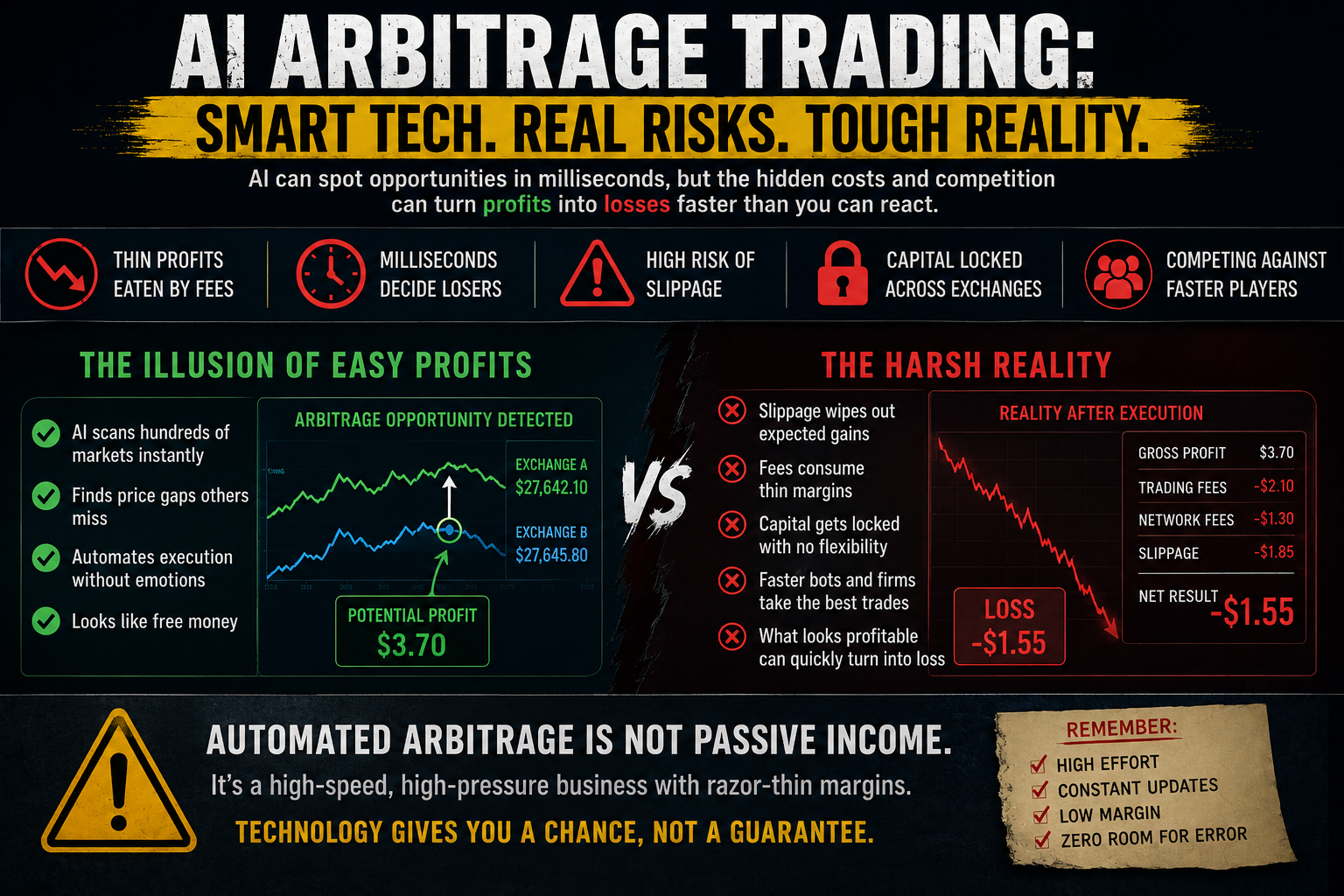
Automated arbitrage can generate profits, but it is not the effortless money machine many traders imagine. Modern arbitrage opportunities often disappear within milliseconds, making manual execution ineffective and forcing traders to rely on automation, infrastructure, and significant capital.
The irony is that while technology has made arbitrage more accessible, it has also made the competition far more intense. The same tools available to retail traders are being used by thousands of other bots chasing the exact same opportunities.
Why Speed Determines Who Wins the Arbitrage Race
Arbitrage depends on identifying and exploiting price differences between markets before those differences disappear.
In today's electronic markets, these pricing gaps often exist for only fractions of a second. By the time a human spots the opportunity and manually places an order, the market has usually corrected itself.
Automated vs. Manual Arbitrage
| Feature | Manual Arbitrage | Automated Arbitrage |
|---|---|---|
| Execution Speed | Seconds to minutes | Milliseconds |
| Market Monitoring | Limited exchanges | Hundreds of pairs |
| Emotion Risk | High | Rules-based |
| Opportunity Capture | Rarely successful | Highly efficient |
| Scalability | Very limited | Highly scalable |
Automation allows systems to continuously scan markets, calculate profitability, and execute trades before competitors react.
Building an Automated Arbitrage System Requires More Than a Bot
Successful automation follows a structured process rather than a simple software installation.
-
Select a target market such as cryptocurrency, forex, or sports betting.
-
Connect directly to multiple exchanges using APIs to receive live pricing and order book data.
-
Program logic that identifies profitable spreads after accounting for fees and execution costs.
-
Deploy systems on cloud infrastructure positioned close to exchange servers to reduce latency.
-
Implement safeguards that limit slippage and prevent exposure to unhedged positions.
Each step introduces technical complexity that must function flawlessly under real-time market conditions.
The Hidden Costs That Destroy Most Arbitrage Profits
Many traders focus on price discrepancies while overlooking the factors that often erase profits completely.
Slippage Can Reverse a Winning Trade
A pricing gap may appear profitable when detected. However, even a tiny market movement between detection and execution can eliminate the expected gain or create an immediate loss.
Fees Often Consume the Entire Opportunity
Trading commissions, network charges, withdrawal costs, and exchange fees can exceed the small margins that arbitrage strategies target.
A trade that appears profitable on paper may become unprofitable once every cost is included.
Capital Must Remain Idle
Spatial arbitrage typically requires funds to be maintained across multiple exchanges simultaneously.
While this improves execution speed, it also means capital remains locked in place rather than being used for other investments or yield-generating opportunities.
Competing Against Faster Players
One of the biggest challenges is trading against sophisticated institutional market makers.
These firms operate with superior infrastructure and execution speed, often identifying and exploiting opportunities before retail systems can react. In some cases, slower traders end up inheriting the least attractive side of a trade.
Arbitrage Has Become a Technology Business
The modern arbitrage landscape increasingly rewards engineering expertise rather than market prediction.
The edge no longer comes from spotting opportunities. It comes from detecting them faster, processing them more efficiently, and executing them before competitors.
This creates a constant cycle of upgrades, optimization, and system maintenance. A profitable strategy today may stop working tomorrow as exchanges modify their systems or competitors improve their speed.
What Comes Next for Automated Arbitrage Traders
Automated arbitrage is likely to remain viable, but the barriers to success continue to rise.
Future participants will need stronger infrastructure, faster execution, and more sophisticated risk management simply to remain competitive. As markets become increasingly efficient, the margin for error continues to shrink.
For traders considering automation, the key question is not whether arbitrage opportunities exist. The real question is whether they can build and maintain a system capable of capturing those opportunities before everyone else does.
FAQ: Brief Insights on Automated Arbitrage
Is automated arbitrage passive income?
No. Automated arbitrage requires continuous monitoring, maintenance, and strategy adjustments to remain effective.
Why can't traders perform arbitrage manually?
Most opportunities disappear within milliseconds, making human reaction times too slow to compete.
What is the biggest risk in automated arbitrage?
Slippage, fees, and competition from faster market participants are among the most significant threats to profitability.
Does automated arbitrage require large amounts of capital?
Many strategies require substantial liquidity across multiple exchanges, which can create significant capital requirements.