
You earn $100,000 a year.
That sounds like a strong household income.
Then you open a real-estate app in Toronto, Vancouver or another expensive Canadian market and see ordinary-looking homes listed for $800,000, $1 million or more.
So maybe the answer is simply earning more.
At $150,000, buying should become much easier.
At $200,000, surely the affordability problem starts disappearing.
Except Canada's mortgage system does not look at your salary and simply multiply it by four or five.
Your down payment, mortgage rate, stress-test rate, property taxes, heating costs, condo fees, car payments, student loans, credit-card balances and other debts can all change what a lender is willing to approve.
That creates a more useful question than simply asking whether $100,000 is a “good salary”:
How much house can someone earning $100,000, $150,000 or $200,000 actually afford in Canada in 2026?
The surprising part is not that $200,000 buys more house than $100,000.
It is that even doubling your income does not automatically make every Canadian housing market comfortably affordable.
Quick Answer
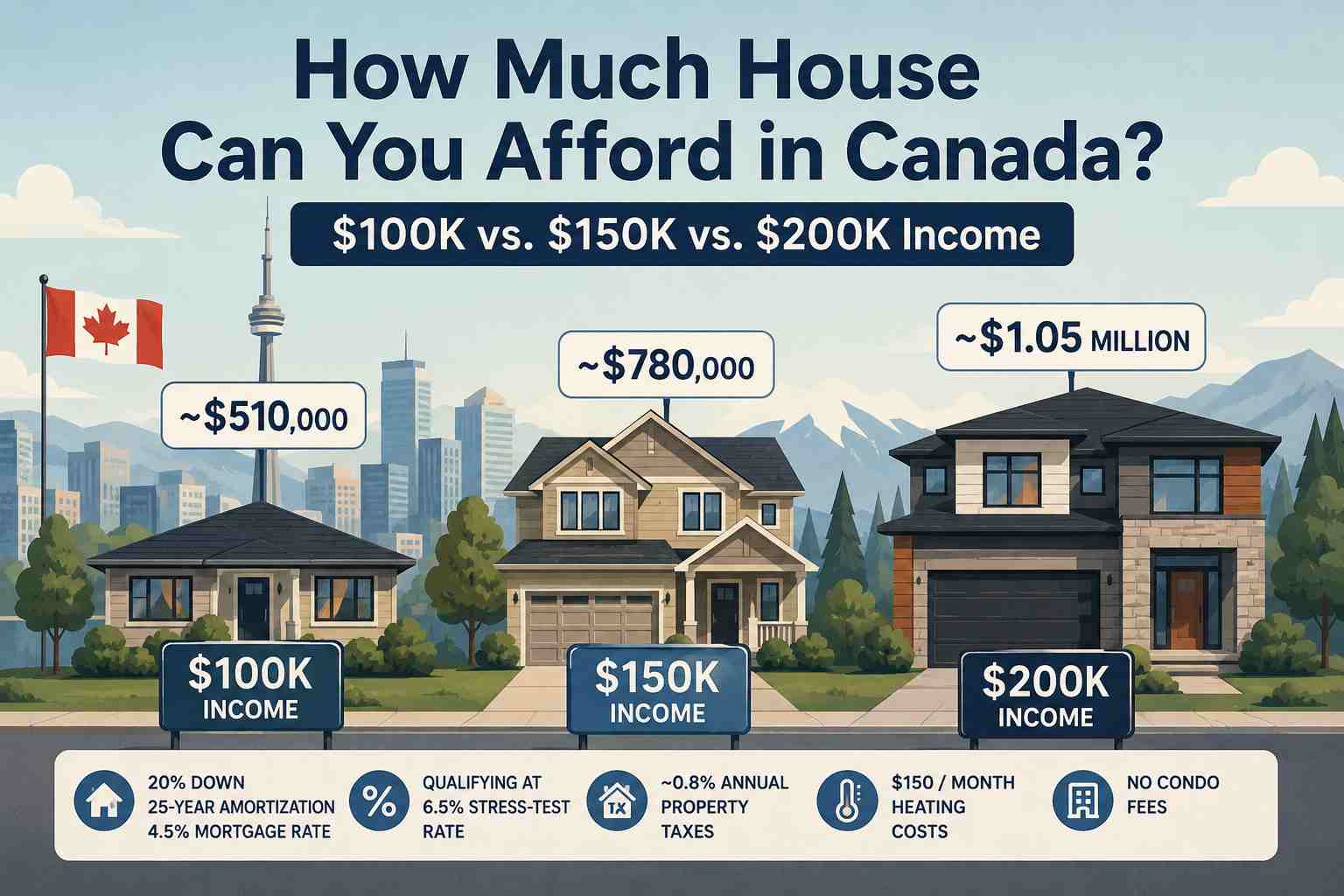
Under a simplified 2026 mortgage scenario, a debt-free Canadian household could be around $510,000 on a $100,000 income, $780,000 on $150,000 and roughly $1.05 million on $200,000.
Those estimates assume:
- 20% down
- no other debt
- 25-year amortization
- 4.5% contract mortgage rate
- qualification at 6.5% under the mortgage stress test
- approximately 0.8% annual property taxes
- $150 per month for heating
- no condo fees
| Gross household income | Illustrative home price | Approx. 20% down payment | Approx. mortgage |
|---|---|---|---|
| $100,000 | ~$510,000 | ~$102,000 | ~$408,000 |
| $150,000 | ~$780,000 | ~$156,000 | ~$624,000 |
| $200,000 | ~$1.05 million | ~$210,000 | ~$840,000 |
These are illustrative affordability estimates, not mortgage pre-approvals.
Change the mortgage rate, debts, down payment, taxes, condo fees or lender and the answer can change materially.
That is why two households earning exactly the same salary can end up with dramatically different home-buying budgets.
Key Takeaways
- A household earning $100,000 may be around the low-$500,000 home-price range under the assumptions used here.
- At $150,000, illustrative affordability moves toward roughly the high-$700,000 range.
- At $200,000, the same calculation approaches approximately $1 million.
- Income alone does not determine mortgage qualification.
- Canadian borrowers may have to qualify at a mortgage stress-test rate above their actual contract rate.
- Car loans, student loans, credit-card balances and other debts can reduce purchasing power.
- Property taxes, heating costs and part of applicable condo fees can also affect qualification.
- A larger down payment can make a more expensive property possible without necessarily increasing the mortgage.
- The maximum amount a lender approves is not necessarily the amount a household can comfortably afford.
Why a $100,000 Salary Doesn't Automatically Mean a $500,000 Mortgage
One of the most common home-buying shortcuts is:
Take your income and multiply it by four or five.
That might provide a rough starting point.
It is not how mortgage qualification actually works.
Canadian lenders look at how much of your gross income would be consumed by housing costs and other debts.
For CMHC-insured mortgages, CMHC generally limits the Gross Debt Service ratio, or GDS, to 39% and the Total Debt Service ratio, or TDS, to 44%.
GDS can include:
- mortgage principal and interest
- property taxes
- heating costs
- 50% of applicable condominium fees
TDS takes those housing expenses and adds other debt obligations.
That means two households earning $100,000 can look completely different to a lender.
One may have no car payment and no other debt.
The other may have a $900 vehicle payment, student loans and revolving credit balances.
Same salary.
Very different mortgage capacity.
How Much House Can You Afford With a $100K Income in Canada?
Let's start with one of the most searched salary milestones.
A household earning:
$100,000 annually = approximately $8,333 gross per month.
Using a 39% GDS ceiling gives a theoretical housing-cost allowance of approximately:
$3,250 per month.
But that does not mean you have $3,250 available purely for a mortgage payment.
Property taxes, heating costs and applicable condominium expenses consume part of that amount.
Under our simplified scenario:
- $100,000 household income
- no other debt
- 20% down payment
- 25-year amortization
- assumed 4.5% contract rate
- 6.5% qualifying rate
- approximately 0.8% annual property tax
- $150 monthly heating estimate
- no condo fees
the household could land around a:
$510,000 purchase price
What would that require?
A 20% down payment would be approximately:
$102,000
That would leave a mortgage of roughly:
$408,000.
And this is where the affordability discussion becomes much more real.
Someone earning $100,000 may feel financially successful.
But in Toronto or Vancouver, a budget around $500,000 may still push the buyer toward smaller condos, older units or locations farther from the city centre rather than a detached home.
If you're considering that route, TwikUp's analysis of whether falling Toronto condo prices make 2026 a better time to buy looks at that question directly.
How Much House Can You Afford With a $150K Income in Canada?
Now the numbers start becoming more interesting.
A $150,000 household income equals approximately:
$12,500 gross per month.
At 39%, the theoretical maximum housing-cost allowance becomes approximately:
$4,875 per month.
Under the same simplified assumptions, estimated purchasing power rises to approximately:
$780,000
A 20% down payment would be roughly:
$156,000
leaving a mortgage around:
$624,000.
That opens considerably more housing options in many Canadian cities.
But not everywhere.
A $780,000 budget might buy a townhouse or condo in one market and potentially a detached home in another.
That geographic difference matters almost as much as income.
TwikUp's Canada housing market outlook by city for 2026–2031 explores how different the housing equation can look between Toronto, Vancouver, Calgary, Ottawa, Montreal and other Canadian markets.
Two Households Earn $150K. Do They Really Have the Same Budget?
This is where the simple salary comparison breaks down.
Consider two households.
Household A
Income: $150,000
Car: paid off.
Student debt: none.
Credit cards: paid monthly.
Other debt: minimal.
Household B
Income: $150,000
Car payment: $900/month
Student loan: $400/month
Other required debt payments: $300/month
Their salaries are identical.
Their mortgage qualification may not be.
Why?
Because lenders do not look only at GDS.
They also look at Total Debt Service.
Other debt payments consume part of that capacity.
So the expensive vehicle sitting in your driveway can indirectly reduce the size of the house you can qualify to put beside it.
That is one reason a headline saying “$150K income = $780K house” should never be treated as a universal rule.
How Much House Can You Afford With a $200K Income in Canada?
At $200,000, many households may expect the affordability problem to disappear.
A $200,000 household income equals approximately:
$16,667 gross per month.
At a 39% GDS ratio, that creates a theoretical housing-cost ceiling around:
$6,500 per month.
Using the same assumptions, estimated purchasing power comes to approximately:
$1.05 million
That means roughly:
- Home price: ~$1,050,000
- 20% down: ~$210,000
- Mortgage: ~$840,000
So yes, a household earning $200,000 can potentially cross into million-dollar-home territory.
But that still does not mean housing suddenly feels cheap.
A million-dollar budget means something very different depending on where you live.
And there is an even more important distinction:
Qualifying for a $1 million home and comfortably carrying a $1 million home are not the same thing.
The Mortgage Stress Test Changes the Calculation
This is one of the biggest reasons online affordability estimates can surprise Canadian buyers.
For uninsured mortgages subject to the federal minimum qualifying rate, borrowers generally qualify at the greater of:
their contract mortgage rate + 2 percentage points
or
5.25%.
So if your mortgage rate is 4.5%, the qualifying rate would generally be:
6.5%.
Your actual mortgage payments are still based on your contract.
But the lender evaluates whether your finances could withstand the mortgage at the higher qualifying rate.
The stress test is intended to create additional resilience if circumstances later become more difficult, including higher borrowing costs or other financial pressures.
That creates an important distinction:
The payment you can comfortably make today is not necessarily the mortgage amount a lender will approve.
What If You Have Less Than 20% Down?
This changes the calculation again.
Canada's minimum down-payment rules generally work like this:
| Home price | Minimum down payment |
|---|---|
| $500,000 or less | 5% |
| Over $500,000 and under $1.5 million | 5% of first $500K + 10% above $500K |
| $1.5 million or more | 20% |
For example, the minimum down payment on a $700,000 home would generally be:
5% of the first $500,000:
$25,000
plus 10% of the remaining $200,000:
$20,000
for a total minimum down payment of:
$45,000
However, mortgages with less than 20% down will generally require mortgage default insurance.
That premium can also be added to the mortgage, increasing the amount financed.
So a smaller down payment can help someone enter the market sooner.
But it also changes the borrowing calculation and can increase the amount of debt attached to the purchase.
A $100K Income With $120K Saved Is Very Different From $100K Income With $25K Saved
This is why asking only:
“How much house can I afford on my salary?”
misses half the story.
Consider one person earning $100,000 who has saved:
$120,000.
Now compare them with another $100,000 earner who has:
$25,000 saved.
Their incomes may support similar monthly housing expenses.
Their practical buying options can still be very different because of:
- down-payment requirements
- mortgage insurance
- closing costs
- the amount that actually needs to be borrowed
Income determines part of your borrowing capacity.
Cash determines whether you can actually complete the purchase.
Don't Forget Closing Costs
Imagine getting approved for a $700,000 home and successfully saving the down payment.
You're done, right?
Not quite.
Depending on the property, province and municipality, buyers may also face costs such as:
- land transfer taxes
- legal fees
- title insurance
- home inspection
- appraisal expenses
- adjustments for prepaid taxes or utilities
- moving expenses
- immediate repairs
- furniture or appliances
Some jurisdictions also offer rebates or incentives that may reduce certain costs for eligible buyers.
But the broader lesson is simple:
Your entire savings account should not automatically become your down payment.
Keeping money available after closing can protect you from turning a successful home purchase into a cash-flow problem.
Could a 30-Year Mortgage Help You Afford More?
For insured mortgages, eligible first-time homebuyers and buyers of newly built homes can qualify for amortizations of up to 30 years.
Extending amortization from 25 years to 30 years generally reduces the required monthly mortgage payment.
That can improve cash flow and potentially affect qualification.
But there is a trade-off.
You repay the mortgage over a longer period and, all else being equal, can pay more interest over the life of the loan.
A lower monthly payment therefore does not mean the house has become cheaper.
It means the cost is being spread across more time.
$100K vs. $150K vs. $200K: What the Numbers Really Show
Here is the simplified scenario again:
| Income | Gross monthly income | 39% of gross income | Illustrative home price |
|---|---|---|---|
| $100K | $8,333 | $3,250 | ~$510K |
| $150K | $12,500 | $4,875 | ~$780K |
| $200K | $16,667 | $6,500 | ~$1.05M |
But do not read this table as:
“I earn $150K, therefore I can buy a $780K home.”
Read it as:
“Under these specific assumptions, a debt-free household earning $150K could land around this range.”
Change the assumptions and the answer changes.
That is the real lesson.
What Can Reduce Your Home-Buying Budget?
Even a high-income household can see purchasing power fall.
1. Car loans
A large monthly vehicle payment consumes TDS capacity.
2. Credit-card debt
Required payments on revolving balances can reduce borrowing room.
3. Student loans
Student-debt payments may also be included in the lender's debt calculations.
4. High property taxes
Two equally priced homes can produce different affordability results if their annual property-tax bills are substantially different.
5. Condo fees
For CMHC's calculation, 50% of applicable condominium fees are generally included in GDS and TDS.
6. Higher mortgage rates
A higher contract rate can result in an even higher stress-test qualifying rate.
7. Variable or difficult-to-document income
A salaried employee earning $150,000 with stable documented income may be assessed differently from someone whose earnings depend heavily on commissions, bonuses or self-employment income.
$2,500 Rent vs. Buying: The Question Changes Once You Know Your Budget
Suppose you discover you can qualify for a $600,000 property.
That does not automatically mean buying is the better decision.
You might currently rent for $2,500 per month.
A homeowner could instead face:
- mortgage payments
- property taxes
- home insurance
- repairs
- maintenance
- condo fees, where applicable
- transaction costs when eventually selling
But an owner also builds equity as mortgage principal is repaid and participates in future changes in the property's value.
That means affordability leads naturally into a second question:
Does buying actually make more financial sense than renting?
TwikUp models that question directly in $2,500 Rent vs. a $600,000 Home: Is It Better to Rent or Buy in Canada in 2026?.
The Bigger Trap: Maximum Mortgage vs. Comfortable Mortgage
There is one number your lender calculates.
Then there is another number your household should calculate.
Suppose the lender says you can buy an $800,000 property.
Does that mean you should?
Not necessarily.
The lender does not know that you want two children.
It does not know that you plan to travel every year.
It does not know that you want to save aggressively for retirement.
It does not know whether you expect childcare costs to rise.
It does not know whether replacing the roof five years from now would seriously strain your finances.
And it does not know how much financial breathing room makes you sleep comfortably at night.
Mortgage qualification asks whether you can carry the debt under lending rules.
Personal affordability asks whether you can carry the life that comes with it.
Those are two different calculations.
TwikUp Insight
The most useful affordability number in Canada's housing market may not be the maximum home price your lender approves.
It may be the amount below it.
A household earning $150,000 that qualifies around our illustrative $780,000 scenario does not necessarily need to search for $775,000 homes.
Buying for $650,000 or $700,000 could leave substantially more room for:
- savings
- childcare
- travel
- home maintenance
- retirement investing
- emergencies
- future rate increases
And this matters even more when comparing cities.
A household earning $150,000 may feel severely constrained in parts of Toronto or Vancouver while having much more housing choice in other Canadian markets.
That leads to a better question than simply asking what the bank will lend you:
Instead of asking how much house your salary can buy, ask how much of your life you are willing to spend paying for that house.
Frequently Asked Questions
How much mortgage can I get with a $100K salary in Canada?
There is no universal amount.
Under the simplified assumptions used in this article — including no other debt, 20% down, a 25-year amortization and qualification at 6.5% — a $100,000 household income produces an illustrative purchase price of around $510,000.
Your actual qualification may be higher or lower.
How much house can I afford with a $150K salary in Canada?
Under the same assumptions, a debt-free household earning $150,000 could be around a $780,000 home price with 20% down.
Mortgage rates, property taxes, debts, condo fees and lender underwriting can materially change that figure.
How much house can I afford with a $200K salary in Canada?
Our illustrative scenario produces a purchase price of approximately $1.05 million with 20% down.
This should not be treated as a mortgage approval or guarantee of financing.
Can I buy a $1 million house with a $150K income?
Potentially, but it may be difficult for a household relying solely on $150,000 of qualifying income under typical debt-service constraints.
A larger down payment can reduce the mortgage required, while other monthly debts can reduce borrowing capacity.
Does a bigger down payment increase how much house I can afford?
It can.
A larger down payment reduces the mortgage required and may allow a buyer to purchase a more expensive property without needing to borrow the full difference.
Income, debt-service limits and lender underwriting still matter.
Does having no debt help you qualify for a bigger mortgage?
Generally, yes.
Other debt obligations consume part of total debt-service capacity, so lower monthly debt payments can leave more room for housing costs.
Is the maximum mortgage a lender approves the amount I should spend?
Not necessarily.
A lender's maximum is based on qualification rules.
Your personal budget should also consider childcare, retirement savings, maintenance, travel, emergencies and how much financial flexibility you want after buying.
Bottom Line
If your household earns $100,000, $150,000 or $200,000, your salary is only the beginning of the home-affordability calculation.
Under the simplified scenario used in this article:
$100K income → roughly $510K home
$150K income → roughly $780K home
$200K income → roughly $1.05M home
But your real number depends on your:
- mortgage rate
- stress-test rate
- down payment
- debts
- property taxes
- heating costs
- condo fees
- amortization
- lender
And once you find out what you can buy, there is one final question worth asking before making an offer:
How much house do you actually want to pay for every month?
This article is for general informational purposes only. Mortgage qualification and affordability vary by borrower, property, lender and insurer. The examples above are estimates and are not financial advice, a mortgage approval or a guarantee of financing.
Sources
- Office of the Superintendent of Financial Institutions — Minimum Qualifying Rate for Uninsured Mortgages
- Financial Consumer Agency of Canada — How Much You Need for a Down Payment
- Financial Consumer Agency of Canada — Mortgage Terms and Amortization
- CMHC — Calculating GDS and TDS
- CMHC — Purchase Mortgage Loan Insurance
- Department of Finance Canada — Mortgage Reforms