
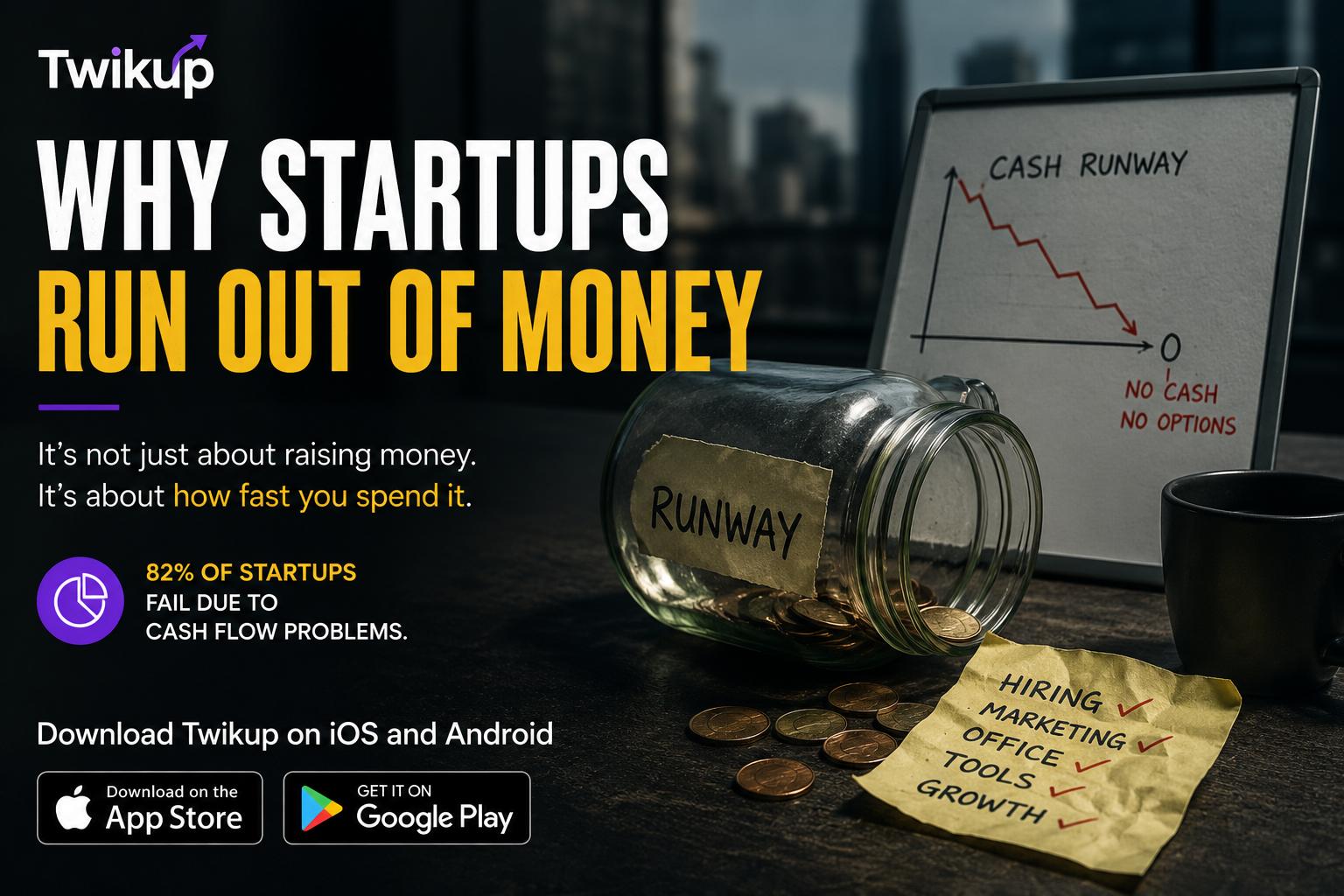
A startup can have an impressive product, enthusiastic users and a founder who works until 2 a.m.—and still wake up one morning unable to make payroll.
That is what happened to Maya.
Eighteen months earlier, she had raised C$1.2 million for a software platform designed to help small retailers manage inventory. Investors liked the pitch. Customers praised the demo. The company hired engineers, moved into a polished office and launched an ambitious marketing campaign.
The bank balance looked enormous.
Until it did not.
By the time Maya realized the company had only four months of cash left, its revenue was growing—but nowhere near quickly enough to support a 17-person team.
The startup had not failed because nobody wanted its product.
It was running out of time before it could build a sustainable business.
Quick Answer
Startups run out of money when they spend cash faster than they can replace it through revenue, investment or financing.
The immediate cause is usually an unsustainable net burn rate, but the deeper problem may be premature hiring, weak pricing, poor customer retention, slow sales, rising customer-acquisition costs, delayed fundraising or spending that does not produce meaningful progress.
A startup survives by converting cash into valuable milestones before its runway expires.
The Two Numbers Every Founder Must Know
Maya could tell investors how many people had joined the product waitlist.
She knew the company’s website traffic, social-media impressions and number of sales demonstrations.
But when an investor asked about net burn and runway, she needed to check with her accountant.
That was the warning.
Gross burn rate
Gross burn is the total amount of cash a startup spends during a particular period, normally one month.
It can include:
- Salaries and employee benefits
- Office rent
- Cloud infrastructure
- Software subscriptions
- Advertising
- Contractors
- Insurance
- Legal and accounting costs
Suppose Maya’s company spent C$190,000 per month.
Its gross burn rate was therefore:
Gross burn rate = C$190,000 per month
Net burn rate
Net burn accounts for the cash generated by the business.
If the startup spent C$190,000 but collected C$55,000 from customers, its net burn would be:
Net burn rate = Monthly cash spending − Monthly cash received

C$190,000 − C$55,000 = C$135,000
The company was therefore losing C$135,000 in cash every month.
Stripe describes gross burn as total monthly cash spending and net burn as monthly expenditure minus monthly revenue. It also notes that investors examine burn alongside growth, customer-acquisition costs and customer lifetime value—not as an isolated number.
Cash runway
Runway estimates how many months a startup can continue operating at its current net burn rate.
If Maya had C$540,000 remaining:
Cash runway = Available cash ÷ Monthly net burn

C$540,000 ÷ C$135,000 = 4 months
That calculation changed the atmosphere in the room.
The company did not have C$540,000 to “grow the business.”
It had four months to survive.
Why Startups Run Out of Money
Running out of cash is rarely one isolated error. It is usually the final result of several decisions that appeared reasonable when they were made.
1. They Hire for the Company They Hope to Become
After raising her seed round, Maya believed the company needed to look ready for rapid growth.
She hired:
- Three additional engineers
- A head of marketing
- Two sales representatives
- A customer-success manager
- An operations coordinator
Every person appeared useful.
The problem was timing.
The startup had not yet established a repeatable sales process. It was adding permanent expenses before proving that new employees could generate enough revenue or measurable progress to justify their cost.
A C$100,000 salary does not create only C$100,000 of annual spending. Benefits, payroll costs, recruitment, equipment, software and management time increase the real commitment.
One premature hire rarely kills a startup.
Eight premature hires can.
Better approach
Every major hire should be tied to a constraint or milestone.
Before opening a position, founders should ask:
- What specific problem will this person solve?
- Why must that problem be solved now?
- What result should appear within six months?
- Could a founder, contractor or automated process handle it temporarily?
- What happens to runway after the hire?
Hiring should follow validated demand—not substitute for it.
2. They Confuse Fundraising With Revenue
Maya’s C$1.2-million round felt like proof that the company was succeeding.
But investment capital is not customer revenue.
Funding buys an opportunity to build, test and expand a business. It does not confirm that the company has found product-market fit.
A startup can raise a large round and still have:
- Weak customer retention
- Low willingness to pay
- An expensive sales process
- Poor unit economics
- No reliable growth channel
Fundraising announcements often create the illusion that the difficult part is over. In reality, the countdown begins as soon as the money reaches the bank.
Founders planning their capital journey should understand what investors expect at each stage. TwikUp’s complete startup fundraising roadmap explains how the company-building challenge changes from the initial idea through seed funding, growth rounds and a potential public offering.
3. They Scale Before Customers Truly Care
Maya’s company had 140 paying businesses.
That sounded encouraging.
However, nearly one-third of them stopped using the product within six months.
The startup responded by spending more on advertising to replace departing customers. Website traffic increased. New accounts continued arriving. Revenue appeared to be growing.
Underneath the headline, the company was pouring money into a leaking bucket.
Scaling an unproven product magnifies its weaknesses:
- Poor retention creates expensive replacement cycles.
- Weak onboarding increases customer-support costs.
- Low engagement makes renewals uncertain.
- Product gaps force salespeople to offer discounts.
- Unclear positioning makes advertising less efficient.
The goal is not simply to acquire customers.
It is to acquire customers who receive enough value to stay, pay and recommend the product.
4. They Underprice the Product
Maya initially priced the platform at C$49 per month because competitors appeared inexpensive and she wanted adoption to be easy.
Customers liked the price.
The startup did not.
Each account required onboarding, support, data storage, payment processing and ongoing product work. After those costs were considered, the revenue contributed little toward the salaries required to operate the company.
Cheap pricing can create impressive user numbers while hiding a weak business.
Founders often underprice because they fear rejection. But rejection provides information. A product that customers will use only when heavily discounted may not be delivering enough measurable value.
Pricing should reflect:
- The economic value created for customers
- The cost of delivering the service
- The complexity of onboarding and support
- Customer willingness to pay
- The company’s desired gross margin
- The price of realistic alternatives
Revenue growth means less when every new customer adds almost as much cost as income.
5. They Spend on Growth Without Measuring Efficiency
Maya’s marketing dashboard showed thousands of clicks.
The finance spreadsheet showed something different.
The company was paying approximately C$1,400 to acquire a customer producing roughly C$588 in first-year subscription revenue before service costs.
The company hoped customers would remain for several years. Many did not.
Growth becomes dangerous when founders measure activity rather than economics.
Important questions include:
Customer acquisition cost:
How much does it cost to win one paying customer?

Gross margin:
How much revenue remains after directly serving that customer?

Payback period:
How long does it take to recover the acquisition cost?

Retention:
How many customers continue paying?

Lifetime value:
How much gross profit might a customer generate before leaving?
A startup may intentionally lose money while expanding. The spending must still produce credible evidence that the economics can improve.
Otherwise, the business is not buying growth.
It is renting revenue.
6. They Mistake Valuation for Financial Strength
A startup valued at C$20 million does not necessarily have C$20 million.
Valuation represents the negotiated value of the company’s equity during a financing transaction. It does not describe the cash available for payroll.
A highly valued company may still have:
- Less than six months of runway
- Negative margins
- Limited revenue
- Debt obligations
- Dependence on another financing round
This distinction becomes especially important around unicorn companies. Billion-dollar valuations can reflect investor expectations about future growth rather than current profitability or liquidity.
TwikUp’s guide to how unicorn startups reach billion-dollar valuations explains why private-market valuation, investor ownership and actual cash reserves are very different concepts.
7. They Assume the Next Funding Round Will Arrive on Schedule
Maya’s original financial plan contained a reassuring line:
Raise Series A in Q3.
It looked like a milestone.
In reality, it was an assumption.
Fundraising can take months. Investors may conduct financial, legal, technical and customer due diligence. Partners may like the company but delay a decision. Market conditions can weaken. A lead investor can withdraw. Existing shareholders may refuse to participate.
Carta reported that startups on its platform raised US$26 billion in the second quarter of 2025, down 4% from the previous year and 54% below the 2021 peak. The figures illustrate why founders cannot assume that capital will always be available on favourable terms.
Fundraising becomes harder when investors know the company is desperate.
With 18 months of runway, a founder can reject poor terms.
With eight weeks of runway, nearly every negotiation becomes defensive.
Start before the emergency
Founders should begin preparing long before the bank account reaches a critical level.
Preparation may include:
- Clean financial records
- Updated ownership records
- A realistic financial model
- Customer references
- Revenue and retention data
- A clear use-of-funds plan
- Evidence that the previous round produced meaningful milestones
The difference between seed and Series A is particularly important. A seed-stage story may be built around the team, opportunity and early proof. By Series A, investors often expect stronger evidence that the company can scale.
See TwikUp’s breakdown of seed rounds versus Series A funding for a deeper explanation of how founder expectations change.
8. Revenue Arrives Later Than Expenses
A company may be profitable on paper and still experience a cash crisis.
Imagine a startup signs a C$240,000 annual enterprise contract.
The customer pays 60 days after receiving each quarterly invoice. Meanwhile, the startup must pay salaries, cloud costs and contractors every month.
The income statement may show revenue.
The bank account may still be empty.
Cash-flow timing becomes especially dangerous when:
- Customers pay slowly
- Inventory must be purchased in advance
- Projects require upfront labour
- Annual costs are paid before revenue arrives
- Tax obligations are underestimated
- Refunds or chargebacks increase
- Customers receive generous payment terms
Founders should forecast the date cash will actually enter or leave the bank—not merely when revenue or expenses are recorded.
9. Small Costs Become Permanent Infrastructure
At first, Maya approved subscriptions quickly.
C$80 per month for analytics did not seem important. Neither did C$150 for recruitment software, C$300 for customer support, C$700 for a larger office or C$2,000 for a public-relations consultant.
Together, the company accumulated thousands of dollars in recurring monthly expenses.
Startup costs often behave like barnacles. Each one attaches quietly. Few are large enough to trigger alarm, but collectively they slow the company down.
A disciplined monthly review should classify spending into four groups:
| Category | Meaning |
|---|---|
| Essential | Required to operate safely or legally |
| Growth-producing | Demonstrably improves revenue or a key milestone |
| Experimental | Being tested with a defined budget and deadline |
| Unnecessary | Produces no meaningful result |
The difficult part is not cancelling obviously useless spending.
It is cancelling spending that feels professional but does not make the company stronger.
10. Founders React Too Late
By the time Maya finally considered reducing staff, the company had less than four months of runway.
A smaller adjustment made nine months earlier might have extended runway without damaging the business. Waiting turned a strategic decision into an emergency.
Late cuts are more painful because founders have fewer options.
They may be forced to:
- Conduct sudden layoffs
- Abandon important projects
- Accept a down round
- Sell the company cheaply
- Take expensive debt
- Delay supplier payments
- Shut down without an orderly transition
Cash problems grow quietly and then appear suddenly.
The best time to respond is when the company still looks healthy.
The Difference Between Productive Burn and Waste
Spending money is not automatically irresponsible.
A startup exists to use resources to create something more valuable. Refusing to spend can be just as damaging as overspending.
The real question is what the burn produces.
Productive burn may create:
- A validated product
- Strong retention
- Faster revenue growth
- Regulatory approval
- A defensible technology advantage
- A repeatable sales system
- Lower production costs
- Expansion into a proven market
Unproductive burn may create:
- Vanity metrics
- Excessive management layers
- Unused office space
- Features customers did not request
- Advertising without retention
- Expansion before operational readiness
- Hiring without clear ownership
- Conferences and branding without sales
Two startups can each burn C$200,000 per month.
One may be building a valuable engine.
The other may simply be becoming more expensive.
TwikUp Insight
A startup does not need enough money to reach profitability immediately. It needs enough money to reach its next financeable milestone.
That milestone might be:
- Launching a working product
- Reaching C$100,000 in annual recurring revenue
- Demonstrating strong customer retention
- Completing a regulatory process
- Proving that customers can be acquired profitably
- Reaching cash-flow break-even
The founder’s job is therefore not merely to “extend runway.”
It is to make sure every remaining month creates evidence that improves the company’s chances of earning revenue or raising its next round.
More months without progress do not necessarily save a startup.
They can simply postpone the same outcome.
How Founders Can Prevent a Cash Crisis
Maya and her co-founder eventually held a meeting they should have held six months earlier.
They built three financial scenarios.
Scenario 1: Expected case
Revenue continued growing at the recent average.
Scenario 2: Downside case
New sales slowed, two large customers left and the next funding round took longer than expected.
Scenario 3: Survival case
The company stopped nonessential hiring, reduced marketing experiments, renegotiated contracts and focused only on its strongest customer segment.
The third scenario was less exciting.
It was also the only one that gave the startup enough time to prove that its customers would remain.
Founders can adopt the same discipline through a simple operating rhythm.
Every week
- Review cash in the bank.
- Examine major incoming and outgoing payments.
- Investigate unexpected spending.
- Update near-term sales and collection expectations.
Every month
- Calculate gross burn.
- Calculate net burn.
- Recalculate runway.
- Compare forecasts with actual results.
- Review customer acquisition and retention.
- Remove expenses that have no accountable owner or result.
Every quarter
- Build expected, downside and severe-downside scenarios.
- Reassess hiring plans.
- Decide whether fundraising preparation must begin.
- Identify the milestone the current runway is meant to achieve.
- Ask whether the business model is becoming stronger.
Where Venture-Capital Money Comes From
Founders sometimes imagine venture firms as unlimited pools of capital.
They are not.
VC firms generally raise money from outside investors—often called limited partners—and then invest that capital according to a fund strategy. Venture investors must therefore consider portfolio returns, ownership, risk, timing and the remaining capital available in their funds.
That helps explain why a VC may admire a startup but still decline to invest.
The decision is not based only on whether the company is “good.” It may also depend on the fund’s stage, sector, ownership requirements and portfolio construction.
TwikUp’s guide to who funds venture capitalists and how VC firms make money explains the system behind the people writing startup cheques.
Maya’s Final Decision
Maya reduced the company’s monthly net burn from C$135,000 to approximately C$72,000.
She paused expansion, eliminated tools nobody actively owned, moved out of the larger office and focused sales efforts on retailers with multiple locations—the customers showing the strongest retention and willingness to pay.
The decision was painful.
The company looked smaller.
But its runway almost doubled.
Nine months later, the startup had fewer employees than Maya originally imagined. It also had better retention, clearer pricing and a much stronger explanation of why customers bought the product.
The company had not become less ambitious.
It had stopped confusing ambition with spending.
The Bottom Line
Startups run out of money when their cash disappears before the business reaches revenue sustainability or another fundable milestone.
The final bank balance may be zero, but the real causes normally begin earlier:
- Hiring before product-market fit
- Scaling weak retention
- Underpricing the product
- Paying too much to acquire customers
- Ignoring cash-flow timing
- Treating fundraising as guaranteed
- Mistaking valuation for liquidity
- Waiting too long to reduce burn
Founders cannot eliminate uncertainty.
They can make uncertainty survivable.
Know the company’s burn rate. Recalculate runway regularly. Connect spending to measurable progress. Prepare for fundraising before desperation appears—and remember that every dollar should buy either learning, growth or time.
Anything else is simply a faster countdown.
Sources
- Stripe: What Burn Rate Is and How to Calculate It
- Y Combinator: Key Startup Metrics
- Carta: Startup Funding—A Founder’s Guide
- U.S. Bureau of Labor Statistics: Establishment Age and Survival Data
This article is for general educational purposes and does not constitute financial, legal, tax or investment advice. Startup founders should consult qualified professionals regarding their company’s particular circumstances.