
A startup needs money to manufacture its first major order.
The founder approaches venture capital firms, sends dozens of pitch decks and spends months attending meetings. Investors like the product—but the company is considered too early, the market too specialized or the potential exit too uncertain.
Then the founder asks a different question:
What if the company’s customers became its investors?
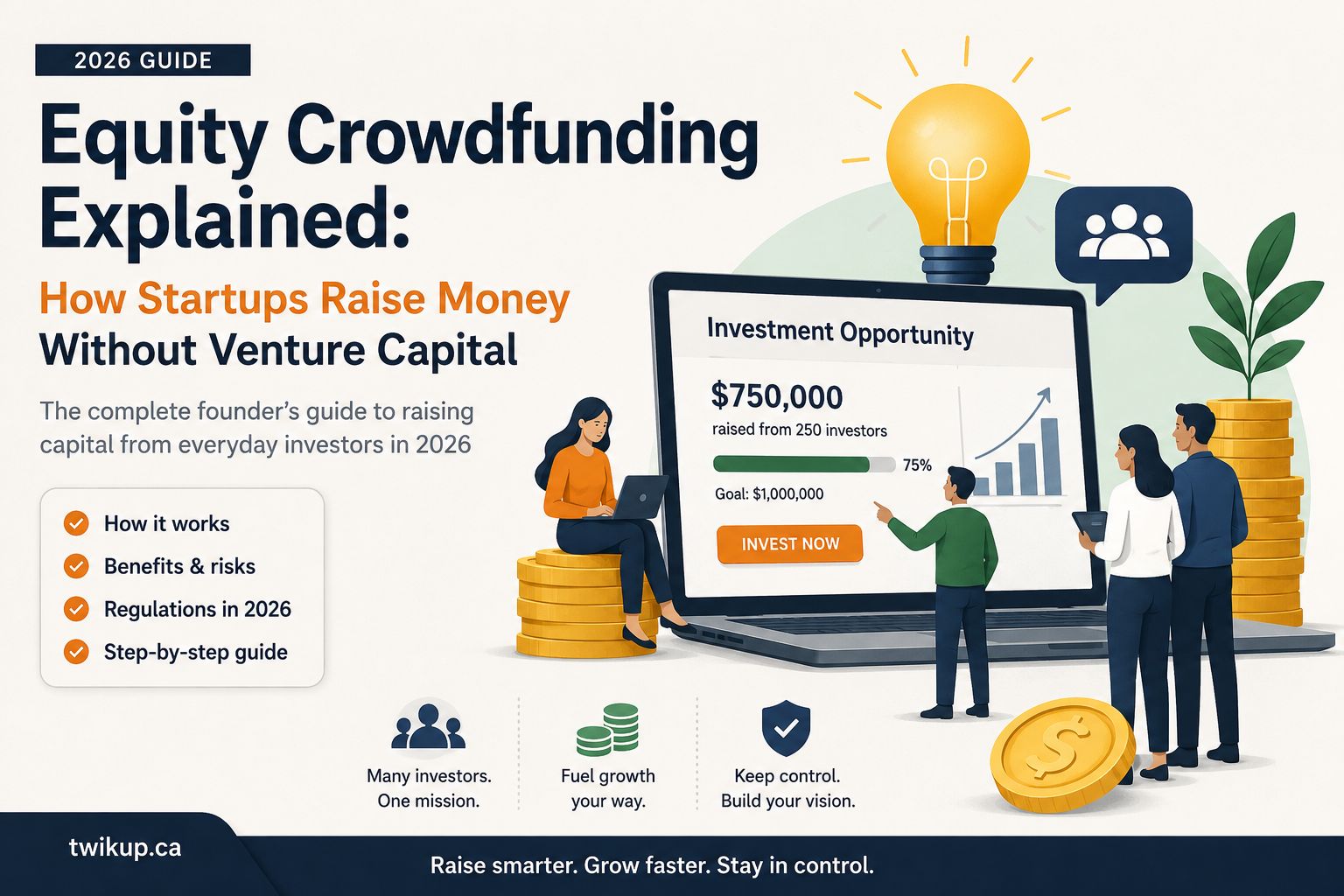
Instead of persuading one venture capital firm to write a large cheque, the startup invites hundreds—or potentially thousands—of people to invest smaller amounts through an online funding platform.
The company raises capital. Its supporters receive securities representing an economic interest in the business. And the founder gains something that may be nearly as valuable as the money: a community that wants the company to succeed.
That is the promise of equity crowdfunding.
However, it is not simply a Kickstarter campaign with shares attached. It is a regulated securities offering that can affect ownership, governance, reporting obligations, future fundraising and the startup’s capitalization table for years.
This guide explains how equity crowdfunding works, why founders use it, how it differs from venture capital and reward-based crowdfunding, what investors actually receive, and where campaigns commonly go wrong.
Quick Answer
Equity crowdfunding allows a startup or private company to raise money online from a large group of investors by issuing securities—such as shares, preferred shares, convertible securities or certain debt instruments—in exchange for their investment.
Unlike reward-based crowdfunding, contributors are not merely pre-ordering a product or receiving merchandise. They are investing in the company or acquiring another security connected to it.
A typical equity crowdfunding campaign follows this sequence:
- The startup chooses a compliant funding portal.
- It determines the security, valuation and fundraising terms.
- It prepares the required offering information.
- The campaign is published online.
- Investors review the opportunity and commit money.
- The company receives the funds if the campaign satisfies its closing conditions.
- Investors receive the securities described in the offering.
Equity crowdfunding can help a startup raise capital without relying entirely on venture capital, but it does not mean raising money without regulation, dilution, disclosure or investor expectations.
In Canada, start-up crowdfunding is available through a nationally harmonized securities-law framework. Under the commonly used start-up crowdfunding exemption, an eligible issuer group may raise up to $1.5 million during a 12-month period, subject to specific requirements. The ordinary investment limit is generally $2,500 per offering, increasing to $10,000 when a registered dealer determines that the investment is suitable for the purchaser.
In the United States, Regulation Crowdfunding currently permits an eligible company to raise up to US$5 million in a 12-month period, and the transaction must be conducted through a single SEC-registered broker-dealer or funding portal that is also a FINRA member.
The rules depend on where the company and investors are located. Founders should obtain qualified legal, tax and accounting advice before launching an offering.
TwikUp Insight
The most successful equity crowdfunding campaigns do not begin when the campaign page goes live. They begin months earlier, when the company builds a community willing to care about the outcome.
Equity crowdfunding may appear to democratize startup finance—and in many ways, it does. But access to a crowd does not automatically create demand from a crowd.
The strongest campaigns usually have at least three engines working together:
- a credible business with evidence of demand;
- a compelling story people can explain to others;
- an existing audience that provides early momentum.
A founder who launches with no customers, no mailing list, no committed supporters and no clear use for the capital may discover an uncomfortable truth:
A funding portal can provide infrastructure and visibility, but it cannot manufacture trust.
The deeper strategic value of equity crowdfunding is therefore not merely that it replaces venture capital. It can convert customers, followers and community members into financially aligned supporters.
But that strength can become a weakness when expectations are poorly managed. A startup may finish the campaign with hundreds of new shareholders, more communication responsibilities and less flexibility than the founder anticipated.
Equity crowdfunding works best when it is treated as a financing strategy, community campaign and securities transaction at the same time.
What Is Equity Crowdfunding?
Equity crowdfunding is a method of raising capital by offering securities to multiple investors through an online platform.
Instead of obtaining all the money from:
- one venture capital firm;
- a small group of angel investors;
- a bank;
- the founder’s savings; or
- friends and family,
the startup may raise smaller amounts from a much larger investor base.
Imagine that a company wants to raise $500,000.
It could seek:
- one investor willing to invest $500,000;
- five investors contributing $100,000 each;
- 100 investors contributing $5,000 each; or
- 1,000 investors contributing an average of $500 each.
Equity crowdfunding makes the final two possibilities more practical by centralizing the campaign, disclosures, investment commitments and closing process on an online portal.
The phrase equity crowdfunding is often used broadly. Depending on the offering structure, investors may receive:
- common shares;
- preferred shares;
- non-convertible debt;
- convertible notes;
- simple agreements tied to future equity;
- limited partnership units; or
- another permitted security.
Therefore, not every securities crowdfunding campaign gives investors immediate common-stock ownership. Founders and investors must read the actual offering terms rather than relying on the campaign’s marketing language.
Equity Crowdfunding vs. Regular Crowdfunding
Not all crowdfunding makes someone an investor.
This is one of the most important distinctions in the entire subject.
Donation-Based Crowdfunding
People contribute money to support a person, project, charity or cause. They generally do not expect a financial return.
Reward-Based Crowdfunding
Supporters contribute money in exchange for a product, service, experience or non-financial reward.
For example, someone might contribute $300 to help fund a new coffee machine and receive one of the first units produced.
That person is usually a customer or pre-purchaser—not a shareholder.
Debt Crowdfunding
Investors lend money to the business and may receive interest and repayment according to the lending terms.
Equity or Securities Crowdfunding
Investors provide capital in exchange for shares or another security. Their potential return is connected to the company’s future performance and the specific rights attached to the security.
Canadian securities regulators explicitly distinguish securities crowdfunding from platforms where supporters are donors or product pre-purchasers. A person who receives shares, bonds or other securities is investing, while someone supporting a typical reward campaign may receive a product but no ownership interest.
| Crowdfunding model | What the contributor provides | What they may receive | Ownership? |
|---|---|---|---|
| Donation | Contribution | Nothing financial | No |
| Reward | Contribution or pre-order | Product or reward | No |
| Debt | Loan | Interest and repayment | Usually no |
| Equity/securities | Investment | Shares or another security | Often, depending on terms |
The Coffee Company That Could Not Get a VC Meeting
Consider a fictional startup called Northern Ember Coffee.
Its founder, Maya, developed a compact commercial coffee roaster that reduced energy consumption and allowed independent cafés to roast smaller batches locally.
The business had:
- 2,500 customers on its mailing list;
- 700 deposits from interested café owners;
- a working prototype;
- several promising supplier relationships; and
- strong engagement on social media.
But it had a problem.
Producing the first commercial batch would require $600,000.
Maya contacted venture capital firms. Some declined because they focused on software. Others said the company’s potential growth was not fast enough. One fund offered to invest—but wanted a large ownership stake, a board seat and terms Maya believed would reduce her control too early.
A bank was also hesitant because Northern Ember lacked years of operating history and sufficient assets to support a conventional loan.
Maya considered venture debt, but debt would introduce repayments before the company had stable cash flow. Founders evaluating that route should understand how venture debt provides capital without immediate equity dilution—and why it can still create significant risk.
Then Maya noticed something:
Her customers were already emotionally invested in the mission.
Many had followed the prototype’s development for two years. Some had tested it. Others had repeatedly asked when the machine would become available.
Northern Ember prepared an equity crowdfunding campaign. The company offered eligible investors an opportunity to acquire securities at clearly disclosed terms and explained that the money would be used for tooling, inventory, certifications and initial production.
The campaign opened on a Monday.
The company’s existing customers contributed the first investments. Their activity created early momentum. Coffee-industry creators discussed the campaign, and independent café owners shared it with their networks.
Northern Ember eventually reached its minimum target and closed the financing.
But the money did not arrive without consequences.
Maya now had:
- a larger shareholder base;
- legal and administrative responsibilities;
- investors expecting updates;
- a valuation that future investors would examine;
- public claims that had to remain accurate; and
- pressure to deliver the production milestones described in the offering.
The campaign solved a capital problem.
It also transformed the company.
That is the real story of equity crowdfunding: the closing is not the ending—it is the beginning of a new financial relationship.
How Equity Crowdfunding Works Step by Step
1. The Startup Determines Whether Crowdfunding Fits
Before choosing a portal or filming a campaign video, the founders must decide whether equity crowdfunding is strategically appropriate.
They should assess:
- how much capital the business actually needs;
- what milestone the money will fund;
- whether the startup can attract enough investors;
- whether the founders are prepared to dilute ownership;
- whether the company can support additional shareholders;
- what security it will offer;
- whether its financial records are campaign-ready;
- how the campaign may affect future financing; and
- whether another funding method would be less expensive or restrictive.
The funding target should come from a financial plan—not from the largest number the founder believes the crowd might support.
A company should connect the raise to its budget, burn rate, runway and operating milestones. TwikUp’s guide to building a startup finance strategy explains how these elements should work together.
2. The Company Chooses a Funding Portal
A regulated securities offering cannot generally be conducted through an ordinary checkout page on the startup’s website.
In the United States, Regulation Crowdfunding transactions must take place online through an SEC-registered intermediary—a broker-dealer or funding portal—and an offering must be conducted through a single intermediary.
Canada’s start-up crowdfunding framework similarly requires securities to be distributed through an online funding portal that satisfies the applicable requirements. Depending on its status, a portal may be registered as a dealer or rely on a registration exemption.
A founder should evaluate more than the platform’s headline fee.
Important questions include:
- Is the portal permitted to operate in the relevant jurisdiction?
- What types of companies does it accept?
- Does it have investors interested in this industry?
- Does it provide nominee or special-purpose-vehicle structures?
- What due diligence does it perform?
- What marketing support is actually included?
- Who handles investor identity verification?
- How are funds held?
- What happens if the minimum target is not reached?
- How long does the review and onboarding process take?
- Are there payment-processing, legal, closing or ongoing administration charges?
- Who maintains investor records after closing?
The platform is not merely a marketing website. It becomes part of the company’s financing infrastructure.
3. The Founders Select the Security
The startup must determine exactly what investors are buying.
Common Shares
These may provide direct ownership and potentially voting rights, depending on the share terms and corporate documents.
Preferred Shares
Preferred shares may include economic or governance rights different from those attached to common shares.
Convertible Securities
A convertible instrument may convert into equity in the future after a qualifying event or according to another contractual mechanism.
Debt Securities
The company borrows money and agrees to repayment terms, potentially including interest.
Other Permitted Instruments
The available choices depend on the jurisdiction, exemption and portal.
In Canada, the start-up crowdfunding regime is restricted to certain relatively simple securities, including common shares, non-convertible preferred shares, certain convertible securities, non-convertible debt, specified cooperative shares and limited partnership units.
Founders should not choose an instrument solely because it appears simple during the campaign.
The important questions are:
- What rights will investors receive?
- Will the security carry voting power?
- How will future dilution work?
- Does it contain conversion rights?
- Will investors receive information rights?
- What happens during a sale of the company?
- Can the instrument complicate a later institutional round?
- How will it appear on the capitalization table?
A security that makes fundraising easier today can make the next financing more difficult tomorrow.
4. The Startup Sets Its Valuation and Terms
Suppose a startup is valued at $4 million before the investment and raises $1 million.
The simplified post-money valuation would be:
Pre-money valuation:     $4,000,000
New investment:          $1,000,000
Post-money valuation:    $5,000,000
The new investors would collectively own approximately:
$1,000,000 ÷ $5,000,000 = 20%
The existing shareholders would collectively retain approximately 80%, before considering options, warrants, convertible securities or other capitalization complexities.
This example is intentionally simplified.
A startup’s real capitalization may include:
- founder shares;
- employee options;
- advisory equity;
- preferred shares;
- warrants;
- convertible notes;
- SAFEs or similar instruments;
- promised but unissued equity;
- rights from previous financing rounds.
The founder must therefore understand both the headline valuation and the fully diluted ownership impact.
An unrealistically high valuation may appear founder-friendly because it reduces immediate dilution. But it can create a future problem if the company fails to grow into that valuation.
The next round may then occur at:
- the same valuation, signalling limited progress;
- a lower valuation, creating a down round;
- or unattractive terms designed to compensate new investors for the earlier pricing.
A valuation should support the company’s next chapter, not merely maximize campaign optics.
5. The Company Prepares Its Offering Materials
An equity crowdfunding campaign typically requires more than a persuasive pitch deck.
The company may need to disclose information concerning:
- its business model;
- products or services;
- directors and officers;
- ownership structure;
- capitalization;
- fundraising target;
- valuation;
- offered security;
- use of proceeds;
- risk factors;
- financial condition;
- outstanding debt;
- previous financings;
- related-party transactions;
- material litigation;
- investor rights;
- campaign deadline; and
- circumstances under which the offering will close.
Canadian start-up crowdfunding offering documents contain basic information about the business, its management, financial condition, amount sought, intended use of proceeds, the investment and associated risks. Securities regulators generally do not pre-approve these offering documents.
In the United States, companies relying on Regulation Crowdfunding make required disclosures through Form C, with the applicable level of financial disclosure depending on factors including the amount being raised and the issuer’s history under the exemption. Founders should rely on current SEC requirements and professional advice when determining what must be filed.
Marketing must remain consistent with the legal offering materials.
A polished video cannot cure:
- inaccurate revenue figures;
- exaggerated market-size claims;
- omitted liabilities;
- misleading customer statistics;
- unrealistic projections presented as certainty;
- undisclosed conflicts; or
- vague explanations of how the capital will be used.
The campaign should be exciting, but excitement cannot come at the expense of accuracy.
6. The Campaign Establishes a Minimum Target
Many campaigns specify a minimum amount that must be raised before the financing can close.
Suppose Northern Ember Coffee wants to raise between $400,000 and $800,000.
The company determines that manufacturing cannot begin with less than $400,000. It therefore establishes:
- Minimum target: $400,000
- Maximum target: $800,000
If investors commit only $320,000 by the deadline, the company may not be permitted to close the campaign and use those funds.
The minimum target protects investors from a situation in which the company receives far less money than it needs to execute the plan described in the offering.
Canadian guidance explains that investor funds are held until the minimum target is reached and must be returned if the business fails to meet that target.
The minimum should answer a practical question:
What is the smallest amount that allows the business to execute a credible version of this plan?
Setting it artificially low may help the campaign display “funded” status, but it can leave the company undercapitalized immediately after closing.
7. The Startup Builds Pre-Launch Momentum
Many founders assume the portal will provide the crowd.
Usually, the startup must bring much of the crowd itself.
Before launch, a company may build:
- a customer email list;
- a reservation list;
- an investor-interest list;
- social-media communities;
- relationships with industry creators;
- strategic partnerships;
- press contacts;
- founder networks; and
- commitments from early supporters, where legally permissible and appropriately handled.
The first days of a campaign matter because investors often interpret early traction as a signal of credibility.
Consider two identical campaigns:
Campaign A
- Target: $500,000
- Raised after five days: $8,000
- Few comments
- No visible community activity
Campaign B
- Target: $500,000
- Raised after five days: $175,000
- Active founder responses
- Strong customer participation
- Multiple industry discussions
Campaign B appears more credible, even if the underlying businesses are identical.
Momentum creates social proof.
But social proof is not due diligence. Popularity does not prove that the investment is appropriately priced, financially sound or likely to generate a return.
8. Investors Review and Commit
Potential investors can examine the campaign, offering document, risks, terms and company information before deciding whether to participate.
They should assess:
- what security they will receive;
- the company’s valuation;
- the founders’ experience;
- current revenue and expenses;
- the use of proceeds;
- competitive advantages;
- customer concentration;
- intellectual-property ownership;
- debt and other obligations;
- the likelihood of additional fundraising;
- potential dilution;
- reporting commitments;
- transfer restrictions;
- possible exit pathways; and
- the possibility of losing the entire investment.
Investors must understand that private-company securities can be extremely illiquid.
Unlike a publicly traded stock, an investor may not be able to open a brokerage app and sell the position tomorrow.
Canadian securities regulators warn that crowdfunded startup securities may need to be held indefinitely and might never be resold. Investors may also receive substantially less ongoing disclosure than shareholders of public companies.
9. The Campaign Closes
If the campaign satisfies its minimum, deadline and legal requirements, the financing can close.
The company receives the net proceeds after applicable costs, which may include:
- portal fees;
- payment-processing costs;
- legal expenses;
- accounting expenses;
- marketing costs;
- filing fees;
- securities administration;
- escrow or trust expenses; and
- ongoing investor-management costs.
Investors receive the security specified in the offering.
If the minimum is not reached, funds are generally returned according to the applicable rules and campaign terms.
In Canada’s start-up crowdfunding framework, an offering generally must close within 90 days, and purchasers receive a two-day contractual or statutory cancellation period under the applicable structure.
Closing the campaign may feel like the finish line.
Operationally, it is closer to the starting gun.
10. The Company Executes and Communicates
After closing, the company must use the capital responsibly and comply with its legal and contractual obligations.
Investors will want to know:
- Did the company achieve the milestone?
- Is revenue growing?
- Has the launch been delayed?
- Is more financing required?
- Has the strategy changed?
- Is the company running out of money?
- Are future investors receiving superior rights?
- Is an acquisition or shutdown possible?
A founder should create an investor communication system before the campaign closes.
That may include:
- quarterly updates;
- annual financial information;
- milestone reports;
- secure investor portals;
- material-event notices;
- shareholder meetings;
- tax documentation; and
- a consistent process for investor questions.
A business that raised successfully but communicates poorly can lose the community goodwill that made the campaign possible.
Why Do Startups Choose Equity Crowdfunding?
Access to a Broader Investor Base
Traditional startup fundraising often depends on access to wealthy individuals, angel groups and venture capital networks.
Equity crowdfunding can provide a regulated path for a broader group of eligible participants to invest, subject to jurisdictional limits.
This may be especially valuable for founders who:
- live outside major venture-capital hubs;
- lack established investor networks;
- operate in industries overlooked by conventional funds;
- serve a passionate consumer community;
- have strong commercial traction but do not fit a typical VC model; or
- want to diversify their capital sources.
Customers Can Become Owners
A customer who owns a financial interest in the company may become a powerful advocate.
That investor might:
- recommend the product;
- provide feedback;
- introduce potential customers;
- promote the company;
- attend events;
- defend the brand; or
- participate in future campaigns.
This alignment can create a community flywheel:
Customers become investors
        ↓
Investors become advocates
        ↓
Advocates attract customers
        ↓
Growth attracts more investors
However, not every investor becomes an ambassador. Some will simply expect financial performance and better communication.
Market Validation
A successful campaign may demonstrate that people are willing not only to purchase the product but also to invest in the company behind it.
That signal can help with:
- supplier negotiations;
- recruiting;
- media coverage;
- future fundraising;
- strategic partnerships; and
- customer acquisition.
Still, a funded campaign is not proof of a sustainable business model.
It may demonstrate enthusiasm without proving:
- repeat purchases;
- attractive margins;
- low customer-acquisition costs;
- scalable operations;
- reliable production;
- strong retention; or
- eventual profitability.
Capital raised is an input—not an operating result.
More Control Over the Fundraising Story
In a conventional VC process, founders repeatedly pitch behind closed doors.
Equity crowdfunding allows the company to communicate its story publicly through:
- written explanations;
- product demonstrations;
- founder videos;
- customer testimonials;
- campaign updates;
- webinars; and
- community events.
This can favour companies whose products are easy for everyday investors to understand.
A consumer product with visible customer love may perform better in a crowdfunding environment than a highly technical enterprise platform whose value requires industry expertise.
Potential Negotiating Leverage
A successful crowdfunding round can give a company:
- more runway;
- stronger traction;
- a validated valuation;
- greater visibility;
- a larger user community; and
- less immediate dependence on one institutional investor.
This may strengthen the startup’s position in future conversations with venture capitalists.
Equity crowdfunding and venture capital are not always opposites. A company might use crowdfunding before, alongside or after institutional financing.
The broader fundraising journey is explained in TwikUp’s complete startup fundraising roadmap from idea to IPO.
Equity Crowdfunding vs. Venture Capital
| Factor | Equity crowdfunding | Venture capital |
|---|---|---|
| Investor base | Potentially many retail and other investors | Usually one or several professional funds |
| Fundraising channel | Online funding portal | Direct negotiations and investor networks |
| Public visibility | Often highly public | Usually more private |
| Typical support | Community, advocacy and capital | Capital, strategy, recruiting and networks |
| Governance | Depends on structure | Often includes stronger contractual and board rights |
| Negotiation | Standardized campaign terms for participants | Heavily negotiated financing documents |
| Speed | Preparation can still take months | Process can also take months |
| Founder access | Can broaden access | Often relationship-driven |
| Marketing requirement | Usually substantial | Primarily investor outreach |
| Shareholder management | Potentially many investors | Smaller number of institutional holders |
| Exit pressure | Depends on investor terms and expectations | Funds often operate within defined return cycles |
| Suitability | Community-led or underfunded opportunities | High-growth businesses fitting fund economics |
Venture capitalists are not merely looking for good companies. They are searching for outcomes large enough to produce the returns required by a portfolio-based fund model.
That is why a profitable company can still be rejected by VCs.
TwikUp’s analysis of why venture capitalists expect many startups to fail explains the mathematics behind this behaviour.
Founders should also understand where the capital originates. Venture capitalists generally invest money supplied by limited partners, rather than simply investing their personal wealth. Read who funds venture capitalists and how VC firms make money for a deeper explanation.
Does Equity Crowdfunding Let Founders Keep Control?
Possibly—but not automatically.
Equity crowdfunding can allow founders to avoid giving one venture capital firm significant negotiating power. However, the founder is still selling securities and may still dilute ownership.
Control depends on:
- the percentage sold;
- voting rights;
- share classes;
- investor agreements;
- board composition;
- protective provisions;
- future financing terms;
- corporate law;
- founder vesting; and
- the rights attached to previously issued securities.
A founder might retain 70% of the economic ownership but lose practical control through governance arrangements.
Alternatively, the founder might issue non-voting securities to crowdfunding investors while retaining voting control, subject to the offering structure and applicable law.
The crucial point is:
Ownership percentage and company control are related, but they are not identical.
Even founders who retain majority ownership can eventually be removed from leadership under certain governance structures. TwikUp explains this risk in Your Board Can Fire You: What Every Founder Should Know After Raising Capital.
How Much Equity Should a Startup Offer?
There is no universally correct percentage.
The answer depends on:
- capital required;
- valuation;
- company stage;
- existing ownership;
- investor demand;
- current traction;
- market conditions;
- security terms;
- future capital needs; and
- the milestones the round is expected to unlock.
Consider three simplified scenarios:
| Pre-money valuation | Capital raised | Simplified post-money valuation | New investor ownership |
|---|---|---|---|
| $2 million | $500,000 | $2.5 million | 20% |
| $4 million | $500,000 | $4.5 million | 11.1% |
| $9.5 million | $500,000 | $10 million | 5% |
A higher valuation reduces immediate dilution, but only when investors accept it.
Founders should work backwards:
- What milestone must be reached?
- How much capital does it realistically require?
- How long will the capital last?
- What contingency is necessary?
- What valuation can be credibly supported?
- What dilution is acceptable?
- How much room should remain for future employees and investors?
The company should also calculate its monthly cash use. TwikUp’s guide to startup burn rate and cash runway provides the necessary formulas and practical examples.
The Dilution Founders Often Underestimate
Suppose a founder owns 100% of a company.
Crowdfunding Round
The company issues 20% to crowdfunding investors.
The founder retains 80%.
Employee Option Pool Expansion
The company creates or expands an employee option pool representing 10% of the post-pool capitalization.
The founder’s percentage declines further.
Venture Round
A venture fund later acquires 25% of the company.
The founder, crowdfunding investors and option holders are diluted again.
A simplified illustration might look like this:
| Stage | Founder | Crowdfunding investors | Employees/options | New VC |
|---|---|---|---|---|
| Before financing | 100% | — | — | — |
| After crowdfunding | 80% | 20% | — | — |
| After option pool | 72% | 18% | 10% | — |
| After VC round | 54% | 13.5% | 7.5% | 25% |
The exact outcome depends on transaction mechanics, but the lesson remains:
The equity sold in the crowdfunding round is only one part of the founder’s lifetime dilution.
A founder should model several future rounds before agreeing to the first one.
What Happens to Early Investors in Later Rounds?
Crowdfunding investors may be diluted when the company issues additional securities.
Suppose an investor owns 1% after the crowdfunding campaign.
If the company later issues enough new shares to increase the total share count by 25%, that investor’s percentage may decline unless the investor has and exercises a relevant participation or pre-emptive right.
Dilution does not always mean the investment has lost value.
For example:
Before new financing:
1% of a $5 million company = $50,000 theoretical value

After new financing:
0.75% of a $20 million company = $150,000 theoretical value
The ownership percentage declined, but the theoretical value increased.
However, private-company valuations are not guaranteed realizable prices. An investor may still be unable to sell the shares.
Investors should also examine whether future securities could receive superior rights, such as:
- liquidation preferences;
- anti-dilution protections;
- priority dividends;
- board representation;
- information rights;
- redemption rights; or
- veto rights.
A crowdfunding investor may own shares in the same company as a future venture fund without receiving the same economic protections.
What Are the Advantages for Founders?
Broader Access to Capital
The company can approach a larger pool rather than depending entirely on a few gatekeepers.
Community Alignment
Customers and supporters may become financially aligned advocates.
Brand Exposure
The campaign itself can generate awareness, leads and media interest.
Validation
Investor participation may demonstrate market enthusiasm.
Flexible Capital Strategy
Crowdfunding can complement bootstrapping, angel financing, debt, grants or later venture capital.
Founder Narrative
The company can explain its mission directly to potential investors.
Potentially Reduced Dependence on One Investor
A distributed investor base may reduce the influence of any single participant, depending on the securities and governance arrangement.
What Are the Disadvantages for Founders?
Equity Dilution
The founders and existing investors will own a smaller percentage after new securities are issued.
Campaign Costs
Legal, accounting, platform, processing, marketing and administration costs can materially reduce the usable proceeds.
Public Failure Risk
If the campaign struggles or fails, customers, employees, competitors and future investors may see the result.
Time Commitment
Preparing, launching and managing a campaign can consume months of founder attention.
Ongoing Investor Relations
Hundreds of investors can create significant communication and administrative responsibilities.
Disclosure of Sensitive Information
The company may need to reveal financial, operational and strategic information that it would prefer to keep private.
Future Financing Complexity
Institutional investors may scrutinize the shareholder structure, valuation, promised rights and campaign communications.
Reputation Risk
Delays and business setbacks may disappoint not only investors but also the startup’s most loyal customers.
Legal Exposure
Misleading or incomplete disclosures can create regulatory, contractual and litigation risk.
What Are the Advantages for Investors?
Equity crowdfunding may allow investors to:
- access private-company opportunities;
- support founders or missions they believe in;
- invest smaller amounts than some traditional private placements require;
- participate in potential company growth;
- diversify a speculative private-investment allocation; and
- become more deeply connected to a brand or community.
These are possibilities—not promises.
The fact that an opportunity is accessible does not make it appropriate for every investor.
What Are the Risks for Investors?
Total Loss
Startups fail frequently, and an investor can lose the entire amount invested.
Canadian securities regulators explicitly warn that startup crowdfunding is risky and that investors should participate only with money they can afford to lose.
Illiquidity
The securities may not trade on an active market. Investors may have to hold them indefinitely.
Limited Information
Private businesses generally provide less public disclosure than listed companies.
Dilution
Later financing rounds can reduce an early investor’s ownership percentage.
Valuation Risk
A compelling campaign can still be overpriced.
Execution Risk
The team may fail to manufacture, market or distribute the product.
Key-Person Risk
The business may depend heavily on one founder.
Fraud or Misrepresentation
Online visibility does not eliminate the possibility of inaccurate claims or misconduct.
No Guaranteed Dividends
Owning equity does not mean the company will distribute profits.
Uncertain Exit
A return may depend on an acquisition, public listing, permitted secondary sale, redemption or another liquidity event that may never occur.
Different Shareholder Rights
Crowdfunding investors may receive fewer protections than institutional investors in later rounds.
How Can Investors Evaluate a Campaign?
A professional-looking campaign page is not enough.
Investors should examine five areas.
1. The Business
Ask:
- What problem does the company solve?
- Who pays for the solution?
- Is the market large enough?
- Is revenue recurring or transactional?
- Are gross margins attractive?
- Are customers concentrated?
- Is there evidence of repeat demand?
2. The Team
Ask:
- Have the founders built companies before?
- Do they understand this industry?
- Are they working full time?
- Is ownership of the intellectual property clear?
- Are key roles missing?
- Are there conflicts or related-party transactions?
3. The Financial Position
Ask:
- How much cash does the company have?
- How quickly is it spending?
- How much debt exists?
- Is revenue growing?
- Will this round reach a meaningful milestone?
- How soon might another round be required?
4. The Deal
Ask:
- What security am I buying?
- What is the valuation?
- What rights come with the security?
- Can I vote?
- Can I participate in future rounds?
- What happens during a sale?
- Are other investors receiving better terms?
5. The Risks
Ask:
- What could make the company fail?
- What assumptions support the plan?
- Is manufacturing dependent on one supplier?
- Does the company face regulatory approval?
- Could a better-funded competitor copy the product?
- How long might the investment remain illiquid?
The goal is not to eliminate risk. That is impossible.
The goal is to understand the risk before accepting it.
The Hidden Cost of Raising “Community Capital”
Community capital sounds friendlier than institutional capital.
But community investors are still investors.
A founder who raises money from loyal customers must manage a difficult dual relationship:
Customer expectation: Deliver the product
Investor expectation: Grow the company’s value
Those goals can conflict.
Imagine Northern Ember Coffee experiences a manufacturing delay.
Customers want the machine shipped immediately.
Management believes delaying six months will improve reliability and protect long-term company value.
Some investors support the decision. Others accuse the company of poor execution. A few customers demand refunds while simultaneously worrying that refunds could weaken the company they invested in.
The emotional closeness that powers a community round can therefore magnify disappointment.
Founders should never use words such as community, mission or movement to minimize the financial risk.
Transparency is not bad marketing.
For a securities campaign, transparency is part of the product.
Common Equity Crowdfunding Mistakes
Launching Without an Existing Audience
A portal is not a substitute for community building.
Raising Without a Specific Milestone
“General growth” is weaker than a clear plan tied to production, hiring, regulatory approval or market expansion.
Ignoring the Full Cost of the Campaign
A $1 million raise does not provide $1 million of usable operating capital after fees and expenses.
Setting an Unsupported Valuation
A valuation chosen only to minimize dilution may damage credibility and complicate the next round.
Treating Investors Like Customers
Investors require information about financial performance, material risks and capital strategy—not merely product announcements.
Overpromising in Marketing
Aggressive projections may generate attention but also create legal and reputational exposure.
Neglecting the Cap Table
A poorly structured shareholder base can discourage future institutional investors.
Failing to Plan the Next Round
The company should know how long the new capital is expected to last and what evidence it must produce before raising again.
Assuming a Successful Raise Means the Business Is Safe
Fundraising success can conceal weak unit economics.
Going Silent After Closing
Investors who supported the campaign should not learn about major developments through rumours or social media.
How Founders Can Prepare a Strong Campaign
Six to Twelve Months Before Launch
- Clean up corporate records.
- Confirm intellectual-property ownership.
- Improve bookkeeping.
- Resolve founder-equity issues.
- Build a customer community.
- Track meaningful performance metrics.
- Develop realistic financial forecasts.
- Review existing shareholder agreements.
Three to Six Months Before Launch
- Engage securities counsel and accounting support.
- Compare funding portals.
- Determine the security and target.
- Model dilution.
- Prepare the use-of-proceeds plan.
- Identify campaign risks.
- Begin producing campaign content.
- Build a compliant communications strategy.
One to Three Months Before Launch
- Complete portal review.
- Finalize offering materials.
- Test the campaign narrative.
- Prepare frequently asked questions.
- Train the team on permitted communications.
- Organize launch-day outreach.
- Establish investor-update systems.
- Prepare operational plans for several funding outcomes.
After Launch
- Answer questions accurately.
- Correct material mistakes quickly.
- publish meaningful updates;
- track campaign conversion;
- communicate progress without exaggeration;
- maintain consistency with the offering documents; and
- prepare for closing and shareholder onboarding.
How Should the Startup Use the Money?
The use of proceeds should be specific enough to demonstrate planning but flexible enough to accommodate reasonable operating changes.
For example:
| Use | Amount | Percentage |
|---|---|---|
| Manufacturing and inventory | $300,000 | 40% |
| Product development | $150,000 | 20% |
| Sales and marketing | $112,500 | 15% |
| Key hires | $112,500 | 15% |
| Legal, accounting and campaign costs | $37,500 | 5% |
| Contingency reserve | $37,500 | 5% |
| Total | $750,000 | 100% |
The company should also show how the allocation changes at different funding levels.
At the Minimum Target
The business might fund one production run and delay geographic expansion.
At the Base Target
It might fund production, hire a sales lead and expand into two markets.
At the Maximum Target
It might accelerate inventory purchases, obtain additional certifications and launch internationally.
Investors should be able to see how their money connects to measurable progress.
Equity Crowdfunding and Startup Runway
Raising capital matters only if the capital lasts long enough to reach the next milestone.
Suppose a company receives $800,000 after campaign expenses.
It already has $100,000 in cash and expects to burn $75,000 per month.
Its simplified runway is:
Available cash = $900,000
Monthly net burn = $75,000

Runway = $900,000 ÷ $75,000
Runway = 12 months
Twelve months may sound sufficient.
But the next fundraising process could take six months. If the company waits until month ten to begin, it may already be negotiating from desperation.
A founder should therefore decide before the crowdfunding campaign:
- what milestone must be reached;
- when preparations for the next raise begin;
- what happens if revenue underperforms;
- which expenses can be reduced;
- and what backup capital sources exist.
After raising, operational discipline becomes more—not less—important. TwikUp’s guide, You Raised Millions—Here’s What Happens Next and Where Many Founders Go Wrong, explores the post-funding mistakes that can rapidly destroy runway.
Can Equity Crowdfunding Replace Venture Capital?
For some startups, yes.
For many, only partially.
Equity crowdfunding may be sufficient when the company:
- needs a moderate amount of capital;
- can reach profitability without repeated large rounds;
- has strong customer support;
- operates in a community-oriented market;
- has an easy-to-understand product;
- does not require extensive institutional guidance; and
- can grow without spending hundreds of millions of dollars.
It may be less suitable as a complete replacement when the company:
- requires enormous ongoing capital;
- operates in a technically complex market;
- needs specialized investor networks;
- depends on high-level regulatory introductions;
- expects several institutional rounds;
- faces long research-and-development cycles; or
- requires investors capable of financing the company through multiple downturns.
The better question is not:
Is equity crowdfunding better than venture capital?
It is:
Which form of capital best fits this company’s economics, stage, community, governance needs and long-term strategy?
Can a Startup Combine Crowdfunding With Other Financing?
Yes, subject to legal and structural requirements.
A startup’s capital stack might include:
- founder savings;
- revenue;
- grants;
- friends-and-family capital;
- angel investment;
- equity crowdfunding;
- bank financing;
- equipment financing;
- venture debt; and
- institutional venture capital.
For example:
Founder capital:             $100,000
Government grant:            $150,000
Equity crowdfunding:         $750,000
Equipment financing:         $250,000
Total available financing: $1,250,000
The advantage is diversification.
The risk is complexity.
Each source may have different:
- repayment requirements;
- security interests;
- reporting obligations;
- conversion rights;
- governance rights;
- covenants;
- maturity dates; and
- expectations.
Capital should fit together like an engineered structure—not a pile of unrelated cheques.
Canada: How Start-Up Crowdfunding Works
Canada regulates securities primarily through provincial and territorial authorities, coordinated through the Canadian Securities Administrators.
National Instrument 45-110 created a harmonized start-up crowdfunding framework across Canadian jurisdictions.
Key features of the commonly used exemption include:
- the issuer’s head office must be in Canada;
- the offering must be conducted through an eligible online funding portal;
- only specified securities may be offered;
- investors must review the offering information and risk warning;
- an issuer group may raise up to $1.5 million in a 12-month period;
- the ordinary investor limit is $2,500 per offering;
- the limit may rise to $10,000 with suitability advice from a registered dealer;
- the offering generally must close within 90 days;
- the issuer must establish a minimum amount;
- investors receive a two-day cancellation period; and
- securities may be subject to indefinite resale restrictions unless a relevant exception becomes available.
These are selected features, not a complete legal checklist.
The availability of a particular exemption and its treatment can depend on the issuer, security, portal, province, investor and transaction structure.
United States: Regulation Crowdfunding
Regulation Crowdfunding, commonly called Reg CF, provides a federal exemption allowing eligible companies to offer securities through regulated online intermediaries.
Selected features include:
- an eligible company may raise up to US$5 million in a 12-month period;
- transactions must occur through a single SEC-registered broker-dealer or funding portal;
- the intermediary must also be a FINRA member;
- issuers must make prescribed disclosures;
- non-accredited investors are subject to aggregate investment limits;
- accredited investors are not subject to Reg CF’s investment limits;
- investors generally cannot freely resell the securities for one year, subject to exceptions;
- issuers may have ongoing reporting obligations; and
- material changes can require updated disclosure and investor reconfirmation.
The SEC’s current rules—not old campaign articles or historical summaries—should be used when structuring a 2026 offering.
What Happens if the Startup Fails?
If the startup fails, common outcomes can include:
- the company ceasing operations;
- assets being sold;
- secured lenders being paid first;
- other creditors receiving partial repayment;
- preferred investors receiving priority according to their rights;
- common shareholders receiving nothing;
- the securities becoming worthless; and
- investors being unable to claim an ordinary product refund merely because the investment performed poorly.
Equity investors are owners, not guaranteed lenders.
Their potential upside exists because their capital accepts substantial downside risk.
That trade-off should be stated plainly:
The possible return may be large, but the most realistic downside is a complete loss.
What Happens if the Startup Succeeds?
Success can produce several outcomes.
Acquisition
Another company buys the startup. Investor returns depend on the purchase price, security rights and capitalization structure.
Public Offering
The company eventually lists shares publicly, potentially creating liquidity after applicable restrictions.
Secondary Sale
An investor sells the security through a permitted private transaction or approved secondary market.
Redemption or Repurchase
The company buys securities back, if permitted and financially feasible.
Dividends or Distributions
A profitable company distributes cash to shareholders, although many startups reinvest earnings instead.
Continued Private Ownership
The company succeeds operationally but remains private for many years. Investors may hold valuable securities without an easy way to sell them.
A successful business does not automatically produce a liquid investment.
Frequently Asked Questions
Is equity crowdfunding the same as Kickstarter?
No. Kickstarter is commonly associated with reward-based crowdfunding, where supporters may receive a product or perk. Equity crowdfunding involves the issuance of securities and is governed by securities laws.
Do crowdfunding investors own part of the company?
They may, depending on the security offered. Common or preferred shares usually represent equity ownership. Debt and convertible instruments operate differently.
Can anyone invest?
Eligibility and investment limits depend on the jurisdiction, investor status, offering exemption and platform.
Can a startup advertise its campaign?
Marketing is subject to securities rules and platform requirements. Founders should obtain legal guidance before publicly promoting an offering.
Does the startup need revenue?
Not necessarily, but pre-revenue companies may be more difficult to value and carry greater execution risk.
Does the portal guarantee the investment?
No. A regulated portal facilitates the transaction and performs required functions, but it does not guarantee the startup’s success or the investor’s return.
Can investors sell their shares?
Possibly, but crowdfunded securities are often illiquid and subject to resale restrictions. Investors should assume they may need to hold them indefinitely.
Will investors receive dividends?
Only if the security provides for them and the company lawfully declares or pays them. Many growing startups do not distribute dividends.
Can a founder use crowdfunding before venture capital?
Yes. A company may use crowdfunding to reach a milestone that later attracts institutional investors.
Can a VC invest in a crowdfunded startup later?
Yes. However, the VC will examine the capitalization table, shareholder rights, governance, valuation and compliance history.
Is equity crowdfunding free money?
No. The startup gives investors securities, accepts legal obligations, incurs campaign costs and may dilute existing shareholders.
A Founder’s Final Decision Framework
Before launching, answer these ten questions:
- Why does the company need this money?
- What measurable milestone will the capital fund?
- Why is equity appropriate instead of revenue, grants or debt?
- Who is likely to invest, and why?
- What security will investors receive?
- Can the valuation be defended?
- How much dilution occurs now and after future rounds?
- Can the company manage the resulting shareholder base?
- What happens if only the minimum is raised?
- How will investors eventually receive a return—or understand that they may not?
A founder who cannot answer these questions is not ready to launch.
Final Takeaway
Equity crowdfunding can open a door that traditional startup finance often keeps closed.
It allows a company to raise capital from the people who understand its product, believe in its mission or want to participate in its potential growth.
For the right startup, that can create a powerful combination:
Capital + customers + community + advocacy
But equity crowdfunding is not an escape from the realities of finance.
The founder is still:
- selling securities;
- accepting dilution;
- disclosing risks;
- establishing a valuation;
- managing investor expectations;
- creating future governance consequences; and
- promising to use other people’s money responsibly.
The crowd may replace the venture capitalist’s cheque.
It does not replace discipline.
Northern Ember Coffee did not succeed merely because hundreds of people invested. It succeeded only if Maya could transform that investment into reliable products, satisfied customers, stronger revenue and a company worth more than it was on campaign day.
That is the distinction every founder must remember:
Fundraising proves that people believe the story. Execution determines whether the story becomes true.
Important Disclaimer
This article is provided for general educational and informational purposes only. It does not constitute legal, securities, tax, accounting or investment advice, an offer to sell securities, or a recommendation to invest in any company or crowdfunding campaign.
Equity crowdfunding rules, limits and obligations vary by jurisdiction and may change. Startups should consult qualified securities counsel, accountants and other professional advisers before offering securities. Investors should independently assess each opportunity, review the official offering documents and consider obtaining professional advice. Private startup investments are speculative, illiquid and can result in the loss of the entire investment.
Sources
- Canadian Securities Administrators — Start-up Crowdfunding FAQs
- Canadian Securities Administrators — Nationally Harmonized Start-up Crowdfunding Rules
- Alberta Securities Commission — Common Capital-Raising Prospectus Exemptions
- Ontario Securities Commission — National Instrument 45-110
- U.S. Securities and Exchange Commission — Regulation Crowdfunding
- U.S. Securities and Exchange Commission — Regulation Crowdfunding Compliance Guide for Issuers
- FINRA — Funding Portals
- FINRA — Regulation Crowdfunding FAQs
- FINRA — Crowdfunding: What Investors Should Know