
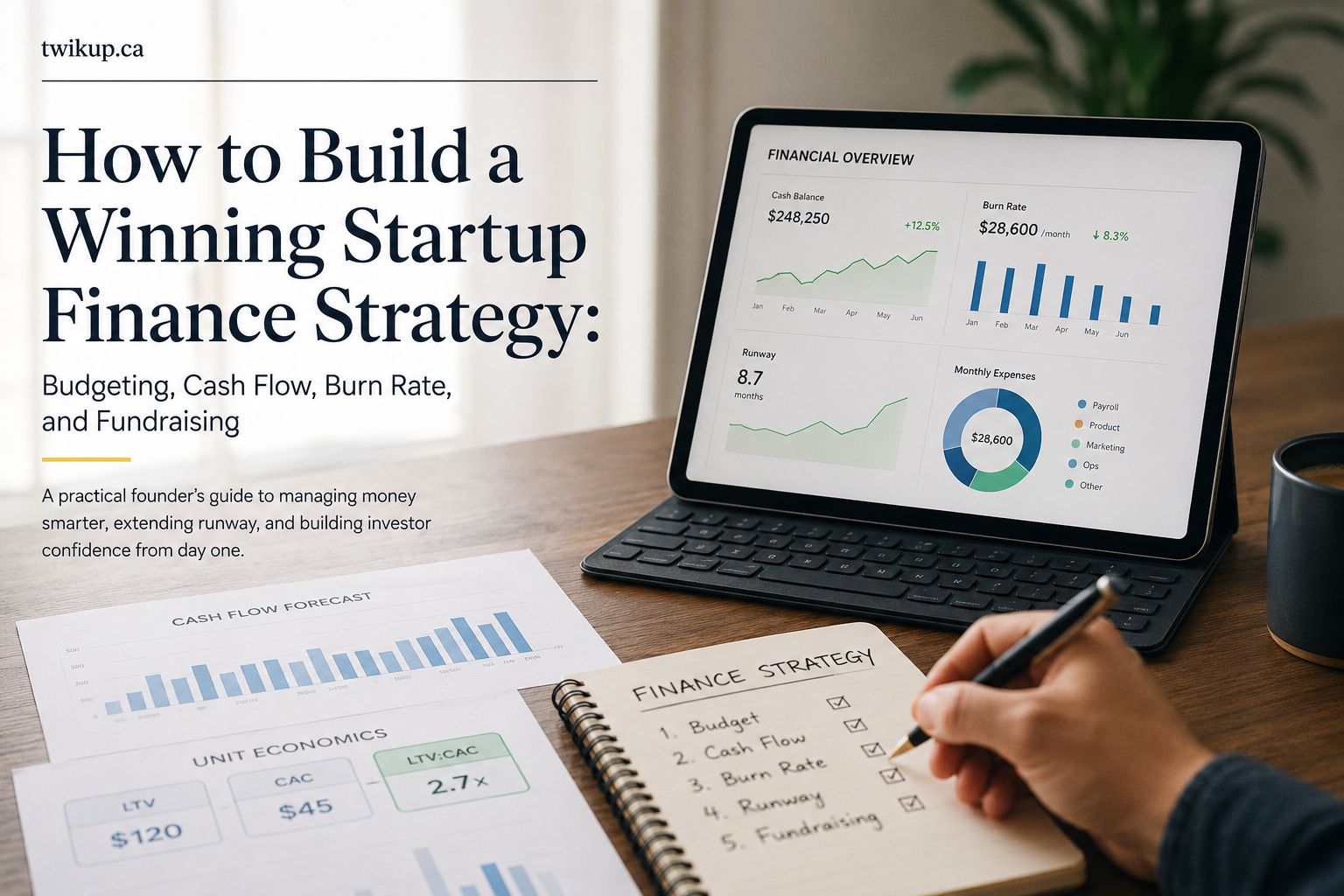
How to Build a Winning Startup Finance Strategy: Budgeting, Cash Flow, Burn Rate, and Fundraising
A startup rarely runs out of ideas.
It runs out of cash.
That distinction matters because a promising product, growing customer base, talented team, and impressive investor presentation cannot save a company that is unable to make payroll.
Startup finance is therefore not just an accounting function. It is the system that determines:
- How quickly your startup can grow
- Which opportunities it can pursue
- How much risk it can absorb
- When it should hire
- Whether it needs outside capital
- How much negotiating power founders retain
- How long the company has to find a working business model
The strongest founders do not wait until money becomes a problem. They build a financial strategy before spending accelerates.
That strategy does not need to be complicated. It needs to be honest, measurable, frequently updated, and connected to the company’s most important milestones.
Quick Answer
A winning startup finance strategy is a practical plan for deciding how the company will earn, spend, preserve, and raise money while moving toward sustainable growth.
It should include:
- A realistic revenue model
- A 12-to-24-month operating budget
- A short-term cash-flow forecast
- Gross and net burn-rate tracking
- A continuously updated runway calculation
- Base, upside, and downside scenarios
- Hiring and capital-allocation rules
- Fundraising milestones and timing
- Unit-economics targets
- Monthly reporting and accountability
The central goal is not simply to reduce spending.
It is to ensure that every dollar helps the startup reach a milestone that makes the business stronger, more valuable, or more capable of financing itself.
TwikUp Insight
A startup budget should not answer only:
How much are we allowed to spend?
It should answer:
What must this spending help us prove?
An early-stage startup is purchasing evidence.
Product spending should help prove that customers want the product.
Marketing spending should help prove that customers can be acquired efficiently.
Hiring should help prove that the business can grow beyond its founders.
Infrastructure spending should help prove that the product can operate reliably at a larger scale.
Fundraising should buy enough time to reach the next major proof point.
This leads to one of the most important principles in startup finance:
Capital should be tied to milestones—not optimism.
The Night a Successful Startup Nearly Ran Out of Money
Imagine a founder named Maya.
Her software startup had recently crossed $1 million in annual recurring revenue. Customers liked the product, investors praised the company’s growth, and the team had expanded from 8 employees to 27.
From the outside, the business looked successful.
Then Maya received a message from her finance lead on a Thursday evening:
“At our current cash balance, we may not be able to cover payroll three months from now.”
Maya was confused.
Revenue had increased.
The company had recently closed several large contracts.
The sales dashboard looked excellent.
How could it be running out of money?
The answer was hidden beneath the growth:
- Enterprise customers were paying 60 to 90 days after invoicing.
- The company had hired ahead of revenue.
- Cloud costs had increased as usage grew.
- Annual software contracts had been prepaid.
- Sales commissions were paid before some customer invoices were collected.
- Several forecasted deals had been delayed.
- Management was tracking revenue, but not weekly cash movements.
The company was growing—but its cash conversion cycle was working against it.
Maya froze hiring, renegotiated payment terms, offered customers incentives for annual prepayment, postponed non-essential projects, and began reviewing a 13-week cash-flow forecast every Monday.
The business survived.
The lesson was not that growth was dangerous.
The lesson was that revenue, profit, and cash are three different things.
A founder who watches only one of them is seeing only part of the company.
What Is a Startup Finance Strategy?
A startup finance strategy is the decision-making system that connects a company’s cash, business model, operating plan, growth targets, and funding choices.
It addresses five fundamental questions:
- Where will money come from?
- Where should money be spent?
- How quickly is cash being consumed?
- What milestones must be reached before more money is needed?
- What happens if the original plan is wrong?
A financial strategy is broader than a budget.
A budget estimates income and expenses.
A financial strategy explains what the company is trying to accomplish with those resources, what assumptions must be true, how performance will be measured, and what management will do when reality differs from the forecast.
The TwikUp CAPITAL Framework for Startup Finance
Founders can organize their financial strategy using the TwikUp CAPITAL Framework:
C — Cash visibility
A — Assumption-based forecasting
P — Prioritized capital allocation
I — Intelligent burn management
T — Traction-linked fundraising
A — Accountability through reporting
L — Long-term financial resilience
C: Cash Visibility
Know exactly:
- How much unrestricted cash is available
- What payments are due
- When customers are expected to pay
- Which expenses are committed
- How much cash will likely remain in 13 weeks
- How many months of runway remain
A: Assumption-Based Forecasting
Every forecast should clearly state its assumptions:
- Number of customers
- Average selling price
- Sales conversion rate
- Customer churn
- Hiring dates
- Salary costs
- Marketing efficiency
- Payment timing
- Gross margin
- Fundraising date
A forecast without visible assumptions is difficult to challenge and easy to manipulate.
P: Prioritized Capital Allocation
Every meaningful expense should support one of the startup’s highest-priority outcomes:
- Product-market fit
- Revenue growth
- Customer retention
- Regulatory readiness
- Operational reliability
- Unit-economics improvement
- Fundraising readiness
I: Intelligent Burn Management
The objective is not to minimize burn at any cost.
The objective is to ensure that burn creates meaningful progress.
T: Traction-Linked Fundraising
Raise capital based on:
- The milestone being pursued
- The cost of reaching it
- The time required
- A realistic contingency buffer
- The evidence investors will expect at the next stage
A: Accountability Through Reporting
Compare:
- Budget versus actual results
- Forecast versus actual revenue
- Planned versus actual hiring
- Expected versus actual cash balance
- Growth created versus cash consumed
L: Long-Term Financial Resilience
Prepare for:
- Delayed fundraising
- Customer losses
- Economic slowdowns
- Higher acquisition costs
- Vendor price increases
- Product delays
- Regulatory or legal expenses
The Difference Between Revenue, Profit, and Cash Flow
These terms are related, but they are not interchangeable.
Revenue
Revenue is the money earned by selling products or services.
A software startup with 500 customers paying $100 per month generates:
500 customers × $100 = $50,000 monthly recurring revenue
Profit
Profit is what remains after relevant expenses are subtracted from revenue.
If the company earns $50,000 and records $80,000 in monthly expenses:
$50,000 revenue − $80,000 expenses = −$30,000 operating result
The company is losing $30,000 per month on an accounting basis before considering other adjustments.
Cash Flow
Cash flow tracks when money physically enters or leaves the company’s accounts.
Suppose the startup signs a $120,000 annual enterprise contract in January but allows the customer to pay quarterly.
The contract may increase booked revenue, but the full $120,000 is not immediately available to pay employees.
That is why founders must monitor all three:
| Measure | Core question |
|---|---|
| Revenue | Are customers buying? |
| Profit | Does the business earn more than it costs? |
| Cash flow | Can the company meet its obligations when due? |
A startup can report revenue growth while experiencing worsening cash flow.
It can also generate positive cash flow temporarily after fundraising while remaining deeply unprofitable.
Cash from investors is financing—not customer revenue.
Step 1: Define the Financial Goal of Your Current Stage
A startup’s financial priorities should change as the company develops.
Idea Stage
The objective is to validate the problem without building an expensive organization.
Financial priorities:
- Minimize fixed expenses
- Conduct customer research
- Test demand
- Build a lightweight prototype
- Avoid premature hiring
- Separate personal and business finances
At this stage, the biggest financial risk is spending heavily before confirming that customers care.
Pre-Seed Stage
The objective is to prove that a specific group of users wants the product.
Financial priorities:
- Build a minimum viable product
- Track activation and retention
- Identify an initial revenue model
- Estimate the cost of reaching product-market fit
- Preserve founder flexibility
- Keep the team focused and small
Seed Stage
The objective is to build repeatable signs of traction.
Financial priorities:
- Improve retention
- Establish a measurable sales process
- Understand customer acquisition cost
- Increase recurring revenue
- Create a repeatable hiring plan
- Build reliable reporting
Series A Stage
The objective is usually to demonstrate that capital can accelerate an already functioning growth engine.
Financial priorities:
- Department-level budgets
- Reliable revenue forecasting
- Cohort analysis
- Sales efficiency
- Gross-margin improvement
- Strong financial controls
- Board-ready reporting
Growth Stage
The objective is to scale without losing control.
Financial priorities:
- Multi-year planning
- International expansion modelling
- Treasury and cash management
- Compliance systems
- Profitability pathways
- Strategic debt or equity financing
- Acquisition analysis
- Internal controls and audit readiness
The financial plan should evolve with the company. A spreadsheet designed for three founders will not be sufficient for a 100-person organization.
Step 2: Build a Revenue Model From Business Drivers
One of the most common forecasting mistakes is starting with a desired revenue number.
For example:
“We want to generate $2 million next year.”
That is a goal—not a model.
A useful revenue forecast explains what must happen to produce that result.
SaaS Revenue Model
A simplified SaaS model could use:
Ending customers =
Beginning customers
+ New customers
− Churned customers
Then:
Monthly recurring revenue =
Active customers × Average monthly revenue per customer
Example
Suppose a startup begins the month with 300 customers.
During the month:
- It adds 40 customers.
- It loses 15 customers.
- Average monthly revenue is $150.
Ending customers = 300 + 40 − 15
Ending customers = 325
MRR = 325 × $150
MRR = $48,750
This model allows founders to test the impact of:
- Higher pricing
- Better retention
- Faster customer acquisition
- Lower sales conversion
- Expansion revenue
Marketplace Revenue Model
A marketplace may use:
Gross merchandise value =
Number of transactions × Average transaction value
Marketplace revenue =
Gross merchandise value × Take rate
If 20,000 transactions average $60 and the startup earns a 12% fee:
GMV = 20,000 × $60
GMV = $1,200,000
Revenue = $1,200,000 × 12%
Revenue = $144,000
Ecommerce Revenue Model
An ecommerce startup may model:
Revenue =
Website visitors
× Conversion rate
× Average order value
With:
- 100,000 visitors
- 2.5% conversion
- $80 average order value
100,000 × 2.5% × $80 = $200,000 revenue
Usage-Based Revenue Model
A usage-based company may calculate:
Revenue =
Active accounts
× Average usage per account
× Price per unit
The best revenue model identifies the few operating drivers that create financial results.
That makes the forecast useful for decision-making rather than presentation.
Step 3: Build a Bottom-Up Startup Budget
A startup budget should be built from specific operating plans—not broad percentages copied from another company.
Begin With Four Questions
For every expense, ask:
- What are we buying?
- Why is it needed now?
- Which milestone does it support?
- What happens if we delay it?
Then divide spending into meaningful categories.
People Costs
Include more than salaries:
- Base compensation
- Employer payroll costs
- Benefits
- Bonuses
- Commissions
- Recruiting fees
- Equipment
- Training
- Contractor expenses
- Travel
- Severance or termination exposure
A $100,000 employee may cost significantly more than $100,000 after related expenses.
The hiring model should show each planned employee, role, expected start date, and total cost.
Example Hiring Schedule
| Role | Planned start | Monthly all-in cost | Business reason |
|---|---|---|---|
| Senior engineer | March | $14,000 | Accelerate core product |
| Account executive | June | $12,500 | Expand validated sales motion |
| Customer-success manager | August | $9,000 | Reduce churn |
| Finance lead | January next year | $15,000 | Improve controls and reporting |
Hiring should be triggered by evidence, not excitement.
Product and Technology
Include:
- Cloud infrastructure
- AI model or API usage
- Data storage
- Development software
- Cybersecurity
- Testing tools
- Product-design tools
- Contractors
- Monitoring systems
- Technical support
Separate fixed subscriptions from costs that grow with usage.
That distinction becomes important when forecasting gross margin.
Sales and Marketing
Include:
- Advertising
- Content
- Events
- Sales commissions
- Agencies
- Marketing software
- Sponsorships
- Partnerships
- Customer onboarding
- Travel
Marketing should not be budgeted only because competitors are spending.
It should be connected to measurable assumptions:
Marketing spend
→ Qualified leads
→ Sales opportunities
→ New customers
→ Gross profit
General and Administrative Costs
Include:
- Legal expenses
- Accounting
- Tax preparation
- Insurance
- Banking fees
- Office expenses
- Licences
- Human-resources software
- Compliance
- Board costs
Capital Expenditures
Include major purchases that may not appear as a normal monthly operating expense:
- Equipment
- Office buildouts
- Manufacturing machinery
- Servers
- Laboratory equipment
Contingency
A budget should include room for uncertainty.
Unexpected expenses are not unusual. What is unusual is expecting an early-stage forecast to be perfectly accurate.
A Sample Startup Budget
Consider a SaaS startup with $1.5 million in cash and $60,000 in monthly revenue.
Its monthly budget may look like this:
| Category | Monthly amount |
|---|---|
| Customer revenue | $60,000 |
| Payroll and benefits | $125,000 |
| Cloud and product tools | $18,000 |
| Sales and marketing | $30,000 |
| Legal and accounting | $7,000 |
| Insurance and administration | $5,000 |
| Office and travel | $5,000 |
| Total cash expenses | $190,000 |
The company’s gross cash burn is:
Gross burn = $190,000
Its net burn is:
Net burn = Cash expenses − Cash revenue
Net burn = $190,000 − $60,000
Net burn = $130,000 per month
Its simplified runway is:
Runway = Cash balance ÷ Net monthly burn
Runway = $1,500,000 ÷ $130,000
Runway ≈ 11.5 months
But that 11.5-month figure is only a snapshot.
If the startup hires four people next quarter, net burn may rise. If revenue grows, it may fall. If customers pay late, actual cash availability may deteriorate even when reported revenue increases.
That is why runway should also be modelled month by month.
For a deeper explanation, read What Is Startup Burn Rate? How to Calculate Burn Rate and Cash Runway.
Step 4: Build a 13-Week Cash-Flow Forecast
An annual budget provides strategic direction.
A 13-week cash-flow forecast provides operational visibility.
It shows expected cash receipts and payments by week for approximately one quarter. BDC recommends rolling cash-flow planning as a way to evaluate cash use and runway, while the U.S. Small Business Administration emphasizes using cash-flow projections alongside sales and expense forecasts.
What to Include
Opening Cash
The amount available at the beginning of the week.
Expected Cash Inflows
- Customer payments
- Subscription receipts
- Financing
- Tax refunds
- Grants
- Other operating income
Expected Cash Outflows
- Payroll
- Taxes
- Rent
- Vendors
- Cloud services
- Marketing
- Debt payments
- Insurance
- Legal expenses
- Capital purchases
Closing Cash
Closing cash =
Opening cash
+ Cash received
− Cash paid
The closing balance becomes the next week’s opening balance.
Why 13 Weeks?
It is long enough to identify upcoming pressure, but short enough to estimate individual receipts and payments with reasonable detail.
It can reveal:
- A large tax payment that was omitted from the annual plan
- A customer invoice likely to arrive after payroll
- Annual software renewals
- A seasonal revenue decline
- A hiring plan that creates an unexpected cash shortage
- A period when emergency financing may be required
Use Payment Dates, Not Invoice Dates
Cash forecasting should reflect when money is expected to move—not merely when an invoice is issued or an expense is recorded.
A $200,000 invoice does not fund payroll until the customer pays it.
Step 5: Understand Gross Burn, Net Burn, and Runway
Gross Burn Rate
Gross burn measures total cash operating expenses during a period.
Gross burn =
Total monthly cash operating expenses
Net Burn Rate
Net burn measures the amount by which cash decreases after operating cash inflows.
Net burn =
Monthly cash expenses
− Monthly cash inflows
If cash expenses are $250,000 and customer collections are $100,000:
Net burn = $250,000 − $100,000
Net burn = $150,000
Cash Runway
Cash runway estimates how long the startup can continue operating at its current net burn.
Cash runway =
Available cash ÷ Monthly net burn
BDC defines runway as the period a business can continue operating before exhausting its available cash based on current expenditure.
The Limitation of a Simple Runway Formula
The formula assumes burn remains constant.
In reality:
- New employees increase spending.
- Revenue may grow or decline.
- Customers may pay late.
- One-time expenses may arise.
- Marketing may be increased or reduced.
- Financing may arrive later than expected.
Therefore, founders should maintain two runway figures:
Snapshot Runway
Current cash ÷ Current net burn
Forecast Runway
The month in the financial model when projected cash falls below the minimum required operating balance.
Forecast runway is generally more useful.
Step 6: Measure What Your Burn Is Producing
Burn rate alone does not tell you whether a startup is financially responsible.
Two startups can each burn $300,000 per month while producing very different results.
Startup A may be:
- Growing recurring revenue rapidly
- Retaining customers
- Improving gross margin
- Building a defensible product
- Developing a repeatable sales process
Startup B may be:
- Losing customers
- Hiring without clear priorities
- Funding unproductive advertising
- Building features nobody requested
- Repeatedly missing forecasts
The same burn can represent productive investment or financial drift.
Use Milestone Efficiency
Ask:
What measurable progress did this spending create?
Possible measures include:
- Revenue added
- Gross profit added
- Customers retained
- Product releases completed
- Sales-cycle reduction
- Infrastructure reliability
- Regulatory approval
- Market expansion
- Customer-acquisition payback improvement
Burn Multiple
Growth-stage subscription businesses sometimes examine the relationship between net burn and net new recurring revenue.
A simplified version is:
Burn multiple =
Net cash burned
÷ Net new annual recurring revenue
Example:
- Net cash burned during the year: $2.4 million
- Net new ARR: $1.2 million
Burn multiple = $2.4 million ÷ $1.2 million
Burn multiple = 2.0
This means the company burned $2 for each $1 of net new ARR created.
The figure should not be used in isolation. Business model, gross margin, retention, market conditions, company stage, and growth rate all matter.
The deeper principle is simple:
Founders should measure both the cash consumed and the value created.
Step 7: Build Three Financial Scenarios
A single forecast can create false confidence.
Strong startup models include at least three scenarios.
Base Case
The most realistic outcome based on current evidence.
Upside Case
What happens if:
- Sales conversion improves
- Revenue arrives faster
- Churn declines
- Hiring remains on schedule
- Pricing increases succeed
Downside Case
What happens if:
- Revenue is 20% to 30% lower
- Major contracts are delayed
- Customers pay more slowly
- Fundraising takes longer
- Customer-acquisition cost rises
- Product development slips
- A major customer leaves
Example Scenario Table
| Metric | Downside | Base | Upside |
|---|---|---|---|
| Year-end MRR | $120,000 | $170,000 | $230,000 |
| Monthly net burn | $190,000 | $145,000 | $100,000 |
| Year-end cash | $350,000 | $810,000 | $1,300,000 |
| Forecast runway | 5 months | 11 months | 20 months |
| Fundraising need | Immediate | Within 6 months | Potentially optional |
The downside case is not pessimism.
It is preparation.
It tells the founder which actions must be taken before a difficult situation becomes an emergency.
Step 8: Create Financial Triggers Before You Need Them
Do not wait for a crisis to decide how to respond.
Set financial triggers in advance.
Example Trigger System
Green Zone: More Than 18 Months of Runway
Possible actions:
- Invest selectively in proven growth channels
- Make priority hires
- Fund product improvements
- Maintain fundraising relationships
Yellow Zone: 12 to 18 Months
Possible actions:
- Reassess hiring
- Prepare fundraising materials
- Review vendor contracts
- Accelerate collections
- Test downside scenarios
Orange Zone: 9 to 12 Months
Possible actions:
- Begin active fundraising
- Pause non-essential hiring
- Reduce low-return spending
- Review founder and executive compensation
- Prioritize near-term revenue
Red Zone: Less Than 9 Months
Possible actions:
- Implement a formal cash-preservation plan
- Stop discretionary projects
- Renegotiate major obligations
- Consider bridge financing
- Evaluate strategic alternatives
- Protect payroll and critical operations
These ranges are not universal rules. A capital-intensive biotech company, profitable software business, seasonal retailer, and hardware startup have very different financing cycles.
The important point is to act while the company still has choices.
Step 9: Connect Hiring to Financial and Operating Evidence
Hiring is often the largest and least reversible startup expense.
A new employee does not create only one month of cost. The decision may create a long-term commitment involving salary, benefits, management time, equipment, recruiting, and severance risk.
Before approving a role, ask:
- What constraint is this person solving?
- What measurable result should improve?
- Why can the current team not solve it?
- Is the need permanent?
- Could a contractor or automation solve it?
- What is the fully loaded annual cost?
- How does the hire change runway?
- What must be true for the hire to pay back?
The Difference Between Hope-Based and Trigger-Based Hiring
Hope-Based Hiring
“We expect sales to grow, so let’s hire six salespeople.”
Trigger-Based Hiring
“Our two current representatives have met quota for three consecutive months, pipeline coverage remains strong, onboarding is repeatable, and customer retention supports expansion. We will add two representatives.”
Trigger-based hiring reduces the risk of building capacity before demand has been validated.
Step 10: Understand Unit Economics Before Scaling
A startup can grow revenue while destroying value on every transaction.
Unit economics estimate whether an individual customer, order, account, or transaction can eventually produce an attractive financial return.
Customer Acquisition Cost
A simplified formula is:
CAC =
Sales and marketing costs
÷ New customers acquired
If a startup spends $120,000 on sales and marketing and acquires 100 customers:
CAC = $120,000 ÷ 100
CAC = $1,200
Customer Lifetime Value
A simplified subscription estimate may use:
LTV =
Average revenue per customer
× Gross margin
÷ Customer churn rate
This is only an estimate and can become misleading when the company has limited retention data.
CAC Payback Period
CAC payback =
Customer acquisition cost
÷ Monthly gross profit per customer
If CAC is $1,200 and monthly gross profit per customer is $150:
CAC payback = $1,200 ÷ $150
CAC payback = 8 months
Contribution Margin
Contribution margin measures what remains after costs directly associated with fulfilling a sale.
Contribution margin =
Revenue
− Variable fulfilment costs
A startup should understand whether growth improves its financial position or simply increases its losses.
A Founder Story: The Marketing Campaign That “Worked”
Daniel’s ecommerce startup launched a large paid-media campaign.
The dashboard looked impressive:
- Website traffic doubled.
- Orders increased by 80%.
- Social-media engagement surged.
- Revenue reached a company record.
The marketing team called it the most successful campaign in the company’s history.
Then finance reviewed the complete economics.
The startup had:
- Spent heavily to acquire each buyer
- Offered large discounts
- Provided free shipping
- Paid high fulfilment costs
- Experienced elevated product returns
- Attracted mostly one-time customers
Revenue had increased.
Contribution margin had fallen.
Cash losses had widened.
The campaign succeeded according to the advertising dashboard but failed according to the company’s bank account.
After that, Daniel changed the reporting system. Marketing was no longer evaluated only by traffic and revenue.
It was evaluated by:
- Customer acquisition cost
- Contribution margin
- Repeat purchase rate
- Refund rate
- Payback period
- Cash generated after fulfilment
Financial strategy improves when departments share the same definition of success.
Step 11: Decide How Much Cash the Startup Should Raise
A startup should not choose its fundraising target because a round size sounds impressive.
The amount should be based on a milestone plan.
The Milestone-Based Fundraising Formula
Capital required =
Operating cash needed to reach the milestone
+ One-time investments
+ Minimum cash buffer
+ Fundraising contingency
− Expected customer-generated cash
Suppose a startup expects:
- $2.4 million in operating cash needs
- $300,000 in one-time investments
- $500,000 minimum cash buffer
- $400,000 contingency
- $900,000 in customer-generated cash
Capital required =
$2.4M + $0.3M + $0.5M + $0.4M − $0.9M
Capital required = $2.7 million
The next question is:
What will $2.7 million allow the startup to prove?
Possible milestones include:
- Launching the product
- Reaching $1 million ARR
- Demonstrating strong retention
- Receiving regulatory approval
- Achieving positive contribution margin
- Expanding into a second market
- Becoming cash-flow break-even
Founders can explore the complete funding journey in The Complete Startup Fundraising Roadmap: From Idea to IPO.
Step 12: Begin Fundraising Before Cash Becomes an Emergency
Fundraising contains several stages:
- Building investor relationships
- Preparing the story and data room
- Contacting investors
- Conducting meetings
- Answering follow-up questions
- Receiving and negotiating offers
- Completing due diligence
- Finalizing legal documents
- Receiving funds
Each stage can take longer than expected.
The worst time to raise capital is when every investor knows that the company urgently needs it.
Limited runway can weaken the founder’s negotiating position and pressure the company to accept:
- A lower valuation
- Greater dilution
- Unfavourable investor rights
- Restrictive governance terms
- A smaller round than required
- Bridge financing that delays rather than solves the problem
Before signing an offer, study Startup Term Sheets Explained: Every Clause Founders Must Understand Before Raising Investment.
A large valuation can appear attractive, but it must be supported by future growth and financing expectations. Read Your Startup Isn’t Worth What You Think—Here’s How Investors Actually Value It.
Step 13: Prepare the Financial Model Investors Will Examine
Investors are not expecting a founder to predict the future perfectly.
They are evaluating:
- Whether assumptions are coherent
- Whether the founder understands the business
- Whether the market can support the plan
- Whether spending matches the company’s priorities
- Whether the requested capital can create a meaningful milestone
- Whether the company will likely require more financing
- Whether outcomes can produce venture-scale returns
Stripe describes a fundraising financial model as a forward-looking projection showing how growth, margins, and cash requirements may develop over time, allowing investors to test the underlying assumptions.
A Fundraising Model Should Usually Include
Revenue Build
- Customers
- Pricing
- Retention
- Expansion
- Sales capacity
- Conversion rates
Cost of Revenue
- Hosting
- Payment processing
- Customer support
- Fulfilment
- Third-party data
- Manufacturing
Operating Expenses
- Product and engineering
- Sales and marketing
- General and administrative
- Research
- Compliance
Headcount Plan
- Current employees
- Planned hires
- Start dates
- Salaries
- Benefits
- Department ownership
Cash-Flow Forecast
- Opening cash
- Cash generated or consumed
- Financing
- Closing cash
- Runway
Key Metrics
- Revenue growth
- Gross margin
- Churn
- CAC
- LTV
- Payback
- Burn
- Runway
Scenario Analysis
- Downside
- Base
- Upside
Step 14: Build a Clean Due-Diligence Trail
Due diligence is the process through which investors test whether the company they were presented matches the company that actually exists.
Financial diligence may examine:
- Bank statements
- Historical financial statements
- Revenue recognition
- Customer contracts
- Tax filings
- Capitalization records
- Debt
- Employee obligations
- Vendor commitments
- Forecast assumptions
- Intellectual-property ownership
- Legal claims
- Insurance
- Regulatory exposure
Founders should not begin organizing these records after receiving investor interest.
Maintain them continuously.
Questions Investors May Ask
- How much cash is available today?
- What is the current net burn?
- How has burn changed during the past six months?
- What are the largest expense categories?
- How concentrated is revenue?
- How many customers have delayed payment?
- What percentage of revenue is recurring?
- Why did actual revenue differ from the previous forecast?
- Which hires are included in the plan?
- When will the company need to raise again?
- What would management cut if the round were smaller?
A clean diligence process builds confidence.
An inconsistent one creates doubt—even when the underlying company is promising.
Step 15: Compare Equity, Debt, and Customer-Funded Growth
Not every startup should finance itself in the same way.
Bootstrapping
Bootstrapping means building primarily through founder resources and customer revenue.
Advantages
- Lower dilution
- Greater founder control
- Strong spending discipline
- Freedom from investor timelines
Risks
- Slower growth
- Personal financial exposure
- Limited hiring capacity
- Difficulty competing in capital-intensive markets
Equity Financing
Investors provide capital in exchange for ownership or the right to receive ownership.
Advantages
- No regular principal repayment
- Access to investor networks
- Capacity to fund high-risk growth
- Potential support with hiring and strategy
Risks
- Founder dilution
- Governance obligations
- Investor expectations
- Pressure for a large exit
- Reduced founder control
Venture Debt
Venture debt can provide capital without the same immediate equity dilution as a traditional priced round, but it creates repayment obligations and may include covenants, fees, security interests, or warrants.
Debt does not remove financial risk. It changes its form.
Read What Is Venture Debt? The Complete Guide to Startup Debt Financing Without Equity Dilution.
Customer Financing
Customers may finance growth through:
- Annual prepayments
- Deposits
- Paid pilots
- Implementation fees
- Long-term contracts
- Pre-orders
Customer-generated funding can be attractive because it may reduce dilution while validating real demand.
However, prepaid revenue also creates an obligation to deliver future services.
Step 16: Understand What Changes After You Raise Money
A funding announcement feels like the finish line.
Financially, it is the beginning of a more demanding stage.
The startup now has:
- More cash
- Higher expectations
- A new valuation to justify
- Investors to report to
- A milestone to reach
- A likely date by which another financing decision must be made
The most dangerous period can be the months immediately after a raise.
Hiring accelerates.
Software subscriptions multiply.
Office expenses grow.
Marketing experiments become larger.
Founders may believe the company is wealthier than it is.
But investor capital is not surplus money.
It is prepaid time.
Read You Raised Millions—Here’s What Happens Next and Where Many Founders Go Wrong.
Step 17: Build Board-Level Financial Discipline
After institutional financing, financial decisions increasingly become governance decisions.
A board may review:
- Budget approval
- Executive hiring
- Major financing
- Option grants
- Debt
- Acquisitions
- Cash runway
- Material contracts
- Strategic changes
Founders should provide clear, consistent reporting rather than using board meetings to reveal surprises.
A Useful Board Finance Pack
Executive Summary
- What changed?
- What is working?
- What is not working?
- What decisions are required?
Financial Performance
- Revenue
- Gross margin
- Operating expenses
- Net burn
- Cash balance
- Runway
Budget Versus Actual
- Major variances
- Explanations
- Corrective actions
Operating Metrics
- Customers
- Retention
- Pipeline
- Conversion
- Product usage
Forecast
- Updated base case
- Downside case
- Expected financing date
Risks
- Customer concentration
- Legal exposure
- Hiring delays
- Product delays
- Financing dependency
External capital also changes the founder’s relationship with company control. Read Your Board Can Fire You: What Every Founder Should Know After Raising Capital.
To understand the capital behind venture firms themselves, read Who Funds the Venture Capitalists? The Money Behind VC Firms Explained.
Step 18: Introduce a Monthly Finance Operating Rhythm
A financial strategy becomes valuable only when it influences behaviour.
Weekly Review
Track:
- Bank balance
- Customer collections
- Upcoming payments
- 13-week cash forecast
- Major spending commitments
- Fundraising status
Monthly Review
Track:
- Revenue versus forecast
- Spending versus budget
- Gross and net burn
- Runway
- Headcount
- Gross margin
- Customer acquisition cost
- Retention
- Cash collections
Quarterly Review
Reassess:
- Revenue assumptions
- Hiring plan
- Department budgets
- Pricing
- Product priorities
- Financing requirements
- Base, upside, and downside scenarios
Annual Review
Develop:
- Strategic operating plan
- Annual budget
- Capital plan
- Hiring roadmap
- Department targets
- Major risk assessment
A forecast should not be treated as a promise carved in stone.
It should be updated as the startup learns.
The Five Numbers Every Founder Should Know Without Opening a Spreadsheet
At any important meeting, a founder should be able to state:
1. Current Cash Balance
How much unrestricted cash is available now?
2. Monthly Net Burn
How much cash is the company currently losing each month?
3. Forecast Runway
When does the model indicate that cash reaches the minimum operating threshold?
4. Monthly Revenue or Recurring Revenue
How much customer-generated revenue is the business producing?
5. Next Financing Milestone
What must be achieved before the next round or before the company becomes self-sustaining?
A founder who cannot answer these questions may be delegating finance without understanding it.
Finance can be supported by accountants, controllers, and CFOs.
Accountability remains with leadership.
Common Startup Finance Mistakes
1. Treating the Fundraising Round as Revenue
Investor money increases cash but does not validate customer demand.
2. Hiring Before the Work Becomes Repeatable
A larger team can amplify confusion as easily as it amplifies growth.
3. Forecasting Revenue From Market Size
Capturing 1% of a billion-dollar market is not a sales strategy.
A forecast must explain how customers will be reached, converted, retained, and monetized.
4. Using the Bank Balance as the Financial Model
The current balance does not reveal future obligations.
5. Ignoring Payment Timing
Booked sales do not guarantee timely cash collection.
6. Tracking Gross Burn but Not Net Burn
Gross burn shows spending. Net burn shows the company’s actual monthly cash loss after operating inflows.
7. Tracking Net Burn but Not Its Trend
A single month may be distorted by annual payments or delayed collections.
Use rolling trends and forecasts.
8. Raising Only Enough to Survive
A round should finance the company to a milestone that improves strategic options.
9. Assuming the Next Round Will Be Available
Capital markets, investor appetite, and company performance can change.
The next round is a possibility—not an entitlement.
10. Scaling Negative Unit Economics
Growth can accelerate losses when customer economics do not work.
11. Hiding Bad News From the Board
Small issues become larger when they are delayed.
12. Cutting Everything Equally
Across-the-board cuts may damage high-performing areas while protecting low-value spending.
Prioritize strategically.
How to Reduce Burn Without Damaging the Startup
Cost reduction should protect the company’s core engine.
Rank Spending Into Four Groups
1. Essential and Productive
Spending required to operate and reach priority milestones.
Examples:
- Core engineering
- Customer support
- Security
- High-performing acquisition channels
2. Essential but Inefficient
Necessary spending that should be renegotiated or redesigned.
Examples:
- Expensive infrastructure
- Overlapping software
- Inefficient vendor contracts
3. Useful but Deferrable
Spending that may help but is not urgent.
Examples:
- Office redesign
- Secondary market expansion
- Non-essential events
4. Unproductive
Spending with no strong strategic or measurable justification.
Cut this first.
Practical Cash-Preservation Actions
- Slow or pause non-critical hiring
- Remove unused software
- Consolidate vendors
- Renegotiate payment terms
- Improve customer collections
- Request deposits or annual prepayments
- Reduce low-return advertising
- Delay discretionary projects
- Review cloud usage
- Reassess contractor arrangements
- Reduce inventory exposure
- Prioritize profitable customer segments
Do not cut solely to make the burn number look better.
Cut to create a more focused company.
When Should a Startup Hire a Finance Professional?
Bookkeeper
Useful when transaction volume becomes difficult to manage accurately.
Typical responsibilities:
- Categorizing transactions
- Recording invoices
- Reconciling bank accounts
- Maintaining basic records
Accountant
Useful for:
- Financial statements
- Tax filings
- Accounting policies
- Revenue recognition
- Compliance
Controller
Useful when the startup requires stronger internal controls, monthly closes, reporting, and accounting operations.
Head of Finance or FP&A Lead
Useful when the startup needs:
- Detailed forecasting
- Scenario planning
- Department budgets
- Investor reporting
- Strategic analysis
CFO
A senior CFO becomes valuable when financial complexity, capital strategy, governance, acquisitions, international operations, or risk require executive-level leadership.
Hiring a prestigious CFO too early can create unnecessary cost.
Waiting too long can leave a scaling company without adequate control.
Startup Finance Dashboard
A practical dashboard may include:
| Category | Metric | Frequency |
|---|---|---|
| Liquidity | Cash balance | Weekly |
| Liquidity | 13-week forecast | Weekly |
| Sustainability | Gross burn | Monthly |
| Sustainability | Net burn | Monthly |
| Sustainability | Forecast runway | Monthly |
| Growth | Revenue or MRR | Monthly |
| Quality | Gross margin | Monthly |
| Retention | Customer or revenue churn | Monthly |
| Acquisition | CAC | Monthly or quarterly |
| Efficiency | CAC payback | Quarterly |
| Planning | Budget versus actual | Monthly |
| Team | Headcount versus plan | Monthly |
| Risk | Customer concentration | Monthly |
| Financing | Fundraising progress | Weekly during a raise |
The dashboard should not contain dozens of vanity metrics.
It should highlight the numbers that change decisions.
Startup Finance Strategy by Stage
| Stage | Primary financial objective | Main risk |
|---|---|---|
| Idea | Validate cheaply | Spending before demand |
| Pre-seed | Reach product evidence | Building too much |
| Seed | Prove repeatability | Hiring ahead of traction |
| Series A | Scale a working engine | Inefficient growth |
| Growth | Build durable operations | Complexity and loss of control |
| Late stage | Balance growth and profitability | Missing market expectations |
| Pre-IPO | Establish predictability and governance | Weak controls or inconsistent performance |
There is no universal “good” burn rate.
A good burn rate is one that:
- The company can finance
- Produces measurable progress
- Fits the startup’s stage
- Preserves sufficient time to react
- Is supported by realistic assumptions
Frequently Asked Questions
What is the most important financial metric for a startup?
There is no single metric for every business, but cash balance, net burn, and forecast runway are foundational because they indicate whether the company can continue operating.
The most useful operating metric depends on the business model. A subscription startup may prioritize recurring revenue and retention, while a marketplace may focus on transaction volume, take rate, liquidity, and contribution margin.
How often should a startup review its cash flow?
Short-term cash flow should generally be reviewed weekly, particularly when the company has limited runway, irregular customer payments, or rapidly changing expenses.
How much runway should a startup maintain?
The appropriate amount depends on the company’s stage, fundraising environment, revenue predictability, and cost structure.
Management should preserve enough runway to reach a meaningful milestone and respond if fundraising or revenue takes longer than expected.
Is a high burn rate always bad?
No.
A high burn rate may be rational when the startup has strong economics, substantial liquidity, and a clear opportunity to invest efficiently.
It becomes dangerous when spending grows faster than validated progress or when the company lacks time to change direction.
Should startups focus on growth or profitability?
The answer depends on the business model, stage, access to capital, and quality of growth.
Growth supported by strong retention, healthy margins, and attractive customer economics may justify investment.
Growth that creates recurring losses without improving economics may not.
When should founders start fundraising?
Preparation and relationship-building should begin well before the company faces a cash emergency.
Active timing should be based on forecast runway, expected fundraising duration, required milestones, and financing conditions.
How accurate should startup forecasts be?
Early-stage forecasts will rarely be perfectly accurate.
Their value comes from:
- Making assumptions visible
- Testing scenarios
- Comparing expectations with actual results
- Helping leadership respond quickly
Is venture debt safer than equity?
Not necessarily.
Equity creates dilution and governance implications. Debt creates repayment obligations and potential restrictions.
The safer option depends on the startup’s cash flow, risk, growth plan, and ability to service the financing.
What is the biggest budgeting mistake founders make?
One of the biggest mistakes is building an expense list without connecting spending to milestones.
A budget should show not only what will be spent, but why the spending is necessary and what evidence it should create.
Can a profitable startup run out of cash?
Yes.
A profitable company can still experience a cash shortage when customers pay late, inventory consumes cash, debt payments are due, or large expenses must be paid before associated revenue is collected.
The Startup Finance Checklist
Cash and Forecasting
- We know our current unrestricted cash balance.
- We maintain a 13-week cash-flow forecast.
- We update our monthly forecast regularly.
- We understand when customers are expected to pay.
- We have identified large upcoming obligations.
Budgeting
- Every department has a clear budget.
- Major expenses are connected to milestones.
- Hiring dates and fully loaded costs are modelled.
- One-time costs are included.
- Budget-to-actual results are reviewed monthly.
Burn and Runway
- We track gross burn.
- We track net burn.
- We understand the trend in burn.
- We maintain a forecast runway.
- We know which actions would extend runway.
Revenue and Unit Economics
- Revenue is built from operating drivers.
- Pricing assumptions are documented.
- Retention or repeat purchases are measured.
- Gross and contribution margins are understood.
- Customer-acquisition economics are monitored.
Fundraising
- The amount being raised is linked to a milestone.
- The financial model has base, upside, and downside scenarios.
- The data room is organized.
- Capitalization records are accurate.
- Fundraising begins before cash becomes critical.
- Term-sheet economics and control rights are understood.
Risk
- We know what happens if revenue is 30% below plan.
- We know what happens if fundraising is delayed.
- We understand customer concentration.
- We have identified non-essential spending.
- Management has agreed on financial triggers.
A 30-Day Startup Finance Action Plan
Week 1: Establish Visibility
- Confirm the actual bank balance.
- List every recurring expense.
- Review unpaid customer invoices.
- Identify taxes and large upcoming payments.
- Calculate current gross and net burn.
- Estimate snapshot runway.
Week 2: Build the Model
- Create a monthly revenue model.
- Build the headcount schedule.
- Categorize fixed and variable expenses.
- Create base, upside, and downside cases.
- Identify the month when cash reaches the minimum threshold.
Week 3: Connect Capital to Strategy
- Define the company’s next major milestone.
- Estimate the capital required to reach it.
- Rank spending by strategic importance.
- Set hiring triggers.
- Identify the first cuts under the downside case.
Week 4: Install the Operating Rhythm
- Launch the weekly cash review.
- Finalize the monthly finance dashboard.
- Assign ownership for each metric.
- Establish budget-variance reporting.
- Prepare an investor-ready financial summary.
- Schedule the next quarterly forecast reset.
At the end of 30 days, the founder should know:
- How much cash exists
- Where it is going
- What the current plan assumes
- When more capital may be needed
- Which milestone that capital must produce
- What actions will be taken if the plan changes
Final Thoughts
Most startups do not collapse in one dramatic moment.
Financial failure usually develops slowly.
It begins with one hire made too early.
One optimistic sales forecast.
One expensive campaign measured by revenue instead of margin.
One customer invoice that arrives later than expected.
One fundraising process started three months too late.
One board meeting where the difficult news is softened.
One month when nobody updates the cash forecast.
Then, suddenly, the founder discovers that the company has only weeks left to survive.
A winning startup finance strategy cannot eliminate uncertainty.
It does something more valuable:
It gives the company time to respond.
Time to reduce spending.
Time to improve pricing.
Time to collect cash.
Time to change the product.
Time to raise capital.
Time to become profitable.
The goal is not to make every forecast correct.
The goal is to understand the consequences when it is wrong.
Great founders do not treat finance as the department that records what already happened.
They use it to decide what should happen next.
Because in a startup, every dollar has three possible jobs:
Prove something.
Build something.
Buy more time.
If an expense does none of those, the founder should question why it exists.
Products create possibilities.
Customers create revenue.
Capital creates time.
But financial discipline determines whether the company gets enough time to win.