
Quick Answer
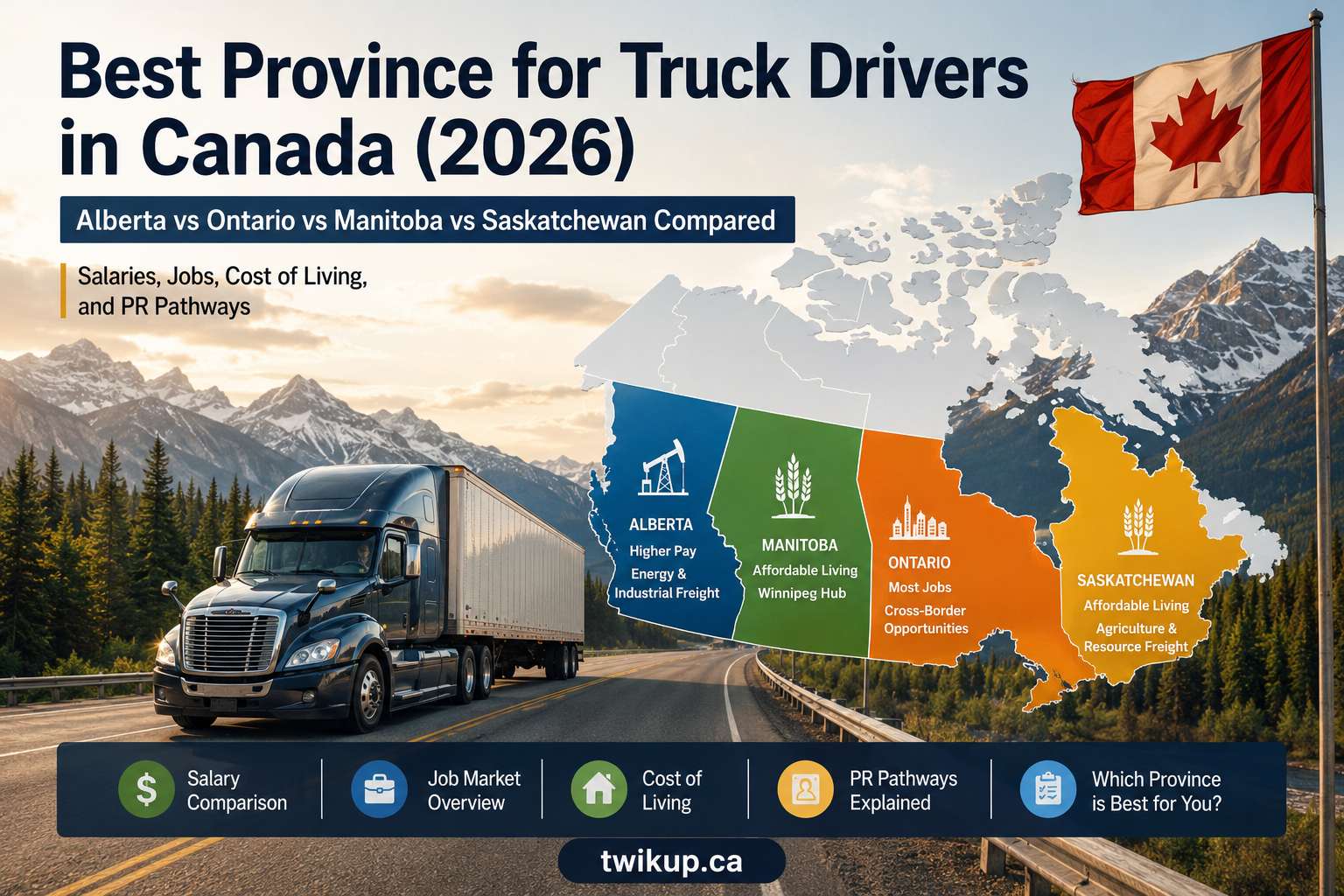
The best province for truck drivers in Canada depends on your goal. Alberta is strongest for higher earning potential, Ontario is best for job volume and cross-border freight, Saskatchewan is strong for affordability and clearer employer-backed pathways, and Manitoba can work well for drivers who want Winnipeg-based routes and lower housing costs.
For immigration, truck drivers should be careful: PNP rules change often, job offers matter, and no province guarantees PR. Canada’s Provincial Nominee Program allows provinces to nominate workers who can support local labour needs, but each province sets its own criteria and annual nomination limits.
Key Takeaways
| Goal | Best Province |
|---|---|
| Highest wage potential | Alberta |
| Most trucking jobs | Ontario |
| Cross-border trucking | Ontario |
| Lower housing cost | Saskatchewan or Manitoba |
| Oil, energy, heavy freight | Alberta |
| Agriculture and prairie freight | Saskatchewan |
| Immigration planning with job offer | Ontario or Saskatchewan |
| Best overall balance | Alberta |
Twikup Insight
Most truck drivers compare provinces only by hourly wage. That is a mistake.
A province paying $3–$5 more per hour may still leave you with less money if rent, insurance, commute costs, winter downtime, or licensing costs are higher. For newcomers, the best province is not always the one with the highest wage. It is usually the province where you can combine:
- stable full-time job offer
- realistic licensing path
- affordable housing
- manageable weather
- employer support
- PR pathway alignment
That is why Alberta, Ontario, Manitoba, and Saskatchewan each make sense for different types of truck drivers.
Truck Driver Occupation in Canada: NOC 73300
Truck drivers in Canada are classified under NOC 73300 — Transport truck drivers. According to Canada’s National Occupational Classification, this occupation includes drivers who operate tractor-trailers, long-combination vehicles, and straight-body trucks over 4,500 kg to transport goods and materials.
This matters because immigration programs, wage data, licensing rules, and job postings usually refer to the NOC code.
Canada-Wide Truck Driver Wage Snapshot
According to Canada Job Bank wage data updated on November 19, 2025, the national median wage for transport truck drivers is $26.42/hour, with a low of $19.45/hour and a high of $37.00/hour. The reference period is 2023–2024.
| Province | Low Wage | Median Wage | High Wage |
|---|---|---|---|
| Alberta | $21.00/hr | $30.00/hr | $42.31/hr |
| Ontario | $19.23/hr | $26.00/hr | $35.00/hr |
| Manitoba | $17.00/hr | $24.00/hr | $34.72/hr |
| Saskatchewan | $18.50/hr | $27.00/hr | $37.00/hr |
Based on official Job Bank wage data, Alberta has the highest median wage among these four provinces, followed by Saskatchewan, Ontario, and Manitoba.
Province Comparison: Alberta vs Ontario vs Manitoba vs Saskatchewan
| Factor | Alberta | Ontario | Manitoba | Saskatchewan |
|---|---|---|---|---|
| Wage potential | Excellent | Good | Moderate | Good |
| Job volume | Strong | Excellent | Moderate | Moderate |
| Housing affordability | Better than Ontario | Weakest | Strong | Strong |
| Cross-border freight | Moderate | Excellent | Moderate | Moderate |
| Winter difficulty | High | Moderate | High | High |
| PR planning | Good, but competitive | Good with job offer | Good for settlement | Strong with Saskatchewan work/job offer |
| Best for | High-income drivers | Job options | Family affordability | Lower cost + employer-backed routes |
1. Alberta for Truck Drivers
Alberta is one of the strongest provinces for truck drivers because it combines higher wages, energy-sector freight, major logistics corridors, and no provincial sales tax.
Alberta’s official Job Bank median wage for transport truck drivers is $30.00/hour, higher than Ontario, Manitoba, and Saskatchewan in the current Job Bank wage table. Some Alberta regions show even stronger earning potential, including Wood Buffalo–Cold Lake at a high wage of $55.00/hour and Athabasca–Grande Prairie–Peace River at a median wage of $35.00/hour.
Why Alberta Can Be Good for Truck Drivers
Alberta is strong for:
- long-haul trucking
- oilfield and energy freight
- oversized loads
- construction materials
- Calgary logistics
- Edmonton freight movement
- northern resource routes
- drivers who want higher income potential
Best Alberta Cities for Truck Drivers
| City / Region | Why It Matters |
|---|---|
| Calgary | Major logistics hub, warehousing, cross-province routes |
| Edmonton | Industrial freight, northern access, construction supply |
| Red Deer | Central Alberta location between Calgary and Edmonton |
| Grande Prairie | Energy, resource, and northern trucking |
| Fort McMurray / Wood Buffalo | Oil sands and specialized freight |
Alberta Pros
- Highest median wage among the four provinces compared
- Strong energy and industrial freight demand
- No provincial sales tax
- Good earning upside for experienced drivers
- Better affordability than Ontario in many areas
Alberta Cons
- Winter driving can be difficult
- Northern routes can be physically and mentally demanding
- Oil and energy freight may fluctuate with commodity cycles
- Some routes require specialized experience
Who Should Choose Alberta?
Alberta is best for truck drivers who want higher pay, are comfortable with long-distance or industrial routes, and can handle winter and northern driving conditions.
Best fit: Experienced long-haul drivers, oilfield drivers, Class 1 drivers, heavy-haul drivers, and drivers who want income growth.
2. Ontario for Truck Drivers
Ontario is the best province for truck drivers who want job volume, route variety, warehousing networks, and cross-border freight opportunities.
Ontario’s median Job Bank wage for transport truck drivers is $26.00/hour, with regional variation. The Kitchener–Waterloo–Barrie region shows a median wage of $28.00/hour, while Toronto shows a median wage of $25.10/hour.
Ontario may not beat Alberta on median wage, but it has something Alberta does not: massive freight density.
Why Ontario Can Be Good for Truck Drivers
Ontario has:
- Canada’s largest population base
- major manufacturing corridors
- large warehousing networks
- GTA freight demand
- cross-border routes to the United States
- strong demand around Windsor, Hamilton, Brampton, Mississauga, London, and Toronto
Best Ontario Cities for Truck Drivers
| City / Region | Why It Matters |
|---|---|
| Brampton / Mississauga | Major trucking and warehousing hub |
| Toronto / GTA | High freight volume |
| Hamilton | Industrial and port-related freight |
| Windsor | U.S. border and auto-sector freight |
| London | Southwestern Ontario logistics |
| Kitchener-Waterloo-Barrie | Strong regional wage data and distribution routes |
Ontario Immigration Angle for Truck Drivers
Ontario can be attractive for truck drivers because the province has an Employer Job Offer: In-Demand Skills stream. The official Ontario page says applicants must generally have at least 9 months of cumulative paid full-time work experience in Ontario in the same in-demand occupation as the job offer.
For readers focused on Ontario, you can link naturally here:
👉 Ontario PR for Truck Drivers: Eligibility and Pathways in 2026
You can also guide readers to:
👉 No Job Offer Ontario PR: Pathways Explained for 2026
👉 PGWP to PR in Ontario: Complete Pathways Explained for 2026
Ontario Pros
- Highest job volume potential
- Best for cross-border trucking
- Strong warehousing and logistics sector
- Many employer options
- Good for drivers who want local, regional, or U.S. routes
Ontario Cons
- Housing is expensive, especially near the GTA
- Insurance and cost of living can be high
- More competition for jobs
- Traffic congestion can reduce quality of life
Who Should Choose Ontario?
Ontario is best for truck drivers who want job choice, employer variety, and cross-border opportunities.
Best fit: Newcomers already in Ontario, drivers with U.S. route interest, local delivery drivers, long-haul drivers, and drivers near logistics hubs like Brampton, Mississauga, Windsor, London, and Hamilton.
3. Manitoba for Truck Drivers
Manitoba can be a practical choice for truck drivers who want lower living costs, Winnipeg-based work, and central Canadian routes.
The Job Bank median wage for transport truck drivers in Manitoba is $24.00/hour, lower than Alberta, Ontario, and Saskatchewan in the current wage table. However, Manitoba can still work well because housing and daily expenses may be more manageable than Ontario.
Why Manitoba Can Be Good for Truck Drivers
Manitoba is located in central Canada, which makes it useful for:
- prairie freight
- Winnipeg-based distribution
- long-haul routes across Western and Central Canada
- food, agriculture, retail, and manufacturing transport
- drivers who want a lower-cost lifestyle
Best Manitoba Cities for Truck Drivers
| City / Region | Why It Matters |
|---|---|
| Winnipeg | Main trucking and logistics hub |
| Brandon | Agriculture and regional freight |
| Steinbach / Southeast Manitoba | Strong trucking community and regional routes |
| Thompson / North Manitoba | Northern and remote freight opportunities |
Manitoba Pros
- Lower housing cost than Ontario
- Winnipeg has a meaningful trucking base
- Good central location
- Family-friendly cost structure
- Practical option for drivers who want stability over maximum wage
Manitoba Cons
- Lower median wage than Alberta, Ontario, and Saskatchewan
- Cold winters and difficult driving conditions
- Fewer large urban job markets compared with Ontario
- Some routes may involve long prairie or northern driving
Who Should Choose Manitoba?
Manitoba is best for truck drivers who want affordability, Winnipeg-based work, and a practical family lifestyle.
Best fit: Drivers who value lower cost of living, families, Winnipeg-based drivers, and people who do not want Ontario housing costs.
4. Saskatchewan for Truck Drivers
Saskatchewan is one of the most interesting provinces for truck drivers because it combines solid wages, lower housing costs, agriculture/mining freight, and clearer employer-backed immigration rules for some workers.
The Job Bank median wage for transport truck drivers in Saskatchewan is $27.00/hour, higher than Ontario and Manitoba, but lower than Alberta.
Why Saskatchewan Can Be Good for Truck Drivers
Saskatchewan is strong for:
- agriculture freight
- mining and resource transport
- regional trucking
- long-haul prairie routes
- lower competition than Ontario
- affordability
- employer-backed immigration planning
Best Saskatchewan Cities for Truck Drivers
| City / Region | Why It Matters |
|---|---|
| Regina | Provincial capital, logistics, government and regional freight |
| Saskatoon | Major economic hub, warehousing, mining and agriculture links |
| Prince Albert | Northern access and regional trucking |
| Moose Jaw / Swift Current | Prairie freight and highway routes |
Saskatchewan Immigration Angle for Truck Drivers
Saskatchewan’s official SINP page says trucking is a capped sector, with trucking subject to 5% of the province’s total allocation, listed as 238 nominations in the current program information.
The same official Saskatchewan page says truck drivers under NOC 73300 must have a valid CUAET work permit, LMIA-supported work permit, or Francophone Mobility work permit to apply under the Skilled Worker With Existing Work Permit category. It also lists requirements including a permanent full-time job offer, a valid IRCC work permit, employer position assessment, and at least six months / 780 hours of full-time consecutive work experience with the supporting employer.
This makes Saskatchewan attractive, but not automatic. The pathway is highly dependent on:
- employer support
- valid work permit type
- Saskatchewan work experience
- job offer approval
- annual caps
- timing of intake windows
Saskatchewan Pros
- Better median wage than Ontario and Manitoba
- Lower cost of living than Ontario
- Clear employer-backed SINP information for eligible truck drivers
- Strong agriculture and resource freight
- Less urban congestion than Ontario
Saskatchewan Cons
- Smaller job market than Ontario
- Cold winters and prairie driving conditions
- Immigration caps can create uncertainty
- Employer support is critical
- Some work permit types may not qualify for certain streams
Who Should Choose Saskatchewan?
Saskatchewan is best for truck drivers who want affordability, prairie freight, and a realistic employer-backed settlement plan.
Best fit: Drivers already working in Saskatchewan, LMIA-supported workers, drivers with a strong employer, and families seeking lower housing costs.
Alberta vs Ontario for Truck Drivers
| Factor | Alberta | Ontario |
|---|---|---|
| Median wage | Higher | Lower |
| Job volume | Strong | Very strong |
| Cost of living | Better overall | Higher, especially GTA |
| Cross-border routes | Moderate | Excellent |
| Winter difficulty | High | Moderate |
| Best for | Higher pay | More job options |
Verdict: Alberta vs Ontario
Choose Alberta if you want higher wage potential and are comfortable with industrial, long-haul, or northern routes.
Choose Ontario if you want more job openings, more employer choice, and better U.S. border freight opportunities.
For immigration-focused readers, Ontario-specific trucking PR details should be linked here:
👉 Ontario PR for Truck Drivers: Eligibility and Pathways in 2026
Manitoba vs Saskatchewan for Truck Drivers
| Factor | Manitoba | Saskatchewan |
|---|---|---|
| Median wage | Lower | Higher |
| Housing affordability | Strong | Strong |
| Main hub | Winnipeg | Regina / Saskatoon |
| Freight type | Central Canada, retail, agriculture | Agriculture, mining, resource freight |
| Immigration planning | Good but varies | Stronger employer-backed clarity |
| Best for | Winnipeg stability | Prairie affordability + job offer pathway |
Verdict: Manitoba vs Saskatchewan
Choose Manitoba if you want Winnipeg-based stability, lower living costs, and a central Canadian lifestyle.
Choose Saskatchewan if you want slightly stronger wage data, lower housing costs, and an employer-backed pathway that may be clearer for eligible workers.
Which Province Pays Truck Drivers the Most?
Among Alberta, Ontario, Manitoba, and Saskatchewan, Alberta has the highest median wage in the current Job Bank wage table.
| Rank | Province | Median Wage |
|---|---|---|
| 1 | Alberta | $30.00/hr |
| 2 | Saskatchewan | $27.00/hr |
| 3 | Ontario | $26.00/hr |
| 4 | Manitoba | $24.00/hr |
These are official Job Bank wage figures for transport truck drivers and use the 2023–2024 reference period.
Which Province Has the Most Trucking Jobs?
Ontario likely has the strongest job volume because of its population size, warehousing network, manufacturing base, and U.S. border freight routes.
However, job volume does not automatically mean better life quality. Ontario drivers may face:
- higher rent
- higher home prices
- more traffic
- higher insurance
- more competition
Alberta may offer better pay, while Saskatchewan and Manitoba may offer better affordability.
Which Province Is Best for New Immigrant Truck Drivers?
For new immigrants, the best province is usually the one where you can secure:
- a legitimate full-time job offer
- correct provincial truck licence
- employer support
- legal work authorization
- enough Canadian work experience
- a realistic PNP pathway
For Ontario-specific readers, link here:
👉 No Job Offer Ontario PR: Pathways Explained for 2026
For readers comparing faster immigration options, link here:
👉 Top 10 Fastest Immigration Pathways to Canada Right Now
What About International Students and PGWP Holders?
International students should be extra careful before choosing trucking as a PR strategy.
A trucking job may help in some cases, but eligibility depends on:
- province
- NOC code
- stream rules
- work permit type
- job offer
- employer eligibility
- Canadian work experience
- language score
- licensing requirements
For Ontario PGWP-focused readers, link here:
👉 PGWP to PR in Ontario: Complete Pathways Explained for 2026
For students comparing other provinces, you can also mention:
👉 BC International Graduate Stream Complete Guide for 2026
Best Province by Driver Type
| Driver Type | Best Province |
|---|---|
| Experienced long-haul driver | Alberta |
| New driver looking for many job options | Ontario |
| Driver with U.S. cross-border interest | Ontario |
| Driver wanting lower housing costs | Saskatchewan |
| Family-focused driver | Manitoba or Saskatchewan |
| Driver already working in Saskatchewan | Saskatchewan |
| Driver already working in Ontario | Ontario |
| Driver wanting oilfield or heavy freight | Alberta |
| Driver wanting agriculture routes | Saskatchewan |
| Driver wanting city-based local work | Ontario |
Final Ranking
1. Alberta — Best Overall for Earning Potential
Alberta wins for wage potential, industrial freight, and overall income upside.
2. Ontario — Best for Job Volume
Ontario wins for job availability, route variety, warehousing, and cross-border trucking.
3. Saskatchewan — Best for Affordability + Employer-Backed Planning
Saskatchewan is a strong choice for drivers who want lower living costs and have the right employer support.
4. Manitoba — Best for Stable, Lower-Cost Family Life
Manitoba is not the highest-paying option, but it can be practical for drivers who want Winnipeg-based work and affordability.
FAQs
Which province is best for truck drivers in Canada?
Alberta is best for higher earning potential, Ontario is best for job volume, Saskatchewan is best for affordability and employer-backed planning, and Manitoba is best for lower-cost stability.
Which province pays truck drivers the most?
Among Alberta, Ontario, Manitoba, and Saskatchewan, Alberta has the highest median wage according to Job Bank data.
Is Ontario good for truck drivers?
Yes. Ontario is strong for job volume, warehousing, manufacturing, and cross-border freight. The downside is higher housing and living costs.
Is Alberta better than Ontario for truck drivers?
Alberta is better for wage potential. Ontario is better for job volume and U.S. border routes.
Is Saskatchewan good for truck drivers?
Yes. Saskatchewan offers solid wages, lower housing costs, and strong prairie freight opportunities. It may also be attractive for eligible workers with employer support.
Is Manitoba good for truck drivers?
Yes, especially for drivers who want Winnipeg-based work and lower living costs. However, the median wage is lower than Alberta, Ontario, and Saskatchewan.
Can truck drivers get PR in Canada?
Yes, some truck drivers may qualify through provincial or federal pathways, but PR is never guaranteed. Eligibility depends on the province, job offer, work experience, language score, licensing, and current program rules.
Do truck drivers need a job offer for PR?
Often, yes. Many truck driver immigration pathways are employer-backed, especially provincial nominee routes.
Which province is best for truck drivers with families?
Saskatchewan and Manitoba may be better for families because housing can be more affordable than Ontario. Alberta can also work well if the driver secures a strong-paying role.
Which province is best for cross-border truck drivers?
Ontario is usually the strongest because of its U.S. border access and freight corridors through Windsor, Niagara, Sarnia, and the GTA.
Conclusion
There is no single best province for every truck driver in Canada.
If your top priority is earning potential, Alberta is the strongest choice.
If your top priority is job availability, Ontario is hard to beat.
If your top priority is affordability and employer-backed planning, Saskatchewan is very attractive.
If your top priority is stable family life with lower costs, Manitoba can make sense.
The smartest decision is not simply choosing the province with the highest wage. It is choosing the province where your income, housing cost, job offer, licensing, immigration pathway, and lifestyle all work together.
For truck drivers planning PR, always verify current rules before moving provinces or accepting a job offer.