
Quick Answer
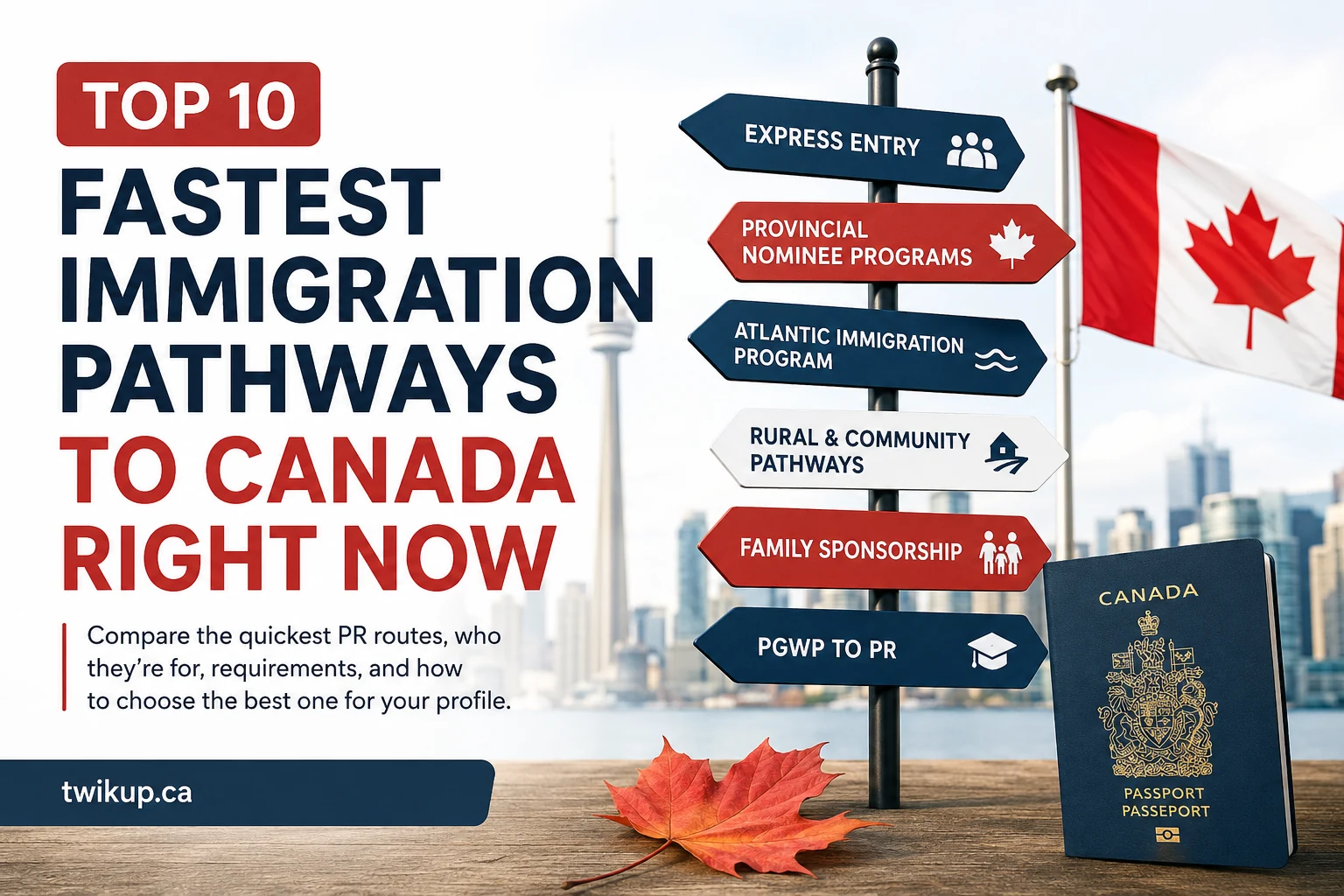
The fastest immigration pathway to Canada usually depends on your profile, not just the program name. For many skilled workers, Express Entry can be one of the fastest routes because IRCC says most complete Express Entry permanent residence applications are processed within 6 months or less after submission. However, if your CRS score is not competitive, a Provincial Nominee Program, Atlantic Immigration Program, or a targeted pathway for your occupation may be faster in practice.
For a deeper CRS breakdown, read: Canada PR in 2026: What CRS Score Is Really Needed.
Twikup Insight
The “fastest” Canada PR pathway is not always the “easiest” pathway.
A person with strong English, Canadian work experience, and a high CRS score may find Express Entry fastest. But a truck driver, software engineer, healthcare worker, tradesperson, or PGWP holder may have a better chance through a province-specific stream.
That is why the smartest strategy is not asking, “Which program is fastest?” It is asking:
Which pathway is fastest for my profile, occupation, province, language score, and CRS reality?
Key Takeaways
- Express Entry is often the fastest route for high-scoring skilled workers.
- Express Entry-aligned PNPs can be powerful because a nomination can significantly improve a candidate’s PR chances.
- Atlantic Immigration Program can be useful for workers with a job offer from a designated Atlantic employer.
- Rural and Francophone community pilots may help candidates willing to settle in smaller communities.
- Family sponsorship can be the most direct route for eligible spouses, partners, children, parents, or other eligible family members.
- Start-up Visa is not a normal fast route in 2026 because the program is paused for new applications, with limited rules for candidates who already had valid 2025 commitment certificates.
- The best route depends on eligibility, job offer, province, language score, work experience, and documentation.
Fastest Canada Immigration Pathways Compared
| Rank | Pathway | Best For | Job Offer Needed? | Why It Can Be Fast |
|---|---|---|---|---|
| 1 | Express Entry – Canadian Experience Class | Workers with Canadian skilled work experience | Usually no | Strong fit for candidates already in Canada |
| 2 | Express Entry – Federal Skilled Worker | Skilled workers outside or inside Canada | Usually no | Direct federal PR route for strong CRS profiles |
| 3 | Express Entry-Aligned PNP | Candidates targeted by a province | Depends on stream | Provincial nomination can strengthen PR pathway |
| 4 | Atlantic Immigration Program | Workers with Atlantic Canada job offers | Yes | Employer-driven pathway with settlement support |
| 5 | Rural Community Immigration Pilot | Workers willing to settle in selected rural communities | Yes | Designed around local labour needs |
| 6 | Francophone Community Immigration Pilot | French-speaking workers outside Quebec | Yes, usually | Helps support Francophone communities outside Quebec |
| 7 | PGWP to PR Pathways | International graduates in Canada | Depends | Canadian education and work experience can improve options |
| 8 | Occupation-Specific PNP Streams | Truck drivers, tech workers, healthcare, trades | Often yes | Provinces target labour shortages |
| 9 | Family Sponsorship | Eligible spouses, partners, children, family members | No | Direct family reunification route |
| 10 | Business / Entrepreneur Routes | Founders and investors | Program-specific | Useful only for eligible business profiles, not usually fastest |
1. Express Entry – Canadian Experience Class
The Canadian Experience Class is often one of the fastest PR pathways for people already working in Canada.
It is designed for candidates with eligible Canadian skilled work experience. If you have Canadian work experience, strong language test results, and a competitive CRS score, this route can move faster than many province-based options.
IRCC states that most Express Entry applications are processed within 6 months or less once a complete permanent residence application is received. Government of Canada – Express Entry processing
This route is especially useful for:
- PGWP holders
- Temporary foreign workers
- Skilled professionals already in Canada
- Candidates with strong English or French test scores
- Applicants with Canadian education and work experience
If you are on a post-graduation work permit, read this next: PGWP to PR in Ontario: Complete Pathways Explained for 2026.
2. Express Entry – Federal Skilled Worker Program
The Federal Skilled Worker Program is a major pathway for skilled workers who may not have Canadian work experience but have strong foreign work experience, education, language scores, and settlement funds.
This route can be fast if your CRS score is high enough to receive an invitation to apply.
It is best suited for:
- Skilled workers outside Canada
- Professionals with strong education credentials
- Candidates with high IELTS/CELPIP or TEF/TCF scores
- People with competitive CRS scores
- Applicants who do not want to rely only on one province
The challenge is competition. A candidate may be eligible for Express Entry but still not receive an invitation if their CRS score is below recent draw levels.
That is why CRS planning matters. Read: Canada PR in 2026: What CRS Score Is Really Needed.
3. Express Entry-Aligned Provincial Nominee Programs
A Provincial Nominee Program, or PNP, allows provinces and territories to nominate people who have the skills, education, and work experience needed in that province or territory. Government of Canada – Provincial Nominee Program
Some PNP streams are linked with Express Entry. To qualify for an Express Entry PNP process, candidates generally need to be eligible for one of the three Express Entry programs and receive a provincial nomination. Government of Canada – Express Entry PNP eligibility
This can be one of the best strategies for candidates whose CRS score is not high enough for a direct federal invitation.
PNPs are especially important for:
- Truck drivers
- Healthcare workers
- Tech workers
- Tradespeople
- International graduates
- Candidates with regional job offers
- People willing to settle outside Toronto, Vancouver, or Montreal
For a broader province-by-province view, read: Provinces Offering the Most Immigration Opportunities.
4. Atlantic Immigration Program
The Atlantic Immigration Program helps designated employers in Atlantic Canada hire qualified workers they cannot fill locally. It covers New Brunswick, Newfoundland and Labrador, Nova Scotia, and Prince Edward Island. Government of Canada – Atlantic Immigration Program
This pathway can be practical for candidates who have a real job offer from a designated employer.
To use this program, the employer must be designated, and the job offer must meet program rules. Government of Canada – AIP job offer
This route is best for:
- Workers open to Atlantic Canada
- Candidates with job offers
- International graduates from Atlantic institutions
- Skilled workers in local labour shortage roles
- Families looking for smaller, more affordable communities
The biggest advantage is that it is employer-driven and region-specific. The biggest challenge is finding the right designated employer.
5. Rural Community Immigration Pilot
The Rural Community Immigration Pilot offers permanent residence to skilled workers who want to work and settle in selected rural and remote communities. The Government of Canada says 14 communities were selected to participate. Government of Canada – Rural Community Immigration Pilot
To apply, candidates generally need a valid job offer from a designated employer in the community, related work experience, language proof, education credentials, and settlement funds. Government of Canada – RCIP eligibility
This can be a smart route for candidates who are flexible about location.
It may suit:
- Skilled workers with job offers
- People open to smaller communities
- Candidates outside major cities
- Workers in local shortage occupations
- Families looking for lower-cost settlement options
This pathway is not for everyone. But for the right candidate, a smaller community pathway can sometimes be more realistic than competing only through CRS.
6. Francophone Community Immigration Pilot
French ability can make a major difference in Canadian immigration.
The Francophone Community Immigration Pilot is designed to support French-speaking immigration outside Quebec. It is especially relevant for candidates who can work in French or bilingual environments and are open to settling in participating Francophone communities.
This pathway may be useful for:
- French-speaking skilled workers
- Bilingual candidates
- Applicants with job offers in participating communities
- People who want to settle outside Quebec
- Candidates who want alternatives to high CRS competition
If you speak French, do not treat it as a small bonus. It can completely change your immigration strategy.
7. PGWP to PR Pathways
For international students, the Post-Graduation Work Permit to PR route is one of the most important immigration strategies in Canada.
The PGWP itself is not permanent residence. But it can help graduates gain Canadian work experience, improve CRS scores, qualify for Canadian Experience Class, and access provincial graduate or employer streams.
This route is especially useful for:
- International students in Canada
- Graduates working in skilled jobs
- Ontario PGWP holders
- Candidates building Canadian experience
- People who need time to improve CRS
Ontario graduates should read this full guide: PGWP to PR in Ontario: Complete Pathways Explained for 2026.
8. Occupation-Specific PNP Streams
Some of the fastest practical pathways are not “general” immigration programs. They are occupation-specific opportunities through provinces.
This matters because Canada’s immigration system often prioritizes real labour market needs.
Examples include:
- Truck drivers
- Software engineers
- Healthcare workers
- Early childhood educators
- Construction trades
- Agriculture and food workers
- Skilled trades
- Tech roles
For truck drivers, province selection matters a lot. Compare options here: Best Province for Truck Drivers in Canada 2026: Alberta vs Ontario vs Manitoba vs Saskatchewan.
For software engineers in Ontario, read: Ontario PR for Software Engineers: Eligibility and Pathways in 2026.
For tech workers interested in British Columbia, read: BC Tech Stream: Complete Guide to BC PNP Tech Immigration in 2026.
9. Family Sponsorship
Family sponsorship can be the most direct PR pathway if you qualify.
The Government of Canada says eligible sponsors may sponsor certain family members to become permanent residents so they can live, study, and work in Canada. Government of Canada – Family sponsorship
For spouses, partners, and dependent children, Canada has a specific sponsorship program. Government of Canada – Sponsor spouse, partner or child
This route may apply to:
- Spouses
- Common-law partners
- Conjugal partners
- Dependent children
- Parents and grandparents, when applicable
- Other eligible relatives in limited cases
The sponsor must meet eligibility rules. For example, sponsors generally need to be at least 18 and be a Canadian citizen, permanent resident, or registered person under the Canadian Indian Act. Government of Canada – Sponsorship eligibility
Family sponsorship is not based on CRS. That is why it can be a strong route for eligible families.
10. Business and Entrepreneur Immigration
Business immigration can work for the right candidate, but it is usually not the fastest or simplest route.
The Start-up Visa Program has also changed significantly. The Government of Canada says that as of January 1, 2026, the Start-Up Visa Program is paused, and applicants with a valid 2025 commitment certificate must apply by June 30, 2026. Government of Canada – Start-up Visa eligibility
That means Start-up Visa should not be presented as a general fast immigration route for new applicants in 2026.
Business routes may still be relevant through:
- Provincial entrepreneur streams
- Investor-style provincial pathways
- Self-employed or business-linked options, where available
- Candidates with strong business plans and settlement capital
But for most workers, Express Entry, PNP, employer-driven streams, or family sponsorship are usually more realistic.
Fastest Pathway by Applicant Type
| Applicant Type | Best Pathways to Explore |
|---|---|
| High CRS skilled worker | Express Entry |
| PGWP holder | Canadian Experience Class, Ontario PNP, graduate streams |
| Truck driver | Province-specific PNP streams |
| Software engineer | Ontario tech pathways, BC PNP Tech, Express Entry |
| Low CRS candidate | PNP, employer-driven routes, rural/community pilots |
| French speaker | Francophone pathways, Express Entry French advantages, community pilots |
| Candidate with Atlantic job offer | Atlantic Immigration Program |
| Candidate with spouse or partner in Canada | Family sponsorship |
| Candidate willing to settle in smaller communities | Rural Community Immigration Pilot |
| Founder or entrepreneur | Provincial entrepreneur routes, limited business pathways |
Which Canada PR Pathway Is Fastest Without a Job Offer?
If you do not have a job offer, your strongest options are usually:
- Express Entry
- Federal Skilled Worker Program
- Canadian Experience Class, if you have Canadian work experience
- Some PNP streams that do not always require job offers
- French-language or category-based opportunities, where applicable
However, without a job offer, your CRS score becomes much more important.
Read this before choosing a pathway: Canada PR in 2026: What CRS Score Is Really Needed.
Which Canada PR Pathway Is Fastest With a Job Offer?
If you have a genuine job offer, your options may expand.
You may be able to explore:
- Atlantic Immigration Program
- Rural Community Immigration Pilot
- Employer-driven PNP streams
- Provincial nominee programs
- Occupation-specific streams
- Work permit to PR strategies
The key is whether the employer, occupation, province, and job offer meet program rules.
Which Pathway Is Best for Low CRS Candidates?
Low CRS candidates should not rely only on direct Express Entry draws.
Better options may include:
- Provincial Nominee Programs
- Employer-supported streams
- Rural community pathways
- Atlantic Immigration Program
- French language improvement
- Canadian education or work experience
- Occupation-specific provincial streams
A low CRS score does not always mean Canada PR is impossible. It usually means the strategy needs to move from “federal-only” to “province + occupation + employer + language.”
Common Mistakes That Delay Canada PR
Many applicants lose time because they focus only on the fastest-looking program instead of the best-fit program.
Avoid these mistakes:
- Choosing a pathway without checking official eligibility
- Ignoring province-specific streams
- Waiting too long to improve language scores
- Assuming a job offer automatically qualifies
- Applying with incomplete documents
- Not checking processing times
- Ignoring settlement fund requirements
- Treating CRS as the only immigration factor
- Not updating your profile after gaining experience
- Using outdated information from forums or social media
IRCC says processing times can vary depending on application type, completeness, and complexity. Government of Canada – Check processing times
Final Verdict
The fastest immigration pathway to Canada depends on who you are.
If you have a high CRS score, Express Entry may be fastest. If you have a job offer, AIP, PNP, or rural pathways may be stronger. If you are a PGWP holder, your best route may be Canadian Experience Class or a provincial graduate stream. If you work in trucking, tech, healthcare, or trades, your occupation may open province-specific options. If you have eligible family in Canada, family sponsorship may be the most direct route.
The real answer is not one pathway for everyone.
The fastest pathway is the one where your profile already matches the rules.
Sources
- Government of Canada – Check IRCC processing times
- Government of Canada – Express Entry application processing
- Government of Canada – Provincial Nominee Program
- Government of Canada – Express Entry PNP eligibility
- Government of Canada – Atlantic Immigration Program
- Government of Canada – Atlantic Immigration Program job offer rules
- Government of Canada – Rural Community Immigration Pilot
- Government of Canada – Rural Community Immigration Pilot eligibility
- Government of Canada – Family sponsorship
- Government of Canada – Sponsor your spouse, partner or child
- Government of Canada – Sponsorship eligibility
- Government of Canada – Start-up Visa eligibility