
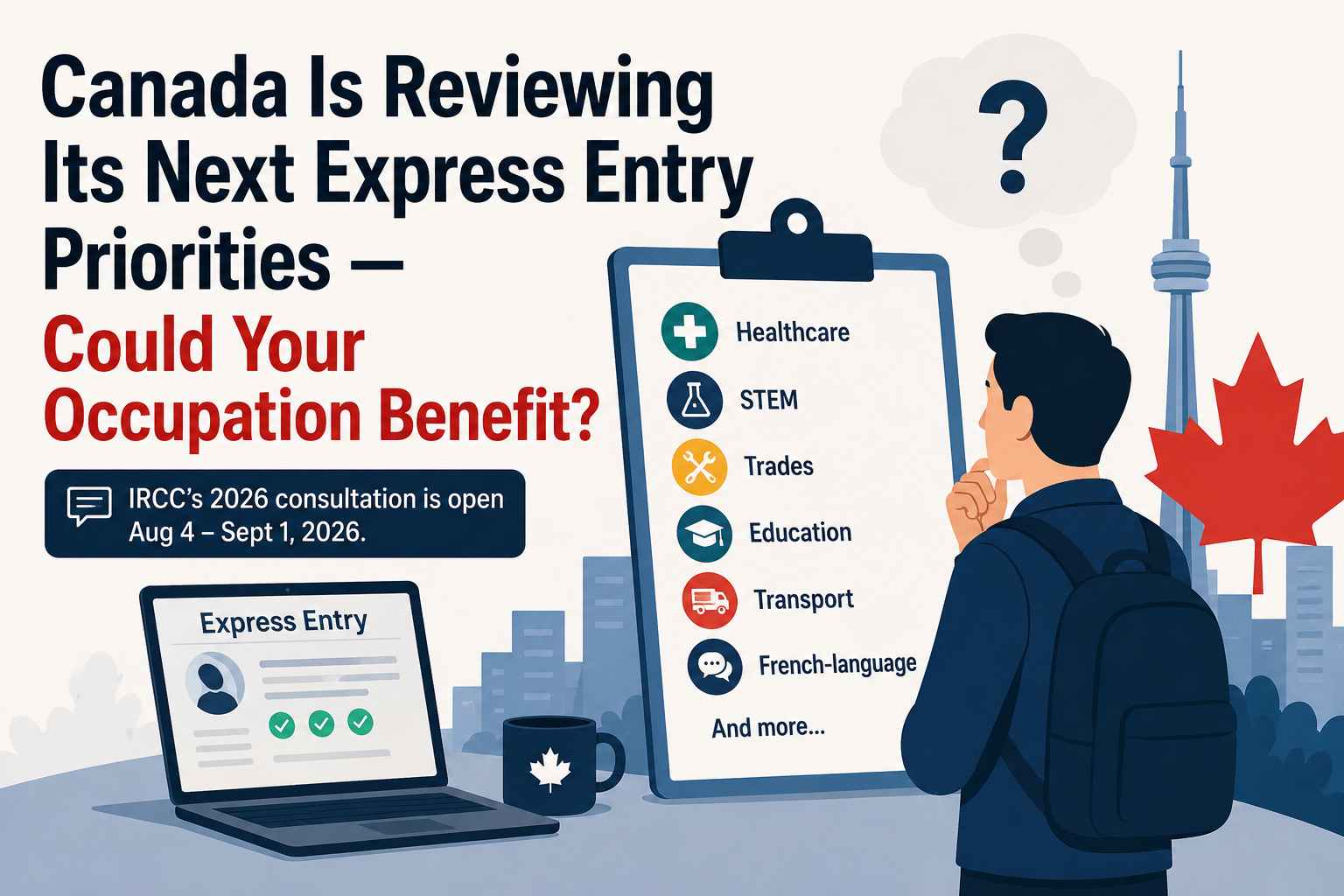
Imagine two people sitting in the Express Entry pool.
Both are young. Both have skilled work experience. Both have strong language scores. Their Comprehensive Ranking System scores are almost identical.
But one works in an occupation Canada decides it urgently needs.
The other does not.
That difference could matter.
Canada is currently reviewing the economic priorities that could help shape future category-based selection under Express Entry, and Immigration, Refugees and Citizenship Canada (IRCC) is asking Canadians and stakeholders what the system should prioritize next.
The consultation runs from August 4 to September 1, 2026.
That does not mean Canada has announced new Express Entry occupations.
It does mean something important is happening behind the scenes: Canada is gathering information that could influence which skills, occupations and economic priorities receive greater attention in future Express Entry category-based rounds.
For workers already in Canada — particularly international graduates, PGWP holders and people trying to move from temporary status to permanent residence — the outcome is worth watching closely.
Quick Answer
Canada is reviewing the economic priorities that could help shape future Express Entry category-based selection.
IRCC's 2026 consultation asks for feedback on how category-based selection should support Canada's economy, including addressing long-term labour shortages and supporting economic growth.
Canada has not announced the next Express Entry categories or a new list of priority occupations.
However, previous consultations, labour-market evidence and stakeholder input have helped inform category decisions.
That means your occupation could potentially become more — or less — strategically important in future Express Entry rounds depending on the categories Canada ultimately chooses.
For candidates, the message is simple:
Do not change your career based on speculation about future Express Entry categories. But do understand where your occupation fits in Canada's current system and watch closely for what changes next.
Key Takeaways
- IRCC's 2026 Express Entry category consultation is open from August 4 to September 1, 2026.
- Canada uses category-based selection to target candidates who can contribute to specific economic priorities.
- Canada's current 2026 categories include areas such as healthcare and social services, STEM, trades, education and French-language proficiency, alongside several newer categories.
- Canada has not yet announced future categories resulting from this consultation.
- Working in a targeted occupation does not automatically guarantee permanent residence.
- Candidates generally must first qualify for one of the programs managed through Express Entry and meet the requirements of the applicable category.
- Eligible candidates are still ranked through the Comprehensive Ranking System (CRS) during category-based rounds.
- PGWP holders approaching the end of their work permits should not rely on the possibility of a future category change as their immigration strategy.
Why Canada Is Reviewing Express Entry Priorities Again
Express Entry used to be easier to understand from the outside.
Create a profile.
Receive a CRS score.
Wait for a draw.
Hope your score is high enough.
That basic structure still exists, but category-based selection has added another layer.
Instead of looking only at the highest-ranking candidates across a broad pool, Canada can conduct rounds targeting candidates who meet a particular economic objective.
That could mean workers in occupations facing long-term shortages.
It could mean candidates with particular language abilities.
Or it could mean people whose experience aligns with another economic priority identified by the federal government.
This gives Canada a way to ask a different question.
Not simply:
Who has the highest CRS score?
But also:
Which types of workers does Canada's economy need?
That distinction has made a candidate's occupation considerably more important to Express Entry strategy.
What Is Canada Actually Consulting About?
This is where the headline needs some context.
Canada is not running a public vote where Canadians choose which occupations should receive permanent residence invitations.
IRCC's consultation is broader.
The department says category-based selection gives it more flexibility in selecting economic immigrants through Express Entry while maintaining Canada's focus on skilled workers who can integrate and contribute economically.
For 2026, IRCC says its categories focus on selecting workers who can help address long-term labour shortages and support economic growth.
The consultation gives stakeholders an opportunity to provide feedback that can help inform future priorities.
That matters because Express Entry categories are not necessarily permanent.
Canada can renew categories, modify them or introduce new ones as its economic priorities change.
What Are Canada's Express Entry Categories in 2026?
Understanding what could happen next starts with understanding what Canada is already prioritizing.
IRCC announced its 2026 category-based selection priorities in February.
Several existing categories were renewed:
French-language proficiency
Canada continues to prioritize French-speaking immigration outside Quebec as part of its broader Francophone immigration objectives.
Healthcare and social services occupations
Canada continues targeting eligible workers in healthcare and social services — sectors where labour shortages can directly affect Canadians' access to essential services.
STEM occupations
Certain science, technology, engineering and mathematics occupations remain part of category-based selection.
Trade occupations
Eligible skilled trades continue to receive targeted attention as Canada deals with workforce needs in construction and other skilled-trade sectors.
Education occupations
The education category, introduced previously, continues in 2026.
But Canada also made notable additions for 2026.
These include categories targeting:
- medical doctors with Canadian work experience
- researchers with Canadian work experience
- senior managers with Canadian work experience
- transport occupations
- skilled military recruits with a Canadian Armed Forces job offer
These changes demonstrate something important for anyone planning an immigration strategy:
Express Entry priorities can evolve.
An occupation that is not strategically important under one year's category structure could potentially become more relevant later.
And a category that exists today should not automatically be assumed to remain unchanged forever.
Could Your Occupation Become a Future Express Entry Priority?
Potentially.
But there is an important difference between possible and announced.
IRCC has not announced the next categories resulting from the 2026 consultation.
There is therefore no legitimate new list of occupations that applicants can use today to say:
“My job will definitely be prioritized next.”
Any such claim would be speculation.
What we can examine is how Canada makes these decisions.
IRCC has said category selection can be informed by labour-market information and projections as well as input from provinces, territories and stakeholders.
That means occupations connected to persistent labour shortages or major Canadian economic priorities can potentially receive greater attention.
But Canada's needs can change.
A rapidly growing occupation today may look different two years from now.
A shortage may improve.
A new shortage may emerge.
Technology may transform demand.
A province may experience labour pressures that look completely different from those in another province.
That is exactly why category-based selection gives the immigration system flexibility.
Your Occupation Now Matters in Two Different Ways
This is one of the most important concepts for Express Entry candidates to understand.
Your occupation can matter for eligibility.
But it can also matter for selection strategy.
Those are not necessarily the same thing.
A candidate may qualify for Express Entry through one of the programs managed by the system without belonging to a currently targeted category.
Conversely, having experience in an occupation included in a category does not automatically mean someone will receive permanent residence.
Think of Express Entry as two doors.
Door 1: Can you enter the Express Entry system?
Express Entry manages applications for:
- Canadian Experience Class
- Federal Skilled Worker Program
- Federal Skilled Trades Program
You must meet the requirements of an eligible program.
Door 2: Which invitation rounds could potentially select you?
Once you're in the pool, different types of rounds can occur.
There can be general rounds, program-specific rounds and category-based rounds.
For a category-based round, you must meet that category's requirements.
Eligible candidates are then ranked using CRS.
So being in a priority occupation can potentially open another route to being considered for an invitation.
It does not remove the rest of the Express Entry system.
Priority Occupation Does Not Mean Automatic PR
This deserves its own section because it is one of the easiest Express Entry concepts to misunderstand.
Suppose your occupation appears in an Express Entry category.
That does not mean:
“Canada needs my occupation, therefore I will get PR.”
You generally still need to:
- qualify for one of the immigration programs managed through Express Entry;
- have an active Express Entry profile;
- satisfy the eligibility requirements for the category;
- be competitive within the relevant invitation round; and
- receive an Invitation to Apply.
CRS therefore remains important.
IRCC describes the Comprehensive Ranking System as the points-based system used to assess, score and rank Express Entry profiles.
Age, education, language ability, Canadian and foreign work experience and other factors can influence a candidate's position.
Category-based selection changes who can be targeted in a particular round.
It does not turn Express Entry into guaranteed permanent residence for everyone working in a selected occupation.
Why This Matters Especially for International Students
Now consider an international student who graduated in Canada.
They receive a Post-Graduation Work Permit.
They find a skilled job.
They begin accumulating Canadian work experience.
Eventually, they enter the Express Entry pool.
But their CRS score is not competitive enough for the rounds available to them.
At that point, category-based selection can become extremely important.
If their work experience fits an eligible category, they may potentially be considered in a category-based round in addition to other rounds for which they qualify.
This is why choosing the right employment after graduation can have immigration consequences.
But there is a major warning.
Do not choose an occupation solely because it happens to appear on today's Express Entry category list.
Immigration policy changes.
Your occupation should make sense for your career, qualifications and immigration strategy — not simply because you saw a social-media post promising that a particular job “guarantees PR.”
If you studied in Ontario and are trying to map the broader route from graduation to permanent residence, TwikUp's guide to getting PR in Ontario as an international student: 8 pathways for 2026 explains the alternatives beyond relying on a single Express Entry strategy.
What If Your PGWP Is Expiring While Canada Reviews the Categories?
This is where the story becomes much more urgent.
Imagine your PGWP expires in four months.
Your occupation isn't currently giving you the Express Entry opportunity you hoped for.
Then you hear Canada is reviewing future categories.
It may be tempting to think:
Maybe my occupation will be added. I'll wait.
That could be a serious mistake.
The consultation itself does not give anyone immigration status.
It does not extend a work permit.
It does not guarantee that a new category will be created.
And even if Canada eventually introduces a category relevant to your occupation, there is no guarantee about when a corresponding draw might occur or whether your profile would receive an invitation.
Your immigration status has its own deadlines.
Anyone approaching a PGWP expiry should therefore evaluate the options that are actually available under current rules rather than building a plan around a category that may never materialize.
TwikUp has a separate breakdown of 8 options if your PGWP is expiring in 2026 and you want to stay and work in Canada.
That planning should begin well before the expiry date printed on the permit.
Could Canada's Priorities Shift Again in 2027?
Yes.
In fact, the structure of category-based selection is designed to allow priorities to evolve.
Canada's labour market is constantly changing.
Consider what could influence future immigration needs:
A shortage of healthcare professionals can affect hospital capacity.
A shortage of construction workers can complicate efforts to increase housing supply.
A shortage of teachers can pressure growing school systems.
Demand for researchers can become important as Canada competes internationally for innovation and investment.
And changing transportation, technology and industrial needs can create entirely different workforce pressures.
That does not tell us which categories Canada will select next.
It tells us why applicants should stop thinking about Express Entry categories as a permanent list.
They are better understood as a policy tool Canada can adjust as its economic needs change.
What Should Express Entry Candidates Do Right Now?
The first thing is surprisingly simple:
Do not panic and do not chase rumours.
A consultation is not an immigration announcement.
Instead, candidates can use this period to understand their current position.
Check your exact NOC
Do not assume your job title determines your occupation.
Your National Occupational Classification code should correspond to the work you actually perform, including the relevant duties.
Check whether you qualify for Express Entry
Being employed in Canada does not automatically make someone eligible.
Determine whether you meet the requirements for the Canadian Experience Class, Federal Skilled Worker Program or Federal Skilled Trades Program.
Check current category eligibility
If your occupation is already included in a category, understand the exact requirements rather than relying on a simplified occupation list circulating online.
Know your CRS score
Even category-based rounds use CRS to rank eligible candidates.
Improving language results, gaining qualifying experience and strengthening other legitimate CRS factors may therefore remain valuable.
Examine alternatives
Express Entry is not Canada's only economic immigration route.
Depending on your circumstances, Provincial Nominee Programs and other federal or provincial pathways may be relevant.
International graduates in Ontario, for example, should understand both federal and provincial possibilities instead of assuming Express Entry is their only road to permanent residence.
Watch for the actual government announcement
The consultation closes on September 1, 2026.
What matters after that is not speculation about what IRCC might do.
What matters is what the federal government eventually announces and implements.
The Bigger Shift in Canadian Immigration
There is a broader story underneath this consultation.
Canada's economic immigration system is becoming increasingly targeted.
Economic immigration represents the largest share of Canada's planned permanent immigration, and IRCC says category-based selection is one of the tools it is using to prioritize skilled workers who can address skills shortages and other economic priorities.
That means the future of Express Entry may increasingly involve two questions:
How strong is your immigration profile?
And:
How closely does your experience align with Canada's current economic priorities?
A candidate can potentially have a strong answer to one question and a weaker answer to the other.
Understanding both is becoming increasingly important.
TwikUp Insight
For years, the most famous number in Express Entry was the CRS score.
It still matters enormously.
But category-based selection has added another number applicants increasingly need to know:
their NOC code.
That represents a meaningful change in how people should think about Canadian economic immigration.
Canada is not abandoning the idea of selecting skilled immigrants with strong human-capital characteristics.
Instead, it has created a mechanism that lets the government combine that approach with more targeted economic selection.
For applicants, this means immigration planning should not revolve around predicting the next draw.
It should revolve around building a profile that gives you multiple realistic pathways.
A strong CRS score.
Accurate occupational classification.
Canadian experience where applicable.
Provincial options.
Language improvement.
And a clear plan for maintaining legal status while pursuing permanent residence.
If Canada's next Express Entry priorities happen to favour your occupation, that could become another opportunity.
But it should be an opportunity added to your plan — not the entire plan itself.
Frequently Asked Questions
Is Canada changing Express Entry categories in 2026?
Canada is currently consulting on economic priorities that could help inform future category-based selection. The consultation itself does not mean new categories have already been approved or announced.
When does the 2026 Express Entry consultation close?
IRCC says the consultation runs from August 4 to September 1, 2026.
Does working in an Express Entry priority occupation guarantee PR?
No. Candidates must meet the applicable Express Entry and category requirements and still compete within the relevant invitation process.
Does CRS still matter in category-based Express Entry draws?
Yes. Candidates eligible for a category-based round are ranked using the Comprehensive Ranking System.
Could Canada add new occupations in the future?
Yes. Category-based selection allows the government to adjust categories according to identified economic goals. However, applicants should wait for an official IRCC announcement rather than assuming a particular occupation will be added.
Should I change jobs to enter an Express Entry category?
Not solely because of speculation about future categories. Immigration rules and category priorities can change, and your work experience must legitimately satisfy the applicable requirements.
My PGWP expires soon. Should I wait for new Express Entry categories?
You should not rely on an unannounced future category to solve an approaching status deadline. Review the immigration and temporary-status options actually available to you under current rules.
Sources
Immigration, Refugees and Citizenship Canada — 2026 consultations on economic priorities for category-based selection in Express Entry https://www.canada.ca/en/immigration-refugees-citizenship/corporate/transparency/consultations/2026-consultations-express-entry-selection.html
IRCC — Online survey on Express Entry categories and priorities https://www.canada.ca/content/dam/ircc/documents/pdf/english/corporate/transparency/consultations/survey-ee-2026-en.pdf
IRCC — Express Entry: Category-based selection https://www.canada.ca/en/immigration-refugees-citizenship/services/immigrate-canada/express-entry/rounds-invitations/category-based-selection.html
IRCC — Canada prioritizes top talent in 2026 immigration Express Entry categories https://www.canada.ca/en/immigration-refugees-citizenship/news/2026/02/canada-prioritizes-top-talent-in-2026-immigration-express-entry-categories.html
IRCC — Express Entry: Who can apply https://www.canada.ca/en/immigration-refugees-citizenship/services/immigrate-canada/express-entry/who-can-apply.html
IRCC — Comprehensive Ranking System criteria https://www.canada.ca/en/immigration-refugees-citizenship/services/immigrate-canada/express-entry/check-score/crs-criteria.html
IRCC — 2026–27 Departmental Plan https://www.canada.ca/en/immigration-refugees-citizenship/corporate/publications-manuals/departmental-plans/2026-27-departmental-plan/departmental-plan-2026-2027-full.html
Immigration rules and eligibility requirements can change. This article provides general information and is not legal or immigration advice. Applicants should verify their circumstances using current IRCC information or seek advice from an authorized immigration professional.