
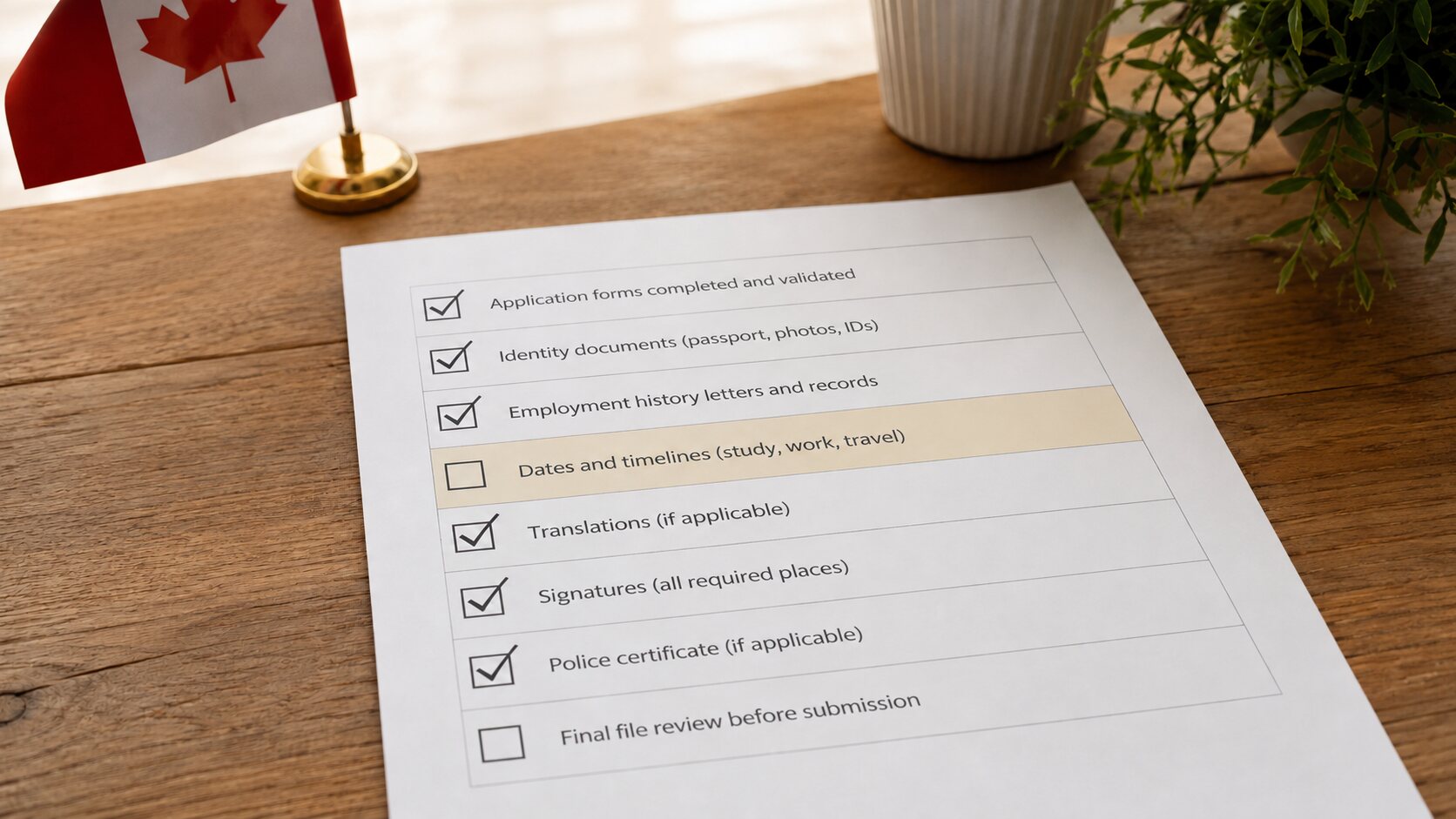
You are one click from submitting an IRCC application when you notice that an employment letter gives a different start month from your form. Do not guess, edit blindly or hope it will not matter. Pause and check the application as one connected record.
This IRCC application checklist helps you find avoidable errors before submission: start with the program’s official instructions, build one timeline, match every claim to evidence, and deal openly with missing records. IRCC says a required document left out of an application can lead to a delay, return or refusal. The goal is not a prettier upload folder. It is an accurate application in which the forms and proof tell the same story.
1. Start with the exact IRCC application package
A generic online checklist is a useful reminder, not the authority for your case. IRCC says each program has its own supporting-document requirements, and some applications require several forms to be submitted together. Use the instruction guide, application package and any personalized document checklist generated for your circumstances.
Before uploading anything, create a simple document map. One row should represent one required form, document or explanation. If family members are included, assign each item to the right person.
| Checkpoint | Record |
|---|---|
| Requirement | The checklist’s exact item or form name |
| Applicant | Principal applicant or family member |
| Evidence | The document intended to meet the requirement |
| Dates | Issue date, expiry date and relevant coverage period |
| Language | Original language and any required translation steps |
| Status | Ready, missing or needs review |
Add fees, signatures and dates to the same map. IRCC’s application-package guidance identifies the forms and fees for a program, while a personalized checklist can identify documents required for the applicant’s situation.
2. Build one master timeline
Most difficult inconsistencies are not found by reading each form separately. They appear when a work date, address or travel period is compared against the rest of the application.
Make a month-by-month timeline before your final review. Include employment, study, unemployment, travel, addresses and other activities the relevant form requests. Use underlying records—such as passports, visas, contracts, pay records and school documents—to establish dates rather than relying on memory.
If you must complete Schedule A, IMM 5669, IRCC says not to leave gaps in the requested personal-history period. For paper applications, that history generally covers the most recent 10 years or since age 18, whichever is more recent. Periods without a job still need an accurate activity, such as studying, travelling, being unemployed or retired. Schedule A also requires residential addresses, not post-office-box addresses, for the requested period.
A discrepancy is not automatically fatal, but it deserves an answer. Check the original record first. If two accurate documents describe the same period differently, explain the difference clearly where the application allows or requires an explanation. Do not invent a date simply to make records appear uniform.
3. Give every uploaded document a job
A large bundle of documents is not necessarily strong evidence. For each upload, ask: What fact does this prove? Then check that it supports the claim actually made in the form.
For work experience, IRCC lists employment contracts, pay stubs, tax documents and employer reference letters as examples of proof. Its common supporting-documents guidance says an employer reference letter can include job duties, dates worked and salary. Check the particular program instructions as well: the required evidence may be more specific than the common examples.
A practical review of an employment letter includes:
- employer identity and contact details, where required;
- job title and duties relevant to the claim;
- dates that match the master timeline;
- salary and other details required by the applicable instructions; and
- legible pages that are complete and in the correct upload slot.
The same approach helps with relationship evidence. IRCC lists documents such as civil-status certificates, joint financial records, proof of a common address, communication records and photographs as possible proof of relationship. The exact mix of evidence depends on the program and the facts of the case.
Clear filenames—for example, Employer_ReferenceLetter_2022-2024.pdf—make a final audit easier. They are an organizational tool, not a substitute for required content.
4. Keep translations and missing records visible
Do not mark a document as complete merely because you can read it. For documents not in English or French, follow the translation instructions in the current program guide and checklist. Compare names, dates, numbers and page sequence between the original and the translated material before upload.
A missing document should not disappear from your tracking sheet. IRCC recognizes that an applicant may be unable to obtain a required record because of circumstances outside their control, including delays in another country, war or natural disasters. In that situation, IRCC says to provide a letter explaining why the document cannot be obtained or is delayed, along with available supporting proof such as receipts.
For online applications, IRCC instructs applicants to combine the explanation and supporting documents into one file and upload it in place of the missing document. For paper applications, include them in the application package.
Police certificates need particular care. IRCC says the explanation must describe efforts made to obtain the certificate and include proof that the applicant contacted the correct authority. A letter and proof do not guarantee acceptance; the officer reviews the circumstances and may request more information, allow more time, continue processing without the document or make a decision based on the submitted evidence.
5. Audit backwards before you submit
For the final pass, do not simply reread from the first page. Start with every important claim and trace it back to proof. A claimed job should lead to a matching employer letter and supporting records. A travel period should fit the passport and personal history. A “Yes” answer should lead to its required explanation.
Use this final submission check:
- Every personalized checklist item has a matching form, upload or documented explanation.
- Names match the passport, travel document or identity document. IMM 5669 says not to use initials.
- Requested history has no unexplained gaps.
- Dates agree across forms and supporting records, or any genuine difference is explained accurately.
- Required signatures and dates are complete.
- Documents are current where validity matters.
- Every file opens, is legible and is uploaded in the right place.
- You have saved the submitted forms, checklist and supporting records.
Then leave the application alone briefly and return with fresh eyes. The payoff is practical: a reviewer can follow your information without having to reconstruct the story from conflicting dates, incomplete forms or unexplained absences.
6. What to do next
Open IRCC’s official forms and instructions finder, select your exact application type, and build the document map from that package. Check again immediately before submission because application instructions and document requirements can change. This article is a quality-control framework, not a replacement for the program-specific guide or personalized checklist.
Frequently asked questions
Can a missing document cause an IRCC application to be returned?
Yes. IRCC says that if a required document is not included, an application could be delayed, returned or refused. Use the guide and checklist for the exact program, and provide an explanation with available supporting proof if the document cannot be obtained for reasons outside your control.
Must every month in personal history be covered on IMM 5669?
Yes, for the period requested by the form. IRCC says not to leave gaps in time. Record the accurate activity for each period, including work, study, travel, unemployment or retirement, as applicable.
Are descriptive filenames required by IRCC?
The official common-document guidance cited here does not set a universal filename format. Descriptive filenames can help you organize and audit the application, but they do not replace required forms or evidence.
What if I cannot get a police certificate?
Explain all efforts made to obtain it, show that you contacted the correct authority and include available proof, such as a receipt, tracking record or an authority’s explanation of a delay. IRCC says this evidence does not guarantee acceptance.