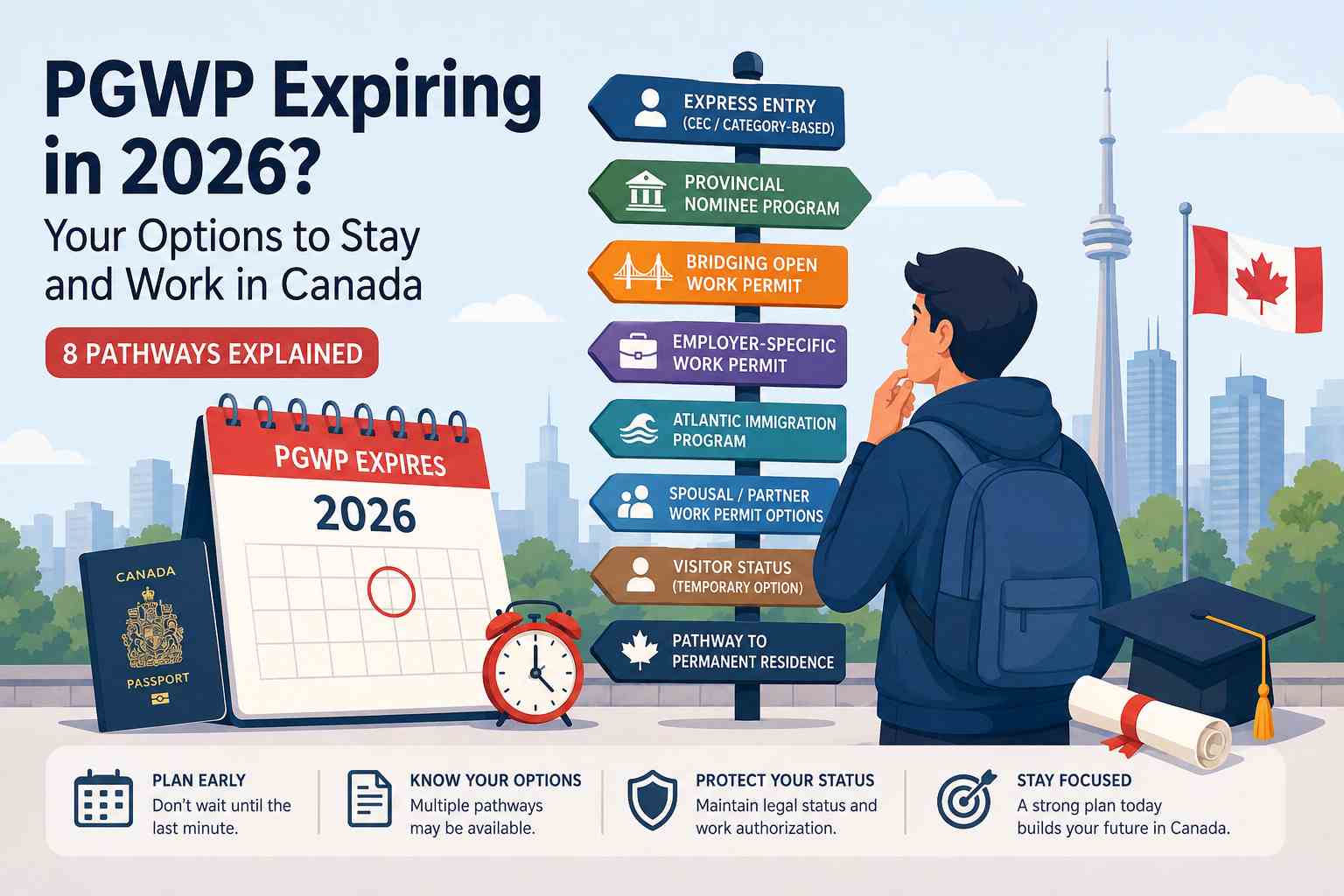
PGWP Expiring in 2026? 8 Options to Stay and Work in Canada
Your Post-Graduation Work Permit expires in four months.
You have a job. You have built a life in Canada. Maybe you have already accumulated months of Canadian work experience.
But your Express Entry score is not high enough for an invitation.
Then you discover the part that makes the situation much more urgent:
A PGWP normally cannot simply be renewed because you need more time to qualify for permanent residence.
Suddenly, the expiry date printed on your work permit is not just another immigration deadline.
It could determine whether you can keep working in Canada at all.
For thousands of former international students facing a PGWP expiry in 2026, the smartest strategy is therefore not to wait for the final few weeks and hope for an Express Entry invitation.
It is to work backwards from the expiry date and determine which legal status or permanent residence pathway could realistically come next.
Quick Answer
If your PGWP is expiring in 2026, you may have several options depending on your immigration profile:
- qualify for permanent residence through Express Entry
- pursue a Provincial Nominee Program
- become eligible for a Bridging Open Work Permit after submitting a qualifying PR application
- move to an employer-specific work permit
- use another LMIA-exempt work permit category if eligible
- pursue the Atlantic Immigration Program
- qualify for a spousal or partner-based work permit in certain circumstances
- change your status to visitor if you need to remain legally in Canada but do not currently have another work authorization
But there is one crucial distinction:
Being eligible for permanent residence does not automatically give you the right to keep working after your PGWP expires.
Your PR strategy and your temporary-status strategy must therefore be planned together.
First: Can You Extend a PGWP in 2026?
Usually, not simply because it is expiring.
A Post-Graduation Work Permit is generally issued based on the length and type of eligible Canadian study completed, subject to IRCC rules.
For example, eligible graduates of programs lasting two years or more may receive a PGWP of up to three years. Eligible master's graduates may also qualify for a three-year PGWP even when the master's program was shorter than two years, provided the program and applicant meet the applicable requirements.
But receiving a PGWP once does not normally create a right to another PGWP later.
There is, however, an important exception.
Your passport shortened your original PGWP
Suppose you were eligible for a three-year PGWP.
Your passport, however, expired 18 months after IRCC issued the permit.
IRCC may have issued your PGWP only until the passport expiry date.
If that happened, IRCC says you can apply to extend the PGWP after obtaining a new passport, for the remaining period for which you were originally eligible.
This application must generally be made on paper.
That is very different from asking IRCC for an extra year simply because you have not obtained PR yet.
TwikUp Insight: Check your original PGWP immediately. If its duration was shortened because of your passport expiry, your situation may be very different from someone who has already received the full PGWP period for which they were eligible.
The Real PGWP Problem: Two Clocks Are Running
Imagine this situation.
A graduate receives a three-year PGWP.
For the first year, getting PR feels distant.
Then they find a skilled job.
Months pass.
Their Canadian experience grows.
Their Express Entry profile becomes stronger.
But suddenly only six months remain on the work permit.
Now two clocks are running simultaneously.
Clock 1: Your immigration score
You may be gaining Canadian work experience, improving language scores or becoming eligible for a provincial pathway.
Clock 2: Your legal authorization to work
Your PGWP continues moving toward its expiry date regardless of what happens to your CRS score.
That is why the question should not simply be:
“Can I get PR?”
It should be:
“Can I reach the next immigration stage before my current authorization to work expires?”
That difference changes the entire strategy.
Option 1: Canadian Experience Class Through Express Entry
For many PGWP holders, the Canadian Experience Class (CEC) is the most obvious PR pathway.
To meet the Canadian skilled-work requirement, you generally need at least:
1 year or 1,560 hours of eligible Canadian skilled work experience during the three years before applying.
The work must generally:
- have been performed while you were authorized to work in Canada
- be paid employment
- fall within NOC TEER 0, 1, 2 or 3
- match the required duties of the occupation
There are also language requirements.
For CEC, the minimum is generally:
| NOC level | Minimum language requirement |
|---|---|
| TEER 0 or 1 | CLB/NCLC 7 |
| TEER 2 or 3 | CLB/NCLC 5 |
Importantly, work experience gained while you were a full-time student generally does not count toward the CEC minimum work-experience requirement.
Example
Imagine Arjun graduates in Ontario and begins a qualifying TEER 1 job in September 2025.
His PGWP expires in December 2026.
By September 2026, he could potentially reach one year of qualifying Canadian experience.
That may make him eligible for CEC if he satisfies the other requirements.
But eligibility is only the first hurdle.
Entering the Express Entry pool does not mean Canada has granted you PR.
And it does not extend your PGWP.
You still need an Invitation to Apply, submit the PR application and deal with your temporary status while that process unfolds.
For a deeper Ontario-specific strategy, see PGWP to PR in Ontario: Complete Pathways Explained for 2026.
Option 2: Target Express Entry Category-Based Selection
Looking only at general Express Entry draws can cause PGWP holders to underestimate their chances.
Canada also runs category-based Express Entry selection.
For 2026, categories include:
- French-language proficiency
- healthcare and social services occupations
- STEM occupations
- trade occupations
- education occupations
- transport occupations
- physicians with Canadian work experience
- senior managers with Canadian work experience
- researchers with Canadian work experience
- skilled military recruits
For occupation-based categories, meeting the occupational requirements does not automatically guarantee an invitation.
You still need to qualify for Express Entry and satisfy the requirements of the particular category and invitation round.
But your occupation can materially change your immigration strategy.
Someone working in an eligible healthcare, STEM, trade, education or transport occupation should therefore assess more than their CRS score alone.
French can also change the equation
French-language proficiency remains a dedicated Express Entry category.
Candidates seeking eligibility for that category need French test results showing at least NCLC 7 in all four language abilities, along with the other applicable Express Entry requirements.
That means improving French can potentially become an immigration strategy rather than simply another way to gain CRS points.
Option 3: Provincial Nominee Programs
If your CRS score is not competitive enough, your next question should be:
Could a province want my profile even if Express Entry has not invited me?
Canada's Provincial Nominee Program allows provinces and territories to select immigrants based on their own economic and labour-market priorities.
There are both Express Entry-linked and non-Express Entry provincial pathways.
An Express Entry provincial nomination can provide 600 additional CRS points.
That can fundamentally transform an Express Entry profile.
But provincial programs differ significantly.
They may consider factors such as:
- your occupation
- job offer
- Canadian education
- province of study
- work experience
- language ability
- employer
- regional labour shortages
- intention to live in the province
Do not assume Ontario is automatically your best option simply because you studied there.
Depending on your occupation and circumstances, another province may offer a pathway that aligns more closely with your profile.
Read Easiest Province to Get Canada PR in 2026: Lowest CRS Scores & Best Provinces before comparing provincial strategies.
And if you studied in Ontario, our broader guide How to Get PR in Ontario as an International Student: 8 Pathways for 2026 explains the Ontario-specific options in greater detail.
Option 4: Bridging Open Work Permit — But Timing Matters
This is one of the most misunderstood parts of the PGWP-to-PR journey.
Some workers assume:
“I created an Express Entry profile, so I can get a Bridging Open Work Permit.”
That is not how it works.
For an Express Entry BOWP, you generally need to have actually submitted a complete permanent residence application after receiving an Invitation to Apply and passed the completeness check.
IRCC also requires an acknowledgement of receipt and other eligibility conditions.
Simply being:
- eligible for Express Entry
- inside the Express Entry pool
- waiting for a draw
- or hoping for an ITA
does not by itself make you eligible for a BOWP.
Why this matters
Imagine your PGWP expires November 30.
You enter the Express Entry pool in September.
But you have not received an ITA by November.
You cannot simply assume that being in the pool will bridge your PGWP.
That is why people with expiring permits need a Plan B before the expiry date, rather than relying exclusively on a future Express Entry draw.
Option 5: Employer-Specific Work Permit
Permanent residence is not the only route that can allow someone to continue working in Canada.
Another possibility is moving from a PGWP to an employer-specific work permit, sometimes called a closed work permit.
Unlike your PGWP, which generally allows you to work for different employers, an employer-specific permit ties your authorization to particular employment conditions.
Depending on the pathway, your employer may need a Labour Market Impact Assessment (LMIA).
Other work permits may be LMIA-exempt under specific immigration programs or international agreements.
This creates an important conversation to have with your employer well before your PGWP expires:
“Would the company be willing and eligible to support the work-permit process required for me to continue working?”
Do not wait until two weeks before expiry to start that discussion.
Moving from an open PGWP to employer-specific authorization also changes your flexibility in the labour market.
If this becomes your likely route, read Closed Work Permit to PR: Canadian Pathways Explained for 2026.
Option 6: Atlantic Immigration Program
For some PGWP holders willing to relocate, Atlantic Canada deserves serious consideration.
The Atlantic Immigration Program (AIP) is a permanent residence pathway designed for skilled foreign workers and certain international graduates who want to live and work in:
- New Brunswick
- Nova Scotia
- Prince Edward Island
- Newfoundland and Labrador
The program depends heavily on employment.
You need a qualifying job offer from a designated employer, along with the other applicable requirements.
For eligible applicants moving through the AIP process, a temporary employer-specific work permit may also be available while the PR application is being processed.
IRCC says this permit can be valid for two years and is tied to the employer that offered the qualifying job.
For someone facing a PGWP deadline, the bigger lesson is important:
Your immigration strategy does not have to remain tied to the province where you studied.
Sometimes relocation can open pathways that your current location does not.
Option 7: Spousal or Partner-Based Work Permit Options
Your spouse or common-law partner's immigration situation may also affect your options.
Canada allows open work permits for spouses or common-law partners in certain situations, but eligibility rules have become more restrictive.
Not every spouse of a worker automatically qualifies.
Eligibility can depend on factors such as:
- the principal worker's occupation
- the type and validity of their work permit
- whether the principal applicant is on an eligible pathway to permanent residence
- the specific immigration program involved
If you are married or in a qualifying common-law relationship and your spouse has Canadian immigration status, check the current IRCC requirements carefully rather than assuming that a spousal open work permit is automatically available.
Option 8: Change to Visitor Status — A Safety Net, Not a Work Permit
Suppose your PGWP expires next month.
You have not received an ITA.
You do not yet qualify for another work permit.
And your employer cannot support another work-permit pathway in time.
You may be able to apply to change your temporary status from worker to visitor before your current status expires.
A visitor record can allow you to remain legally in Canada while you reassess your next steps.
But there is a major catch:
Visitor status does not give you authorization to continue working after your work permit expires.
If you apply for visitor status while your PGWP is still valid, you can generally work only until the PGWP expiry date.
After that, you must stop working unless you have separate authorization.
There is another important warning.
IRCC advises that changing from worker status to visitor does not simply give you extra time to apply for another work permit from inside Canada. Most visitors are not eligible to apply for work permits from within Canada and may need to leave Canada to make a new application.
Visitor status should therefore be treated as a status-preservation strategy, not as a replacement for a work permit.
What Is Maintained Status?
This concept becomes extremely important as your PGWP expiry approaches.
If you are eligible to apply for a new work permit and submit the appropriate application before your existing work permit expires, you may be able to remain in Canada under maintained status while IRCC processes the application.
In qualifying work-permit-extension situations, you may also continue working under the applicable conditions while waiting for a decision, provided you remain in Canada.
But do not confuse this with simply submitting any immigration application before your PGWP expires.
For example, applying to become a visitor can allow you to remain in Canada while that application is processed, but once the PGWP expires, it does not allow you to continue working.
Similarly, applying for a study permit does not automatically let you continue working after your existing work permit expires.
The type of application matters.
What If Your PGWP Has Already Expired?
The situation becomes significantly more difficult.
IRCC states that the expiry date on your work permit is generally the date you must stop working.
If your work permit expires before you submit an eligible extension or change application, you may lose your temporary resident status.
In many cases, you may apply to restore your status within 90 days of losing it if you meet the restoration requirements.
But restoration does not mean you can continue working while you wait.
You must stop working after losing your authorization.
And restoration is not guaranteed.
If more than 90 days have passed, IRCC says people who have not applied for restoration generally need to leave Canada and reapply from outside Canada if they want to work in Canada again, although specific public policies or exceptions can sometimes alter the rules for particular groups.
This is why acting before the PGWP expiry date is dramatically better than trying to repair your status afterward.
Your PGWP Expiry Timeline: What to Do Before the Deadline
12 Months Before Expiry
Treat this as your strategic planning stage.
Check:
- exact PGWP expiry date
- passport expiry
- NOC code
- TEER category
- months of qualifying Canadian work experience
- Express Entry eligibility
- estimated CRS score
- language-test expiry date
- French-language potential
- PNP options
- occupation-based Express Entry categories
- employer willingness to support another work permit
At this point you still have time to change direction.
6–12 Months Before Expiry
This is when your strategy should become much more aggressive.
If your CRS score is weak, do not simply wait.
Investigate whether you can improve your profile through:
- stronger language results
- French
- additional qualifying Canadian work experience
- a provincial nomination
- occupation-specific pathways
- another eligible work-permit route
- relocation to a province where your profile has stronger opportunities
This is also the stage when you should begin serious conversations with your employer if an employer-specific work permit may eventually be needed.
3–6 Months Before Expiry
Now the question becomes less theoretical.
You need to know which route is actually executable.
Ask:
Do I already have an ITA?
Have I submitted my PR application?
Could I qualify for a BOWP?
Is a provincial nomination realistically close?
Can my employer support another work permit?
Do I qualify for another LMIA-exempt category?
Would relocation open a viable pathway?
At this stage, relying on “maybe the CRS will drop” becomes increasingly risky.
Less Than 90 Days Before Expiry
Your priority shifts heavily toward preserving legal status and, where possible, work authorization.
You should know exactly:
- what application you qualify to submit,
- when it must be submitted,
- whether it gives you maintained status,
- whether you can continue working after PGWP expiry,
- and what happens if that application is refused.
Do not assume that submitting a PR profile, visitor application or another unrelated immigration application automatically allows you to continue working.
PGWP Expiry Decision Tree
Use this simplified framework.
Have you already submitted an eligible PR application and received the required acknowledgement?
Yes → Check whether you qualify for a Bridging Open Work Permit.
No → Continue below.
Are you competitive for Express Entry or an eligible 2026 category?
Yes → Keep pursuing Express Entry, but maintain a separate work-permit/status plan until you actually reach the stage that permits a BOWP.
No → Continue below.
Could you qualify for a Provincial Nominee Program?
Yes → Prioritize the relevant provincial stream and investigate whether the nomination/pathway can also support continued work authorization.
No → Continue below.
Can your employer support an employer-specific work permit?
Yes → Determine whether an LMIA or LMIA-exempt route applies and start early.
No → Continue below.
Are you eligible for another work-permit category?
Check possibilities including eligible family-based, international-agreement, provincial or regional programs.
No work-permit option before expiry?
Consider changing to visitor status before losing temporary status — but understand that you generally must stop working when the PGWP expires.
One Mistake PGWP Holders Should Avoid
The most dangerous strategy is:
“I'll wait for the next Express Entry draw.”
A draw might help.
But your work permit has a fixed expiry date.
Express Entry invitations do not arrive according to your personal immigration deadline.
Provincial programs can change.
Eligibility rules can change.
Employer processes take time.
Language tests take time.
Documents take time.
And an Express Entry profile alone does not provide work authorization.
Your strategy therefore needs multiple routes running simultaneously.
For example:
Plan A: Express Entry / CEC Plan B: Provincial nomination Plan C: Employer-supported work permit Plan D: Alternative regional or LMIA-exempt pathway Emergency Plan: Preserve legal temporary status if no work authorization is available
That is much safer than building your entire future around one CRS cutoff.
TwikUp Insight
A PGWP expiry is often described as a permanent-residence problem.
It is actually two different immigration problems happening at the same time.
The first is:
How do I become a permanent resident?
The second is:
How do I legally remain — and, if possible, keep working — until that happens?
Someone can have an excellent long-term PR pathway but still face a short-term work-authorization gap.
Someone else may obtain another work permit but still have no strong permanent-residence strategy.
The strongest PGWP plan solves both problems together.
That is why the most valuable date in your immigration plan may not be the next Express Entry draw.
It may simply be the expiry date printed on your work permit.
Key Takeaways
- A PGWP generally cannot simply be renewed because you need more time to obtain PR.
- A PGWP shortened because of passport expiry may be extendable for the remaining period for which you were originally eligible.
- Canadian Experience Class generally requires at least one year or 1,560 hours of qualifying Canadian skilled work experience within the previous three years.
- Work performed while you were a full-time student generally does not count toward the CEC minimum requirement.
- Entering the Express Entry pool does not automatically make you eligible for a Bridging Open Work Permit.
- An Express Entry-linked provincial nomination can add 600 CRS points.
- Employer-specific work permits can provide another route for some PGWP holders.
- Atlantic Canada may offer an alternative pathway for applicants willing and eligible to relocate.
- Visitor status can preserve your legal stay but does not normally allow you to continue working after your PGWP expires.
- If your permit expires and you lose status, restoration may be possible in many cases within 90 days, but you must stop working and approval is not guaranteed.
- The best time to develop a PGWP-expiry strategy is months before the permit expires, not during its final week.
Sources
Government of Canada — Post-Graduation Work Permit: About the PGWP https://www.canada.ca/en/immigration-refugees-citizenship/services/study-canada/work/after-graduation/about.html
Government of Canada — Post-Graduation Work Permit: How to Apply / Extending Due to Passport Expiry https://www.canada.ca/en/immigration-refugees-citizenship/services/study-canada/work/after-graduation/apply.html
Government of Canada — Canadian Experience Class https://www.canada.ca/en/immigration-refugees-citizenship/services/immigrate-canada/express-entry/who-can-apply/canadian-experience-class.html
Government of Canada — Express Entry Language Test Requirements https://www.canada.ca/en/immigration-refugees-citizenship/services/immigrate-canada/express-entry/documents/language-test.html
Government of Canada — Express Entry Category-Based Selection https://www.canada.ca/en/immigration-refugees-citizenship/services/immigrate-canada/express-entry/rounds-invitations/category-based-selection.html
Government of Canada — Provincial Nominee Program https://www.canada.ca/en/immigration-refugees-citizenship/services/immigrate-canada/provincial-nominees.html
Government of Canada — Express Entry Provincial Nomination https://www.canada.ca/en/immigration-refugees-citizenship/services/immigrate-canada/provincial-nominees/express-entry/get-confirm-nomination.html
Government of Canada — Bridging Open Work Permit https://www.canada.ca/en/immigration-refugees-citizenship/services/work-canada/pr-work-permits/bridging.html
Government of Canada — Work Permit Eligibility and Requirements https://www.canada.ca/en/immigration-refugees-citizenship/services/work-canada/permit-inside/eligibility.html
Government of Canada — What to Do if Your Work Permit Is Expiring https://www.canada.ca/en/immigration-refugees-citizenship/services/work-canada/extend/expired-permit.html
Government of Canada — Restore Your Status and Get a Work Permit https://www.canada.ca/en/immigration-refugees-citizenship/services/work-canada/restore.html
Government of Canada — Visitor Record Eligibility https://www.canada.ca/en/immigration-refugees-citizenship/services/visit-canada/extend-stay/eligibility.html
Government of Canada — Atlantic Immigration Program Temporary Work Permit https://www.canada.ca/en/immigration-refugees-citizenship/services/immigrate-canada/atlantic-immigration/how-to-immigrate/temporary-work-permit.html
Government of Canada — Open Work Permits for Family Members of Foreign Workers https://www.canada.ca/en/immigration-refugees-citizenship/services/work-canada/special-instructions/spouses-dependent-children/eligibility.html
Immigration programs, invitation rounds, temporary public policies and eligibility requirements can change. This article provides general information and is not legal or immigration advice. Always verify your individual eligibility with Immigration, Refugees and Citizenship Canada (IRCC) or an authorized immigration professional.
