
You find a Canadian employer willing to hire you.
They tell you they can “do an LMIA.”
Suddenly, it sounds as though the hardest part of coming to Canada — or remaining in Canada — has been solved.
But that is where one of the biggest misunderstandings about Canada's temporary foreign worker system begins.
An LMIA is not a work permit.
It is not permanent residence.
And in 2026, an LMIA-backed job offer does not automatically give you 50 or 200 additional Express Entry CRS points.
A Labour Market Impact Assessment, or LMIA, is fundamentally an assessment of an employer's request to hire a temporary foreign worker and the potential effect that hiring could have on Canada's labour market.
If an employer receives a positive LMIA, the foreign worker may then be able to use it as part of an application for an employer-specific work permit.
For some workers, that Canadian employment can later become part of a much bigger immigration strategy:
LMIA → Employer-Specific Work Permit → Canadian Work Experience → Potential PR Pathway
But every arrow in that chain has its own requirements.
Here is how the LMIA system actually works in Canada in 2026.
Quick Answer
A Labour Market Impact Assessment (LMIA) is generally obtained by a Canadian employer when the employer wants to hire a foreign worker through the Temporary Foreign Worker Program.
A positive LMIA generally indicates that the employer has demonstrated that hiring the temporary foreign worker is expected to have a positive or neutral impact on Canada's labour market under the applicable program requirements.
The typical process looks like this:
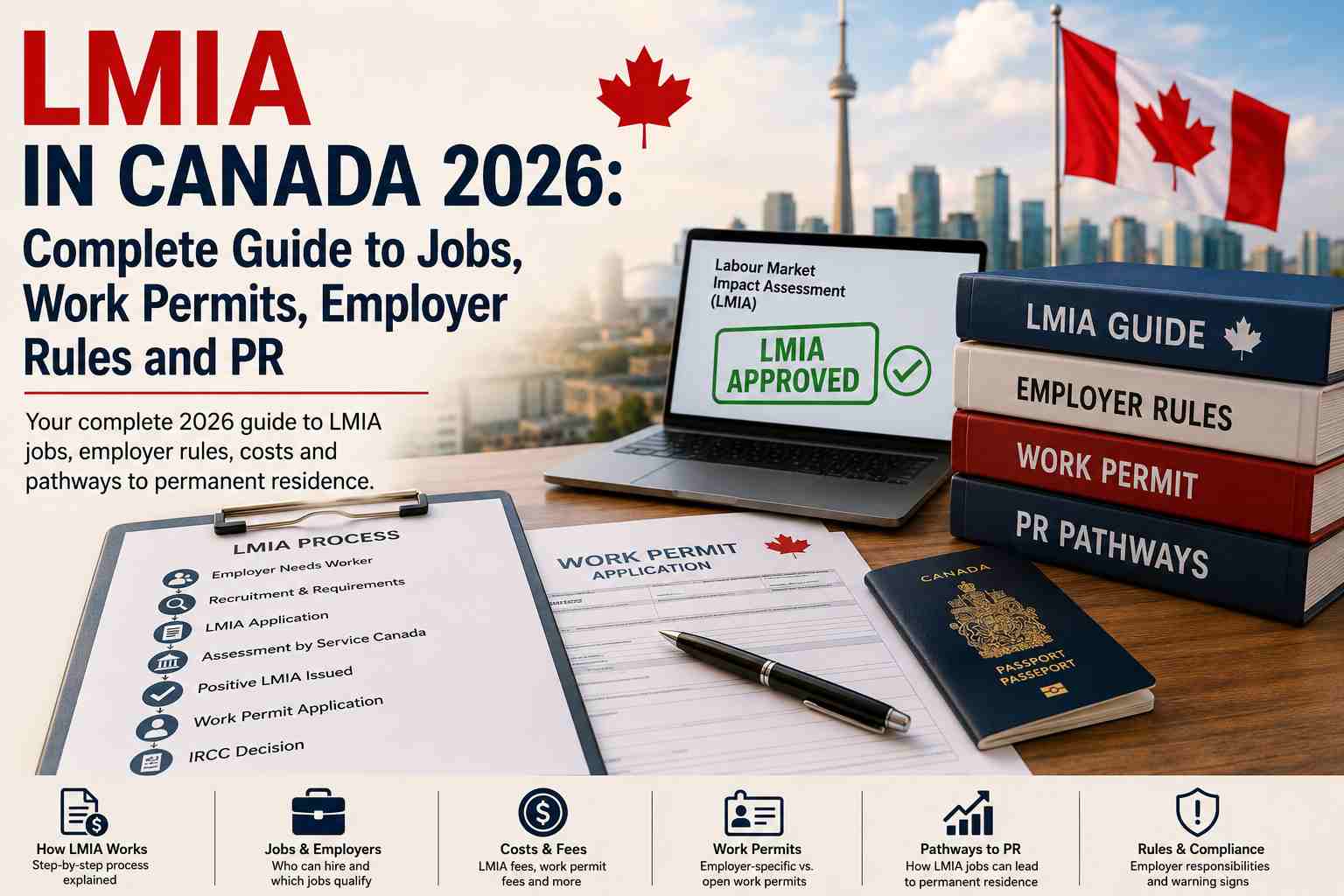
Canadian employer needs worker → employer determines whether an LMIA is required → employer completes applicable recruitment and LMIA requirements → Service Canada assesses the application → positive LMIA issued → worker applies for an employer-specific work permit → IRCC decides the work-permit application
The worker normally does not personally apply for the LMIA.
The employer does.
And even after a positive LMIA is issued, the worker still needs to qualify for the appropriate work permit.
Key Takeaways
- An LMIA and a work permit are two different things.
- Employers normally apply for the LMIA through the Temporary Foreign Worker Program.
- Many LMIA applications carry a $1,000 processing fee for each position requested, subject to exceptions.
- Applicable LMIA processing fees are generally an employer responsibility and cannot be recovered from the temporary foreign worker.
- A positive LMIA does not guarantee that IRCC will approve the worker's work permit.
- LMIA-supported workers generally receive an employer-specific, often called closed, work permit.
- High-wage and low-wage LMIA applications follow different requirements.
- Canada's provincial and territorial hourly wage thresholds were updated effective July 17, 2026.
- Certain low-wage LMIA applications in Census Metropolitan Areas with unemployment of 6% or higher may not be processed, subject to exemptions.
- Canada removed additional Express Entry CRS points for job offers on March 25, 2025.
- A qualifying job offer can nevertheless remain relevant to eligibility under certain immigration programs.
- An LMIA-supported job can potentially help a worker accumulate Canadian work experience that later contributes to a PR strategy.
- Be extremely cautious if someone asks you to buy an LMIA or pay an employer's LMIA processing fee.
What Does LMIA Mean in Canada?
LMIA stands for Labour Market Impact Assessment.
It is an assessment conducted through Employment and Social Development Canada and Service Canada as part of the Temporary Foreign Worker Program.
At its core, the government is assessing whether the employer's request to hire a temporary foreign worker meets the requirements of the program and what impact the hiring is expected to have on Canada's labour market.
Depending on the stream and circumstances, the employer may need to demonstrate things such as:
- that the business and job offer are legitimate
- that there is a genuine employment need
- that the employer can fulfil the terms of the job offer
- that required recruitment efforts were completed
- that the offered wage meets applicable requirements
- that the employer complies with Temporary Foreign Worker Program rules
A positive LMIA can then be used to support the next stage of the process.
But it is important to understand what it does not do.
LMIA vs. Work Permit: They Are Not the Same
This is probably the most important distinction in this guide.
LMIA
The employer normally applies for the LMIA.
The LMIA assesses the employer's request to hire a temporary foreign worker under the Temporary Foreign Worker Program.
Work permit
The foreign worker normally applies for the work permit.
Immigration, Refugees and Citizenship Canada determines whether that individual qualifies to work in Canada.
Think of the LMIA as documentation that may support an immigration application — not the immigration authorization itself.
A positive LMIA does not automatically allow someone to begin working in Canada.
In many cases, after receiving the required positive LMIA documentation from the employer, the worker must apply for an employer-specific work permit.
If approved, the permit can contain conditions including the employer, occupation and location where the person is authorized to work.
If you already have this type of permit and are thinking about permanent residence, read TwikUp's guide to Closed Work Permit to PR: Canadian Pathways Explained for 2026.
How Does the LMIA Process Work in Canada?
There are effectively two major stages.
The first concerns the employer.
The second concerns the worker.
Step 1: A Canadian Employer Wants to Fill a Position
Everything begins with a genuine Canadian job.
The employer determines details such as:
- occupation
- appropriate NOC classification
- job duties and qualifications
- wage
- work location
- hours
- expected length of employment
The employer must then determine whether hiring the foreign worker actually requires an LMIA.
That matters because not every foreign worker or employment situation requires one.
Step 2: Determine Whether an LMIA Is Required
Canada has two major frameworks through which employers hire many foreign workers.
Temporary Foreign Worker Program
This is generally the program under which employers seek an LMIA before hiring a temporary foreign worker.
International Mobility Program
The International Mobility Program includes situations where employers can hire eligible foreign workers without an LMIA, provided the applicable exemption requirements are satisfied.
There are also people in Canada who already hold open work permits and may work for eligible employers without that employer obtaining an LMIA specifically for them.
So the first question should not simply be:
“Can this employer get an LMIA?”
It should be:
“Does this employment situation actually require an LMIA?”
Who Applies for an LMIA?
The Canadian employer, or an authorized representative acting for the employer, generally submits the LMIA application.
This distinction matters because workers sometimes encounter advertisements or intermediaries suggesting that the worker should “purchase” an LMIA.
That is not how the legitimate LMIA system is designed to operate.
Where the $1,000 LMIA processing fee applies, that fee cannot be recovered from the temporary foreign worker.
How Much Does an LMIA Cost in Canada in 2026?
For many Temporary Foreign Worker Program LMIA applications, the processing fee is:
$1,000 for each position requested.
That is the LMIA processing fee, not the worker's immigration application fee.
Exceptions can apply to certain LMIA categories, so employers should verify the requirements for the specific stream under which they are applying.
If the foreign worker subsequently applies for an employer-specific work permit, separate IRCC application fees apply.
Fees can change, so applicants should always confirm current amounts directly with the Government of Canada before submitting an application.
Can an Employer Charge the Worker for an LMIA?
Applicable LMIA processing fees cannot be recovered from the temporary foreign worker.
That should immediately make you cautious about advertisements such as:
“Guaranteed LMIA — pay $20,000.”
or
“LMIA job available for sale.”
A legitimate employer should be hiring someone because the business genuinely needs a worker to perform a real job.
The LMIA system is not designed to be a marketplace where immigration status is sold.
What Is a Positive LMIA?
If Service Canada determines that the applicable requirements have been satisfied and that hiring the temporary foreign worker would have a positive or neutral effect on the Canadian labour market, the employer can receive a positive LMIA decision.
The employer can then provide the worker with the required LMIA and employment information for the applicable work-permit application.
The worker then moves to the IRCC stage.
This is why people sometimes informally refer to an approved LMIA as an “LMIA work permit.”
Technically, however, the two are separate.
Does a Positive LMIA Guarantee a Canadian Work Permit?
No.
Service Canada assesses the LMIA.
IRCC assesses the foreign worker's work-permit application.
Depending on the situation, the worker may still need to demonstrate things such as:
- eligibility for the position
- valid supporting employment documentation
- admissibility
- passport and identity requirements
- biometrics where applicable
- medical examination requirements where applicable
- compliance with the requirements of the work-permit category
A positive LMIA therefore supports the employment side of an LMIA-based application.
It does not guarantee work-permit approval.
What Type of Work Permit Do You Get With an LMIA?
An LMIA commonly supports an employer-specific work permit.
You may also hear this described as a:
- closed work permit
- employer-tied work permit
- LMIA-based work permit
The permit can identify conditions governing your employment.
Employer
You generally cannot simply switch to another employer and continue working under the same employer-specific authorization.
Occupation
The occupation you are authorized to perform may be specified.
Location
The authorized employment location may also appear on the permit.
Expiry date
Your authorization is temporary and expires according to the conditions of the permit.
This is different from an open work permit, which may allow the holder to work for different eligible employers without being tied to one specific employer.
Can You Change Employers on an LMIA-Based Work Permit?
A new job offer does not automatically transfer your existing employer-specific work authorization to another employer.
Depending on your circumstances, a new employer may need to:
- determine whether an LMIA is required
- obtain a new LMIA if required
- provide the necessary employment documentation
- allow you to apply for the appropriate new work authorization
Workers should make sure they have the required authorization before beginning work for a different employer.
High-Wage vs. Low-Wage LMIA in 2026
One of the most important LMIA classifications is determined by the wage being offered.
Canada publishes an hourly wage threshold for every province and territory.
If the offered wage is at or above the applicable provincial or territorial threshold, the employer generally applies through the high-wage stream.
If it is below the threshold, the employer generally applies through the low-wage stream.
Canada updated these hourly wage thresholds effective July 17, 2026.
That means employers should not rely on an old wage chart from a blog, consultant or previous LMIA application.
They should check the current Government of Canada threshold for the province or territory where the position is located.
The offered wage must also comply with applicable prevailing-wage requirements. Simply increasing the wage to cross the high-wage threshold does not automatically make an application compliant.
Why Low-Wage LMIAs Became Harder
Canada has tightened parts of the Temporary Foreign Worker Program considerably.
Low-wage employers face restrictions designed to limit reliance on temporary foreign labour while prioritizing Canadians and permanent residents.
One of the most important restrictions involves local unemployment rates.
The 6% Unemployment Rule
Certain low-wage LMIA applications may not be processed when the position is located in a Census Metropolitan Area with an unemployment rate of 6% or higher.
Exceptions apply to certain occupations and sectors.
The unemployment-rate table used for this policy is updated periodically.
For applications submitted from July 10 through October 8, 2026, employers should therefore check the current Government of Canada table for the Census Metropolitan Area where the worker would actually be employed.
This means the viability of some low-wage LMIA applications can change from one quarter to another.
Low-Wage LMIA Worker Caps
Another major restriction concerns the proportion of an employer's workforce that can consist of temporary foreign workers in low-wage positions.
The general cap is currently 10% at a particular work location.
Certain sectors and occupations can be subject to different rules, including eligible positions in areas such as:
- construction
- food manufacturing
- hospitals
- nursing and residential care facilities
- certain in-home caregiver occupations
Some applicable sectors or occupations can have a 20% cap.
Temporary Rural Measures in 2026
Canada has also introduced temporary measures for eligible rural employers in participating provinces and territories.
These measures run from April 1, 2026 through March 31, 2027.
Depending on the participating province or territory and the measure being implemented, an eligible rural employer may be able to:
- retain an existing proportion of low-wage temporary foreign workers above the normal cap, and/or
- use a 15% cap instead of the normal 10% cap
However, these measures do not automatically apply everywhere in Canada.
Provincial and territorial participation varies, and employers must check whether the measures have been implemented in their jurisdiction and whether they qualify.
For example, as of August 2026, Ontario is not participating in these temporary rural measures.
This is why two employers recruiting for similar jobs can face very different LMIA requirements.
The employer's location, sector and existing workforce composition can all matter.
How Long Can a Low-Wage LMIA Job Last?
Under current Temporary Foreign Worker Program rules, employers hiring through the regular low-wage stream can generally hire temporary foreign workers for a maximum employment duration of one year.
The employment duration must also align with the employer's reasonable employment needs.
That does not mean every work permit will automatically be issued for exactly one year.
The actual immigration authorization depends on the approved employment and IRCC's decision.
What Does the Employer Have to Prove?
An LMIA is much more than filing a job offer.
Service Canada can assess whether the employer and job are legitimate.
Among the issues that can be examined are whether the business:
- provides a good or service in Canada
- genuinely needs the position
- can fulfil the employment offer
- can pay the required wages
- complies with applicable federal and provincial or territorial laws
Employers may need documentation demonstrating business legitimacy.
This helps protect the system from businesses or job offers created primarily to generate immigration documents.
Does the Employer Have to Advertise the Job First?
In many LMIA streams, yes.
The Temporary Foreign Worker Program is intended to allow employers to address labour needs while giving Canadians and permanent residents priority for available jobs.
Employers therefore generally need to satisfy prescribed recruitment requirements before applying to hire a temporary foreign worker.
The exact advertising requirements depend on the LMIA stream.
Employers should follow the rules for their particular stream rather than relying on a generic “four-week LMIA rule.”
Some specialized programs and circumstances have different recruitment requirements.
Can Any Canadian Company Get a Positive LMIA?
Not necessarily.
Simply registering a Canadian corporation does not mean an employer will qualify for a positive LMIA.
Service Canada can examine factors including:
- whether the business genuinely operates in Canada
- whether the position represents a legitimate business need
- whether the employer can pay the worker
- compliance history
- recruitment efforts
- workforce composition
- job location
- wage
- applicable sector requirements
An employer can therefore receive a negative LMIA decision even when the foreign worker is highly qualified.
Remember:
The LMIA assessment primarily concerns the employer, job and potential labour-market impact.
Which Jobs Can Get an LMIA in Canada?
There is no universal list of ordinary jobs that are guaranteed to receive a positive LMIA.
LMIA applications can involve many occupations provided the employer, job and application meet the requirements of the applicable stream.
Positions can potentially exist in industries such as:
- transportation
- construction
- skilled trades
- agriculture
- food production
- technology
- engineering
- healthcare
- hospitality
- manufacturing
- professional services
But seeing an occupation on someone's “LMIA jobs list” does not mean an employer will automatically receive approval.
The actual outcome can depend on:
- occupation
- wage
- region
- unemployment rate
- recruitment
- business need
- workforce composition
- LMIA stream
- other program restrictions
Can Truck Drivers Get an LMIA in Canada?
Transport truck driving has historically been an important occupation for foreign workers, but an employer still needs to satisfy the current LMIA rules applicable to the particular position.
Province, wage, employer and longer-term permanent-residence strategy can also matter.
Someone deciding where to build a career as a truck driver should therefore look beyond whether an LMIA job is available today.
The more important question may be:
What happens after I begin working?
For Ontario-specific options, see Ontario PR for Truck Drivers: Eligibility and Pathways in 2026.
If you are comparing provinces, TwikUp also breaks down Best Province for Truck Drivers in Canada 2026: Alberta vs Ontario vs Manitoba vs Saskatchewan.
Where Can You Find LMIA Jobs in Canada?
The Government of Canada's Job Bank includes job postings and resources for temporary foreign workers.
But there is an important distinction:
An employer being willing to consider a foreign worker is not the same as having an approved LMIA for your position.
When evaluating an opportunity, ask:
- Has the LMIA already been approved?
- Is the employer only planning to apply?
- What occupation and NOC are being used?
- What wage is being offered?
- What location is listed?
- Is the LMIA connected to your position?
- What is the expected employment duration?
- Will the employer provide the documentation required for the work-permit application?
These questions can expose vague or suspicious offers quickly.
Can You Apply for LMIA Jobs From Outside Canada?
Potentially, yes.
A Canadian employer may hire an eligible foreign worker who is outside Canada if the employer, job and worker satisfy the applicable requirements.
After receiving the necessary positive LMIA documentation, the worker generally applies for the appropriate work permit through IRCC.
Approval remains dependent on the applicant meeting Canada's immigration requirements.
Can Someone Already in Canada Get an LMIA?
Potentially.
Being physically present in Canada does not automatically prevent an employer from applying for an LMIA.
For example, someone may currently hold:
- a PGWP
- another open work permit
- an employer-specific work permit
- another form of valid temporary status
An employer may determine that an LMIA is required to support the person's future employer-specific work authorization.
However, this is where immigration status becomes particularly important.
An LMIA by itself does not extend your temporary resident status or automatically authorize you to continue working after your existing work authorization expires.
You must separately maintain legal status and comply with the conditions of your work authorization.
LMIA to PR: Can an LMIA Give You Permanent Residence?
An LMIA does not directly grant permanent residence.
There is no universal immigration program that simply converts every positive LMIA into Canadian PR.
Instead, an LMIA-supported job can sometimes become one part of a broader permanent-residence strategy.
For example:
LMIA
↓
Employer-Specific Work Permit
↓
Eligible Canadian Work Experience
↓
Potential Express Entry, PNP or Other PR Eligibility
The actual outcome can depend on:
- NOC and TEER
- province
- Canadian and foreign work experience
- language ability
- education
- age
- CRS score
- employer
- provincial immigration requirements
- federal immigration program requirements
That is why someone considering an LMIA-supported job should examine the potential PR pathway before accepting the position, rather than waiting until the work permit is close to expiring.
Does an LMIA Give 50 CRS Points in 2026?
No — not simply because you have an LMIA-backed job offer.
This is one of the most important outdated immigration claims still circulating online.
Canada removed additional Express Entry CRS points for job offers effective March 25, 2025.
Before the change, qualifying job offers could provide:
- 50 additional CRS points for many qualifying skilled jobs
- 200 additional CRS points for certain senior-management positions
Those additional CRS job-offer points were removed.
So in 2026, be extremely skeptical if someone tells you:
“Buy an LMIA and get 50 Express Entry points.”
That information is outdated.
Then Why Can an LMIA Still Matter for PR?
Because CRS points and immigration-program eligibility are not the same thing.
Removing additional CRS points for job offers did not make every valid job offer irrelevant to Canadian immigration.
A qualifying job offer can still matter under the eligibility or selection rules of certain federal or provincial immigration programs.
For example, arranged employment can still play a role under certain federal economic immigration requirements.
An LMIA-supported work permit can also allow someone to accumulate eligible Canadian employment experience, which may later affect their immigration options.
The practical value of an LMIA therefore depends on the person's entire immigration strategy.
It should not be reduced to:
LMIA = PR
That equation is incorrect.
Can an LMIA Help With Canadian Experience Class?
An LMIA itself does not make someone eligible for the Canadian Experience Class.
What can matter is the eligible Canadian skilled work experience the person later gains while properly authorized to work.
CEC has its own eligibility requirements.
Someone accepting an LMIA-supported job should therefore examine whether:
- the occupation is eligible
- the employment is properly authorized
- the work experience will satisfy the immigration program being targeted
- applicable language requirements can be met
The quality of the PR strategy matters more than simply obtaining any LMIA-supported job.
Can an LMIA Help With a Provincial Nominee Program?
Potentially.
Some provincial immigration streams require or heavily depend on qualifying employment with an eligible employer.
But every Provincial Nominee Program has its own rules.
A provincial nomination issued through an Express Entry-aligned pathway can be particularly valuable because an eligible provincial nomination provides 600 additional CRS points.
That makes the province an important part of evaluating an LMIA-supported job.
A position that creates a realistic provincial nomination pathway may have significantly more long-term immigration value than another job with no clear pathway beyond temporary employment.
What About an LMIA Supporting Permanent Residence?
Canada also has LMIA processes that may be relevant where an employer wants to support a skilled foreign worker's permanent-residence application, including circumstances involving permanent-residence or dual-intent applications.
But this should not be confused with the former 50 or 200 additional Express Entry CRS points for qualifying job offers.
Those additional CRS job-offer points were removed on March 25, 2025.
The worker must still qualify under the applicable permanent-residence program.
An LMIA does not override the immigration program's eligibility requirements or guarantee permanent residence.
How Long Is an LMIA Valid?
Employers and workers need to distinguish between:
LMIA validity
and
the authorized duration of employment.
They are not necessarily the same thing.
The positive LMIA documentation contains information relevant to when the assessment can be used for the work-permit process.
Canada has changed LMIA validity rules over time.
Workers should therefore look at the actual expiry information on their LMIA documentation rather than assuming an old validity rule found online still applies.
Do not unnecessarily delay the work-permit application after receiving the required documents.
How Long Does an LMIA Take in Canada?
There is no single LMIA processing time that applies to every application.
Service Canada publishes average processing times by stream, and these can change according to application volumes and program conditions.
Different processing times can apply to streams including:
- Global Talent Stream
- Agricultural Stream
- Seasonal Agricultural Worker Program
- High-Wage Stream
- Low-Wage Stream
- Permanent Residence Stream
Because these numbers change, employers and workers should check the current Government of Canada LMIA processing-time page rather than relying on an old number from a blog or previous application.
What Is the Global Talent Stream?
The Global Talent Stream is part of the Temporary Foreign Worker Program and is designed for qualifying employers seeking certain highly skilled workers.
Different qualifying categories exist.
For example, Category B can apply to eligible employers seeking to hire highly skilled foreign workers in occupations included on the Global Talent Occupations List.
The employer must still meet all applicable program requirements.
It should not be treated as a universal “fast LMIA” available for every technology job.
What Happens After the Employer Gets a Positive LMIA?
The employer generally provides the foreign worker with the required LMIA and employment documentation.
The worker can then prepare the appropriate employer-specific work-permit application.
Depending on the person's circumstances and eligibility, an application may be made:
- from outside Canada
- from inside Canada
- at a port of entry where permitted under the applicable rules
Typical documents may include:
- passport
- employment or job-offer documentation
- positive LMIA information
- application forms
- evidence showing eligibility for the occupation
- biometrics where required
- medical examination where required
- other documents requested by IRCC
The exact checklist depends on the applicant's circumstances.
What Happens if the LMIA Is Negative?
If Service Canada issues a negative LMIA, the employer cannot use that negative assessment to support the intended LMIA-based hiring.
A negative decision can occur for many reasons.
For example:
- required recruitment was not adequately demonstrated
- Canadians or permanent residents were available
- the wage does not meet applicable requirements
- the job offer or business need is not sufficiently legitimate
- program requirements were not met
- hiring the foreign worker would have a negative impact on Canada's labour market
The worker cannot simply turn a negative LMIA into a work permit.
The employer would need to determine whether any other legitimate options are available.
Can an LMIA Be Revoked?
Employers must continue complying with Temporary Foreign Worker Program requirements after approval.
A positive decision does not give the employer unlimited freedom to change the employment arrangement.
Employers have obligations related to the conditions of the LMIA decision and employment arrangement and can be subject to inspections.
Non-compliance can have serious consequences.
That is another reason workers should be cautious if an employer promises one wage on immigration documents but says the “real wage” will be lower after the worker starts.
Employer Responsibilities After Hiring an LMIA Worker
Employers participating in the Temporary Foreign Worker Program have ongoing compliance obligations.
These can include compliance with:
- LMIA conditions
- employment terms
- applicable immigration requirements
- wage requirements
- workplace rules
- recordkeeping requirements
Employers can also be inspected by the Government of Canada.
Workers should understand that receiving an employer-specific work permit does not eliminate the employer's obligations under the Temporary Foreign Worker Program or applicable employment laws.
What if an Employer Pays Less Than the LMIA Wage?
That can be a serious warning sign.
The employer is expected to comply with the applicable employment terms and program requirements.
Workers should keep copies of important documents, including:
- employment contracts
- pay statements
- work schedules
- job advertisements where available
- LMIA-related documents provided to them
- work permits
- communications concerning wages and duties
A worker should not assume that temporary immigration status means they have no workplace protections.
LMIA Scams: 8 Warning Signs
Where there is immigration demand, there is also an opportunity for fraud.
Be particularly cautious when someone says:
1. “Pay me and I guarantee a positive LMIA.”
No representative can legitimately guarantee that Service Canada will approve an LMIA.
2. “You don't actually need to work.”
An LMIA is based on genuine employment.
3. “The employer will put you on payroll but you return the money.”
That can indicate a fabricated employment arrangement.
4. “Pay the employer's $1,000 LMIA processing fee.”
Applicable LMIA processing fees cannot be recovered from the temporary foreign worker.
5. “LMIA gives you 50 CRS points.”
That information is outdated.
Canada removed additional CRS points for job offers on March 25, 2025.
6. “Your LMIA means your work permit is guaranteed.”
It does not.
IRCC separately assesses the work-permit application.
7. “You don't need to see the job details.”
You should understand exactly what occupation, wage, duties, employer and location are connected to your employment.
8. “Once you get an LMIA, PR is guaranteed.”
There is no universal LMIA-to-PR guarantee.
Can You Buy an LMIA?
A worker should not treat an LMIA as an immigration product that can simply be purchased.
The system exists to allow genuine Canadian employers to respond to labour needs when the applicable Temporary Foreign Worker Program requirements are satisfied.
Canada removed additional Express Entry CRS points for job offers partly as an anti-fraud measure intended to reduce incentives surrounding the illegal buying and selling of LMIAs.
That makes offers to “sell” an LMIA particularly concerning.
LMIA vs. Open Work Permit
| Feature | LMIA-Based Employer-Specific Work Permit | Open Work Permit |
|---|---|---|
| Employer | Generally connected to a specific employer | Generally not tied to one specific employer |
| LMIA | Employer may need a positive LMIA | An employer generally does not need an LMIA specifically to hire someone who already holds a valid open work permit |
| Conditions | May identify employer, occupation or location | Offers greater employment flexibility, subject to the conditions of the permit |
| Changing employers | May require new authorization | Holder can generally change eligible employers, subject to permit conditions |
Whether someone qualifies for an open work permit depends on the applicable immigration program.
You cannot simply choose an open work permit because it is more convenient.
Is an LMIA Worth It in 2026?
For the right worker and employer, an LMIA can be extremely important.
It may allow someone to:
- obtain employer-specific work authorization
- continue building a career in Canada
- accumulate eligible Canadian work experience
- potentially satisfy employment-related requirements under a PR program
- position themselves for an employer-driven provincial pathway
But an LMIA-supported work permit can also leave someone tied to an employer in a position with limited long-term immigration value.
The better question is therefore not:
“Can I get an LMIA?”
It is:
“If I accept this LMIA-supported job, where can it realistically take me over the next one to three years?”
That is a much better immigration question.
Before Accepting an LMIA Job, Check These 10 Things
Before making a major decision, find out:
- Is the LMIA already approved or only planned?
- What NOC code is being used?
- What TEER category is the occupation?
- What wage is listed?
- What province and work location are listed?
- How long is the approved employment period?
- Will the resulting Canadian work experience qualify for the PR pathway you are targeting?
- Does the province have an employer-driven PNP option that fits your profile?
- What happens when the work permit expires?
- Is anyone demanding money for the LMIA or job?
A worker who answers these questions before accepting the job is in a much stronger position than someone who begins thinking about permanent residence only when the work permit is about to expire.
LMIA Frequently Asked Questions
Is an LMIA a work permit?
No.
The LMIA is generally obtained by the employer. The foreign worker then uses the required employment and LMIA documentation to apply for a work permit where applicable.
Who pays for an LMIA in Canada?
The employer is responsible for applicable LMIA processing fees.
For many applications, the processing fee is currently $1,000 for each position requested, subject to exceptions.
Does an LMIA guarantee a visa or work permit?
No.
IRCC separately determines whether the worker qualifies for the work permit and meets Canada's immigration requirements.
Does an LMIA give 50 CRS points in 2026?
No.
Canada removed additional Express Entry CRS points for job offers on March 25, 2025.
Can an LMIA still help with PR?
Potentially.
A qualifying job offer can remain relevant under certain immigration-program requirements, while LMIA-supported employment may allow a worker to accumulate eligible Canadian work experience.
Neither guarantees permanent residence.
Can an employer hire me without an LMIA?
Possibly.
Some workers and employment situations qualify for LMIA exemptions.
People who already hold eligible open work permits generally do not require an employer to obtain an LMIA specifically to hire them.
Can I change jobs after getting an LMIA-based work permit?
An employer-specific work permit generally restricts you according to the conditions stated on the permit.
Changing employers may require additional immigration steps and new work authorization.
Is every LMIA job a path to PR?
No.
The immigration value of a job depends on factors including occupation, TEER, province, work experience, language ability, education, immigration program and individual eligibility.
Can I apply for my own LMIA?
Generally, the LMIA application is made by the employer seeking to hire the temporary foreign worker.
Can an LMIA be refused?
Yes.
A Canadian employer wanting to hire a foreign worker does not guarantee that Service Canada will issue a positive LMIA.
TwikUp Insight
The biggest mistake workers make with LMIAs may not be failing to find an employer.
It may be focusing on the first immigration step instead of the last one.
Imagine two workers receive legitimate LMIA-supported job opportunities on the same day.
One accepts the first position available without examining the occupation, province or permanent-residence options.
The other examines the NOC, TEER, provincial immigration programs, Canadian-experience requirements, language targets and what will happen when the work permit expires.
Twelve or eighteen months later, their immigration situations could look completely different.
That is why an LMIA should rarely be viewed in isolation.
The stronger strategy is:
Job → LMIA → Work Permit → Canadian Experience → PR Eligibility → Permanent Residence
But every step needs to work for your individual circumstances.
An LMIA is not permanent residence.
It is not a guarantee of a work permit.
And since March 25, 2025, an LMIA-backed job offer does not automatically add 50 or 200 CRS points to an Express Entry profile.
The real value of an LMIA-supported job in 2026 is therefore not simply whether you can obtain one.
It is whether that employment fits into a legitimate, sustainable immigration strategy.
Immigration rules can change quickly. Always verify current requirements and your individual eligibility directly with the Government of Canada or a properly authorized immigration professional before making immigration decisions.
Sources
All external sources below are official Government of Canada sources.
-
Employment and Social Development Canada — Temporary Foreign Worker Program / Labour Market Impact Assessment: https://www.canada.ca/en/employment-social-development/services/foreign-workers.html
-
Employment and Social Development Canada — High-Wage and Low-Wage LMIA Classification and Provincial/Territorial Wage Thresholds: https://www.canada.ca/en/employment-social-development/services/foreign-workers/median-wage.html
-
Employment and Social Development Canada — High-Wage Positions: https://www.canada.ca/en/employment-social-development/services/foreign-workers/median-wage/high.html
-
Employment and Social Development Canada — Low-Wage Positions: https://www.canada.ca/en/employment-social-development/services/foreign-workers/median-wage/low.html
-
Employment and Social Development Canada — Program Requirements for Low-Wage Positions: https://www.canada.ca/en/employment-social-development/services/foreign-workers/median-wage/low/requirements.html
-
Employment and Social Development Canada — Refusal to Process an LMIA Application: https://www.canada.ca/en/employment-social-development/services/foreign-workers/refusal.html
-
Employment and Social Development Canada — Temporary Measures for Rural Employers Under the Temporary Foreign Worker Program: https://www.canada.ca/en/employment-social-development/services/foreign-workers/temporary-measures.html
-
Immigration, Refugees and Citizenship Canada — Employer-Specific Work Permits: https://www.canada.ca/en/immigration-refugees-citizenship/services/work-canada/employer-specific.html
-
Immigration, Refugees and Citizenship Canada — Express Entry: Job Offers: https://www.canada.ca/en/immigration-refugees-citizenship/services/immigrate-canada/express-entry/documents/job-offer.html
-
Immigration, Refugees and Citizenship Canada — Comprehensive Ranking System Criteria: https://www.canada.ca/en/immigration-refugees-citizenship/services/immigrate-canada/express-entry/check-score/crs-criteria.html
-
Immigration, Refugees and Citizenship Canada — Federal Skilled Worker Program: https://www.canada.ca/en/immigration-refugees-citizenship/services/immigrate-canada/express-entry/who-can-apply/federal-skilled-workers.html