
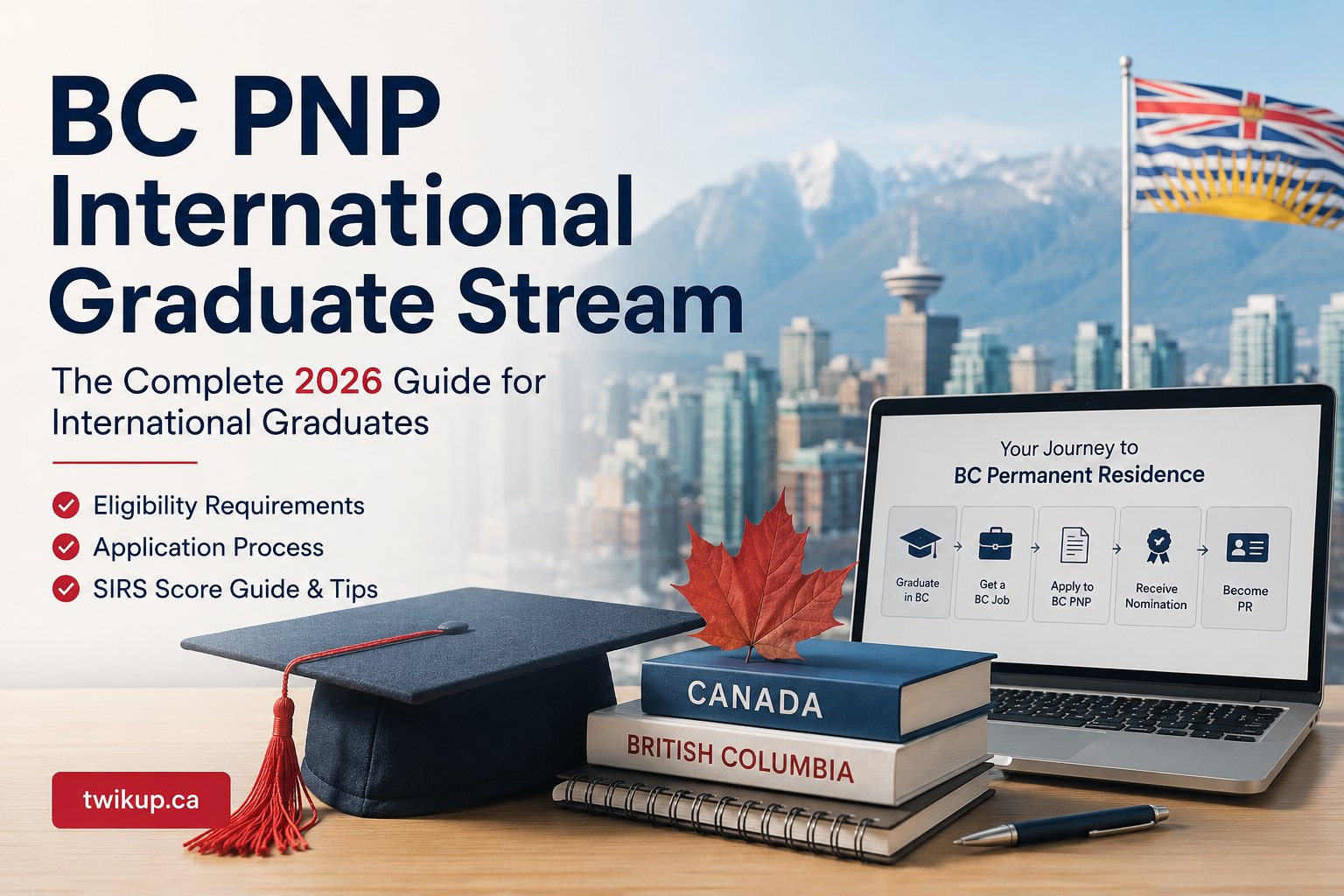
International graduates in British Columbia do not currently have a dedicated BC Provincial Nominee Program graduate stream available for new registrations.
The former International Graduate and International Post-Graduate streams should not be treated as active pathways for new applicants. Graduating from a BC institution can still strengthen an immigration profile, but a Canadian credential does not automatically make someone eligible for provincial nomination or permanent residence.
In 2026, the principal options for eligible BC graduates include:
- The BC PNP Skilled Worker stream
- The BC PNP Health Authority stream
- Express Entry through the Canadian Experience Class
- Express Entry through the Federal Skilled Worker Program
- Federal or regional programs outside the BC PNP
- Provincial programs in another province, when the applicant genuinely intends to live there
This guide explains the current pathways, how a BC education can help and what graduates should do before their work permit expires.
Quick Answer
There is no active BC PNP stream exclusively for recent international graduates in 2026.
Most graduates seeking permanent residence in British Columbia must qualify as workers rather than simply as graduates. For the BC PNP Skilled Worker stream, applicants generally need:
- A qualifying full-time job offer from an eligible BC employer
- Employment in an eligible NOC TEER 0, 1, 2 or 3 occupation
- At least two years of full-time, or full-time-equivalent, skilled work experience
- The qualifications required for the occupation
- Employer support
- Sufficient language ability when required
- Legal immigration status in Canada, when applying from inside Canada
Graduates who obtain at least one year of eligible Canadian skilled work experience may also qualify for the Canadian Experience Class through Express Entry.
What Happened to the BC PNP Graduate Streams?
The BC PNP previously offered immigration pathways designed specifically for recent graduates.
These included:
- International Graduate stream
- International Post-Graduate stream
The International Graduate stream generally required a qualifying credential and an eligible BC job offer. The International Post-Graduate stream provided a potential pathway for certain graduates without requiring a job offer.
These streams are not currently available for new registrations or applications. Applicants who were nominated under previous rules may still have post-nomination obligations, but new graduates should not plan their immigration strategy around these closed pathways.
The current regular Skills Immigration streams are:
- Skilled Worker
- Health Authority
BC PNP eligibility and selection policies can change. Applicants should always use the most recent Skills Immigration Program Guide rather than relying on an older article, social-media post or immigration forum.
Does Graduating in BC Still Help?
Yes, but the advantage is indirect.
A BC education may help a graduate:
- Qualify for a Post-Graduation Work Permit
- Enter the Canadian labour market
- Accumulate eligible Canadian work experience
- Earn education points under the BC PNP registration system
- Earn additional points for education completed in British Columbia
- Improve an Express Entry Comprehensive Ranking System score
- Build relationships with eligible BC employers
- Obtain Canadian professional licensing or certification
Under the current BC PNP scoring system, eligible post-secondary education completed in British Columbia can provide additional registration points. However, these points improve a candidate’s ranking only. They do not replace the basic eligibility requirements for the selected stream.
Meeting the minimum requirements also does not guarantee an invitation to apply.
Pathway 1: BC PNP Skilled Worker Stream
The Skilled Worker stream is the primary provincial pathway for experienced workers in professional, management, technical, trade and other skilled occupations.
Basic Skilled Worker Requirements
An applicant generally needs:
- A valid job offer in an eligible NOC TEER 0, 1, 2 or 3 occupation
- A regular full-time position averaging at least 30 hours per week
- An indeterminate job offer, unless a specific exception applies
- At least two years of full-time or full-time-equivalent experience in a skilled occupation
- Work experience obtained during the previous 10 years
- The education, training, licensing and qualifications required for the offered position
- Support from an eligible BC employer
The two-year experience requirement can include eligible experience obtained in Canada or another country. It is separate from the directly related experience used to calculate registration points.
This distinction is important. A person may have two years of general skilled experience and meet the stream’s minimum experience requirement, but receive fewer registration points if that experience is not directly related to the BC job offer.
Does the Job Have to Be Related to the Graduate’s Education?
The current Skilled Worker stream focuses on whether the applicant is qualified to perform the offered job.
Depending on the occupation, this can involve:
- Education
- Professional training
- Work experience
- Provincial certification
- Registration with a regulatory body
- A trade certificate
- A valid professional licence
Applicants should not assume that any job will qualify simply because it is classified as skilled. The duties must match the selected National Occupational Classification code, and the applicant must satisfy the occupation’s requirements.
Employer Support
Having a job offer is not enough by itself.
The employer must be eligible to support a BC PNP application and must agree to provide the required documentation, including the Employer Declaration Form.
Employers are not obligated to support an employee’s immigration application. Graduates should discuss employer support before creating a BC PNP registration.
Independent-contractor and subcontractor positions are generally not accepted as qualifying job offers.
Pathway 2: Express Entry BC
Express Entry BC is not a separate graduate stream. It is an option connected to an eligible BC PNP stream.
A Skilled Worker or eligible Health Authority applicant may use the Express Entry BC option if they also qualify for a federal Express Entry program and have:
- A valid Express Entry profile number
- A Job Seeker Validation Code
- Eligibility under a participating federal economic immigration program
A provincial nomination connected to Express Entry normally adds 600 CRS points to the candidate’s federal profile.
The nomination does not itself grant permanent residence. The candidate must still receive a federal invitation, submit a complete permanent-residence application and pass federal medical, criminal, security and admissibility checks.
Pathway 3: Canadian Experience Class
For many international graduates, the Canadian Experience Class may become available before the BC PNP Skilled Worker stream.
Canadian Experience Class applicants generally need at least one year—or 1,560 hours—of eligible paid Canadian work experience during the three years before applying.
The experience must:
- Be gained in Canada
- Be obtained while the applicant was authorized to work
- Be in a NOC TEER 0, 1, 2 or 3 occupation
- Match the lead statement and most of the main duties of the selected NOC
- Be paid employment
Work performed while the applicant was a full-time student generally does not count toward the Canadian Experience Class minimum. Self-employment also normally does not count, subject to limited exceptions.
Applicants must also meet the applicable language requirement. There is no education requirement for the Canadian Experience Class, although Canadian education can improve a candidate’s CRS score.
Meeting Canadian Experience Class eligibility does not guarantee an invitation. Candidates are ranked in the Express Entry pool, and invitation results depend on the type of draw and its CRS cut-off.
Pathway 4: Federal Skilled Worker Program
Some BC graduates may qualify for Express Entry through the Federal Skilled Worker Program using eligible experience obtained outside Canada.
This pathway may be relevant to graduates who arrived in Canada with previous professional experience.
Factors include:
- Skilled work experience
- Language-test results
- Education
- Age
- Adaptability
- Settlement funds, when required
- The federal selection-factor score
- The applicant’s overall CRS score
A Canadian credential can improve an Express Entry profile, but the applicant must still meet all Federal Skilled Worker Program requirements.
Pathway 5: Health Authority Stream
The Health Authority stream is for select professionals working within British Columbia’s public healthcare system.
An applicant may qualify if they have an eligible, regular, full-time and indeterminate job offer from a participating BC public-health authority and receive the health authority’s support.
Participating organizations include:
- Provincial Health Services Authority
- First Nations Health Authority
- Fraser Health
- Interior Health
- Island Health
- Northern Health
- Vancouver Coastal Health
- Providence Health Care
Special rules may apply to physicians, nurse practitioners and midwives who are not directly employed by a public health authority.
Unlike the Skilled Worker stream, eligible Health Authority applicants do not register in the regular pool. They may apply directly after confirming that they meet the requirements and have the necessary employer support.
Every health authority has its own process for deciding which employees it will support. A healthcare job does not automatically guarantee support.
Post-Graduation Work Permit Rules in 2026
Graduating from a designated learning institution does not automatically make someone eligible for a Post-Graduation Work Permit.
Applicants must confirm that both their institution and program are PGWP-eligible and that they meet the rules applying to their situation.
Most PGWP applicants who apply on or after November 1, 2024 must provide language-test results.
The general language thresholds are:
- CLB or NCLC 7 for bachelor’s, master’s and doctoral graduates
- CLB or NCLC 7 for other university-program graduates
- CLB or NCLC 5 for college, polytechnic and other non-university graduates
Field-of-study requirements may also apply to graduates of non-degree programs whose study-permit applications were submitted on or after November 1, 2024.
Bachelor’s, master’s and doctoral graduates generally do not have to satisfy the PGWP field-of-study requirement. The federal government has frozen the eligible field-of-study list for 2026, but applicants should still verify their specific Classification of Instructional Programs code.
A PGWP is temporary status. Receiving one does not guarantee permanent residence, and its expiry date should be treated as an important planning deadline.
Understanding the BC PNP Scoring System
Eligible Skilled Worker registrations are scored out of 200 points.
Human-Capital Factors
| Factor | Maximum Points |
|---|---|
| Directly related work experience | 40 |
| Highest level of education | 40 |
| English or French proficiency | 40 |
Economic Factors
| Factor | Maximum Points |
|---|---|
| Hourly wage of the BC job offer | 55 |
| Area of employment within BC | 25 |
A BC post-secondary credential can provide additional education points, but education is only one part of the score.
Applicants may improve their ranking through a combination of:
- More directly related work experience
- Higher education
- Stronger English or French results
- Proficiency in both official languages
- An eligible BC professional designation
- A higher genuine wage
- Employment in an eligible regional location
Applicants must not inflate their wage, alter their job duties or provide misleading information to obtain additional points. Registration information is verified if the candidate receives an invitation.
Misrepresentation can result in refusal and additional immigration consequences.
Invitations to Apply in 2026
BC PNP invitations are not issued on a guaranteed schedule.
In 2026, British Columbia has used targeted selection connected with provincial priorities, including:
- Care
- Build
- Innovate
- High-economic-impact candidates
- Regional needs
Recent high-economic-impact invitations have used high registration scores or significant wage and annual-salary thresholds.
This means that qualifying for the Skilled Worker stream does not necessarily make a candidate competitive enough to receive an invitation.
Candidates should check the official invitation history instead of relying on an old cut-off score. The province may change:
- Selection factors
- Minimum scores
- Wage thresholds
- Targeted occupations
- Number of invitations
- Frequency of draws
Step-by-Step Plan for BC Graduates
Step 1: Confirm PGWP Eligibility
Before graduation, verify:
- Whether the institution and program are PGWP-eligible
- The applicable language requirement
- Whether a field-of-study requirement applies
- The application deadline
- Passport expiry, since it can affect permit validity
Step 2: Protect Your Immigration Status
Do not allow a study permit or work permit to expire without understanding the consequences.
Applying for a new status before the current status expires may allow a person to remain in Canada under maintained status, but permission to work depends on the application and the applicant’s circumstances.
Step 3: Choose Employment Strategically
When evaluating a job, consider:
- The correct NOC code
- Whether it falls within TEER 0, 1, 2 or 3
- Whether the duties match the NOC description
- Whether the employment is paid and authorized
- Whether it can count toward the Canadian Experience Class
- Whether the employer may support a future BC PNP application
- Whether professional licensing is required
Do not rely solely on the job title. Immigration programs assess duties and responsibilities.
Step 4: Track Work Experience Carefully
Keep copies of:
- Employment contracts
- Job-offer letters
- Pay statements
- T4 slips
- Notices of Assessment
- Records of Employment
- Reference letters
- Work schedules
- Work permits
- Documents describing job duties
Dates, hours, wages and duties should be consistent across the application.
Step 5: Complete a Language Test Early
A language test may be needed for:
- A PGWP application
- Express Entry eligibility
- Canadian Experience Class eligibility
- BC PNP eligibility
- BC PNP registration points
Accepted tests depend on the program. For BC PNP purposes, accepted tests include IELTS General Training, CELPIP-General, PTE Core, TEF Canada and TCF Canada.
Test results normally remain valid for two years.
Step 6: Compare Federal and Provincial Options
A graduate should not wait until the final months of a PGWP to begin immigration planning.
Compare:
- BC PNP Skilled Worker
- Express Entry BC
- Canadian Experience Class
- Federal Skilled Worker Program
- Health Authority stream
- Other legitimate federal or regional pathways
Step 7: Create a BC PNP Registration if Eligible
Most Skilled Worker candidates must create a registration through BC PNP Online.
If invited, the candidate normally has 30 calendar days to submit a complete application. The application must demonstrate that both the applicant and employer satisfy the program requirements.
Step 8: Apply for Permanent Residence After Nomination
A BC nomination is permission to apply to the federal government as a provincial nominee. It is not permanent residence.
The applicant must submit the federal application and continue meeting all conditions of nomination until becoming a permanent resident.
A nomination also does not automatically authorize someone to work. A valid work permit or other legal work authorization remains necessary.
Common Mistakes
Assuming a BC Credential Creates a Direct PR Pathway
A BC credential can provide useful points and help a graduate obtain Canadian experience, but there is no automatic graduate-to-PR program.
Relying on Closed Graduate Streams
Many websites still describe the International Graduate and International Post-Graduate streams as active. Check the date and confirm the current program guide.
Counting Student Employment Toward CEC
Work obtained while studying full-time generally does not count toward the Canadian Experience Class minimum.
Selecting the Wrong NOC
The applicant’s duties—not simply the job title—must correspond with the selected NOC.
Waiting Too Long to Take a Language Test
Language-test appointments and results can take time. A weak result may also need to be improved before the work permit expires.
Assuming a Job Offer Guarantees Provincial Nomination
The occupation, employer, wage, applicant, registration score and provincial priorities all affect the outcome.
Ignoring Employer Eligibility
An employer must satisfy BC PNP requirements and agree to support the application.
Letting Temporary Status Expire
A nomination does not restore expired status and does not independently authorize employment.
Frequently Asked Questions
Is the BC International Graduate Stream open in 2026?
No dedicated International Graduate stream is currently available for new registrations. Graduates must examine the current worker and federal pathways.
Is the International Post-Graduate stream open?
It is not open to new applicants. Older nominees may still see references to it in post-nomination instructions.
Can a BC graduate apply for PR without work experience?
Possibly through another federal or provincial pathway, depending on the person’s complete profile. However, the current BC PNP Skilled Worker stream requires at least two years of eligible skilled experience.
Can one year of Canadian work experience be enough?
One year—or 1,560 hours—of eligible Canadian skilled experience may satisfy the Canadian Experience Class work-experience requirement. The applicant must meet all other requirements and still be competitive enough to receive an Express Entry invitation.
Does experience acquired while studying count?
Work performed while the applicant was a full-time student generally does not count toward the Canadian Experience Class minimum. The BC PNP also restricts how work obtained while on a study permit is treated.
Does a BC degree provide BC PNP points?
Eligible post-secondary education completed in BC can provide additional registration points. Points do not replace stream eligibility requirements.
Do graduates need an employer’s support?
For the BC PNP Skilled Worker stream, the applicant normally needs a qualifying job offer and support from an eligible BC employer.
Can a graduate change employers during the process?
Employment changes can affect eligibility, registration information, an application or an existing nomination. Applicants should notify BC PNP when required and obtain advice before making a change that could affect their case.
What is the minimum wage in BC in 2026?
British Columbia’s general minimum wage is $18.25 per hour as of June 1, 2026. A BC PNP job offer may need to satisfy additional wage requirements; paying minimum wage does not automatically make a position eligible.
TwikUp Insight
For most BC graduates, the strongest strategy is to work on several parts of the immigration profile simultaneously.
That can include:
- Protecting temporary status
- Obtaining eligible skilled employment
- Building qualifying Canadian work experience
- Improving English or French scores
- Confirming the correct NOC
- Discussing future support with the employer
- Monitoring federal and provincial invitation rounds
Graduates should avoid building their entire plan around a single provincial stream. Immigration rules, targeted occupations and invitation thresholds can change before a work permit expires.
Immigration Disclaimer
This article provides general educational information and does not constitute legal or immigration advice. Immigration eligibility depends on individual circumstances and rules can change without notice.
Applicants should verify current requirements directly with Immigration, Refugees and Citizenship Canada and the BC Provincial Nominee Program. For advice about an individual case, consult an authorized Canadian immigration lawyer or licensed immigration consultant.
Official Sources
-
BC PNP—Pathway to permanent residency as a worker
https://www.welcomebc.ca/immigrate-to-b-c/for-workers -
BC PNP—Current program documents
https://www.welcomebc.ca/immigrate-to-b-c/about-the-bc-provincial-nominee-program/documents -
BC PNP—Invitations to apply
https://www.welcomebc.ca/immigrate-to-b-c/about-the-bc-provincial-nominee-program/invitations-to-apply -
BC PNP—Program news and updates
https://www.welcomebc.ca/immigrate-to-b-c/about-the-bc-provincial-nominee-program/news -
IRCC—Post-Graduation Work Permit eligibility
https://www.canada.ca/en/immigration-refugees-citizenship/services/study-canada/work/after-graduation/eligibility.html -
IRCC—Canadian Experience Class
https://www.canada.ca/en/immigration-refugees-citizenship/services/immigrate-canada/express-entry/who-can-apply/canadian-experience-class.html -
Government of British Columbia—2026 minimum wage
https://news.gov.bc.ca/releases/2026LBR0021-000581