
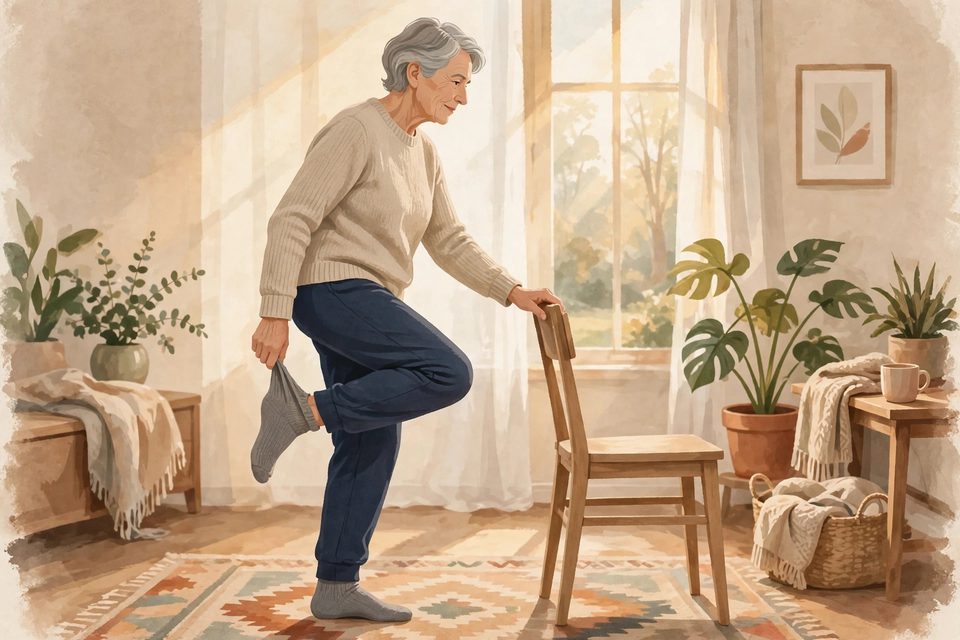
Can You Put On Your Socks Standing Up?
You know the moment.
One foot planted, sock in hand, the other leg hovering — and suddenly you're grabbing the dresser to steady yourself.
It feels like a small thing. A wobble.
But a study of 13,423 adults aged 65 and older suggests that little wobble carries real information about your health — and how long you may live.
What the Researchers Did
The study, published in JAMA Network Open, used Taiwan's national fitness testing program.
Between 2015 and 2016, community-dwelling adults aged 65 and up — average age about 73, 62.5% women — completed a battery of simple fitness tests.
Their results were linked to national health records, and researchers tracked who died over a median follow-up of 7 years. In that time, 1,631 participants (12.2%) died.
The tests were ordinary:
- Standing on one leg, eyes open, for up to 30 seconds
- The 8-foot up-and-go — stand from a chair, walk around a marker 8 feet away, sit back down
- The 30-second chair stand — how many times you can rise from a chair in half a minute
- The 2-minute step test — stepping in place, for heart and lung fitness
What They Found
People who scored in the top fifth on these tests were far less likely to die during follow-up than those in the bottom fifth, even after adjusting for other factors:
- Fastest on the up-and-go: 59% lower risk of death
- Best one-leg balance: 50% lower risk
- Most chair stands: 45% lower risk
- Best step test: 42% lower risk
Combining the tests into one overall fitness score showed the strongest link of all: the fittest group had a 61% lower risk of dying than the least fit.
Balance and agility came out ahead of strength and stamina — and the flexibility tests did not show the same connection to survival.
That fits: balancing on one leg quietly uses your eyes, inner ear, leg strength and your brain's sense of where your body is, all at once.
The Honest Part
This is an association, not a promise.
The study was observational: it shows that people who balanced well tended to live longer, not that practising the sock test will add years to your life.
A few caveats the researchers themselves note:
- Fitness was measured once, at the start — nobody was followed to see whether improving a score changed anything.
- People who volunteer for fitness testing may be healthier than average to begin with.
- Balance may partly be a marker of underlying health rather than a cause of it.
Think of the one-leg stand as a dashboard light, not the engine — a poor score is a nudge to pay attention, not a verdict.
Worth Trying at Home
Stand near a counter or sturdy chair. Lift one foot and time yourself, eyes open, then try the other side.
If 30 seconds feels easy, that's a good sign. If it doesn't, that's information — and balance is trainable at almost any age with gentle, regular practice.
The Twikup Take
The most revealing health test in this study costs nothing and takes 30 seconds.
You don't need to ace it — but if the sock wobble is getting wobblier, treat it as an early, friendly warning worth acting on.
Health note: This article is general information about a research study, not medical advice. Practise balance exercises next to a counter or sturdy chair, and stop if you feel dizzy or unsafe. If you have had falls, or concerns about your balance or mobility, talk to your doctor or a physiotherapist before starting a new exercise routine.
Image: AI-generated illustration.