
Key Takeaways
- BMI sorts adults into risk bands (under 18.5, 18.5–24.9, 25–29.9, 30 and over) but can't tell muscle from fat — or where the fat sits.
- Waist size adds what BMI misses: risk rises at 94 cm for men and 80 cm for women, and hits the high-risk zone at 102 cm and 88 cm.
- Both are screening tools for adults 18 and over, not diagnoses — Health Canada says use them as one part of a fuller health assessment.
Two Numbers Walk Into a Doctor's Office
Your BMI is probably on your medical chart. Your waist size probably isn't. Which is strange, because of the two numbers, the tape measure might be the one telling the truth.
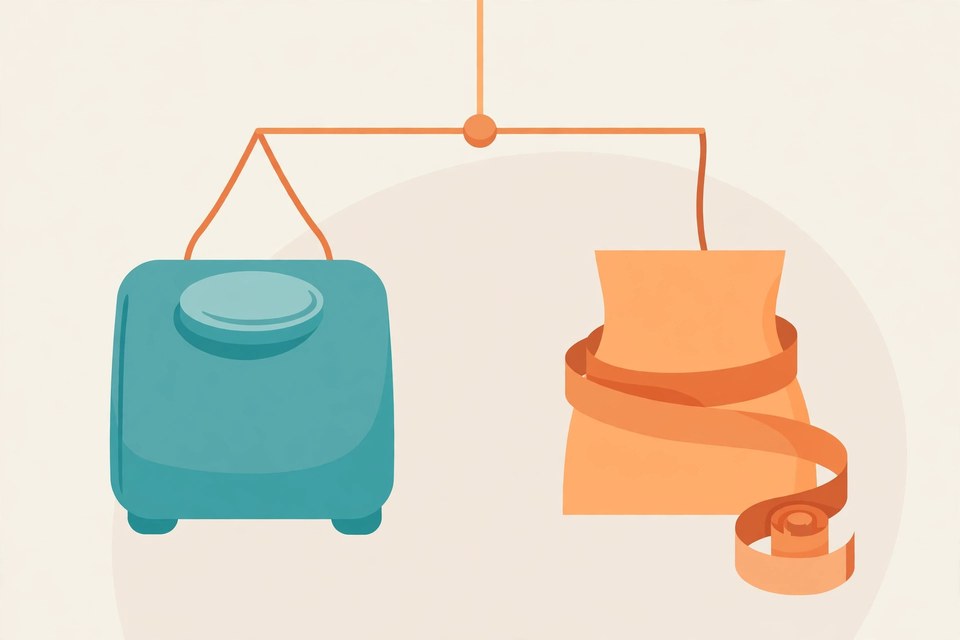
Canada's official weight-classification system uses both — body mass index (BMI) and waist circumference — because each catches things the other misses.
BMI: The Quick Sort
BMI is a ratio: your weight in kilograms divided by your height in metres, squared. It is not a direct measure of body fat — it's a sorting tool, built from population data, that groups adults 18 and over into risk bands:
- Under 18.5 — underweight, increased risk
- 18.5 to 24.9 — normal weight, least risk
- 25.0 to 29.9 — overweight, increased risk
- 30.0 and over — obese, high to extremely high risk (Class I: 30.0–34.9, Class II: 35.0–39.9, Class III: 40 and over)
Try it: at 90 kg and 1.75 m, your BMI is about 29.4 — top of the overweight band. Simple, fast, and rough. And roughness is the problem.
Where BMI Gets It Wrong
BMI can't see what your weight is made of, or where it sits. Health Canada itself flags that it can overestimate or underestimate risk in highly muscular adults, very lean builds, young adults still growing, and adults over 65.
The classic case: a rugby player, 105 kg at 1.83 m, scores a BMI of about 31 — "obese" on paper, lean in real life. The formula can't tell muscle from fat, so it guesses wrong.
The quieter, more dangerous miss runs the other way: someone with a "normal" BMI of 23 who carries most of their fat around the middle. BMI calls them fine. Their waist disagrees.
Waist Size: The Number That Sees the Belly
Waist circumference is an indicator of abdominal fat — the fat packed around the waist and upper body (the "apple" shape), which Health Canada notes carries greater risk than fat on the hips and thighs (the "pear"). This fat, wrapped around internal organs, is the kind most closely tied to type 2 diabetes, coronary heart disease and high blood pressure.
- Risk starts rising at 94 cm (37 in.) for men and 80 cm (32 in.) for women — the increased-risk band used with the Canadian classification system.
- At 102 cm (40 in.) for men and 88 cm (35 in.) for women, you're in the high-risk zone — the cut-offs Health Canada associates with increased risk of type 2 diabetes, coronary heart disease and high blood pressure.
Health Canada adds that these cut-offs are approximate — a waist just under the line still deserves attention. The two numbers also work as a team: for BMIs of 18.5 to 34.9, a large waist bumps your risk classification up a level. (Above a BMI of 35, the waist adds little — risk is already high.)
To measure correctly: find the point midway between your lowest rib and the top of your pelvic bone (the iliac crest), wrap the tape there, snug but not squeezing, at the end of a normal breath out.
So Which Number Wins?
Neither — that's the point of using both. BMI is the cheap, fast first pass; waist size catches the muscular person BMI falsely accuses and the normal-weight person BMI falsely clears. Track only one at home, and the tape is arguably the more honest tool — but either way, treat a high reading as a prompt to talk to a health professional, who can weigh it alongside blood pressure, blood sugar, cholesterol, fitness and family history.
The Twikup Take
BMI is a bouncer checking IDs at the door — quick, roughly right, occasionally wrong about who's actually trouble. Waist size checks what's in the bag.
Your scale knows how much of you there is. The tape knows where it went.
Health note: BMI and waist circumference are screening tools for adults 18 and over — not for children, and not during pregnancy or breastfeeding — and they are not a diagnosis. This article is general information, not medical advice. If you're concerned about your weight or risk, talk to your doctor for a complete assessment.
Image: AI-generated illustration.