
Key Takeaways
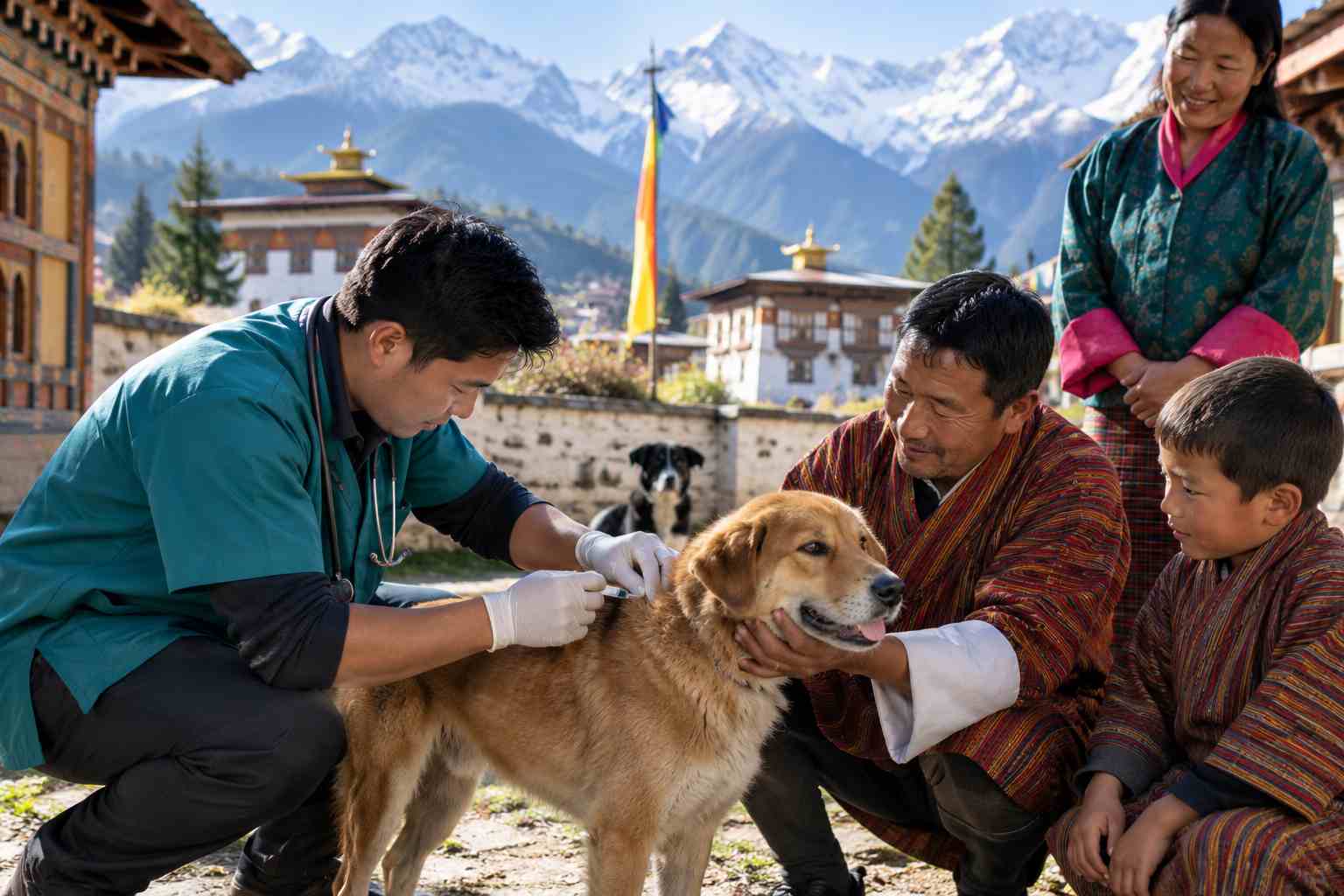
- Bhutan is the first country in the WHO South-East Asia Region to achieve validated elimination of dog-transmitted rabies as a public-health problem.
- Bhutan has maintained zero human deaths from dog-mediated rabies since June 2023, supported by vaccination, surveillance, post-exposure treatment and dog-population management.
- WHO's independent assessment included a 17-22 August 2026 field mission, where experts reviewed health facilities, laboratories, programme records, information systems and the Bhutan-India border area.
A Major Win Against a Deadly Disease
Rabies is unusual among infectious diseases because prevention can make such a dramatic difference.
Once clinical symptoms appear, rabies is almost always fatal. But deaths can be prevented when infected dogs are controlled and people exposed to the virus receive appropriate post-exposure treatment quickly.
That makes prevention especially important.
WHO says Bhutan's success shows what can happen when dog vaccination, human healthcare, surveillance and community action are treated as parts of the same problem rather than separate issues.
Bhutan's First-of-Its-Kind Achievement
The WHO validation gives Bhutan a particularly notable place in the region.
It is the first country in the WHO South-East Asia Region to have dog-transmitted rabies validated as eliminated as a public-health problem.
The achievement also contributes to the broader global goal of ending human deaths from dog-mediated rabies by 2030.
For Bhutan, however, the milestone is the result of more than a decade of sustained work.
The Strategy Was Bigger Than Vaccinating Dogs
One of the most interesting parts of Bhutan's story is that vaccination was only one piece of the puzzle.
The country used a broader One Health approach, recognizing that human health, animal health and the environment are closely connected.
Bhutan strengthened disease surveillance, improved coordination between human and animal health authorities and developed systems for responding when suspected rabies cases were reported.
That meant a suspected case could trigger cooperation between different teams rather than leaving each side to work independently.
The Dogs Were at the Centre of the Fight
Because dogs are the main source of human rabies transmission, controlling the disease in dogs is critical.
Bhutan expanded mass dog vaccination and dog-population management across the country.
WHO also highlighted the work of De-suung volunteers, known as the "Guardians of Peace," who helped take dog vaccination, population management and community awareness efforts into communities across Bhutan.
The strategy focused on stopping transmission at its source while protecting people who might still be exposed.
What Happens After a Dog Bite?
Preventing every possible exposure is difficult.
That is why Bhutan also maintained access to post-exposure prophylaxis, commonly known as PEP.
PEP can prevent the virus from reaching the central nervous system after an exposure. It includes thorough wound washing, a course of human rabies vaccine and, when indicated, rabies immunoglobulins.
Bhutan plans to continue providing universal, free access to PEP across all 20 districts, known as Dzongkhags.
That continued access is important because elimination does not mean the risk of reintroduction disappears forever.
WHO Put Bhutan's Claim to the Test
The achievement was not simply declared by Bhutan and accepted automatically.
WHO's validation followed an independent assessment against established technical criteria.
A regional Dossier Review Group, convened by WHO with support from the World Organisation for Animal Health, carried out a two-phase review.
The process included a review of Bhutan's official dossier followed by a field mission from 17 to 22 August 2026.
Experts visited health facilities, walked through laboratories, reviewed programme records and information systems, visited the Bhutan-India border area and spoke with people involved in the programme.
The purpose was to verify that the progress reported on paper was supported by evidence on the ground.
Zero Human Deaths Since June 2023
One of the key requirements for WHO validation is sustained interruption of human transmission.
Bhutan has maintained zero human deaths from dog-mediated rabies since June 2023.
WHO's criteria recognize elimination as a public-health problem when a country has had no human deaths from dog-transmitted rabies for at least two years while also demonstrating the ability to prevent transmission from returning.
Bhutan's surveillance, laboratory capacity, animal vaccination and post-exposure systems were therefore central to the validation.
The One Health Approach Made the Difference
Bhutan's experience also highlights an increasingly important idea in public health: diseases do not always fit neatly into one department.
Rabies sits at the intersection of human health and animal health.
A person can be exposed through an infected animal, while controlling the disease requires veterinary teams, healthcare workers, laboratories, communities and government agencies to work together.
WHO says Bhutan's achievement demonstrates how this One Health approach can be used to tackle a serious public-health threat.
The Work Is Not Over
Elimination does not mean Bhutan can simply stop its rabies programme.
The country plans to continue mass dog vaccination, dog-population management and integrated human-animal surveillance.
It will also maintain free access to post-exposure prophylaxis across all 20 districts.
Bhutan is also strengthening cross-border coordination with neighbouring Indian states.
That matters because infectious diseases do not respect national borders.
Maintaining surveillance and rapid response will be essential to protecting the progress Bhutan has already made.
A Community Achievement
WHO's announcement credits the achievement to more than government policy.
Bhutan's Ministry of Health and Ministry of Agriculture and Livestock led the programme alongside the De-suung national volunteer service and local communities.
WHO and the World Organisation for Animal Health provided technical support, while financing came through the Bhutan Health Trust Fund and partners including the Pandemic Fund.
The result is a useful reminder that public-health victories are often built slowly, through thousands of practical actions rather than one dramatic event.
What Bhutan's Success Means for Other Countries
Rabies remains a serious global health problem, particularly in communities where access to prevention and treatment can be limited.
WHO says dog-mediated transmission accounts for up to 99% of human rabies transmissions globally.
That makes Bhutan's achievement relevant beyond its borders.
The country has demonstrated that eliminating dog-transmitted human rabies is possible when governments combine animal vaccination, human healthcare, surveillance, community participation and cross-sector cooperation.
Other countries in the region can look to that experience as they work toward the global goal of ending human deaths from dog-mediated rabies.
From Public-Health Threat to Historic Milestone
For years, rabies was a serious public-health concern in Bhutan, particularly in southern border districts.
Now, WHO has formally validated the country's progress.
The achievement is not the end of the work. Bhutan will continue vaccination, surveillance, dog-population management and access to post-exposure treatment to prevent the disease from returning.
But the milestone is significant.
Bhutan has become the first country in WHO's South-East Asia Region to eliminate dog-transmitted rabies as a public-health problem.
And behind that achievement is a simple lesson: when communities, healthcare workers and animal-health teams work toward the same goal, a disease that once seemed difficult to control can become preventable.
Bottom Line
Bhutan has achieved a historic public-health milestone by becoming the first country in the WHO South-East Asia Region to have the elimination of dog-transmitted human rabies validated.
Years of dog vaccination, population management, surveillance, post-exposure treatment and community participation helped the country maintain zero human deaths from dog-mediated rabies since June 2023.
Now Bhutan's challenge is to protect that achievement.
Its next chapter will be about keeping the systems strong enough to make sure rabies does not return.