
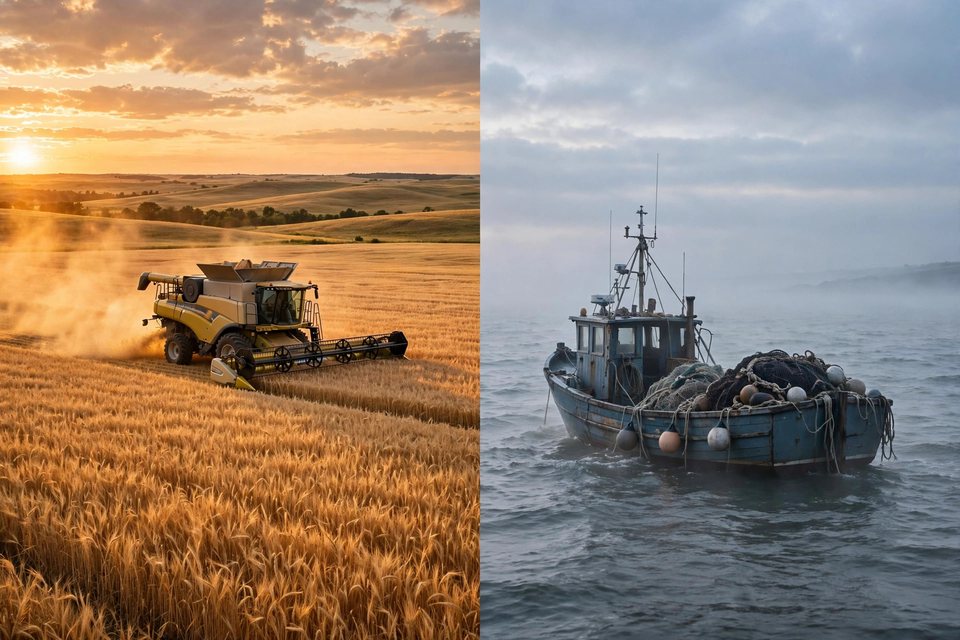
A Tale of Two Harvests: Record Crops on Land, Emptier Nets at Sea
Canada's fields delivered a record harvest. Its fishing boats brought home their smallest catch in more than two decades.
Same country. Two very different harvest stories.
Statistics Canada's latest Census of Environment release, published today, reveals a striking contrast in what Canada's ecosystems are supplying.
On land, crops are breaking records. At sea, commercial fish landings have fallen for five straight years.
And the numbers tell the story.
Record Year in the Fields
Canada's farms had a remarkable 2025.
Agricultural ecosystems supplied 146.6 million tonnes of biomass, with field crops — grains, oilseeds and pulses — stealing the spotlight.
They reached a record 109.3 million tonnes, up 11% from the previous year, helped by favourable growing conditions.
The Prairie provinces delivered their own milestones:
- Saskatchewan: 42.7 million tonnes — a provincial record.
- Alberta: 28.4 million tonnes — a provincial record.
- Manitoba: 15.7 million tonnes — a provincial record.
And the bumper harvest story didn't stop there.
Vegetable production reached 8.2 million tonnes.
Quebec's fruit harvest has nearly tripled since 2002, climbing from 116 thousand tonnes to 326 thousand tonnes.
But while Canada's fields were setting records, the story offshore looked very different.
The Sea Tells a Different Story
Five years. Five consecutive declines.
Canada's sea fisheries landings dropped again in 2024, falling to 613 thousand tonnes — their lowest level since 2002.
And it wasn't confined to one coast.
British Columbia, Nova Scotia, New Brunswick and Quebec all recorded their lowest sea fisheries landings since 2002.
The contrast is hard to miss: record field crops on land, but commercial fish landings at a more-than-two-decade low.
Canada's forests tell another story of change.
They supplied 118.4 million tonnes of timber in 2024, accounting for 46% of Canada's commercially harvested biomass.
Back in 2002, timber accounted for more than 70%.
British Columbia's timber harvest has also fallen by about half over that period.
And amid all those shifting numbers, there's one sweeter development.
Maple syrup production grew to 113.5 thousand tonnes in 2025.
Why StatCan Counts This
So why put crops, fish, timber and maple syrup in the same report?
Because they're all part of what Canada's ecosystems provide.
Statistics Canada's Census of Environment tracks resources such as food, wood, water and fuel, helping Canadians make evidence-based decisions about protecting and sustaining them.
There's an important boundary to these figures.
They cover commercial harvesting and exclude subsistence, recreational and Indigenous food, social and ceremonial harvesting.
That distinction matters: lower commercial fish landings don't, by themselves, tell us how many fish remain in the water.
The Twikup Take
Canada's harvest story isn't simply one of abundance or decline.
It's both.
Prairie fields are producing record crops. Commercial fishing boats are bringing home less than they have in over two decades. And forests are contributing a smaller share of commercially harvested biomass than they once did.
The lesson isn't that every ecosystem is heading in the same direction. It's that they're telling different stories — and each deserves attention.
Canada's fields may be breaking records, but its seas are reminding us that not every harvest is growing.
Image: AI-generated illustration.