
Key Takeaways
- Canada can capture more value from critical minerals by building competitive processing capacity, not only expanding mines.
- China's processing dominance and U.S. demand make supply-chain diversification and negotiating power central to Canada's strategy.
- Ring of Fire development involves infrastructure costs, environmental protection, Indigenous rights and questions over who benefits.
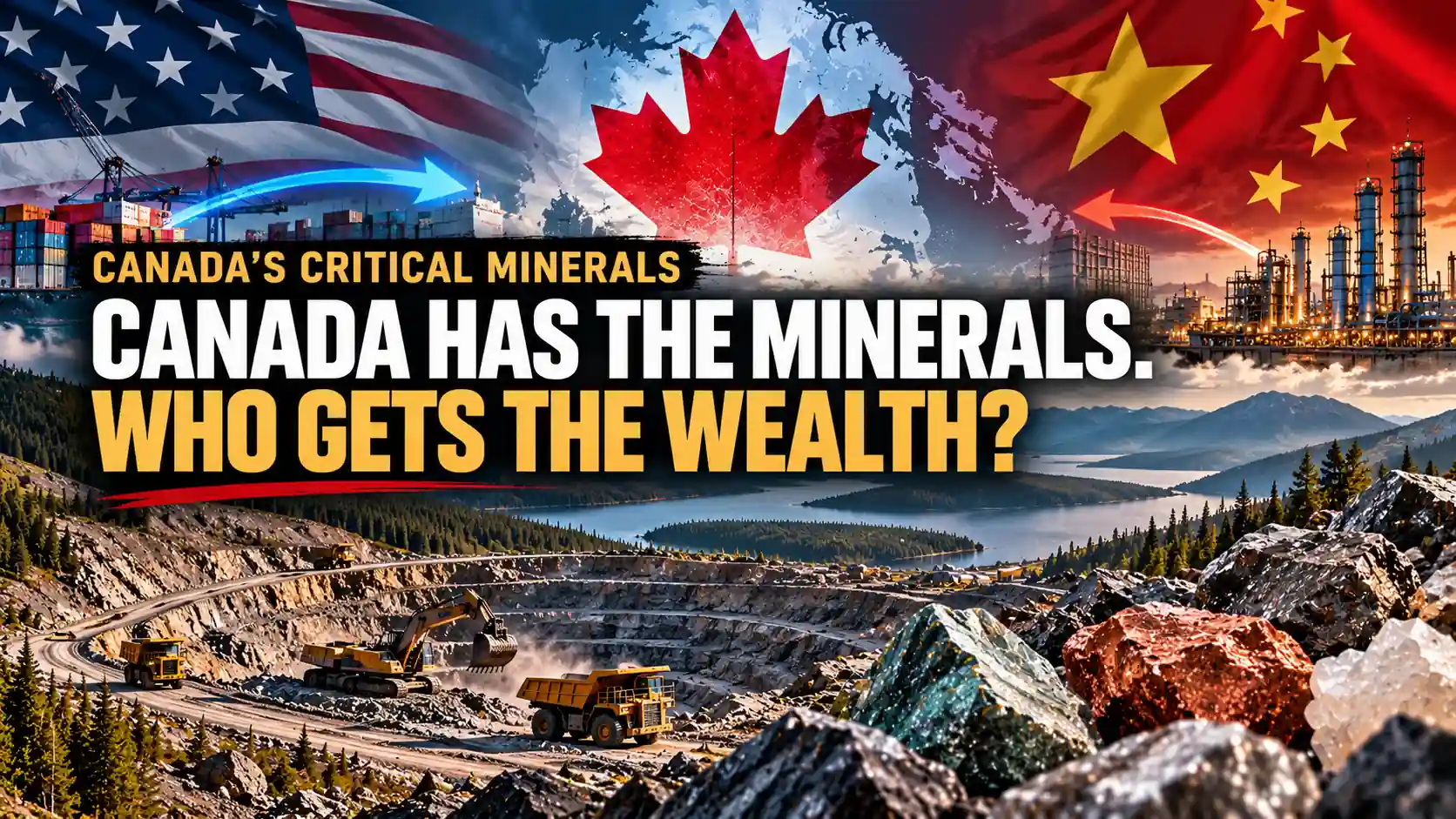
Canada has the minerals needed to power tomorrow's electric cars, fighter jets and advanced technology. But what if Canadians dig them out of the ground while other countries build the billion-dollar industries around them?
Canada gets the mine. Someone else gets the factory.
That is the uncomfortable question behind the global race for critical minerals.
With China dominating major processing supply chains and the United States seeking secure access to strategic materials, Canada has an opportunity to become far more than a supplier of raw resources.
But who will actually control the wealth?
Why Everyone Suddenly Wants Canada's Minerals
Lithium helps power rechargeable batteries. Nickel is used in certain EV batteries. Copper connects electrical grids, while rare earth elements are essential for powerful magnets used in electric motors and defence equipment.
These materials have become strategically important because modern economies increasingly depend on them.
Canada has significant deposits of several critical minerals. Yet extracting them is only one part of the business.
The real money-making opportunity may be in what happens after the minerals leave the mine.
China Controls More Than Just Mines
Here is a number that should get Canada's attention.
According to the International Energy Agency's Global Critical Minerals Outlook 2026, the leading refining country accounted for an average of 72% of production across key energy minerals, excluding rare earths, in 2025.
China dominates the processing of several of those minerals.
That concentration gives countries and businesses controlling processing facilities enormous influence over global supply chains.
In 2025, Chinese restrictions on certain rare earth exports disrupted manufacturers abroad, demonstrating how quickly supply-chain dependence can become an economic problem.
Canada may possess valuable deposits, but without sufficient processing capacity, it could still depend on foreign facilities to turn those resources into usable industrial materials.
America Wants Canada's Minerals. But at What Price?
The United States needs reliable supplies for its automotive, technology and defence industries.
Canada is an obvious partner because of its geography, established trade relationships and mineral resources.
But there is a familiar danger.
If Canadian mines depend heavily on American customers, Canada could find itself repeating an old economic pattern: supplying resources while higher-value manufacturing takes place elsewhere.
That concern is part of a larger debate explored in TwikUp's analysis of whether Canada can escape America's economic dependence.
Canada does not need to reject American investment. It needs enough customers, processing capacity and negotiating power to avoid becoming dependent on a single market.
Who Gets Rich When Canada Digs?
Imagine a hypothetical Canadian lithium mine.
The company extracts the mineral, exports it for processing, and the refined material eventually enters a battery manufactured overseas.
Canada benefits from mining jobs, business activity and applicable taxes and royalties.
But other countries may capture additional value from refining, manufacturing and specialized technology.
Now imagine Canada builds competitive processing facilities alongside its mines.
More of that economic activity could remain in the country.
There is a catch, however. Processing facilities require enormous investment, specialized expertise and reliable customers. The IEA reports that new refining projects outside dominant supplier countries can face substantially higher construction and operating costs.
Canada's challenge is not to manufacture everything. It is to capture the parts of the supply chain where it can compete successfully.
Ontario's Ring of Fire: A Fortune Beneath the Forest?
Northern Ontario's Ring of Fire contains significant mineral deposits, including chromite and nickel.
It also presents one of Canada's most complicated development challenges.
The region is remote, infrastructure is expensive, and proposed mining development raises important questions about wetlands, water protection and Indigenous rights.
In June 2026, federal authorities completed their impact assessment of the Webequie Supply Road, a proposed 107-kilometre route connecting Webequie First Nation with the mineral-rich region. The decision allowed the project to proceed subject to legally binding conditions.
Road development could improve access and create economic opportunities, but it does not automatically guarantee that every proposed mine will be approved or profitable.
Indigenous communities also have differing positions on particular projects. Some are pursuing development partnerships, while others have raised concerns about environmental impacts and decision-making authority.
The issue is not simply whether valuable minerals should be extracted.
It is who decides, who benefits and who bears the consequences.
Could Canada's Arctic Become Another Strategic Battleground?
Critical minerals are not the only northern resources attracting international attention.
Canada's Arctic geography also matters for shipping, security and potential access to global markets.
The Northwest Passage dispute between Canada and the United States illustrates a related challenge: Canada claims authority over important northern waterways, while Washington disputes the legal status of the shipping route.
The Arctic shipping dispute is separate from mineral ownership, but both raise questions about Canadian sovereignty, infrastructure and economic control.
And neither can be resolved by simply pointing to a map.
Can Canada Become a Critical Minerals Superpower?
There are three realistic possibilities.
The industrial powerhouse: Canada develops mines, competitive processing facilities and manufacturing partnerships, creating more skilled jobs and economic value.
The resource supplier: Mining expands, but much of the higher-value processing and manufacturing happens overseas.
The missed opportunity: High costs, financing problems, infrastructure shortages and unresolved disputes leave valuable deposits undeveloped.
None of these outcomes is guaranteed.
Canada already reviews sensitive foreign investments, and its Critical Minerals Strategy aims to strengthen domestic supply chains while working with international partners.
The challenge is turning those ambitions into commercially successful projects that respect environmental obligations and Indigenous rights.
Canada Has the Minerals. Will It Keep the Opportunity?
Canada does not need to own every factory or exclude foreign companies to benefit from its resources.
It needs a strategy that turns mineral deposits into lasting jobs, profitable industries, secure supply chains and meaningful benefits for affected communities.
Because extracting a valuable mineral is not the same as controlling the industry built around it.
A generation from now, will Canadians look back at critical minerals as the foundation of a new industrial economy — or another chapter in which Canada exported the resources and bought back the finished products?
Sources
- TwikUp — Can Canada Escape America's Economic Grip or Is It Trapped by Geography?
- TwikUp — Northwest Passage: Why Canada and the US Disagree Over This Arctic Shipping Route
- International Energy Agency — Global Critical Minerals Outlook 2026
- Natural Resources Canada — Canadian Critical Minerals Strategy
- Government of Canada — Critical Minerals Strategy Annual Report
- Impact Assessment Agency of Canada — Webequie Supply Road Decision, June 2026
- Government of Ontario — Webequie Supply Road Project