
Key Takeaways
- Geography, transport costs and established supply chains keep Canadian exports closely tied to the U.S. market.
- Oil diversification requires viable pipelines, terminals, shipping and compatible refineries—not just overseas buyers.
- Diversification succeeds when alternative customers, suppliers and routes can sustain themselves commercially.
Canada wants more customers beyond the United States. But moving trade is harder than moving a line on a spreadsheet. Pipelines, car factories and the distance to the nearest buyer explain why.
A Canadian prime minister can announce a new trade strategy in an afternoon.
An oil pipeline cannot turn around quite so quickly.
That is the awkward reality behind Canada’s recurring ambition to become less dependent on the United States. Ottawa can court European leaders, sign agreements across the Pacific and encourage businesses to look overseas. But when a Canadian company receives an order, someone still has to deliver it profitably.
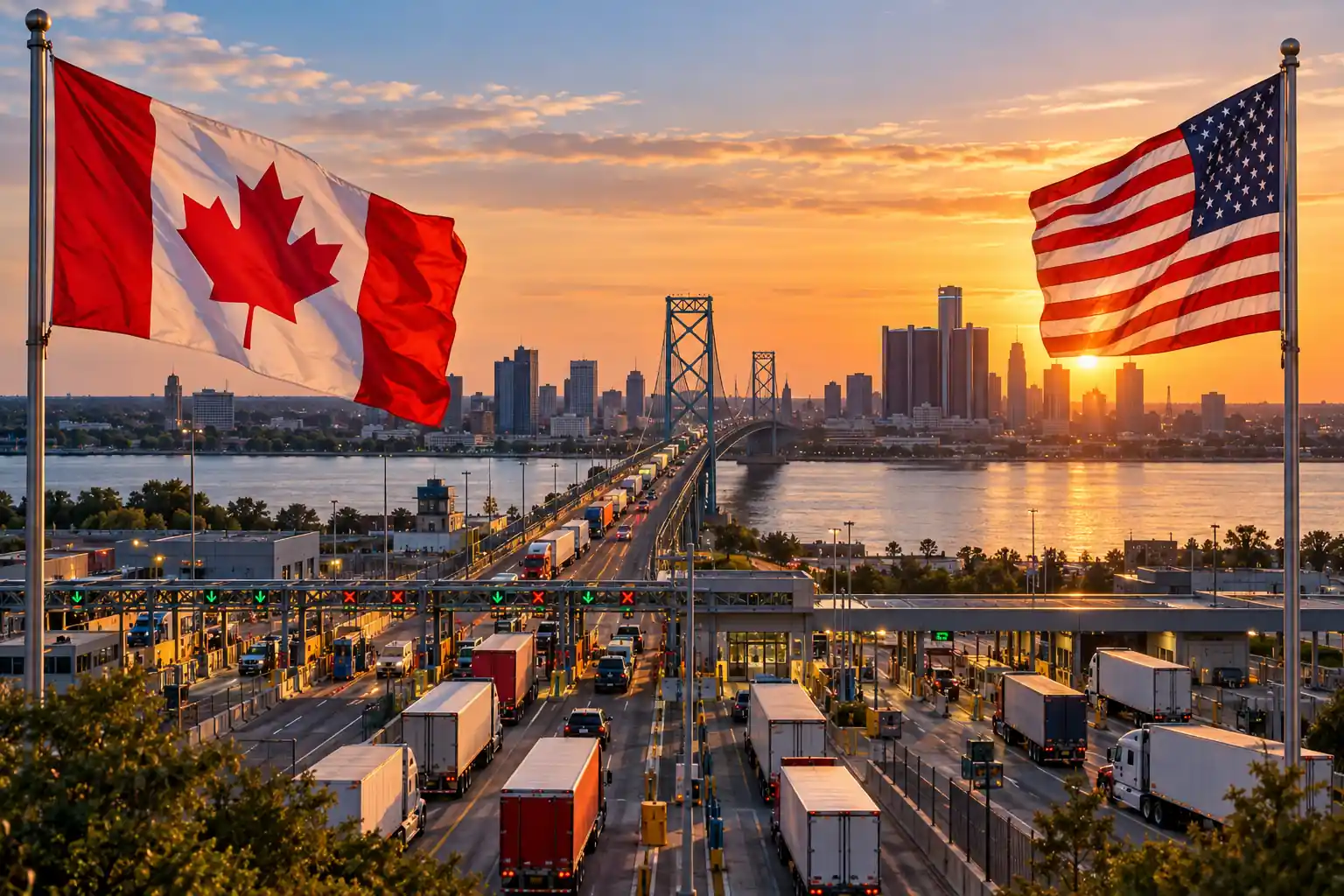
For a factory in Windsor, Detroit is across the river. A customer in Germany is across an ocean.
The difference arrives on the shipping bill.
Canada can reduce its dependence on America. Doing so will require changing the commercial calculations that keep sending Canadian products south.
America Is the Customer Next Door
In 2025, 72.5% of Canada’s merchandise exports went to the United States, down from 76.3% a year earlier. That is a meaningful decline, but it still means nearly three out of every four export dollars in goods came from the American market. Source: Global Affairs Canada
Consider a hypothetical Ontario manufacturer choosing between two customers.
The American buyer uses familiar suppliers and established trucking routes. The overseas buyer offers an attractive opportunity, but reaching it may require ocean freight, a distributor, different product specifications and more inventory sitting in transit.
The overseas deal might still be better. Proximity simply gives the American customer a head start.
Multiply that decision across thousands of businesses and Canada’s trade pattern becomes easier to understand. Companies are responding to delivery times, costs and purchase orders.
The difficulty is that what makes sense for each business can leave the country collectively exposed. If everyone chooses the convenient customer, a dispute with that customer becomes a national problem.
Oil Cannot Follow a Diplomatic Announcement
Oil offers the clearest example of dependence built into physical infrastructure.
Canada exported approximately 4.3 million barrels of crude oil a day in 2025. About 90.1% went to the United States, according to the Canada Energy Regulator. Source: Canada Energy Regulator
An interested buyer in Asia is only the beginning. A producer must get the oil to a suitable terminal, secure shipping and receive a price that makes the journey worthwhile. The buyer also needs a refinery suited to the crude on offer.
Think of it as finding a better-paying job in another city. The salary matters. So do the moving costs and whether you can actually get there.
Canada has demonstrated that new infrastructure can widen its choices. Global Affairs Canada reports that the Trans Mountain expansion helped boost crude exports to destinations including China, India and South Korea. Source: Canada’s merchandise trade performance
That is a tangible form of diversification: giving a product another commercially usable route to market.
The catch is that building those routes takes investment and time. A government can change its message overnight; exporters must work with the capacity available today.
A “Canadian Car” Can Be a Continental Project
Cars present an even more tangled challenge.
Picture an Ontario assembly plant. Its supplier network may include American components, Mexican parts and Canadian manufacturers, with production schedules coordinated across all three countries.
The federal government notes that vehicles can cross borders multiple times during production. North American manufacturing works through shared production systems, rather than neatly separated national industries. Source: Government of Canada’s CUSMA overview
Asking that factory to “trade elsewhere” raises two separate problems.
It needs customers elsewhere. It may also need to reorganize how it makes the vehicle in the first place.
Replacing a supplier can involve testing components, changing contracts and coordinating new delivery schedules. Selling the finished car overseas adds another set of questions about standards, distribution and demand.
A car intended for an American dealership does not acquire a European buyer because Canada wants a more balanced export chart.
This is why diversification must vary by industry. An oil producer needs transport capacity and suitable buyers. A carmaker may need changes across an entire production network.
There is no single switch marked “less America.”
Canada’s Diversification Story Has a Gold-Coloured Catch
There is encouraging evidence that Canadian exporters are finding business elsewhere.
But the headline numbers need a closer look.
Global Affairs Canada reports that rising exports to Europe and Central Asia in 2025 were driven mainly by gold shipments to the United Kingdom. Higher gold prices also supported Canada’s broader export performance. Source: Global Affairs Canada’s 2025 trade analysis
Those are real exports. They count.
Yet a surge in gold sales tells us something different from a surge in overseas orders for Canadian machinery, food or manufactured goods.
One can improve the national figures without demonstrating that businesses across the economy have developed durable alternatives to American customers.
The test is what sits beneath the percentage: more products, more repeat buyers and more businesses capable of surviving a disruption at the U.S. border.
Otherwise, a better-looking trade chart can encourage more confidence than the underlying changes justify.
Could Canada Find an Escape Route Through the Arctic?
Look at a map and another possibility appears: north.
The Northwest Passage connects the Atlantic and Pacific through Canada’s Arctic archipelago. It invites an appealing question: could a country seeking more trade options turn its northern geography into an advantage?
Potentially—but a line through the Arctic is not a ready-made shipping service.
Sea ice remains a navigation hazard, and increased activity brings risks for communities, ecosystems and limited emergency-response capacity. Commercial opportunity depends on whether ships can operate safely and reliably, not simply whether a route looks shorter. Source: Environment and Climate Change Canada
There is also a geopolitical complication. Canada considers the passage’s waters internal waters; the United States considers the route a strait used for international navigation. Source: Global Affairs Canada’s Arctic sovereignty briefing
TwikUp’s explainer on why Canada and the U.S. disagree over the Northwest Passage explores that dispute.
It connects to a larger point: trade routes are also questions of sovereignty, security and who sets the rules.
Even a discussion about Canada’s northern options eventually brings Washington back into the room.
America Has Something to Lose, Too
Canada’s dependence is substantial. Its bargaining position deserves a closer look as well.
In 2025, Canada supplied 63.4% of U.S. crude oil imports, according to the Canada Energy Regulator. That measures America’s imported crude, not its total oil consumption, but it shows the importance of Canadian supply within that market. Source: Canada Energy Regulator
The relationship gives both countries reasons to keep trade flowing. Disruption can hurt businesses on either side.
Still, mutual dependence does not guarantee equal leverage.
Consider two companies that trade with each other. One relies on the relationship for most of its sales. The other considers it an important part of a much larger business.
Both want the deal to continue. They enter a confrontation with different levels of exposure.
For Canada, the strategic value of diversification is therefore greater room to manoeuvre. A credible alternative customer can strengthen a business even when it continues selling primarily to America.
An option does not have to replace your biggest market to become valuable.
What Would Success Actually Look Like?
A useful Canadian trade strategy would start with a practical question: what prevents the next profitable overseas sale?
For one exporter, the obstacle might be rail or port capacity. For another, it could be financing, certification or finding a reliable distributor.
Those problems require specific solutions. More trade agreements can help open doors, but businesses still need a reason—and the ability—to walk through them.
Canada also has to decide what additional resilience is worth.
A company might accept somewhat higher costs to maintain a second supplier. A producer might value access to another export terminal even when its main customer remains American. Those choices can provide insurance against disruption.
But expensive alternatives that attract little sustained business would be a weak return on investment. Diversification works best when the new relationships can support themselves commercially.
The goal should be an economy with more viable choices: exporters that can reach several markets, supply chains that can absorb shocks and businesses that have somewhere to turn when their largest customer changes the terms.
Canada will remain America’s neighbour. It can change how much that fact limits its decisions.
The strongest outcome would be a country that trades confidently with the United States because the relationship works—and has profitable alternatives when it doesn’t.