
Key Takeaways
- Canada calls the Northwest Passage historic internal waters, while the United States considers it an international strait with transit rights.
- The 1988 Arctic Cooperation Agreement requires Canadian consent for U.S. icebreaker voyages without changing either country’s legal position.
- Declining summer sea ice may lengthen navigation windows, but persistent older ice still creates dangerous choke points.
In 1985, an American icebreaker sailed through the Northwest Passage without asking Canada’s permission. Ottawa gave its consent anyway. That diplomatic workaround captures a dispute the two allies still haven’t settled.
An American ship was heading through Canada’s Arctic islands. Canada said it needed permission. The United States declined to ask.
Then Ottawa did something revealing: it consented to the voyage anyway.
The ship passed. Neither government conceded its legal position.
That was the compromise surrounding the U.S. Coast Guard icebreaker Polar Sea in August 1985. Canada could maintain that the voyage had its approval. Washington could maintain that Canadian permission was unnecessary.
Four decades later, the underlying question remains: can foreign ships travel through the Northwest Passage as a matter of right, or does Canada get to decide who enters?
The Water Between the Islands
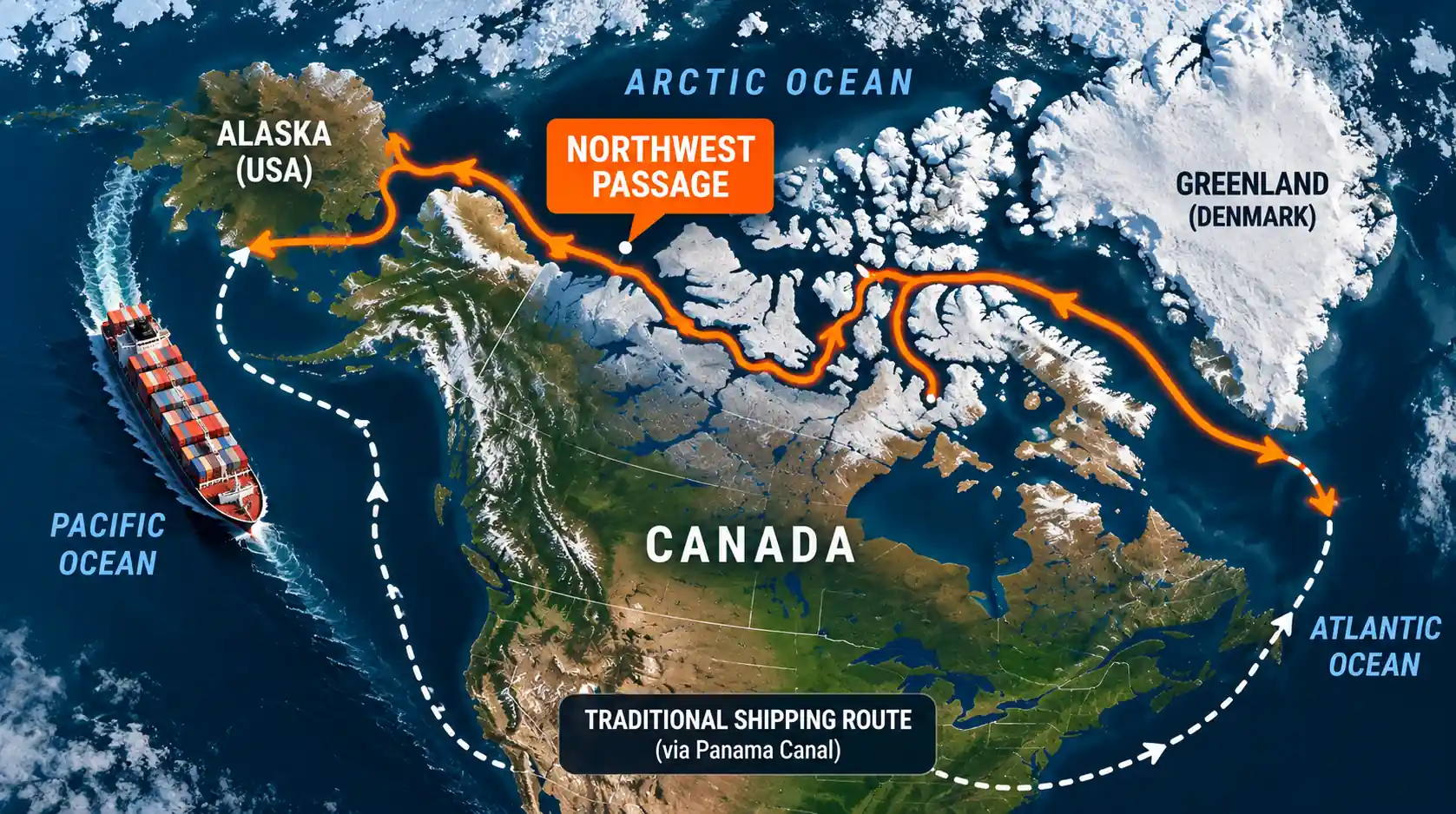
Look at a map of northern Canada. Beyond the mainland lies an enormous archipelago, divided by sounds, channels and straits.
Several routes through those waterways connect the Atlantic and Pacific oceans. Together, they are known as the Northwest Passage.
Canada’s ownership of its Arctic islands is not the central disagreement. The dispute concerns the legal status of the water between them.
Canada says these are historic internal waters, subject to Canadian sovereignty. The United States considers the passage a strait used for international navigation, where foreign vessels have a right of transit passage.
For a ship approaching the Arctic, that distinction has practical consequences.
Under Canada’s position, entry is subject to Canadian consent and control. Under Washington’s interpretation, qualifying transit is a right, although vessels must still follow the applicable rules of international law.
Both countries accept that rules apply. They disagree about which rules—and how much authority those rules give Ottawa.
The Voyage That Exposed the Divide
The Polar Sea did not invent this disagreement. The tanker Manhattan had already made the passage a political flashpoint in 1969.
But the 1985 voyage put the problem back in plain sight.
The United States notified Canada of the planned transit without requesting permission. Canada issued its consent while maintaining its sovereignty claim. The arrangement allowed the voyage to proceed without either side accepting the other’s interpretation.
It was a diplomatic solution to an immediate problem. The legal disagreement survived intact.
Canada then moved to make its claim more explicit.
In September 1985, Ottawa established straight baselines around its Arctic Archipelago, effective January 1, 1986. Canada maintained that the enclosed waters were already internal waters by historic title.
That last point matters. Under the UN Convention on the Law of the Sea, simply drawing straight baselines does not always extinguish passage rights. Canada’s argument rests on the waters’ claimed historic status, not merely the lines surrounding them.
The Agreement That Let Both Sides Hold Their Ground
In January 1988, Canada and the United States signed the Arctic Cooperation Agreement.
Its practical commitment was clear: navigation by U.S. icebreakers in waters Canada claimed as internal would take place with Canadian consent.
Then came the clause that made the compromise possible.
Nothing in the agreement, or in conduct under it, would change either government’s legal position.
Canada secured a consent arrangement. The United States preserved its objection to Canada’s interpretation.
The agreement covered U.S. icebreakers. It did not settle passage rights for every warship, commercial vessel or foreign government.
Its achievement was keeping a disagreement manageable. That is a considerable accomplishment between neighbours whose ships may need to cooperate in some of the world’s most difficult waters.
Why Washington Cares About a Frozen Passage
For the United States, the issue reaches beyond the Canadian Arctic.
Navigation rights underpin the movement of commercial shipping and military forces around the world. Accepting Canada’s position could complicate Washington’s arguments against restrictions elsewhere.
Transit passage, where it applies, includes rights for ships and aircraft. Coastal states retain regulatory powers, but those powers operate within international limits; transit passage cannot simply be suspended.
Canada sees the consequences from the opposite direction.
Accepting an international transit right would limit the control Ottawa claims over entry into these waters. Canada’s policy already permits international navigation subject to Canadian conditions protecting safety, security and the environment.
The disagreement is therefore about whether ships enter under Canada’s authority or exercise a right Canada must respect.
Less Ice Does Not Mean an Easy Shortcut
The passage attracts attention because geography offers a tempting possibility: a shorter journey between some Atlantic and Pacific destinations.
The obstacle is that a shipping route must be dependable, not merely navigable on a favourable day.
Summer sea ice in the Northwest Passage has declined over the long term. Yet Canada’s 2026 climate report describes a complication: thick, older ice can drift into the archipelago and collect in narrow channels, creating choke points.
A warming Arctic can therefore offer longer navigation windows while still producing dangerous local conditions.
That uncertainty matters to operators trying to keep schedules—and to northern communities relying on ships for supplies. The same report identifies persistent ice as a constraint on both international trade and community resupply.
The Northwest Passage is a potential shortcut with an unpredictable gate.
These Waters Are Already Someone’s Home
For Inuit communities, Arctic waterways have purposes that long predate any proposed global shipping corridor.
They connect communities and support travel, hunting and livelihoods. Canada’s account of its Arctic sovereignty also recognizes Inuit use and occupation of the region.
More marine activity can bring opportunities. It also raises the stakes of accidents, environmental damage and emergency response in places where assistance is limited.
A foreign vessel’s navigation rights are one question. Who bears the consequences of its passage is another.
Any serious account of the Northwest Passage needs both.
The Compromise Has Held. The Question Remains.
Canada and the United States have spent decades cooperating without settling their disagreement.
The 1988 agreement gave them a way to manage U.S. icebreaker voyages. Difficult ice conditions have continued to constrain the passage’s commercial potential. Neither development resolved its legal status.
More shipping would not automatically prove Washington right. Retreating ice would not automatically erase Canada’s claim. But greater use could make the disagreement harder to leave in the background.
The Polar Sea voyage showed how both governments could let a ship through while preserving incompatible positions.
Canada said yes. America maintained it did not need to ask.
Sources
- U.S. Naval War College — Excessive Maritime Claims
- Global Affairs Canada — Minister of Foreign Affairs Briefing Book, May 2025
- Government of Canada — Territorial Sea Geographical Coordinates (Area 7) Order
- Government of Canada — Canada–United States Arctic Cooperation Agreement, 1988
- United Nations — Convention on the Law of the Sea, Part III
- Environment and Climate Change Canada — Canada’s Changing Climate Report 2026, Chapter 6