
A young Canadian sends out 100 résumés for an entry-level job and hears almost nothing back.
At the same time, a newcomer who arrived in Canada with years of professional experience is driving for a delivery app because employers will not recognize their foreign experience.
Both look at Canada's labour market and think something has gone wrong.
But they may blame completely different things.
For some Canadians, the explanation seems obvious: Canada brought in too many people too quickly, creating more competition for jobs.
For many immigrants, the story looks very different: they were invited to Canada because the country said it needed workers, only to discover that getting a good job can be remarkably difficult.
So who is right?
The uncomfortable answer is:
Both experiences can be real at the same time.
Immigration increases Canada's labour supply and can increase competition for some jobs, particularly when population growth is rapid and hiring is weak.
But that does not mean immigrants simply "take" a fixed number of Canadian jobs.
Immigrants are also workers, consumers, taxpayers, entrepreneurs and employers. They create demand for housing, groceries, transportation, healthcare, banking, restaurants and countless other services — demand that can create additional employment.
The bigger question facing Canada in 2026 is therefore not:
"Are immigrants stealing Canadian jobs?"
It is:
Did Canada allow its labour force to grow faster than its economy could successfully absorb it?
Quick Answer
Immigration is not simply "taking over Canadian jobs," but rapid population and labour-force growth can increase competition for employment when job creation fails to keep pace.
That distinction matters.
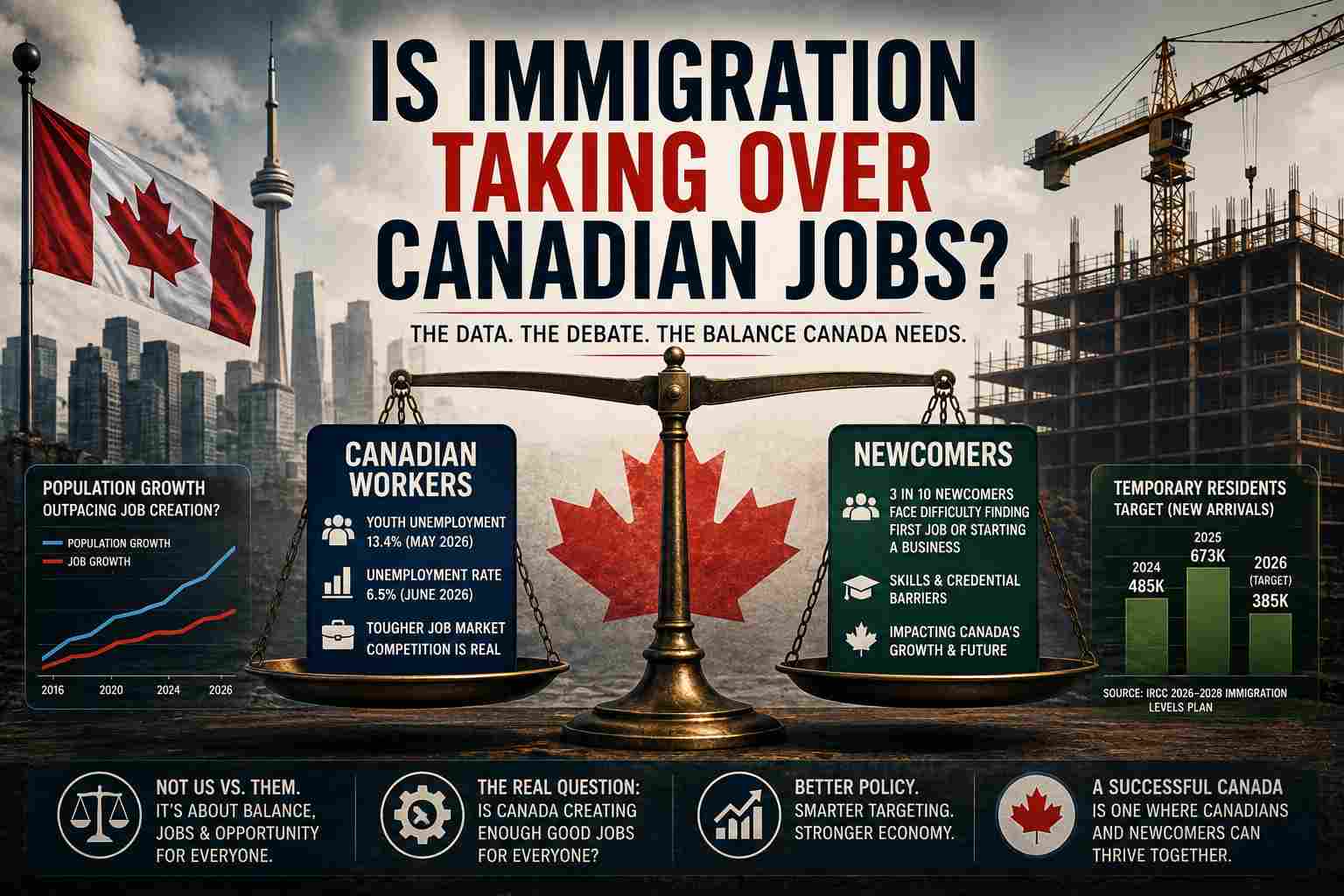
Canada's labour market is currently relatively soft. The Bank of Canada reported that the unemployment rate was 6.5% in June 2026, while businesses remained reluctant to hire aggressively because of weak demand and economic uncertainty.
Young Canadians have faced particularly difficult conditions. Statistics Canada reported a 13.4% youth unemployment rate in May 2026, still considerably above its pre-pandemic average.
At the same time, newcomers themselves frequently struggle to establish careers in Canada.
Statistics Canada found that roughly three in ten recent working-age immigrants and non-permanent residents experienced problems or difficulties finding their first Canadian job or starting their first business.
So the evidence points toward something more complicated than Canadians versus immigrants.
Canada appears to have experienced a labour-market matching problem: a rapidly changing workforce colliding with insufficient job creation, skills mismatches, credential barriers and uneven demand across industries.
Why Canadians Are Asking This Question
Imagine a restaurant advertising ten entry-level positions.
If 30 people apply, competition exists.
If 300 people apply, competition becomes considerably more intense.
That basic economic intuition is not controversial.
When the number of people available to work rises faster than the number of suitable jobs, workers can face more competition.
Canada experienced extraordinary population growth during the first half of the 2020s, including significant growth in the number of international students and temporary workers.
The federal government has now explicitly changed course.
Under Canada's 2026–2028 Immigration Levels Plan, the target for new temporary resident arrivals was reduced to 385,000 in 2026, including approximately 230,000 workers and 155,000 international students.
Ottawa also intends to bring temporary residents below 5% of Canada's population by the end of 2027.
That policy reversal matters.
It is effectively an acknowledgment that immigration levels must be calibrated against Canada's ability to provide jobs, housing, healthcare and infrastructure.
But Does More Immigration Automatically Mean Fewer Jobs for Canadians?
No.
This is where the "one immigrant equals one fewer job for a Canadian" argument falls apart.
An economy does not contain a permanently fixed number of jobs.
Suppose 100,000 additional people move to Canada.
Those people need groceries.
They rent or purchase homes.
They buy phones.
They open bank accounts.
They take transit.
They purchase clothing.
They eat at restaurants.
Some start companies.
Others hire employees.
All of that generates additional economic activity.
Immigration therefore increases labour supply, but it can also increase demand.
The critical question is whether those two sides expand at roughly compatible speeds.
If businesses invest, productivity improves and employment grows alongside the population, a larger workforce can support a larger economy.
If hundreds of thousands of additional workers arrive while businesses stop hiring, however, competition for available positions can become much more visible.
And that is much closer to Canada's current problem.
Canada's Job Market Has Become Much Tougher
The timing matters enormously.
Canada is not currently experiencing an employment boom.
The Bank of Canada described hiring in July 2026 as subdued.
Businesses told the central bank they generally had sufficient capacity and were reluctant to expand hiring because demand growth remained soft and uncertainty persisted.
Canada's unemployment rate stood at 6.5% in June and had generally remained between 6.5% and 7% since the end of 2024.
That changes the immigration debate.
Bringing workers into an economy desperate for employees is very different from bringing workers into an economy where businesses are hesitant to hire.
The number of newcomers cannot therefore be analyzed independently from the number and type of jobs being created.
The Youth Employment Question Is Harder to Ignore
Perhaps the most politically explosive part of this debate involves young Canadians.
Statistics Canada reported that Canada's unemployment rate among people aged 15 to 24 was 13.4% in May 2026.
Youth unemployment had remained consistently above its pre-pandemic average since January 2024.
That does not prove immigration caused Canada's youth unemployment problem.
Interest rates, slower economic growth, automation, changes in retail and hospitality, employer behaviour and other factors all influence youth employment.
But it does make another question legitimate:
Should Canada continue bringing large numbers of temporary workers into occupations where young Canadians are already struggling to find work?
That question deserves evidence rather than slogans.
Canada may simultaneously have severe worker shortages in healthcare, construction or specialized trades while having an oversupply of applicants for some entry-level service jobs.
A national headline saying Canada either "needs workers" or "has too many workers" can therefore be misleading.
Both situations can exist in different occupations at the same time.
Temporary Immigration Changes the Debate
Permanent immigration and temporary migration should not automatically be treated as the same economic phenomenon.
Canada's temporary population expanded substantially during the previous decade.
Bank of Canada researchers found that temporary workers became younger and somewhat less concentrated in skilled occupations between 2015 and 2024.
They also found a substantial wage difference.
The average nominal wage gap between temporary workers and Canadian-born workers widened from approximately 9.5% in 2015 to 22.6% in 2024, although the researchers found that observable differences in worker characteristics could explain the increase.
This creates an important policy concern.
If employers have access to a large pool of workers willing — or economically forced — to accept relatively low wages, does that reduce the pressure on businesses to raise wages, automate or improve working conditions?
That question is different from accusing immigrants of deliberately suppressing wages.
Workers respond to the opportunities and immigration programs governments and employers make available.
The policy question is whether those programs produce the right incentives.
There Is Another Side Nobody Should Ignore: Immigrants Are Struggling Too
Here is where the story becomes uncomfortable for people on both sides of the debate.
Newcomers are not necessarily winning Canada's employment competition.
Many are losing too.
Statistics Canada found that about three in ten recent working-age immigrants and non-permanent residents experienced difficulties finding their first job or establishing their first business in Canada.
Some immigrants arrive with university degrees, professional experience and years of training only to discover that Canadian employers want "Canadian experience."
Engineers drive Ubers.
Experienced professionals work retail.
International graduates compete for entry-level positions.
Doctors can struggle through licensing systems while communities simultaneously report shortages of physicians.
Canada can therefore have skills shortages and skills waste at exactly the same time.
That is not an immigration success story.
But it is not accurately described as immigrants simply taking Canadians' jobs either.
It is evidence of a labour market that is failing to match people with the work Canada actually needs them to perform.
So Who Is Actually Competing With Whom?
This is the question policymakers should be obsessed with.
Canada does not have one national job market.
A nurse in Nova Scotia is not competing for the same vacancy as a software engineer in Toronto.
A construction worker in Calgary is not necessarily competing with an international student applying at a restaurant in Brampton.
The effect of immigration therefore depends heavily on:
- occupation,
- age,
- education,
- geography,
- immigration program,
- wage level,
- skill level,
- and the strength of the economy.
Highly specialized immigration can fill positions employers genuinely cannot staff domestically.
Rapid growth in workers concentrated in already crowded low-wage occupations can produce a completely different result.
That distinction is often lost when immigration becomes a political argument.
What About Wages?
This may ultimately be more important than the raw number of jobs.
Workers do not only compete over whether a job exists.
They compete over what employers need to pay to fill it.
Imagine a business struggling to hire workers at $18 an hour.
Normally, it has several options.
Raise wages.
Improve benefits.
Invest in technology.
Train inexperienced workers.
Or leave the position vacant.
But if another source of labour becomes readily available, the employer may have less incentive to increase compensation.
That does not mean immigration universally lowers Canadian wages.
It means policymakers should pay particular attention to programs that significantly expand labour supply in lower-paid occupations.
The Bank of Canada's research on temporary workers reinforces why this deserves scrutiny.
Then Why Does Canada Still Need Immigration?
Because Canada's demographic problem has not disappeared.
Canada has an aging population.
Workers retire.
Healthcare needs increase as the population ages.
Certain regions struggle to attract employees.
Businesses need specialized skills.
And Canada's future economic growth depends partly on having enough workers and taxpayers to support an aging society.
Stopping immigration entirely would therefore create its own serious economic problems.
The more useful debate is about composition, speed and targeting.
Canada may need immigration.
That does not automatically mean every immigration level is sustainable.
Those two statements can simultaneously be true.
Ottawa Has Already Started Pulling Back
Perhaps the clearest indication that Canada's previous trajectory created problems is the government's own policy response.
The 2026–2028 Immigration Levels Plan targets 385,000 new temporary resident arrivals in 2026, down sharply from the previous 2025 target.
Permanent resident admissions are planned at 380,000 annually from 2026 through 2028.
The government says the changes are designed to align immigration with Canada's labour market, housing supply, healthcare system and capacity to integrate newcomers.
That represents a major shift from the assumptions that shaped immigration policy only a few years ago.
Canada is no longer simply asking:
How many people can we attract?
It is increasingly being forced to ask:
How many people can we successfully absorb?
Those are very different questions.
The Part Both Sides Get Wrong
The strongest anti-immigration argument often assumes Canada's economy contains a fixed bucket of jobs that immigrants remove from Canadians.
It does not.
The strongest pro-immigration argument can make the opposite mistake: assuming that because immigration expands the economy overall, the distributional consequences do not matter.
They do.
An economy can become larger while particular groups of workers become worse off.
A business may benefit from a larger pool of applicants.
Consumers may benefit from more services.
Governments may collect additional taxes.
But a 19-year-old trying to land a first job may experience nothing except dramatically greater competition.
At the same time, the newcomer standing beside that Canadian in the interview line may have spent thousands of dollars coming to Canada after being told the country desperately needed workers.
Turning those two people against each other misses the bigger issue.
TwikUp Insight: Canada May Have Asked the Wrong Immigration Question
For years, Canada's immigration debate largely revolved around numbers.
Should Canada admit 300,000 people?
500,000?
More?
Less?
But the number alone may be the wrong metric.
The better question is:
How many newcomers can Canada integrate into productive employment without significantly worsening housing, infrastructure or labour-market pressures?
If Canada brings in a nurse but prevents her from working as a nurse, the country has not solved its healthcare shortage.
If Canada brings in an engineer who spends years driving for a delivery platform, Canada has increased population without fully capturing that worker's productive potential.
And if businesses can repeatedly hire temporary workers into low-wage occupations while Canadian teenagers cannot find their first jobs, policymakers should investigate whether the program is functioning as intended.
That is not anti-immigration.
It is a question about whether immigration policy is actually delivering what Canadians and newcomers were promised.
The Bottom Line
Are immigrants taking Canadian jobs?
Not in the simplistic sense suggested by that phrase.
Canada's economy does not have a fixed number of jobs, and immigrants themselves create economic demand, establish businesses, pay taxes and fill genuine labour shortages.
But dismissing Canadians' concerns about job competition would be equally simplistic.
When labour supply grows rapidly while hiring remains weak, competition for some jobs can increase. Young workers and people seeking entry-level employment may feel that pressure particularly strongly.
The evidence therefore points toward a more important conclusion:
Canada's problem is not simply immigration. It is immigration that becomes disconnected from job creation, housing, infrastructure and the actual needs of the labour market.
Canada does not have to choose between being pro-immigrant and pro-Canadian worker.
A successful immigration system should protect both.
Because if Canadians cannot find opportunities while newcomers cannot use the skills that brought them here, neither side is winning.
Sources
Statistics Canada — Labour market experiences of recent working-age immigrants and non-permanent residents, 2019 to 2024
Bank of Canada — The Shift in Canadian Immigration Composition and its Effect on Wages
Bank of Canada — Monetary Policy Report, July 2026: Current Canadian Conditions
Statistics Canada — Labour Force Survey, May 2026
Immigration, Refugees and Citizenship Canada — 2026–2028 Immigration Levels Plan