
Key Takeaways
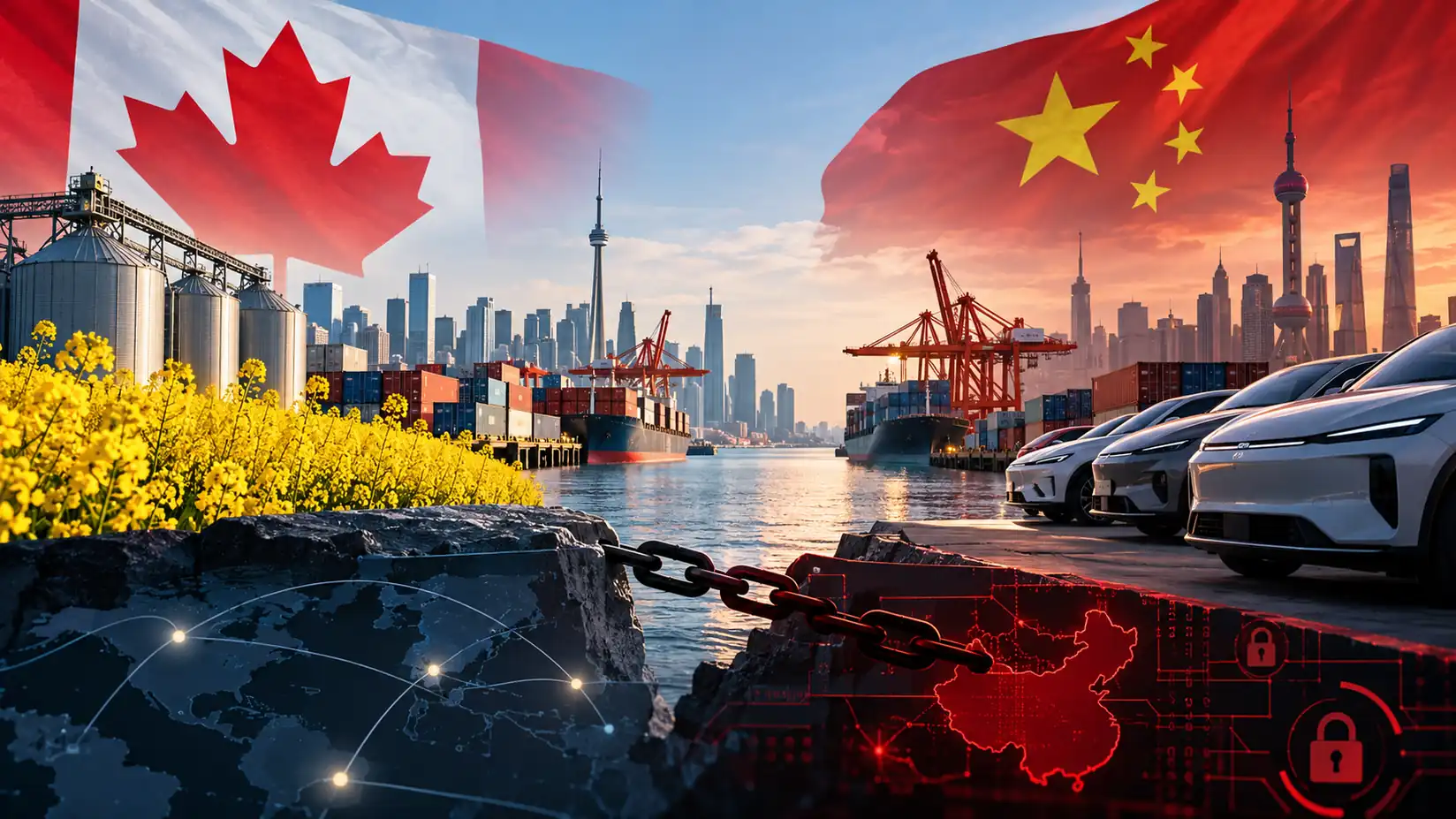
- Canada opened a quota for 49,000 Chinese EVs at a 6.1% tariff while China lowered barriers on Canadian canola and other products.
- Diversifying trade can give Canada more options, but heavy dependence on Chinese demand could create a new vulnerability.
- Canada should assess deals by what would be difficult to replace if the relationship deteriorated, especially in sensitive systems.
Cheaper electric cars and better access for Canadian farmers make closer trade appealing. The harder calculation is what happens when either country wants to walk away.
A Canadian shopping for an electric car and a Canadian growing canola could both benefit from the same agreement with China.
An auto worker has reason to study the fine print.
That is the tension inside Canada’s renewed relationship with Beijing: a deal that opens opportunities for one part of the economy can increase pressure on another. Meanwhile, Canada’s security agencies have their own concerns about the country Ottawa is courting.
Everyone is looking at the same relationship. They are measuring different risks.
One Agreement, Different Canadian Stakes
The trade arrangements introduced in March 2026 put those competing interests into focus.
Canada established an initial annual quota allowing 49,000 Chinese electric vehicles to enter at a 6.1% tariff, lifting the previous 100% surtax for those imports. China reduced its combined applied tariff on Canadian canola seed to 14.9%, from almost 85%, and suspended additional tariffs on canola meal, peas, lobster and crab through the end of 2026. Source: Global Affairs Canada.
For agricultural exporters, lower barriers improve the prospects of selling into a major market. For car buyers, additional competition could eventually mean more affordable options. For domestic automakers and their workers, the question is whether those consumer gains will come with greater pressure on Canadian production.
Those outcomes can coexist.
A cheaper car and a more secure manufacturing job are both legitimate things for Canadians to want. A trade agreement does not automatically deliver both.
Ottawa’s challenge is to explain who stands to gain, who faces additional risk and what evidence would show that the bargain is working.
Why China Is Difficult to Ignore
Canada and China exchanged approximately $125 billion in merchandise in 2025, according to Global Affairs Canada. That is an existing commercial relationship with customers, suppliers and businesses on both sides—not simply a diplomatic ambition. Source: Global Affairs Canada.
For Canada, the appeal of expanding that relationship is straightforward: more customers mean more options.
A business selling to several markets has somewhere else to turn when its biggest buyer reduces orders or demands concessions. The same principle helps explain Canada’s interest in diversifying beyond the United States.
But signing an agreement is easier than building an alternative.
An exporter still needs transportation, competitive costs, reliable delivery and customers willing to buy. As explored in Can Canada Escape America’s Economic Grip?, geography and established infrastructure make that transition difficult.
China can be part of diversification. Becoming heavily dependent on Chinese demand would create another vulnerability.
The useful measure is how many options Canada gains—and how practical those options are when a relationship deteriorates.
The Security Warning Behind the Sales Pitch
In January 2026, Prime Minister Mark Carney visited Beijing and announced a new strategic partnership covering areas including energy, agri-food and trade. The government presented closer cooperation as a way to expand investment and economic opportunity. Source: Prime Minister of Canada.
Canada’s cybersecurity assessment presents a much more troubling picture.
The Canadian Centre for Cyber Security’s 2025–2026 assessment identifies China’s cyber program as the most sophisticated and active state cyber threat facing Canada. It describes activities including espionage, intellectual property theft and malign influence.
It also reports that Chinese state-backed actors had compromised at least 20 networks associated with Canadian government agencies and departments during the four years covered by that finding. The assessment says all known federal government compromises had been resolved. Source: National Cyber Threat Assessment 2025–2026.
These findings give Ottawa concrete reasons to scrutinize access to sensitive systems and information.
They do not establish that every Chinese company poses a threat. Nor should concerns about Beijing become suspicion directed at Chinese Canadians.
The relevant questions concern a transaction’s ownership, access and consequences: who controls the asset, what information they can obtain and how much damage misuse could cause.
Where Trade Becomes Leverage
Selling a shipment of canola and granting access to a sensitive communications network involve different decisions.
The shipment creates a commercial relationship. Access to a network can create an ongoing dependency involving maintenance, software and information.
Both deserve scrutiny, but the consequences of a breakdown differ.
A useful test for policymakers is simple: If this relationship ended tomorrow, what would Canada struggle to replace?
For an exporter, the answer might be a customer. For a manufacturer, it could be an essential component. For a public institution, it might be a service that cannot easily be interrupted.
That replacement problem is where economic dependence can become political leverage. A partner does not need to control everything. Dependence on something difficult to replace may be enough to make resistance costly.
Canada should therefore judge agreements partly by the flexibility they preserve after the signing ceremony.
TwikUp Insight: Count the Cost of Saying No
Export figures and consumer prices matter. They cannot tell the whole story.
A stronger approach would ask whether an agreement expands Canada’s choices over time. Can businesses reach other buyers? Can essential suppliers be replaced? Can sensitive access be restricted and monitored? Are promised investments becoming operating facilities and durable jobs?
Ottawa should also make its economic case as carefully as its security case. A restriction that raises prices needs a clear justification. An investment welcomed for its promised benefits needs scrutiny when those benefits fail to appear.
That requires decisions specific enough to defend—and transparent enough to challenge.
Canada can trade with China while maintaining firm boundaries. Doing so will require more than confidence that both countries currently benefit.
The real test comes when their interests clash.
Canada’s independence will depend partly on how much business it can do with China—and partly on whether it can still afford to say no.