
Key Takeaways
- Preliminary RIK results put the Student List at 52.33% and the Vučić-led list at 39.44%.
- Seat projections give the Student List 140 of 250 seats, enough for an outright majority if confirmed.
- The student movement grew from protests after the Novi Sad railway-station canopy collapse in 2024.
A Landslide in the Official Preliminary Count
Serbia's students have done what a generation of opposition parties could not. According to preliminary results from the Republic Electoral Commission (RIK), based on 7,998 polling stations processed so far, the Student List – Students Win took 52.33 percent of the vote in Sunday's snap parliamentary election — 2,158,583 votes — against 39.44 percent, or 1,626,684 votes, for the Aleksandar Vučić – United Serbia list. The margin: 531,899 votes.
Voters showed up in force. Preliminary RIK figures put turnout at 68.76 percent, among the highest in a Serbian parliamentary election in recent decades — the observer group CRTA measured 67.8 percent by 7 p.m., against 55.5 percent at the same point in 2023. Further down the ballot, Ivica Dačić's Socialist Party of Serbia won just 2.19 percent — below the threshold and out of parliament entirely.
Vučić Concedes on Election Night
There was no drawn-out denial. Aleksandar Vučić acknowledged defeat on election night from Serbian Progressive Party headquarters. "I want to inform you that the student-blockade list has won," he said, adding that the SNS would continue its struggle as an opposition party — a striking reversal for a movement that has governed Serbia since 2012.
The concession caps an extraordinary gamble. Vučić had the National Assembly dissolved in September and resigned the presidency on September 27 in order to run for prime minister, with former speaker Ana Brnabić as acting president. Instead of a fresh mandate, he got the end of his party's 14-year hold on the Assembly. The Student List declared victory the same night, urging celebrating supporters to avoid confrontation as crowds filled the streets of Belgrade and other cities.
The Seat Picture — Projected, Not Yet Final
RIK allocates seats only after the final count, so the arithmetic is still a projection — a dramatic one. CeSID and Ipsos projections give the Student List 140 of the 250 seats and the SNS-led United Serbia list 103, with the remaining seats going to four minority lists: the Alliance of Vojvodina Hungarians (3), the Albanian Coalition (2), and one each for Rasim Ljajić's People First list and the SDA Sandžak list. If that holds, the students command an outright majority on their own. Observers also documented a rougher side to the day: CRTA reported voters photographing ballots at many monitored stations, along with pressure on voters and observers at others.
How a Fallen Canopy Became an Election
The roots reach back to November 1, 2024, when a concrete canopy at Novi Sad railway station collapsed, killing 16 people. The disaster became a symbol of alleged corruption and unaccountable public spending, igniting mass protests and student blockades that shut down universities nationwide. The demands grew from accountability to the one that finally brought the government down: snap elections. The movement then became a ballot line — 250 candidates drawn from the student assemblies, a programme centred on fighting corruption and restoring the rule of law — and on October 25 it converted two years of street pressure into a parliamentary majority.
The Twikup Take
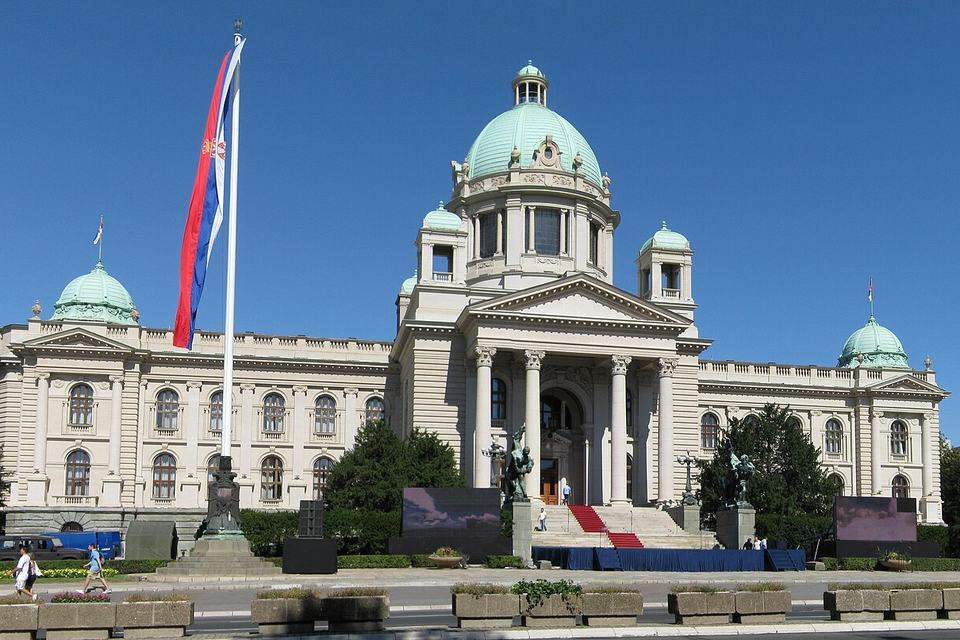
Winning the street is one skill; governing is another. The students toppled a 14-year machine with no single leader and no party behind them — now they have to become both, once RIK certifies the final count. Watch the certification, and then the first cabinet picks: that is where movements either become governments or stall. Photo: Boris Dimitrov / Wikimedia Commons (CC BY-SA 3.0) — the House of the National Assembly of Serbia in Belgrade.