
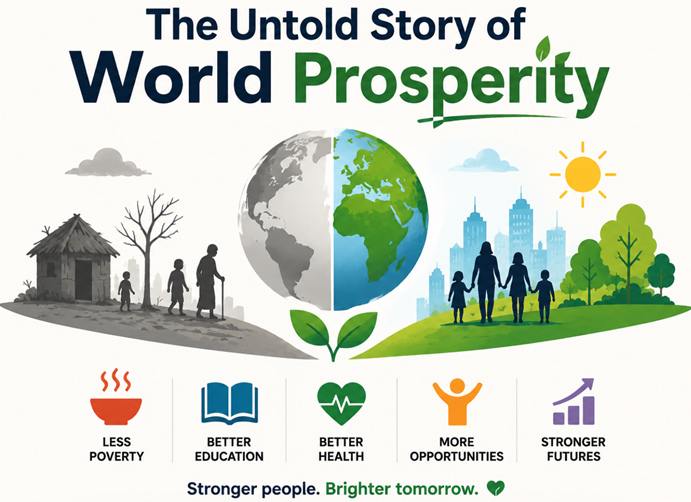
The biggest economic story of the last half-century is not the rise of stock markets or the expansion of national wealth. It is the quiet improvement in human lives. Across much of the world, people are living longer, learning more, and escaping conditions that once seemed unavoidable.
The lesson from fifty years of data is surprisingly simple: prosperity is not merely the ability to produce more wealth. It is the ability to expand what people can do with their lives.
When Economic Progress Became a Human Development Story
For much of modern economic history, prosperity was measured primarily through production and income growth. Rising output was often viewed as the ultimate sign of national success.
Over time, however, a more complete picture emerged. Countries with similar income levels frequently produced very different outcomes in health, education, and opportunity. Some societies translated economic gains into broad improvements in quality of life, while others struggled to do so.
This revealed an important reality: prosperity is multidimensional.
Key ingredients include:
- Income and productive capacity
- Public health outcomes
- Educational attainment
- Access to opportunity
- Social and political stability
- Strong institutions
Economic expansion remains important, but how societies convert growth into human progress often determines long-term success.
The Global Retreat of Extreme Poverty Changed Millions of Lives
Few developments have reshaped the modern world more profoundly than the decline of extreme poverty.
Half a century ago, large populations across developing regions lacked reliable access to healthcare, education, sanitation, and basic economic opportunities. Material deprivation was not confined to isolated communities; it affected entire nations.
Over subsequent decades, many countries pursued economic reforms, expanded infrastructure, invested in education, and connected more deeply with global markets. These changes helped lift hundreds of millions of people above severe poverty conditions.
The significance extends beyond income. Reduced poverty often creates a foundation for better health outcomes, stronger educational participation, and greater economic mobility.
Challenges remain substantial, but the long-term trajectory demonstrates that poverty is not an irreversible condition. Under the right circumstances, sustained progress is possible.
Longer Lives Became One of Humanity's Greatest Economic Achievements
If prosperity were judged through a single long-term indicator, life expectancy would make a compelling case.
Across most regions, people today can expect to live significantly longer than previous generations. This transformation did not happen because of one breakthrough alone. It resulted from cumulative improvements across multiple systems.
Contributors include:
- Expanded vaccination programs
- Better medical treatment
- Improved nutrition
- Stronger maternal healthcare
- Wider access to clean water
- More effective public health infrastructure
These gains are often viewed through a healthcare lens, but they also represent economic progress. A population that survives childhood, remains healthier through adulthood, and participates productively in society creates value that traditional economic statistics may not fully capture.
The Education Revolution That Quietly Reshaped Economies
While technological innovation often attracts attention, education has been one of the most consistent drivers of prosperity.
Several decades ago, literacy challenges remained widespread in many parts of the world. Access to secondary and higher education was often restricted to relatively small segments of society.
Today, educational opportunities have expanded considerably, creating ripple effects throughout economies and communities.
Education contributes to prosperity by:
- Raising workforce productivity
- Encouraging innovation
- Supporting healthier lifestyles
- Increasing earning potential
- Strengthening civic participation
Countries that prioritized human capital frequently achieved more durable economic gains than those relying primarily on natural resources or short-term advantages.
The pattern appears repeatedly across different development stories: investment in people generates long-term returns.
Different Success Stories, Shared Foundations
The world's fastest-growing economies did not all follow identical paths.
Each development journey reflected unique political systems, cultures, and economic circumstances. Yet long-term data reveals several recurring characteristics among countries that achieved sustained progress.
Common foundations include:
- Stronger educational systems
- Expanded infrastructure networks
- Productive investment environments
- Relative political stability
- Participation in international trade
- Institutional strengthening
No universal formula guarantees prosperity. However, successful development rarely occurs without these underlying conditions.
The consistency of these patterns suggests that prosperity is built less through isolated policy decisions and more through sustained institutional development.
Why Prosperity Still Remains Uneven
Global progress has been substantial, but it has not been universal.
Many countries continue to face persistent barriers that make development difficult. In most cases, the challenge is not a single obstacle but a combination of interconnected constraints.
Recurring barriers include:
- Armed conflict
- Institutional weakness
- Educational limitations
- Corruption
- Infrastructure deficits
- Political instability
- Geographic challenges
When uncertainty becomes a defining feature of daily life, economic progress often slows. Businesses become cautious, investment declines, skilled workers leave, and long-term planning becomes more difficult.
Prosperity depends not only on resources but also on creating environments where individuals and organizations can confidently invest in the future.
The Wealth-Happiness Gap That Data Continues to Reveal
One of the most intriguing findings from decades of research is that prosperity and happiness are related without being identical.
At lower income levels, additional earnings can dramatically improve living standards. Better housing, healthcare, education, and nutrition often follow increases in income.
As wealth rises, however, the relationship becomes less straightforward.
Many affluent societies continue to confront issues such as:
- Social isolation
- Stress and burnout
- Declining trust
- Community fragmentation
The evidence suggests that economic resources matter greatly, but human well-being also depends on social connections, institutional trust, and a sense of purpose.
This distinction may become increasingly important as countries pursue future growth strategies.
The Next Prosperity Challenge Is Inclusion
The coming decades may test economic systems in new ways.
Artificial intelligence, automation, demographic shifts, climate pressures, and geopolitical competition are already reshaping labor markets and development models. The central challenge is no longer simply generating growth.
The more difficult question is ensuring that opportunity expands alongside technological progress.
Future prosperity will likely depend on whether societies can:
- Adapt workers to changing industries
- Maintain broad access to education
- Strengthen institutional resilience
- Balance innovation with inclusion
- Expand opportunity across different populations
The debate ahead is not about whether growth matters. It is about who benefits from that growth.
FAQ: Brief Insights on Global Prosperity
Why is GDP alone not enough to measure prosperity?
GDP captures economic output, but it does not fully reflect health, education, opportunity, institutional quality, or overall well-being.
What has been the biggest global improvement over the last 50 years?
The large-scale reduction of extreme poverty and the steady rise in life expectancy stand among the most significant long-term achievements.
Why do some countries grow faster than others?
Successful economies often combine education, infrastructure, stable institutions, productive investment, and access to broader markets.
Does more wealth always create happier societies?
Not necessarily. Higher incomes improve living standards, but factors such as trust, social relationships, and community also influence well-being.
What is the biggest challenge for future prosperity?
Ensuring that technological and economic progress creates opportunities for broad populations rather than concentrating benefits among a limited group.