
At 9:12 a.m., a salesperson receives a message from an important customer:
“Why did our usage decline last month—and what should we change?”
Not long ago, that question would begin a small corporate relay race.
The salesperson would contact the data team. An analyst would request the customer ID, examine the numbers and prepare a spreadsheet. A manager might review the findings before someone in marketing turned them into a recommendation.
By the time the answer reached the customer, the original conversation could be several days old.
Now imagine the salesperson uses an employer-approved AI tool to conduct a preliminary analysis, identify a possible pattern and prepare three follow-up questions. A specialist then reviews the work before anything is sent to the customer.
The analyst is still needed. The salesperson is still employed. But several emails, meetings and days of waiting may be gone.
The first thing AI eliminates may not be the job. It may be the handoff.
Quick Answer
New research from OpenAI suggests people are using AI to perform tasks traditionally associated with neighbouring professions.
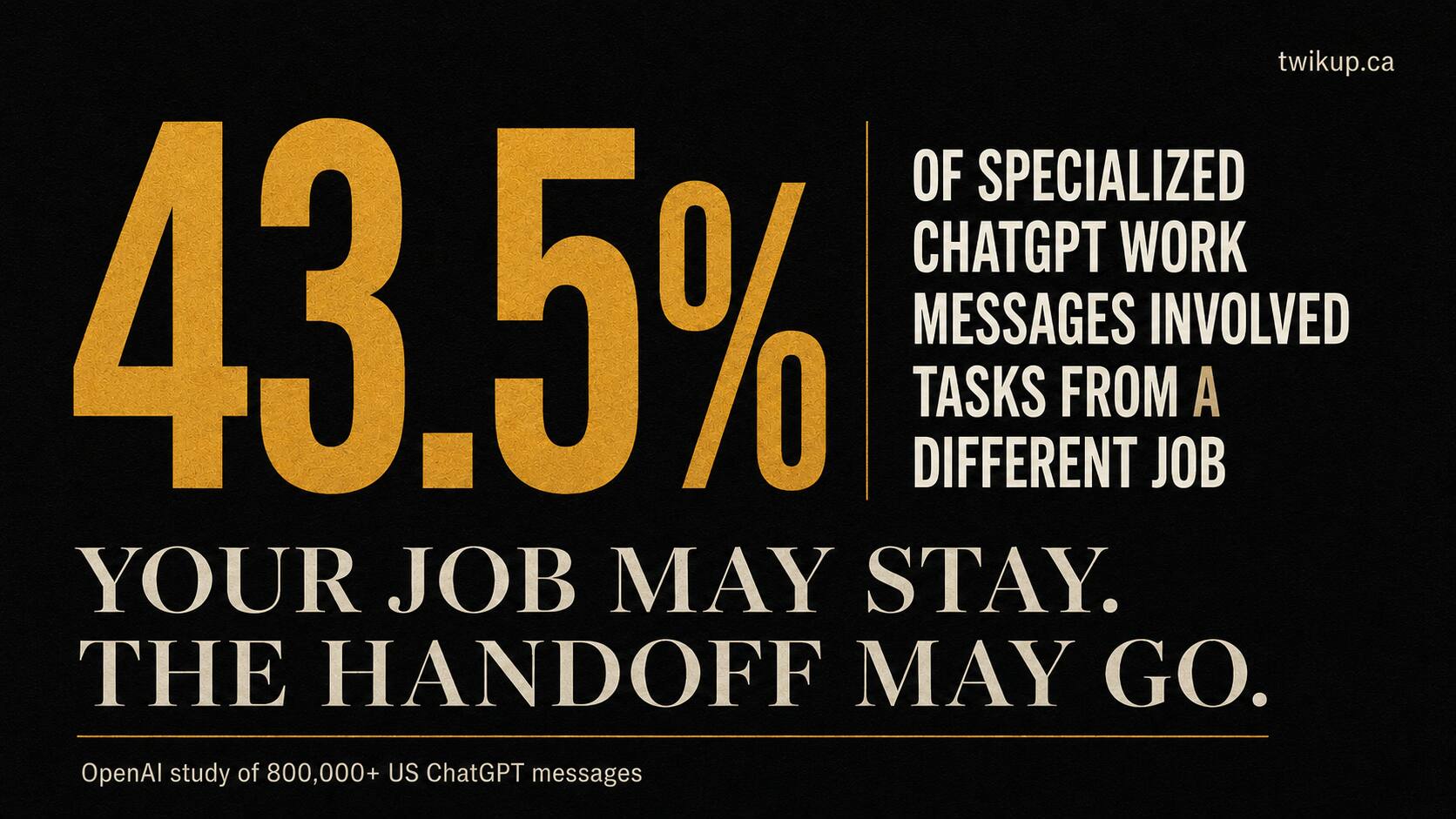
OpenAI analyzed more than 800,000 messages from US ChatGPT users. It found that 16.8% of all work-related messages involved tasks associated with an occupation other than the user’s own.
The researchers then removed generic activities—such as writing, summarizing and scheduling—that are common across many professions. Among the occupation-specific messages that remained, 43.5% involved work associated with another occupation.
That does not prove that AI has eliminated jobs or workplace handoffs. It does suggest that the boundaries between roles may be becoming less rigid.
The Office Relay Race May Be Getting Shorter
Every workplace has invisible borders.
A marketer encounters a broken webpage but must wait for engineering. A salesperson needs customer analysis but depends on a data team. A small-business owner needs promotional copy, a financial calculation and a contract reviewed—but may not have separate specialists for any of them.
These borders exist for good reasons. Specialists contribute training, context and accountability. But each transfer also creates a queue.
OpenAI calls the movement of work across these occupational borders “task crossover.”
In plain language, people are using ChatGPT to attempt tasks that would traditionally have been handed to another department or professional.
The finding aligns with a broader shift identified by the International Labour Organization. Its 2025 assessment concluded that one in four workers worldwide is employed in an occupation with some exposure to generative AI. However, because most occupations still include tasks requiring human involvement, the ILO found that job transformation is more likely than wholesale replacement.
That distinction matters. A job is not a single task. It is a collection of responsibilities, decisions, relationships and forms of accountability. AI may alter some of those components without removing the entire position.
Consider the Marketer Who No Longer Opens a Basic Ticket
Imagine Maya, a marketer at a growing company.
On Tuesday morning, she notices that a campaign page is loading incorrectly. Previously, she might have taken screenshots, opened a support ticket and waited for a developer to reproduce the problem.
This time, Maya uses an approved AI system to help interpret the error, examine a non-sensitive code fragment and organize possible causes.
She does not suddenly become a software engineer. She cannot safely approve a production change or determine whether a proposed fix creates a security risk.
She can, however, approach the engineering team with something more useful than “the page is broken.”
She can say:
“The problem appears connected to this component, it occurs on mobile, and these are the steps that reproduce it.”
The developer still makes the technical decision. The specialist has not disappeared, but the initial handoff has become smaller and more informed.
Maya is an illustrative example, not a documented case from OpenAI’s study. The research examines message patterns rather than following individual workers through completed workplace projects. It therefore shows what people are asking AI to help them do—not whether the resulting work was accurate, approved or successfully implemented.
Some Workers Appear to Be Crossing More Borders
Among the occupation-specific messages in OpenAI’s analysis, tasks associated with another profession represented:
- 77% of messages from customer-experience workers
- 75% from designers
- 69% from human-resources workers
- 56% from legal workers
- 53% from marketers
These percentages require careful interpretation.
They do not mean that 69% of HR positions are disappearing or that AI has automated 56% of legal work. They apply only to the subset of messages that OpenAI classified as occupation-specific, after generic tasks were removed.
Within that narrower group, workers frequently requested help with tasks associated with professions other than their own.
An HR employee might prepare a preliminary financial comparison. A designer might troubleshoot a technical problem. A customer-experience worker might draft marketing material.
Their job titles remain unchanged, but the range of tasks they can begin may become wider.
Financial and Technical Tasks Are Travelling Furthest
OpenAI found that financial calculation and technology troubleshooting appeared among the three most common outside-occupation activities for every other occupational group in its analysis.
Marketing and engineering work also travelled widely across professional boundaries.
Return to Maya. After organizing information about the webpage problem, she might use AI to examine campaign figures or prepare the first draft of a customer notice. Work that once began in three separate departments can now start with one employee.
That does not necessarily remove the specialists. It may change when they enter the process.
Instead of handling every preliminary request, specialists could spend more time reviewing difficult cases, verifying consequential conclusions and making decisions that carry legal, financial or technical risk.
However, this remains a possibility rather than a proven economy-wide outcome.
A 2025 field experiment published by the National Bureau of Economic Research followed 7,137 knowledge workers across 66 companies. Employees given access to generative AI spent approximately two fewer hours on email each week and worked less outside regular hours. But the researchers did not detect a measurable change in the quantity or composition of their tasks.
In other words, AI clearly saved time in that experiment, but it did not yet reorganize work in the way the handoff thesis anticipates.
The two findings are not necessarily contradictory. OpenAI’s data shows that people are asking AI for assistance beyond their occupational boundaries. The NBER experiment cautions that such usage does not automatically produce a measurable redesign of jobs or workflows.
Small Businesses May Feel the Shift First
Now picture the same problem inside a five-person company.
There is no engineering department upstairs. There may be no analyst, legal team or full-time marketer. The founder is often the person who notices a problem—and the person who must find some way to address it.
Among average users in OpenAI’s research, outside-occupation tasks accounted for 18.9% of messages in workspaces with two to five seats, compared with 16.3% in workspaces containing more than 100 seats.
The difference is modest, and OpenAI offers possible explanations rather than establishing a definite cause. One possibility is that employees in smaller organizations use AI as a generalist tool because fewer specialists are available.
For a small business, avoiding a handoff may do more than save time. It may allow someone to begin a task that otherwise would have been delayed, outsourced or abandoned.
The same dynamic could also increase risk. A small company without internal specialists may be less equipped to recognize when an AI-generated calculation, contract interpretation or technical recommendation is wrong.
Removing Waiting Without Removing Judgment
The loudest AI debate asks:
“Which jobs will disappear?”
A more immediate question may be:
“Which parts of my job will no longer require another person to begin?”
A salesperson who can perform preliminary analysis may respond faster. A marketer who can diagnose a webpage problem may reduce unnecessary work for developers. An HR professional who can create a first-pass financial model may arrive at a meeting better prepared.
But removing handoffs can also remove safeguards.
AI can produce a convincing calculation that is incorrect, overlook an important contractual clause or recommend a technical change that creates a security vulnerability. It may also expose confidential information if employees upload customer records, internal code or sensitive documents to an unapproved system.
Organizations therefore need to distinguish between three different actions:
- Beginning a task with AI
- Completing a task with AI
- Approving the result
An employee may be able to begin work outside their specialty without being qualified to complete or approve it.
Clear policies should define when expert review is mandatory, which information may be entered into an AI system and who remains accountable for the final decision.
The most successful workplace may not be the one that removes the most people. It may be the one that removes unnecessary waiting while preserving necessary judgment.
Jobs May Change Before Their Titles Do
OpenAI argues that AI-usage data may reveal changes in work before employers rewrite job descriptions or introduce new titles.
That is plausible, but the study should be read with appropriate caution. OpenAI developed ChatGPT and benefits commercially when organizations use it more widely. Its analysis covers activity on its own platform, not the entire labour market, and messages do not prove that the requested tasks were completed successfully.
Nevertheless, the research offers a useful view of where workplace change might first become visible.
The earliest evidence may not appear in a layoff announcement. It may appear in ordinary moments that are rarely measured:
The support ticket that was never opened.
The meeting that was no longer necessary.
The spreadsheet an employee could finally interpret independently.
The customer who received an answer today instead of next week.
At 9:12 a.m., a question arrived.
At 9:40 a.m., the customer had a useful, specialist-verified response.
Everyone still had a job.
But the relay race had changed.