
Key Takeaways
- Hubble's new galactic-bulge observations are a baseline survey for the Nancy Grace Roman Space Telescope's microlensing planet hunt.
- The bulge holds nearly a quarter of the Milky Way's stellar mass, and its stars can be individually resolved from Earth.
- The survey (program #17776) captures stellar brightness, ages, composition and motion in wavelengths matched to Roman's.
A map of the crowd, drawn before the new telescope arrives
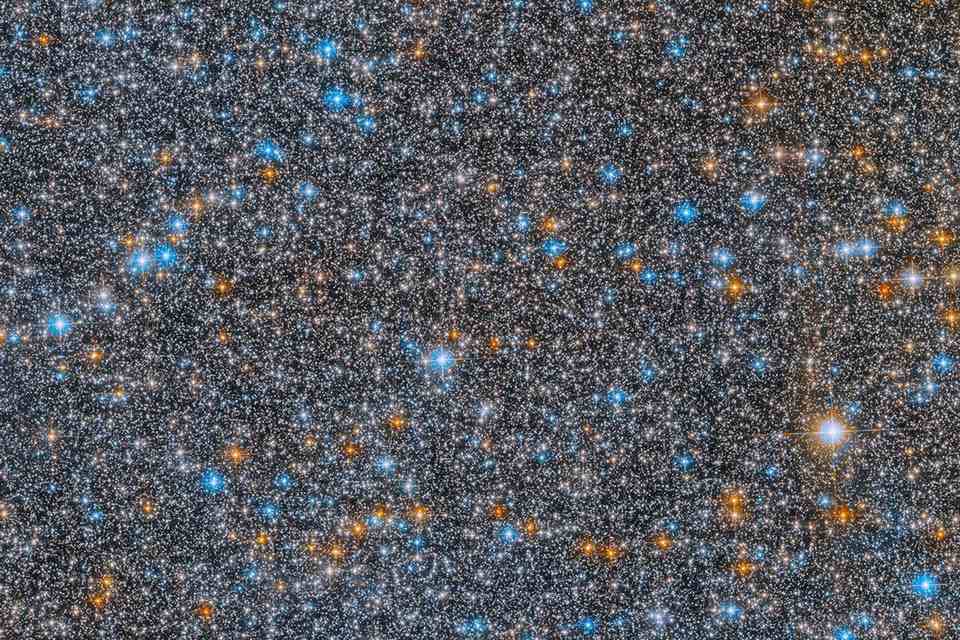
The centre of our galaxy is the most crowded neighbourhood in the sky — and NASA has just taken its portrait. New Hubble Space Telescope observations of the Milky Way's galactic bulge, released Wednesday, are not mainly for looking at: they are a baseline map, drawn so that the upcoming Nancy Grace Roman Space Telescope can read its own planet-hunting data against it.
Why the bulge, and why now
The bulge — the densely packed, spherical region of stars surrounding the centre of the galaxy's disk — holds nearly a quarter of the Milky Way's stellar mass. Because it is close, astronomers can resolve individual stars there, something impossible in the jammed bulges of other galaxies.
Roman will hunt planets in this region by microlensing — watching for the brief brightening when one star's gravity bends the light of another. To interpret those events, researchers need to know the stars before anything lenses them. That is Hubble's job in the new survey (observing program #17776, led by S. Terry): it observed in wavelengths overlapping Roman's sensitivity, at the red end of visible light and into the near-infrared, capturing the brightness, ages, composition and motion of the bulge's stars. The same data can support searches for exoplanets, black holes and neutron stars.
Hubble has form here: its earlier SWEEPS survey examined 180,000 stars in the bulge. The new observations extend that legacy into the Roman era — two telescopes, one crowded sky, the older one handing the newer one its reference chart.
The Twikup Take
Space science's least glamorous work is also some of its most valuable: the careful baseline survey nobody headlines, taken years before the discovery it makes possible. When Roman starts announcing microlensing planets, the fine print will trace back to pictures like this one.
Image: The galactic bulge imaged by the Hubble Space Telescope, Credits: NASA, ESA, and S. Terry (University of Maryland); Image Processing: G. Kober (NASA/Catholic University of America).