
Key Takeaways
- Shenzhou-24 docked with Tiangong about 3.5 hours after launch, carrying China's Tang Hongbo and Wu Yi plus Pakistan's Muhammad Zeeshan Ali.
- Ali is the first foreign astronaut to visit Tiangong and the first Pakistani in orbit; he will make a short stay and return aboard Shenzhou-23.
- The flight follows a February 2025 China–Pakistan agreement to select and train Pakistani astronauts for station missions.
Pakistan just made spaceflight history — aboard China's space station
For the first time, China's Tiangong space station has welcomed an astronaut from another country. And the visitor is making history for Pakistan, too.
China's Shenzhou-24 spacecraft docked with the Tiangong space station on Wednesday, about three and a half hours after lifting off from the Jiuquan Satellite Launch Center. Among the crew was Muhammad Zeeshan Ali, a payload specialist from Pakistan's space agency SUPARCO — now the first foreign astronaut to visit Tiangong and the first Pakistani to reach orbit.
The mission "marks the first joint flight consisting of Chinese and foreign astronauts in the history of China's manned space program," China's state news agency Xinhua reported. The launch took place at 8:18 a.m. Beijing time aboard a Long March-2F rocket. China's authorities declared it "a complete success."
A short visit, but a much bigger mission
Ali's stay aboard Tiangong won't last long. After the joint flight, he will return to Earth aboard the Shenzhou-23 spacecraft with two of its crew.
Meanwhile, commander Tang Hongbo and flight engineer Wu Yi will remain aboard the station for roughly six months. Their work won't be limited to keeping the station running. The mission plans more than 90 scientific experiments and technology tests, including four China–Pakistan cooperative projects. One particularly interesting experiment involves photosynthetic cyanobacteria — a project Ali will conduct while in orbit.
How Pakistan earned its seat
This milestone didn't happen overnight. In February 2025, the China Manned Space Agency and SUPARCO signed an agreement covering the selection and training of Pakistani astronauts for space station missions.
Two Pakistanis completed the three-stage selection process and trained in China. One was selected to fly. The other became the backup. Ali's flight now makes Pakistan part of a new chapter in China's human spaceflight program. With Ali, China has now flown 32 people to orbit: 31 Chinese astronauts and one guest.
The Twikup Take
China spent two decades building Tiangong as its own answer to the International Space Station. Now, it's opening the door to international partners. That's an important shift. Tiangong is no longer just a Chinese space laboratory — it's becoming a station where other countries can participate, conduct experiments and send their own astronauts. Pakistan has secured its first seat in orbit. China's space ambitions now have an international passenger list.
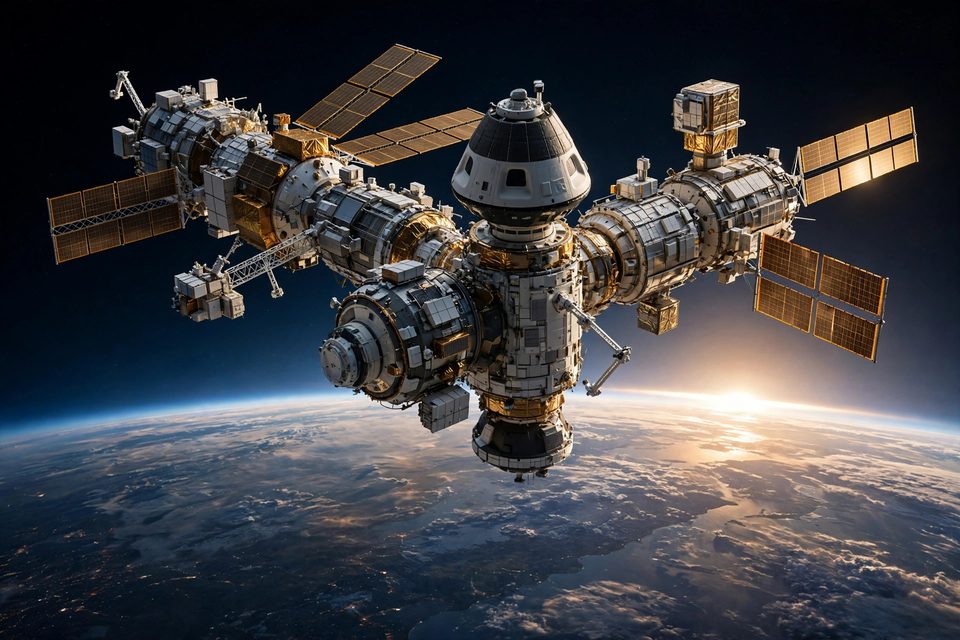
Image: Illustrative image.