
Key Takeaways
- In over 23,000 brain scans, lifetime cannabis use was associated with connectivity patterns inversely matching age-related patterns.
- The patterns also corresponded positively with cognition-related connectivity patterns.
- The authors stress the results are associations only — no causal or dose-dependent effect is shown.
Do the brains of people who have used cannabis look "younger"? The careful answer is: patterned differently
In more than 23,000 UK Biobank brain scans, researchers report that lifetime cannabis use is associated with functional-connectivity patterns that run opposite to the patterns of normal brain aging — most clearly in subcortical–sensorimotor and subcortical–cerebellar networks — and that those cannabis-related patterns also lined up with patterns linked to cognitive performance. The study, published in Communications Biology, is already ripe for a headline it does not support. Here is the authors' own closing line in substance: these are population-level associations, "rather than evidence of causal or dose-dependent effects."
That caveat does heavy lifting. The study is observational and cross-sectional. It compares people who report having used cannabis at some point in their lives with those who haven't, at one point in time. It cannot show cannabis changed anyone's brain. People whose brains age differently might be more likely to have tried cannabis. And lifetime-ever use lumps a teenager's single joint with decades of daily use. The right next step is longitudinal data — scans before and after, with dose and timing — not a verdict either way.
The Twikup Take
Canada legalized cannabis in 2018, so Canadian readers will see this study shared as proof it protects the brain. It does not — and the authors say so themselves, in writing, in the paper. What it actually shows is more interesting than the slogan: in a huge sample, the connectivity signature of lifetime use points the other way from aging's signature. That's a reason to fund the follow-up study, not to change anyone's habits on the strength of a correlation.
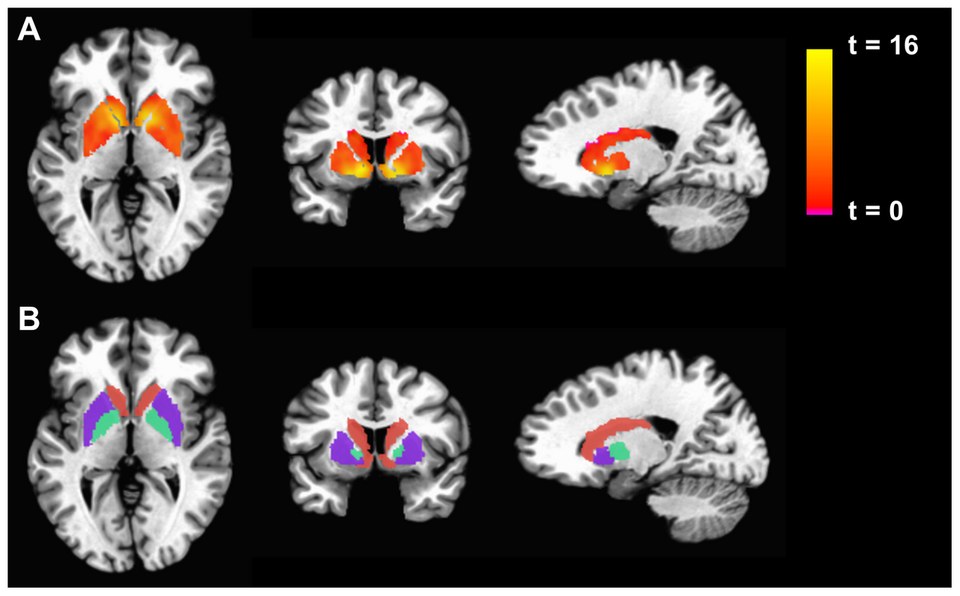
Image: fMRI brain-scan figure by Miller et al. (2014), PLoS ONE, CC BY 4.0, via Wikimedia Commons.