
Key Takeaways
- A Surrey fossil collected in 2001 was identified 25 years later as the new dinosaur Paludohadros proudlovii.
- The juvenile plant-eater lived about 125 million years ago and was roughly five metres long.
- The species honours Will Proudlove, an Ewhurst Works manager who died shortly before the fossil was excavated.
In the collection since 2001
The fossil was dug up in 2001 at Ewhurst Works — the Smokejacks Pit clay quarry in Surrey — and donated to London's Natural History Museum. For 25 years it sat in the collections as just another iguanodontian, the thumb-spiked plant-eaters of southern England that were routinely filed as Iguanodon or Mantellisaurus.
A detailed re-study of those relatives, published in 2023, finally gave researchers the comparisons they needed. The Surrey fossil matched neither. It is a new genus and a new species, described by Ricardo Sacamoto and colleagues in the Journal of Systematic Palaeontology.
A rhino-sized teenager from a swamp
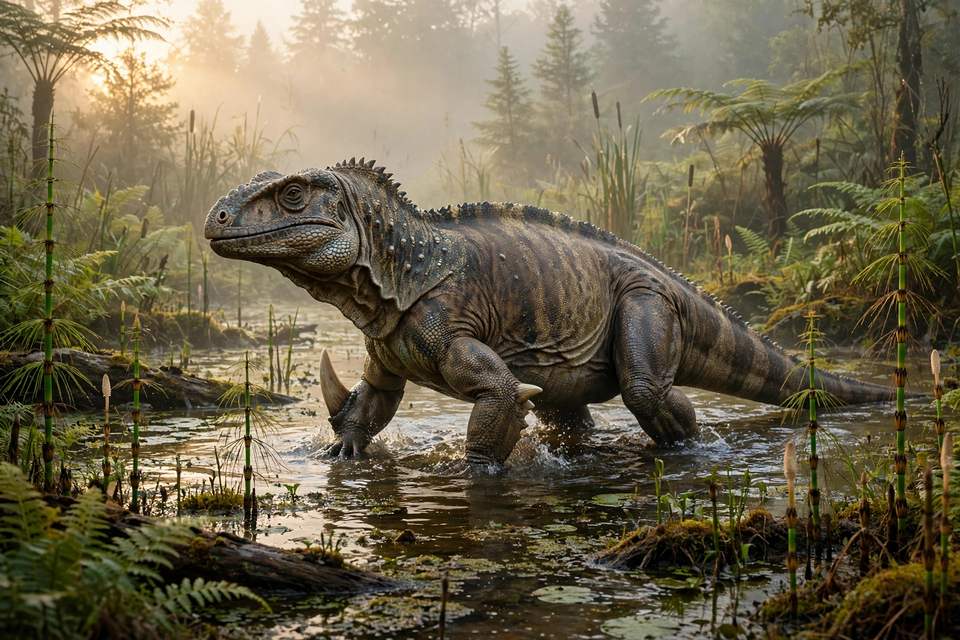
Paludohadros proudlovii lived about 125 million years ago, in the Early Cretaceous, when southern England was muddy wetland — palus is Latin for swamp. The specimen is a juvenile: roughly five metres long and 1.5 to two tonnes, about rhino-sized, with bones not yet fully developed. As an adult, it could have grown twice as large.
The neighbour was a predator
The fossil turned up just 100 metres from where Baryonyx walkeri — the fearsome fish-eating carnivore — was discovered at the same works in 1983. The two may have met in the worst way: the famous Baryonyx specimen's last meal included a baby iguanodontian, and researchers say it is possible that meal was a young Paludohadros, hunted or scavenged.
Why it carries a man's name
Will Proudlove worked his way up to manager at Ewhurst Works and was fascinated by whatever each new layer of clay might reveal. He died at just 35, shortly before this dinosaur was excavated — a year too early to see it. His widow Rachael and their children were invited to watch the 2001 dig, and a quarter-century later his name is now permanently attached to the species: proudlovii.
More hiding in the drawers
Sacamoto, the first researcher ever to name a species with this paper, is now auditing the museum's iguanodontian collections for his PhD — and has already linked more fossils, some collected in the 1950s, to Paludohadros.
The Twikup Take
A new dinosaur did not need a new expedition — it needed a fresh look at a museum shelf, and it arrived carrying the name of a quarry manager who never got to see it. Some of the best discoveries in paleontology are already indoors.
Image: AI-generated illustration.