
Key Takeaways
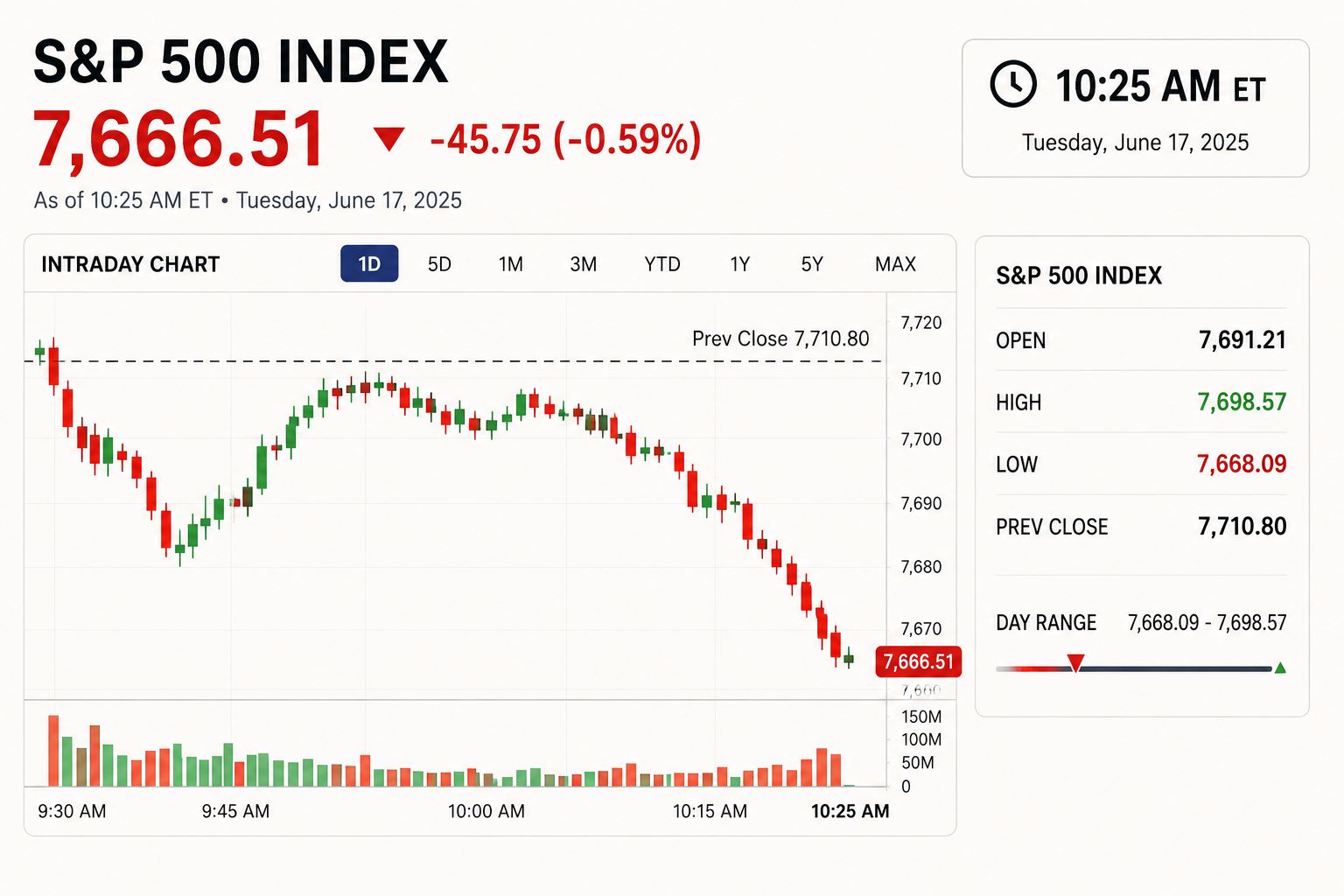
- The S&P 500 was around 7,666.51 at 10:25 a.m. ET, down 0.59% and roughly 31 points below its opening level.
- Brent crude above $90 lifted Chevron and Exxon while increasing inflation concerns for the broader market.
- PG&E and Edison faced wildfire-liability pressure, while Nvidia, Intel and SLB found company-specific support.
Wall Street didn't get the rebound it was looking for Monday morning.
The S&P 500 opened lower and then kept falling, reaching approximately 7,666.51 by 10:25 a.m. ET — down about 0.59% from Friday's close.
But the interesting part isn't simply that stocks are down.
Look underneath the index and Monday's market is splitting in very different directions.
Oil's surge following renewed U.S.-Iran military exchanges is lifting energy companies. California utilities are getting hammered over wildfire-liability concerns. And some semiconductor stocks are managing to stay positive despite the broader pressure.
Meanwhile, higher oil prices and Federal Reserve Chair Kevin Warsh's inflation-focused Jackson Hole message have put interest rates squarely back into the market conversation.
Quick Answer
At approximately 10:25 a.m. ET, the S&P 500 was trading around 7,666.51, down 0.59% from Friday's close of 7,711.76.
That equals a decline of about 45.25 points.
The index opened around 7,697.52, meaning it lost another roughly 31 points after regular trading began.
That deterioration is important.
Investors entered Monday already knowing oil was surging and geopolitical tensions had escalated. Yet stocks didn't simply gap lower and stabilize.
The selling intensified after the opening bell.
Market at 10:25 A.M.
S&P 500: approximately 7,666.51, -0.59%
Previous close: 7,711.76
Opening level: approximately 7,697.52
Russell 2000: approximately -0.7% in an earlier delayed reading
10-year Treasury yield: around the upper 4.7% range
Brent crude: above $90 a barrel
Market snapshot: approximately 10:25–10:30 a.m. ET on August 31, 2026
Market prices can change quickly, so these figures should be treated as a timestamped snapshot rather than closing levels.
Why Is the S&P 500 Falling?
Monday's market comes down to an uncomfortable combination:
Oil, inflation and interest rates.
The oil part started with another escalation between the United States and Iran.
U.S. forces struck two Iranian launchers on Larak Island near the Strait of Hormuz after U.S. Central Command said Iranian forces had been observed preparing rockets carrying sea mines.
Iran subsequently retaliated against U.S. positions in Jordan.
The renewed military exchanges immediately put one of the world's most important energy routes back at the centre of investors' attention.
Brent crude surged above $90 a barrel, reaching an intraday high above $91 earlier Monday.
For oil producers, that's potentially good news.
For much of the rest of the economy, it creates another problem.
Inflation.
Higher energy prices can flow through transportation, manufacturing and other costs. And the timing is particularly uncomfortable because investors are already reassessing the Federal Reserve's inflation outlook.
Then There's Kevin Warsh
Federal Reserve Chair Kevin Warsh used his August 28 Jackson Hole address to emphasize the central bank's responsibility for price stability and its 2% inflation objective.
He did not explicitly announce that another interest-rate increase is coming.
But his inflation-focused message has made investors more sensitive to the possibility that rates may need to rise again if price pressures remain stubborn.
That makes Monday's oil surge particularly important.
Oil is climbing because geopolitical risk has increased.
Higher energy costs could complicate the inflation outlook.
And investors are simultaneously dealing with a Federal Reserve that has made clear that restoring price stability remains central to its mandate.
That's why this isn't just an oil story.
The S&P 500 Is Down. Energy Isn't.
This is where Monday gets more interesting.
The S&P 500 may be falling, but the market isn't moving uniformly.
Energy stocks are benefiting from higher crude prices while several other parts of the market are under pressure.
Early sector readings showed energy firmly positive while utilities were among the day's weakest groups.
That's an unusual divide with a straightforward explanation:
The same oil shock hurting the broader market is helping the companies that produce oil.
Chevron and Exxon Mobil were both up roughly 2%–3% during morning trading.
So while higher crude is contributing to inflation concerns across Wall Street, it's simultaneously improving the immediate backdrop for some of America's largest energy producers.
California Utilities Have a Completely Different Problem
Energy isn't the only major sector story Monday.
California utilities are being hit by something much more specific.
PG&E (PCG)
PG&E shares plunged roughly 18% during morning trading as investors reacted to developments surrounding California's wildfire-liability framework.
The company said Senate Bill 492 provides some improvements related to wildfire recovery and preparedness but does not adequately resolve the broader liability and financing problems it believes utilities face.
The concern is important because wildfire liabilities can affect utilities' ability to raise affordable capital needed for massive investments in grid safety and reliability.
The market's reaction was severe.
And PG&E wasn't alone.
Edison International (EIX)
Edison International also fell sharply as investors reassessed wildfire-liability exposure across California's utility industry.
That suggests Monday's PG&E collapse isn't being treated purely as an isolated company problem.
Investors are repricing a broader regulatory risk affecting utilities operating in California.
The contrast with energy couldn't be much sharper.
Oil producers are benefiting from geopolitical turmoil.
California utilities are dealing with a completely different shock originating in Sacramento.
Both are happening inside the same market.
Chip Stocks Are Providing Another Surprise
Technology isn't behaving uniformly either.
Some semiconductor companies are managing to resist the broader selloff.
Nvidia (NVDA)
Nvidia was modestly higher during morning trading after announcing an expanded partnership with MediaTek.
The companies said their collaboration will span cloud AI infrastructure, local AI computing and automotive platforms.
MediaTek will also adopt Nvidia's NVLink Fusion platform.
The announcement gives Nvidia a company-specific catalyst at a time when the broader market is under pressure.
Intel (INTC)
Intel was also trading higher during the morning.
That doesn't mean technology as a whole is immune from Monday's pressure.
It does show that investors aren't indiscriminately selling every growth or semiconductor company.
Specific corporate catalysts are still powerful enough to create pockets of strength.
SLB Has Oil and AI Working at the Same Time
Then there's SLB.
The company announced Monday that it plans to acquire thermal-management company Kelvion for approximately $3.4 billion in cash while assuming roughly $700 million of debt.
That puts the transaction's total value at approximately $4.1 billion.
The strategic reason is particularly interesting.
SLB says the acquisition will expand its presence in thermal-management infrastructure for data centres — putting the traditional energy-services company closer to the enormous infrastructure buildout surrounding artificial intelligence.
So SLB finds itself sitting at the intersection of two of Monday's biggest market themes:
energy and AI infrastructure.
Shares moved sharply higher during morning trading.
The Number That Matters
Forget the percentage for a moment.
Look at this:
7,697.52 → 7,666.51
That's approximately 31 points of additional S&P 500 weakness after the opening print.
Why does that matter?
Because Wall Street already knew about the geopolitical escalation before trading began.
Oil had already jumped.
Warsh had already delivered his Jackson Hole speech.
S&P 500 futures had already been pointing lower.
Yet when regular trading started, the market didn't simply absorb those developments and settle down.
Selling became more pronounced.
That makes the first-hour move more significant than a simple weak opening.
What to Watch This Afternoon
The biggest variable remains oil.
If crude gives back a meaningful portion of its morning surge, one of the market's biggest immediate inflation concerns could ease.
If Brent continues climbing, however, the divide between energy stocks and much of the rest of the market could become even more pronounced.
The second thing to watch is Treasury yields.
Higher yields would add pressure to rate-sensitive companies. A meaningful retreat could provide some relief.
And then there's market participation.
Energy and selected semiconductor names are providing pockets of strength right now.
If that leadership broadens, Monday's decline could begin looking more like a sector rotation.
If those pockets of strength disappear and selling spreads, the picture becomes considerably weaker.
TwikUp Insight
A 0.6% S&P 500 decline sounds like a simple risk-off day.
Monday morning is more complicated.
One geopolitical shock is producing two opposite trades at once.
Higher oil is helping Chevron, Exxon and other energy companies while simultaneously making the inflation outlook more uncomfortable for the broader market.
California utilities are dealing with their own wildfire-liability shock.
And selected semiconductor companies are still finding buyers because of company-specific catalysts.
So the most interesting question isn't simply:
Why is the S&P 500 falling?
It's this:
Which companies can actually benefit—or at least hold up—when oil is expensive, inflation risk is rising and interest rates remain uncertain?
The first hour is already giving investors very different answers.
Disclaimer
This article is for informational purposes only and does not constitute financial or investment advice. Market prices and conditions can change rapidly. Investors should conduct their own research and consider their individual circumstances before making investment decisions.
Sources
- Federal Reserve Board — “In Our Time,” Chairman Kevin Warsh, Jackson Hole Economic Policy Symposium, August 28, 2026
- S&P Dow Jones Indices — S&P 500 Index
- U.S. Securities and Exchange Commission — PG&E Corporation Form 8-K, August 31, 2026
- Office of Governor Gavin Newsom — Statement on California Wildfire Risk Legislation
- NVIDIA — NVIDIA and MediaTek Deepen Long-Standing Partnership to Build AI Edge to Cloud Computing Platforms
- SLB — SLB to Acquire Kelvion, Expanding its Role Across Data Center Infrastructure
- Reuters — Oil rises as U.S. and Iran resume military attacks