
Key Takeaways
- GDP, personal income, spending and PCE inflation data at 8:30 a.m. ET could reset interest-rate expectations.
- Nvidia's fiscal Q2 results will test whether AI infrastructure demand supports elevated technology-stock expectations.
- Treasury yields, Nasdaq performance, market breadth and Nvidia positioning could reveal whether pre-market calm lasts.
Before the Bell
The S&P 500 is heading toward Wednesday’s opening bell with an unusual problem: the biggest market-moving events of the day have not happened yet.
S&P 500 futures were hovering close to flat in early trading on August 26, while Nasdaq-100 futures were modestly weaker. But the calm surface hides two separate tests.
At 8:30 a.m. ET, the U.S. Bureau of Economic Analysis is scheduled to release its second estimate of second-quarter GDP, preliminary corporate profits and July personal income and spending data, including the PCE price indexes.
Then, after the market closes, Nvidia reports fiscal second-quarter results.
That creates an interesting setup. The morning could determine how investors price the U.S. economy and interest rates. Nvidia could determine whether enthusiasm surrounding AI infrastructure still deserves its enormous influence over technology stocks.
Today is less about where futures start and more about whether the market's two biggest narratives — rates and AI — continue working together.
The Market Setup
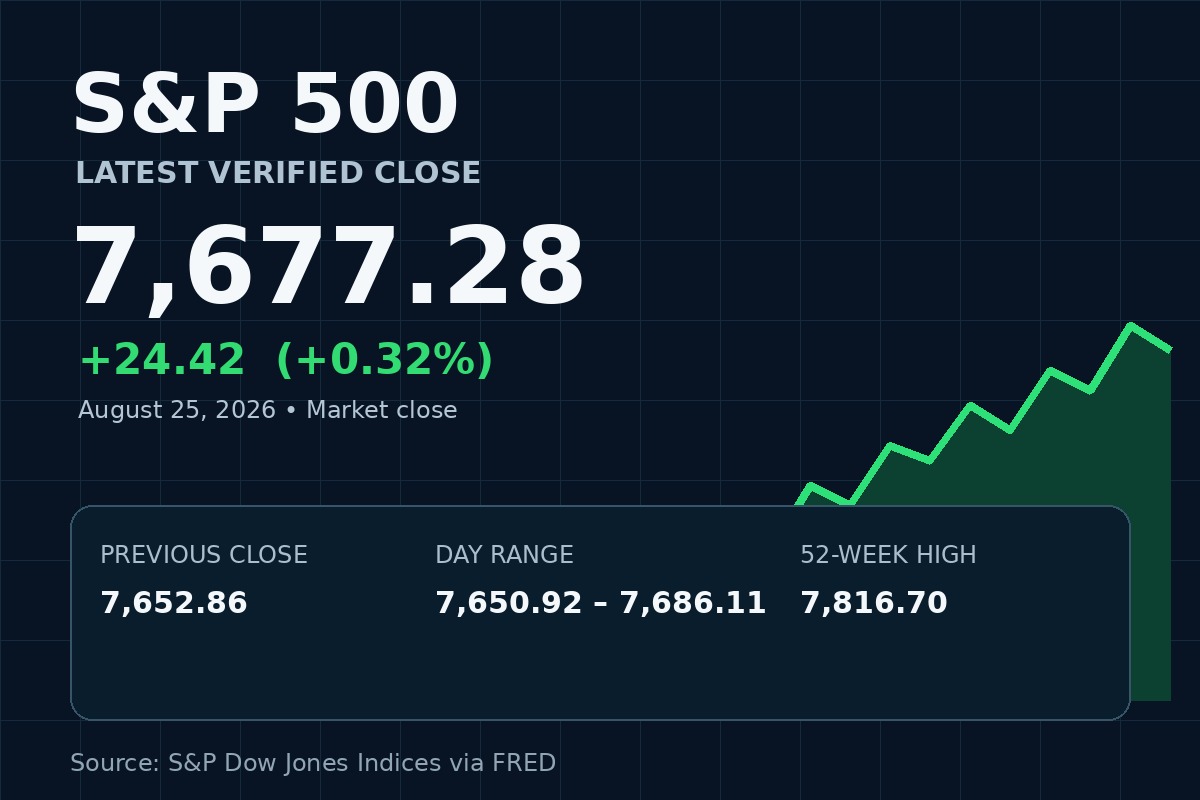
S&P 500 futures: Near flat in early pre-market trading Nasdaq-100 futures: Modestly lower Dow futures: Near flat to slightly positive Previous S&P 500 close: 7,677.28 Previous session: S&P 500 gained about 0.3% Major economic releases: 8:30 a.m. ET Nvidia fiscal Q2 FY2027 results: Approximately 4:20 p.m. ET Nvidia earnings call: 5:00 p.m. ET
The precise futures percentages have moved during the morning, which makes the relative performance more useful than a frozen number: technology futures have shown more hesitation than the broader market ahead of Nvidia.
What Changed Overnight
Tuesday gave equities some breathing room.
The S&P 500 finished higher, while falling Treasury yields reduced some of the valuation pressure that higher interest rates can create for growth companies.
Oil has also retreated from recent elevated levels as markets assess developments surrounding shipping through the Strait of Hormuz. Lower crude prices matter beyond the energy sector because sustained oil inflation can feed into transportation costs, consumer prices and expectations for monetary policy.
But Wednesday introduces something Tuesday did not have: concentrated event risk.
Instead of one obvious headline pushing the entire market, investors face economic data before the bell and one of the world's most consequential corporate earnings reports after it.
That helps explain why relatively quiet S&P 500 futures should not automatically be interpreted as investor confidence.
The market may simply be waiting for information.
What's Really Driving the Market
There are effectively two markets to watch Wednesday.
The first is the interest-rate market.
The Federal Reserve kept its federal funds target range at 3.50% to 3.75% at its July meeting. That makes incoming inflation and growth data especially relevant because investors are trying to determine how much room policymakers have to change rates later this year.
The latest official advance estimate showed U.S. real GDP expanding at a 1.5% annualized rate in the second quarter, slowing from 2.1% in the first quarter.
But the headline GDP figure concealed a stronger piece of the economy.
BEA estimated that real final sales to private domestic purchasers increased 3.9% during the quarter. That measure focuses on consumer spending and private fixed investment and can provide a useful view of underlying private-sector demand.
Wednesday's second GDP estimate can revise that picture.
More importantly for interest-rate expectations, BEA will simultaneously release July personal income and spending figures, including the PCE price indexes.
That combination creates the morning's first test.
If the data changes expectations for inflation or economic momentum, Treasury yields could react — and that reaction may matter more to stocks than the GDP headline alone.
Then comes the second market: AI.
Nvidia is scheduled to report after Wednesday's closing bell.
The company says its fiscal second quarter ended July 26, and its results are expected to be released at approximately 1:20 p.m. Pacific time, followed by a conference call at 2 p.m. Pacific.
This is where today's setup becomes unusual.
Nvidia is not simply another large company reporting earnings. Its results have become a read-through on several layers of the AI economy: accelerator demand, data-centre construction, hyperscaler spending and the willingness of companies to keep committing enormous amounts of capital to computing infrastructure.
That makes Nvidia's report relevant even to investors who do not own Nvidia shares directly.
A strong report could influence sentiment toward semiconductor companies, data-centre suppliers and other AI-linked businesses. A disappointing outlook could raise a much broader question: whether expectations surrounding AI infrastructure have moved faster than the businesses ultimately supporting them.
The S&P 500's market-cap weighting magnifies the importance of that debate.
So Wednesday's flat futures create a slightly misleading picture.
The index looks calm precisely when investors are approaching two events capable of challenging two of its most important supports: the interest-rate environment and the AI investment cycle.
The Number That Matters Today
1.5%
That is the current official advance estimate for second-quarter U.S. real GDP growth at an annualized rate.
But the number matters partly because it may not survive the morning unchanged.
BEA's second estimate arrives at 8:30 a.m. ET and incorporates more complete source data than the advance estimate.
The more interesting question is not simply whether 1.5% becomes 1.4%, 1.6% or something else.
Investors should look underneath the headline.
The advance report showed private domestic demand growing considerably faster than overall GDP. If revisions materially alter that relationship, the market may get a different picture of economic momentum than the headline growth rate alone suggests.
And because PCE inflation data arrives simultaneously, the market will have to process growth and inflation together.
That is the combination most relevant to interest-rate expectations.
Nvidia Is the Second Test — and Possibly the Bigger One
Nvidia has already told investors exactly when the next major checkpoint arrives.
The company is scheduled to publish fiscal Q2 FY2027 results after Wednesday's close.
That means Wednesday's regular session has an unusual asymmetry: investors can react immediately to the economic data, but the biggest company-specific catalyst comes only after the closing bell.
The distinction matters.
If technology stocks struggle during regular trading despite stable or falling Treasury yields, it could indicate investors are reducing exposure ahead of Nvidia rather than simply reacting to rates.
If technology shares strengthen following favourable economic data, Nvidia's results will then test whether that enthusiasm can survive contact with actual AI revenue, demand and management commentary.
In other words, Wednesday could separate two forces that often move together.
Lower yields can help technology valuations.
Nvidia must provide the business fundamentals.
Those are not the same thing.
Other Companies Adding to the Earnings Picture
Intuit (INTU)
Intuit reported fiscal fourth-quarter and full-year 2026 results Tuesday evening.
The company said fourth-quarter revenue increased 14%, while full-year revenue also grew 14%. Intuit surpassed $20 billion in annual revenue, with management emphasizing growth from its AI-focused strategic initiatives.
The results provide another useful data point for investors trying to determine whether companies can turn AI functionality into measurable business growth rather than simply increased spending.
HEICO (HEI)
Aerospace and electronics company HEICO reported another quarter of strong growth.
Third-quarter fiscal 2026 net sales increased 23% to a record $1.413 billion, while operating income climbed 34% to $355.2 million. Net income increased 33% to $235.4 million.
HEICO matters for a different reason than Nvidia: its results provide a window into aerospace, defence and specialized electronics demand rather than consumer technology or AI.
QumulusAI (QMLS)
Smaller AI infrastructure provider QumulusAI reported second-quarter revenue of $6.7 million, more than double the year-earlier level.
More strikingly, the company reported cumulative signed customer contract value of $282.5 million as it expands GPU computing capacity.
The scale is tiny compared with Nvidia, but the business provides another view into the same underlying question confronting the market Wednesday: how much real demand exists for increasingly expensive AI computing infrastructure?
What Could Change After 9:30
Three signals could reveal whether Wednesday's pre-market calm survives regular trading.
1. Treasury yields after the 8:30 data
The initial stock-market reaction matters, but the bond market may provide the cleaner signal. A meaningful move in Treasury yields could quickly alter valuations for technology, real estate and other rate-sensitive sectors.
2. Nasdaq versus the rest of the market
If the Nasdaq significantly underperforms while the Dow or broader market remains stable, Nvidia-related caution may be concentrated in technology rather than signalling broad risk aversion.
3. Market breadth
An S&P 500 move driven by a handful of mega-cap companies can look stronger or weaker than the experience of the average stock. Breadth after the opening can reveal whether investors are making a broad economic judgment or simply repositioning around large technology names.
4. Nvidia positioning into the close
Nvidia does not report until after regular trading ends. How the stock and semiconductor sector behave during the final hours could show how aggressively investors are willing to carry exposure into the announcement.
TwikUp Insight
The most interesting thing about Wednesday's market may be how little the futures screen tells us.
The S&P 500 is approaching a day when investors will receive new information about economic growth, consumer spending, inflation, corporate profits and the world's dominant AI-chip company — yet futures remain close to unchanged.
That does not necessarily mean the market sees little risk.
It may mean investors do not yet know which risk deserves to be priced.
By the end of Wednesday, the market could know considerably more about both sides of its current valuation equation: what interest rates may need to do next, and whether AI earnings can continue supporting the expectations embedded in some of America's largest companies.
The morning begins quietly.
The information arriving afterward is anything but quiet.
Disclaimer
This article is for informational purposes only and does not constitute financial or investment advice. Market prices can change quickly, and investors should conduct their own research before making investment decisions.