
Key Takeaways
- The equal-weight S&P 500 proxy rose about 0.3% while the capitalization-weighted S&P 500 slipped about 0.1%.
- Nvidia’s roughly 1.2% decline ahead of earnings weighed heavily on the Nasdaq because of its outsized index weight.
- Industrials, energy, utilities and materials advanced, pointing to selective rotation rather than broad equity selling.
What Changed After the Bell
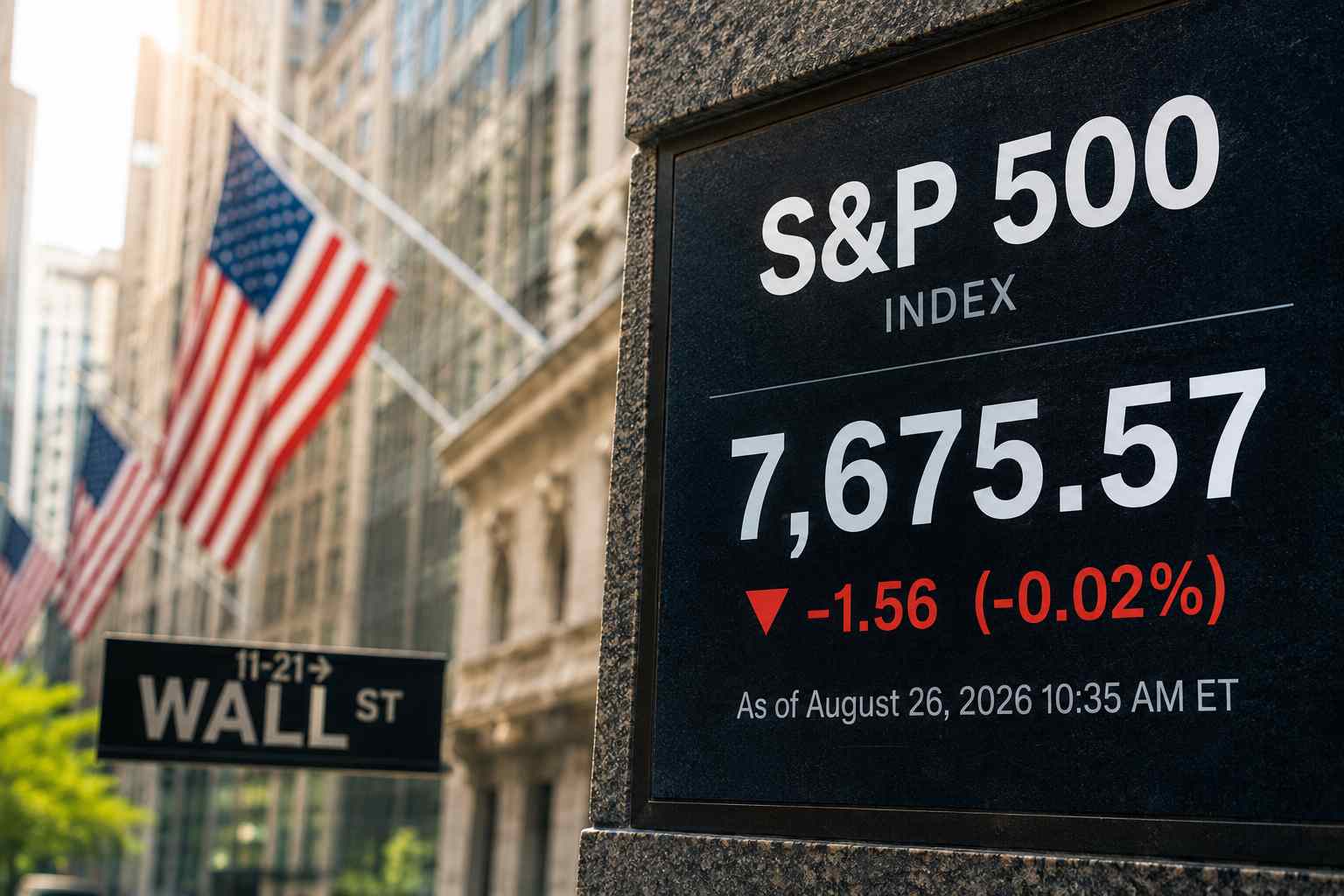
The S&P 500 was approximately 0.1% lower near 10:30 a.m. Wednesday, but the small headline decline understated a clear split inside the market. The Nasdaq fell roughly 0.4% as Nvidia and several other technology heavyweights weakened, while the equal-weight S&P 500 proxy gained about 0.3% and the Russell 2000 remained slightly positive.
Futures had already suggested mild technology weakness. The opening initially challenged that cautious setup: the S&P 500 climbed above Tuesday’s close, while Meta surged and several economically sensitive sectors advanced. That strength faded as Nvidia retreated and Meta surrendered most of its opening gain. Yet investors did not abandon equities broadly. They rotated toward industrials, energy, utilities and materials, leaving the capitalization-weighted index weaker than the average constituent.
Market at 10:30 A.M.
S&P 500: Approximately 7,670, down 0.1%
Nasdaq Composite: Approximately 26,050, down 0.4%
Dow: Approximately 53,450, down 0.2%
Russell 2000: Approximately 3,012, up 0.1%
S&P 500 Equal Weight proxy: Up approximately 0.3%
10-year Treasury yield: Approximately 4.66%
VIX: Approximately 15.5
WTI crude: Approximately $81.65 a barrel, down 0.9%
Market data checked: 10:30 a.m. ET
From Pre-Market to 10:30
Before the opening bell, S&P 500 futures were close to unchanged, Nasdaq-100 futures were down roughly 0.1% to 0.2%, and Dow futures were marginally positive. The market was balancing falling oil prices against an inflation report that offered little immediate relief.
The Bureau of Economic Analysis reported that July’s headline personal consumption expenditures price index rose 0.2% from June and 3.7% from a year earlier. The annual figure was slightly firmer than expected. Core PCE increased 0.2% monthly and 3.3% annually.
Separately, second-quarter GDP growth remained at a 1.5% annualized rate. The underlying details were stronger than that headline suggested: real final sales to private domestic purchasers, a measure of consumer spending and private fixed investment, increased at a revised 4.2% annual rate.
The S&P 500 opened around 7,667, briefly climbed to approximately 7,688 and then reversed toward 7,670. The Nasdaq followed a weaker path, falling from an opening level near 26,100 to roughly 26,050. The Dow also moved from an early gain to a decline.
No major new economic release transformed the market after 9:30. The reversal instead resembled regular-session price discovery. Opening demand lifted several headline stocks and indexes, but buyers became less willing to chase technology before Nvidia’s results. The bond market reinforced that restraint, with the 10-year Treasury yield holding around 4.66%.
What’s Actually Moving the S&P 500?
The first-hour story was the interaction between inflation-sensitive Treasury yields and unusually concentrated technology risk.
The economic data did not present investors with a simple recession-versus-growth choice. July consumer spending slowed to 0.2%, but personal income rose 0.4%. Second-quarter economic growth remained modest, while the revised measure of private domestic demand was comparatively strong. At the same time, inflation remained well above the Federal Reserve’s 2% target.
That combination gave investors little reason to anticipate rapid monetary easing. It also left highly valued growth stocks exposed to company-specific selling.
Nvidia fell approximately 1.2% after opening near $212.64, slipping to around $210.50 ahead of results scheduled after the closing bell. Because Nvidia represents more than 7% of the broad U.S. equity market by weight, its decline exerted considerably more influence than an equivalent move by an average company.
The weakness was not confined to one stock. The Nasdaq lagged, while consumer-discretionary and health-care sector funds fell roughly 0.6% and 0.4%, respectively. Communication services also turned lower after an initially strong start.
In contrast, industrials advanced roughly 1.1%, energy gained about 1.1%, utilities rose approximately 0.7%, and materials added around 0.6%. Energy stocks’ resilience despite lower crude prices suggests the sector was attracting rotation flows rather than merely following Wednesday’s oil move.
The result was an unusual combination: the largest technology companies weakened, but investors continued buying significant portions of the broader market.
What the Headline Index Is Hiding
The capitalization-weighted S&P 500 was down about 0.1%, but the Invesco S&P 500 Equal Weight ETF was up approximately 0.3%. That gap indicates that the average large-cap stock was performing better than the index’s biggest constituents.
Small caps confirmed the distinction. The Russell 2000 remained slightly positive even as the Nasdaq lost nearly 0.4%. Industrial, utility and materials leadership also showed that investors were still willing to own economically sensitive and income-oriented shares.
This was not a uniform flight from risk. It was a selective retreat from concentrated technology exposure, partly offset by strength elsewhere.
A reader watching only the S&P 500 would see a quiet decline. The underlying market showed a more constructive rotation accompanied by caution around its largest company.
Stocks Explaining the First Hour
Nvidia (NVDA)
Nvidia shares fell approximately 1.2% to around $210.50 after opening near $212.60. Its after-hours earnings report is the session’s largest scheduled corporate catalyst, and the company’s enormous index weight magnified its morning decline.
The stock’s weakness also pressured the semiconductor group and helped explain why the Nasdaq lagged both the S&P 500 and the Russell 2000.
Meta Platforms (META)
Meta opened near $590 after gaining in pre-market trading and briefly reached approximately $593. It then retreated toward $571, leaving it only modestly higher.
That reversal removed an important source of early support for communication services and the broader S&P 500. It also showed investors selling into opening strength rather than responding to a new post-open announcement.
Intuit (INTU)
Intuit plunged to approximately $323 at the open following its earnings outlook, compared with a previous close near $357. The shares subsequently recovered toward $347, reducing the loss to roughly 3%.
The difference between Intuit’s opening decline and its 10:30 performance was substantial. Reporting only the current percentage would miss one of the morning’s strongest reversals.
Zoom Communications (ZM)
Zoom remained down approximately 6% after its quarterly results and guidance. Unlike Intuit, it showed little meaningful opening recovery, keeping pressure on software companies.
Zoom’s performance also reinforced the selective nature of the technology selloff. Investors were distinguishing between individual outlooks rather than selling every technology company equally.
Boston Scientific (BSX)
Boston Scientific shares fell roughly 5% following disclosure of a cybersecurity incident that disrupted information-technology systems supporting order processing and shipping.
The company-specific decline contributed to health care’s underperformance and provided another source of weakness outside the technology sector.
J.M. Smucker (SJM)
Smucker opened near $135 before easing toward $130, leaving the shares up approximately 4%.
The gain helped consumer staples remain close to unchanged despite weakness elsewhere. Like Meta, however, Smucker showed that investors were taking profits after a strong opening rather than extending every pre-market move.
The Number That Matters
Approximately +0.3%: the equal-weight S&P 500 proxy.
That gain reveals more about the first hour than the S&P 500’s 0.1% decline.
The equal-weight performance shows that weakness was concentrated among larger constituents. The average company was advancing while Nvidia and other heavyweight technology shares pulled down the published index.
The approximately 0.4-percentage-point gap between the equal-weight proxy and the S&P 500 was therefore the clearest evidence that Wednesday morning’s decline was narrower than it appeared.
What Could Change This Afternoon
Nvidia’s price path remains the clearest test of whether technology weakness intensifies or stabilizes before the company reports earnings. Continued selling could place more pressure on the S&P 500 even if most constituents remain positive.
Treasury yields are equally significant. A sustained move above the first-hour range could create additional pressure on growth shares, while a yield retreat would remove one restraint on technology valuations.
Investors can also monitor whether equal-weight and small-cap strength survives. If those benchmarks turn lower, the morning’s rotation would be giving way to broader selling.
Crude oil may reshape sector leadership following the Energy Information Administration’s weekly petroleum report. Energy shares outperforming while oil declines is a notable divergence; whether it persists will help reveal if the move represents durable rotation or temporary positioning.
Finally, continued reversals in Meta and Intuit would show whether opening buyers are maintaining conviction or merely covering pre-market positions.
TwikUp Insight
The first hour showed a market reducing concentrated event risk without rejecting equities as a whole. Investors sold or trimmed the companies most capable of moving the headline indexes, particularly Nvidia, while allocating capital across industrials, energy, utilities and materials.
That separation matters. Wednesday morning’s S&P 500 decline reflected the construction of the index as much as a deterioration in overall demand for stocks. The market beneath the headline was stronger, more selective and less defensive than the index alone suggested.
Disclaimer
This article is for informational purposes only and does not constitute financial or investment advice. Market conditions and prices can change rapidly. Investors should conduct their own research before making investment decisions.
Sources
- Google Finance — S&P 500 Index
- Google Finance — Nasdaq Composite
- Google Finance — Dow Jones Industrial Average
- Google Finance — Russell 2000 Index
- Google Finance — Invesco S&P 500 Equal Weight ETF
- Google Finance — Cboe Volatility Index
- Google Finance — Cboe 10-Year Treasury Note Yield Index
- Google Finance — October 2026 WTI Crude Oil Futures