
Key Takeaways
- Nasdaq futures led gains as semiconductor and technology stocks rebounded ahead of Nvidia's earnings report.
- The 10-year Treasury yield near 4.67% remains a key valuation test for expensive growth and AI stocks.
- Nvidia's results and guidance could shape expectations for AI-compute demand and broader semiconductor spending.
Before the Bell
Wall Street is trying to bounce Tuesday morning, but the more revealing move is happening inside the market.
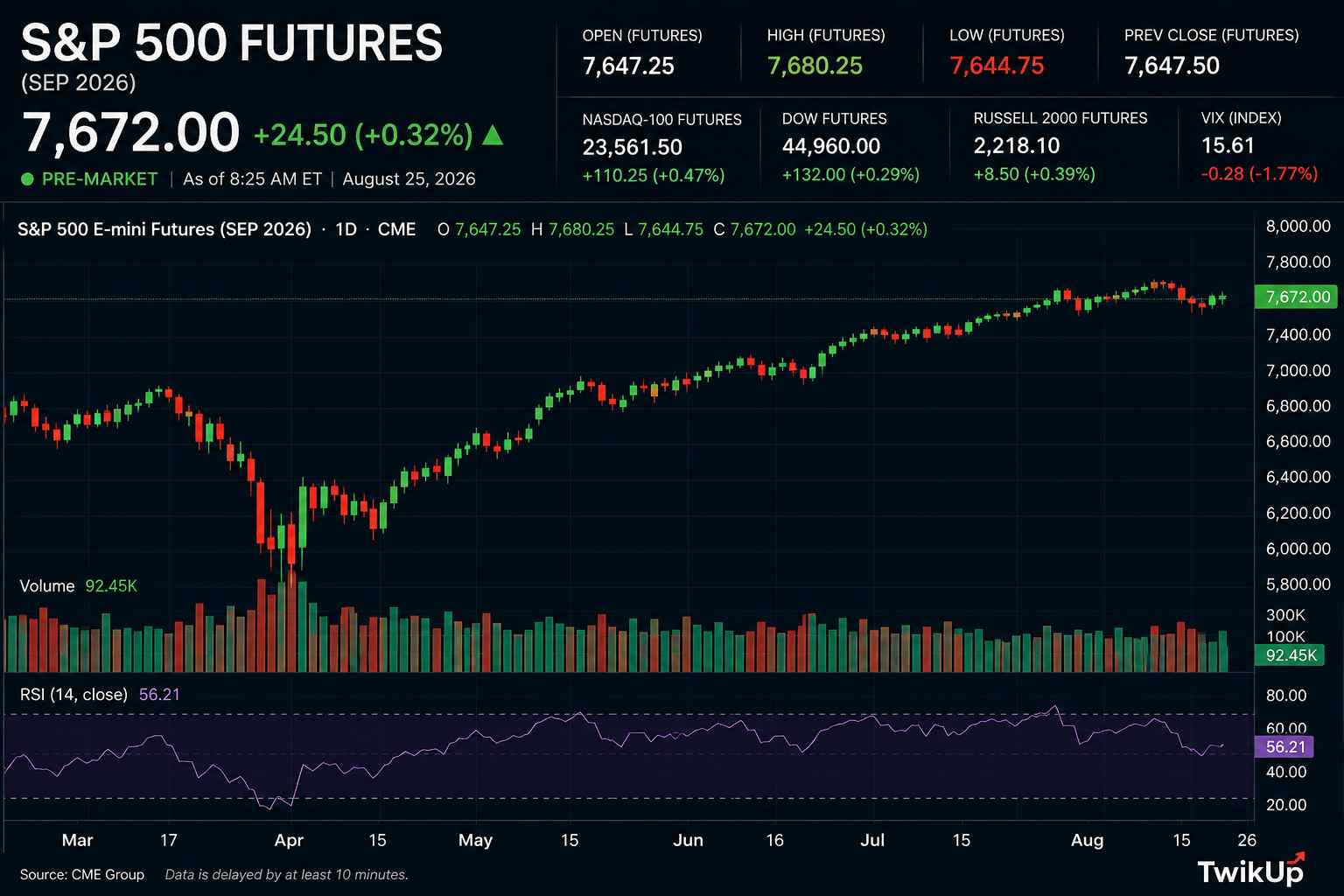
S&P 500 futures were up roughly 0.4%, while Nasdaq-100 futures were outperforming as semiconductor and technology stocks rebounded from Monday's weakness. Dow futures were also positive.
The setup creates an interesting contradiction: investors are moving back toward technology even though the 10-year Treasury yield remains around 4.7%, a level that can make expensive growth-stock valuations harder to justify.
And the market's biggest test has not arrived yet.
Nvidia reports fiscal second-quarter results Wednesday after the closing bell, while important U.S. inflation data are also approaching. Tuesday's rebound may therefore be less about a new bullish catalyst and more about investors repositioning ahead of two events capable of resetting expectations for both AI earnings and interest rates.
The Market Setup
S&P 500 futures: approximately +0.4%
Nasdaq-100 futures: approximately +0.8%
Dow futures: approximately +0.4%
Russell 2000 futures: approximately +0.5%
10-year Treasury yield: approximately 4.67%
WTI crude: approximately $84–$84.50 per barrel, down roughly 2%
Gold: approximately $4,690 per ounce
Market data checked: approximately 8:20 a.m. ET, August 25, 2026
The important detail is not simply that futures are green. Nasdaq futures are leading while oil is falling and long-term Treasury yields remain elevated.
That combination puts technology back at the centre of Tuesday's market story.
What Changed Overnight
Monday produced a noticeable split beneath the major indexes.
The S&P 500 fell 0.28% and the Nasdaq Composite dropped 0.76%, while the Dow managed a 0.26% gain. Technology was among the weaker areas of the market.
Tuesday morning is beginning differently.
Semiconductor stocks are rebounding, with Nvidia and several other chip-related names moving higher before the opening bell.
Nvidia also supplied fresh fundamental news Monday. The company announced that SpaceXAI will deploy its Vera CPUs for next-generation agentic AI workloads and said SpaceXAI plans to extend Nvidia accelerated computing into space through a Vera Rubin-based Starmind AI satellite.
Separately, Nvidia announced that its Groq 3 LPX inference accelerator is now in full production, with Nebius becoming its first AI-cloud adopter.
Those announcements strengthen the broader story around Nvidia's expanding AI ecosystem.
But they are arriving immediately before a much more consequential event: Nvidia's quarterly numbers.
What's Really Driving the Market
Tuesday's rebound looks like a test of how much valuation pressure investors are willing to tolerate when the AI growth story remains intact.
That matters because the market is dealing with two forces moving in opposite directions.
On one side is the bond market.
The 10-year Treasury yield was around 4.67% Tuesday morning. Higher long-term yields can create competition for equities and can be particularly uncomfortable for companies whose valuations depend heavily on profits expected far into the future.
That was part of the difficult backdrop facing technology stocks Monday.
But Tuesday morning, Nasdaq futures are outperforming anyway.
That suggests investors are not simply applying a mechanical "higher yields equal lower technology" rule. Instead, they appear willing to move back toward semiconductor and AI-related companies ahead of Nvidia's earnings.
Nvidia's importance makes this more than an ordinary earnings report.
The company is one of the largest constituents of the S&P 500 and Nasdaq-100. Its results can therefore influence the indexes directly, while its guidance can also affect expectations surrounding semiconductor manufacturers, memory companies, networking suppliers, data-centre operators and the enormous capital spending programs being pursued by major technology companies.
Nvidia has continued expanding that ecosystem ahead of earnings.
Its August announcements have included AI-infrastructure financing partnerships designed to mobilize more than $500 billion of third-party capital over time, a major Ohio AI-compute project, the SpaceXAI partnership and production of Groq 3 LPX.
The question Wednesday is whether Nvidia's financial performance and outlook validate the scale of those ambitions.
That makes Tuesday's Nasdaq rebound particularly interesting.
Investors are buying back into technology before receiving the evidence that could justify—or challenge—the move.
Meanwhile, falling oil provides a different kind of relief. WTI crude was down roughly 2% Tuesday morning despite continued geopolitical tension involving Iran.
Lower oil can reduce one source of inflation pressure, but one morning's commodity move is not enough to establish a broader inflation trend.
The result is a market that looks stronger on the surface while still facing unusually important tests underneath.
Stocks Moving Before the Bell
Nvidia (NVDA)
Nvidia shares were roughly 1% higher in early pre-market trading as technology and semiconductor stocks rebounded.
The company's fiscal second-quarter 2027 results are scheduled for Wednesday, August 26, with results expected at approximately 4:20 p.m. ET and its conference call at 5 p.m. ET.
The report matters well beyond Nvidia. Investors will be looking for evidence about AI-compute demand, data-centre spending and whether extraordinary infrastructure investment is continuing to translate into revenue growth.
Advanced Micro Devices (AMD)
AMD moved higher before the bell after Raymond James upgraded the semiconductor company to Strong Buy from Outperform.
The broader importance is the same theme supporting Tuesday's Nasdaq move: investors remain willing to reward companies positioned around expanding AI and data-centre computing demand.
AMD also offers the market another way to judge whether the AI infrastructure opportunity is broadening beyond Nvidia.
Micron Technology (MU)
Micron traded higher pre-market alongside the broader semiconductor rebound.
Memory has become increasingly connected to the AI infrastructure story because high-performance computing systems require enormous amounts of advanced memory.
That makes Micron useful as another indicator of whether Tuesday's technology recovery is concentrated entirely in Nvidia or spreading across the semiconductor ecosystem.
Bloom Energy (BE)
Bloom Energy shares jumped roughly 5%–6% before the opening bell.
The move followed congressional financial disclosures showing a new position associated with former House Speaker Nancy Pelosi's household.
The stock's reaction is notable, although the disclosure itself does not change Bloom Energy's underlying operating performance.
Navitas Semiconductor (NVTS)
Navitas Semiconductor rose after announcing an agreement to acquire Claros, adding technology aimed at power delivery for AI data centres.
Power has become an increasingly important part of the AI infrastructure equation. Building faster chips is only one part of expanding computing capacity; supplying electricity efficiently inside increasingly dense AI systems is becoming another potential bottleneck.
DICK'S Sporting Goods (DKS)
DICK'S Sporting Goods shares were sharply lower in pre-market trading, falling roughly 12%–15%.
The decline followed a second-quarter earnings miss and reductions to the company's full-year sales and profit forecasts as cautious discretionary spending weighed on demand.
The move stands out because it runs directly against Tuesday's stronger index futures.
That divergence is a useful reminder of what the S&P 500 can hide: an index supported by technology heavyweights can rise even while investors aggressively punish individual companies elsewhere in the market.
The Number That Matters Today
4.67%
The 10-year Treasury yield around 4.67% may be more important to Tuesday's market than the positive S&P 500 futures number.
Technology stocks are attempting to rebound without receiving much help from lower long-term borrowing costs.
If Nasdaq leadership survives while yields remain elevated, it would suggest investors are putting substantial weight on earnings and AI-growth expectations.
If yields rise further and technology begins losing momentum after the opening bell, Monday's valuation pressure could quickly become relevant again.
The relationship matters more than either number by itself.
What Could Change After 9:30
Technology breadth: Nvidia rising is one thing. AMD, Broadcom, Micron and other semiconductor companies participating would make the rebound considerably broader.
The 10-year Treasury yield: A move materially above Tuesday morning's level could increase pressure on expensive growth stocks. Falling yields could provide the opposite backdrop.
New-home sales: The U.S. Census Bureau is scheduled to release July new residential sales at 10 a.m. ET. June sales ran at a seasonally adjusted annual rate of 628,000.
Consumer confidence: The Conference Board is scheduled to release its August Consumer Confidence Index at 10 a.m. ET, providing another look at household sentiment before Wednesday's inflation report.
Nvidia positioning: With earnings arriving Wednesday afternoon, Nvidia's ability to hold its pre-market rebound may offer a useful indication of investor risk appetite ahead of the report—without predicting what the earnings themselves will show.
TwikUp Insight
Tuesday's green futures do not necessarily signal that Wall Street's concerns disappeared overnight.
The more interesting development is that technology is attempting to regain leadership while the 10-year Treasury yield remains near 4.7%.
That puts enormous weight on earnings.
For months, investors have been willing to accept premium AI valuations because earnings growth and infrastructure spending have supported the story. Nvidia's report Wednesday will test that relationship again.
So the real question Tuesday is not whether the S&P 500 opens higher.
It is whether technology can keep pulling the index upward before Nvidia provides the numbers needed to justify investors' confidence.
Disclaimer
This article is for informational purposes only and does not constitute financial or investment advice. Market prices can change quickly, and investors should conduct their own research before making investment decisions.
Sources
- NVIDIA Investor Relations — NVIDIA Sets Conference Call for Second-Quarter Financial Results
- NVIDIA Investor Relations — NVIDIA 2nd Quarter FY27 Financial Results
- NVIDIA Investor Relations — SpaceXAI Adopts NVIDIA Vera CPU to Accelerate Agentic AI at Massive Scale
- NVIDIA Investor Relations — NVIDIA Groq 3 LPX Now in Full Production With World-Class Speed for Agentic AI
- NVIDIA Investor Relations — AI Compute Infrastructure Financing Platforms to Mobilize Over $500 Billion
- U.S. Census Bureau — New Residential Sales Release Schedule
- U.S. Census Bureau — Monthly New Residential Sales, June 2026
- U.S. Treasury — Daily Treasury Rates