
Key Takeaways
- Lower Treasury yields and oil prices supported a technology-led rebound, with the Nasdaq outperforming the S&P 500.
- Consumer confidence fell to 89.4 as expectations for business activity, employment and income weakened.
- Nvidia’s upcoming earnings and the direction of the 10-year Treasury yield remained key drivers for technology stocks.
What Changed Tuesday Morning
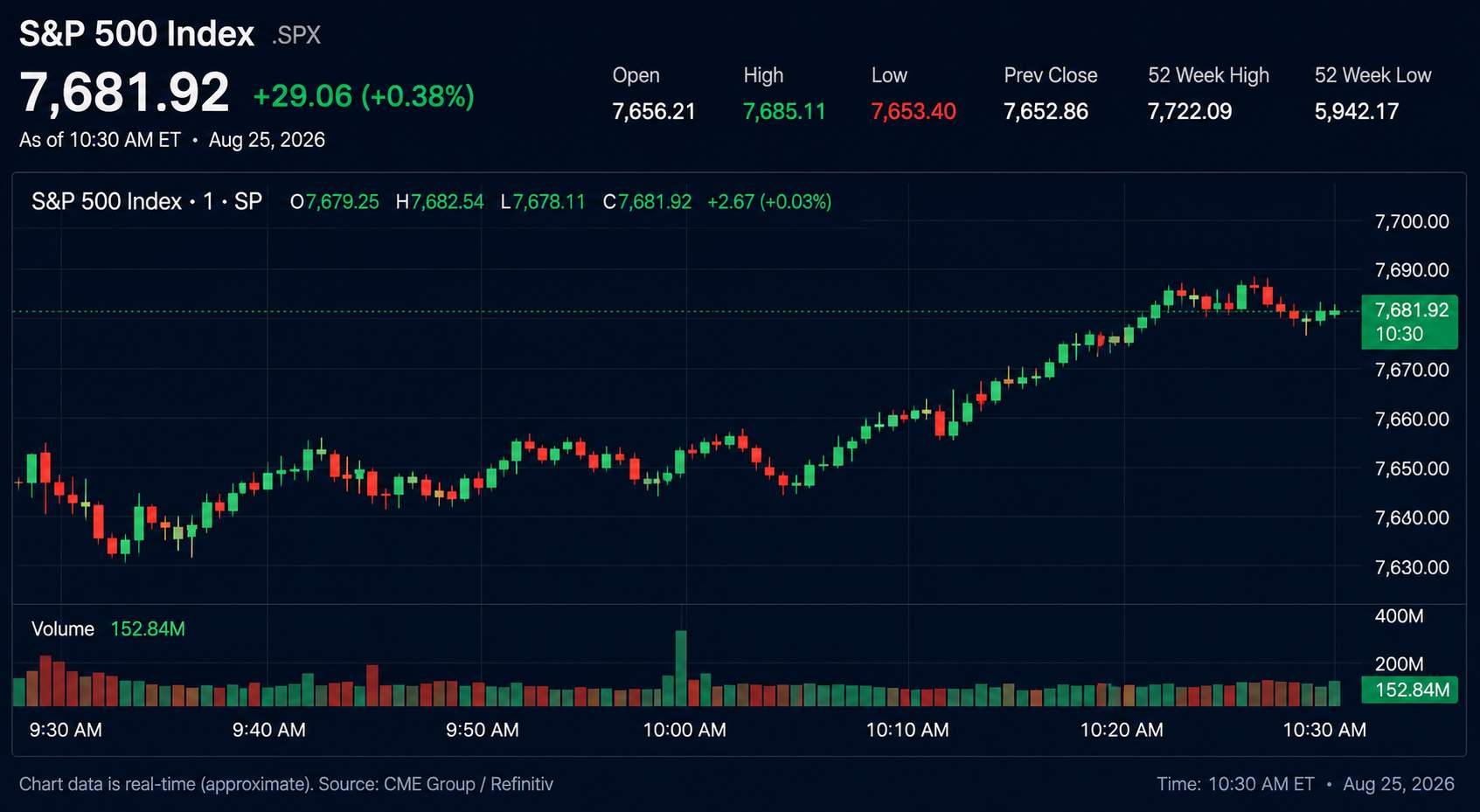
U.S. stocks moved higher Tuesday morning as technology and semiconductor shares recovered from Monday’s decline.
Around 10:30 a.m. ET, the S&P 500 was approximately 0.4% higher, while the technology-heavy Nasdaq Composite was gaining roughly 0.7%–0.8%. The Dow Jones Industrial Average was positive but lagged the other major indexes.
The 10-year Treasury yield was trading near 4.66%, below Monday’s closing level. WTI crude was also lower, trading around $82–$83 per barrel.
Those cross-market moves provided a more supportive backdrop for technology stocks. Lower long-term yields can reduce some of the valuation pressure on companies whose investors expect a large share of their earnings to arrive well into the future.
Oil’s decline also eased one source of near-term inflation concern.
The economic picture became more complicated at 10 a.m. ET, when The Conference Board released its August consumer-confidence report.
The Consumer Confidence Index declined to 89.4 from a revised 90.2 in July. Consumers’ assessment of present conditions improved, but their expectations for business activity, employment and income weakened.
The result left investors with an unusual opening-hour combination: softer consumer expectations, lower Treasury yields and stronger technology stocks.
Market at Approximately 10:30 A.M.
S&P 500: approximately +0.4%
Nasdaq Composite: approximately +0.7% to +0.8%
Dow Jones Industrial Average: approximately +0.1% to +0.2%
10-year Treasury yield: approximately 4.66%
WTI crude: approximately $82–$83 per barrel
These figures represent an intraday snapshot rather than closing values. Market prices and index levels continued to change throughout the session.
The Nasdaq’s outperformance pointed to the clearest early theme: technology and semiconductor stocks were leading the rebound as pressure from the bond market eased.
The Rebound Started Before the Bell
The technology recovery was already developing in pre-market trading.
S&P 500 futures were approximately 0.4% higher Tuesday morning, while Nasdaq 100 futures gained roughly 0.8%. Several semiconductor and large technology stocks also traded higher before the opening bell.
Two broader market moves helped create that setup.
First, oil prices declined sharply.
WTI crude fell toward $82 per barrel after trading at higher levels Monday. Because energy costs can influence inflation expectations, a sustained decline in oil can affect both the stock and Treasury markets.
Second, long-term Treasury yields moved lower.
The 10-year yield retreated toward the mid-4.6% range, easing some of the pressure that higher borrowing costs had placed on highly valued technology and artificial-intelligence stocks.
The market maintained much of that technology strength after regular trading began.
Then came the 10 a.m. consumer-confidence report.
Consumer Confidence Weakens
The Conference Board’s Consumer Confidence Index declined by 0.8 points to 89.4 in August from a revised 90.2 in July.
The headline change was relatively small, but the report’s components showed a notable split.
The Present Situation Index, which measures consumers’ assessment of current business and labour-market conditions, increased by 6.8 points to 121.2.
The Expectations Index, which measures consumers’ short-term outlook for income, employment and business conditions, fell by 5.8 points to 68.2.
All three components of the Expectations Index deteriorated.
Consumers became more pessimistic about future business conditions and the labour market, while their expectations for household income also moderated.
The survey therefore did not show a broad collapse in current conditions. Instead, it showed that consumers felt somewhat better about the present but more cautious about the next six months.
The Conference Board also reported that homebuying expectations declined slightly during the month, although they maintained an upward trend after reaching decade lows in early 2024.
What the Housing Reports Showed
Separate reports released at 9 a.m. ET showed that national home prices continued to increase modestly.
The Federal Housing Finance Agency reported that U.S. house prices rose 2.1% between the second quarter of 2025 and the second quarter of 2026.
Prices increased 0.3% from the first quarter to the second quarter of 2026. FHFA’s seasonally adjusted monthly index was unchanged in June from May.
House prices increased over the year in 46 states and the District of Columbia, while prices declined in four states.
S&P Dow Jones Indices separately reported that the S&P Cotality Case-Shiller U.S. National Home Price Index increased 1.5% year over year in June. That was up from a 1.2% annual increase in May.
After seasonal adjustment, the national Case-Shiller index increased 0.1% from May.
The two reports showed that national home prices were still rising, but at a modest pace.
They did not, by themselves, establish that housing demand was strengthening or weakening. Measures such as existing-home sales, new-home sales, pending sales and purchase-mortgage applications would be needed to make a broader claim about demand.
What Was Moving the S&P 500?
Tuesday morning’s advance appeared to reflect a reduction in some of the pressure facing growth stocks rather than a sudden improvement in the economic outlook.
Technology entered the session recovering from Monday’s weakness.
It received a more favourable backdrop from both the Treasury and oil markets.
When Treasury yields rise, bonds offer investors more attractive returns relative to stocks. Higher yields also reduce the present value of corporate profits expected far into the future.
That calculation can matter especially for growth companies trading at elevated valuations.
When yields decline, some of that valuation pressure can ease.
The simultaneous decline in Treasury yields and rebound in technology stocks made the bond market an important part of Tuesday’s early story.
However, the relationship does not prove that falling yields caused every technology stock to rise. Company developments, earnings expectations and short-term investor positioning also influenced trading.
Oil reinforced the more supportive backdrop.
WTI’s retreat toward $82 per barrel reduced one source of inflation anxiety after energy prices had become increasingly important to the market’s interest-rate outlook.
What the Headline Index Was Hiding
The S&P 500’s gain did not fully describe Tuesday morning’s trading.
The Nasdaq was performing substantially better, indicating that investors were directing more money toward technology and semiconductor stocks.
That distinction matters because the S&P 500 is weighted by market capitalization.
Large technology companies can exert significantly more influence on the index than smaller constituents. An S&P 500 advance driven partly by recovering mega-cap technology stocks does not necessarily mean every area of the market is equally strong.
Tuesday’s opening move was therefore best described as a technology-led rebound.
Stocks Explaining the First Hour
Nvidia
Nvidia was one of the most influential stocks in Tuesday’s market.
Shares advanced as investors positioned ahead of the company’s fiscal second-quarter results, scheduled for Wednesday, August 26, after the closing bell.
Nvidia said it would announce the results at approximately 4:20 p.m. ET, followed by its earnings call at 5 p.m. ET.
The company’s results matter beyond Nvidia itself. They will give investors new information about artificial-intelligence infrastructure spending, semiconductor demand and the expectations surrounding a broader group of technology companies.
Tuesday’s advance showed that some investors were willing to return to Nvidia ahead of the report after Monday’s technology weakness.
Advanced Micro Devices
AMD participated in the semiconductor rebound.
Its involvement added another major AI-computing company to Tuesday’s technology recovery, indicating that the early move extended beyond Nvidia.
Micron Technology
Micron also moved higher as semiconductor and memory stocks recovered.
Memory-chip producers are particularly sensitive to expectations surrounding data centres, AI infrastructure and broader semiconductor demand.
Western Digital
Western Digital joined the rebound in technology hardware and data-storage companies.
Its participation added to the evidence that investors were returning to several parts of the technology sector rather than concentrating exclusively on Nvidia.
Meta Platforms
Meta was among the large technology companies participating in the early advance.
Its movement illustrated how lower long-term yields can coincide with valuation relief for major growth companies, including businesses not directly connected to the day’s semiconductor catalyst.
DICK’S Sporting Goods
DICK’S Sporting Goods was the major exception to the market’s positive tone.
Shares fell sharply following the company’s quarterly report and updated 2026 outlook.
The decline occurred on the same morning that The Conference Board reported weaker consumer expectations.
One retailer cannot define the condition of the entire American consumer. However, the combination gave investors another reason to examine whether household spending was becoming more uneven beneath the headline economic figures.
The Number That Mattered
4.66%
That was approximately where the 10-year Treasury yield traded during the opening portion of Tuesday’s session.
The decline in the yield coincided with renewed strength in Nvidia and several other technology and semiconductor stocks.
That does not establish that the Treasury market was the only reason technology shares advanced.
It does, however, identify an important source of support for growth-stock valuations.
If the 10-year yield reverses sharply higher, some of that support could weaken.
What Could Change Later in the Session
Tuesday morning’s technology rebound remained sensitive to several factors.
Treasury yields were the first thing to watch. If the 10-year yield remained close to or below its morning level, technology stocks could retain an important source of support. A sharp reversal would test that interpretation.
Semiconductor participation also mattered. Continued strength across Nvidia, AMD, Micron and other chip-related companies would make the rebound more convincing than an advance concentrated in one company.
Oil remained important. A significant reversal in crude prices could alter inflation expectations and affect Treasury yields.
Nvidia expectations could increasingly dominate trading. With the company scheduled to report Wednesday, semiconductor stocks remained vulnerable to changes in sentiment ahead of the announcement.
Investors were also awaiting additional inflation data, meaning Tuesday’s consumer-confidence release represented only one part of the broader economic picture.
TwikUp Insight
Tuesday’s opening hour revealed something more useful than simply saying the S&P 500 was higher.
Investors did not suddenly conclude that every economic risk had disappeared. Instead, two sources of recent market pressure—elevated oil prices and higher long-term Treasury yields—eased enough to provide a more supportive environment for technology stocks.
The 10 a.m. consumer-confidence report complicated the picture.
Consumers felt somewhat better about current conditions but became more pessimistic about future business activity, employment and income.
Softer economic expectations can support bonds if investors believe they will reduce future inflation or interest-rate pressure. Persistent weakness in consumer expectations, however, could eventually become a warning about spending and economic growth.
For now, Tuesday’s market showed that the direction of Treasury yields remained nearly as important as the headline economic reports themselves.
Disclaimer
This article is for informational purposes only and does not constitute financial or investment advice. Market conditions and prices can change rapidly. Investors should conduct their own research before making investment decisions.
Sources
- The Conference Board — U.S. Consumer Confidence
- Federal Housing Finance Agency — U.S. house prices rise 2.1% year over year and 0.3% quarter over quarter
- S&P Dow Jones Indices — Case-Shiller annual gain for June 2026
- S&P Dow Jones Indices — S&P 500
- Nasdaq — Nasdaq Composite
- Nvidia — Second-quarter fiscal 2027 earnings announcement)