
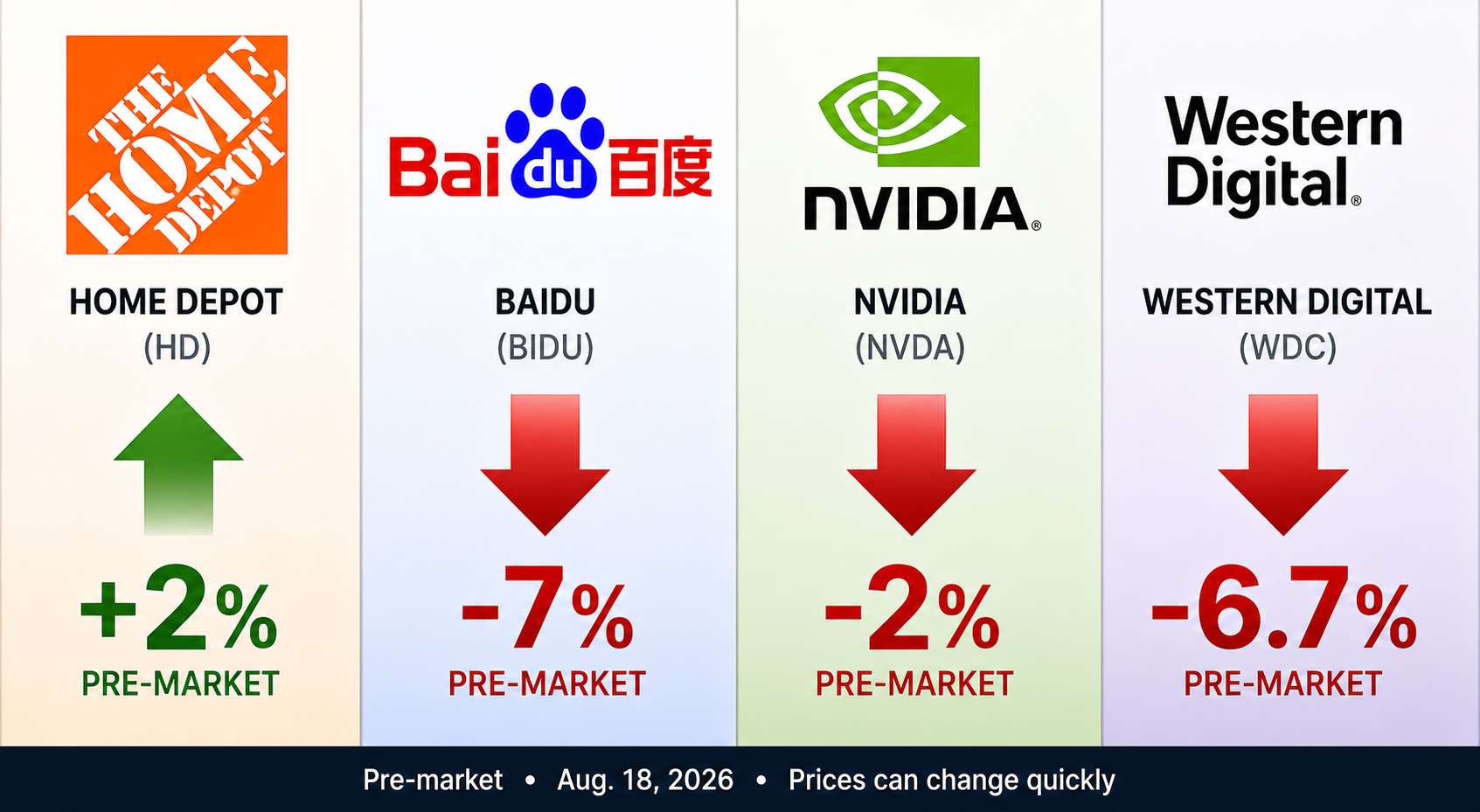
Tuesday morning is producing an unusual split before Wall Street opens.
Home Depot is rising after reporting stronger quarterly sales and reaffirming its full-year outlook. Baidu is moving sharply lower even though some of the fastest-growing parts of its artificial-intelligence business just posted extraordinary growth.
Meanwhile, pressure is spreading across parts of the AI-infrastructure trade, with Nvidia and Western Digital among technology names trading lower before the bell.
The contrast creates a bigger story than a simple list of pre-market winners and losers:
Investors do not appear to be abandoning AI. But they may be becoming much more selective about what kind of growth they are willing to reward.
Quick Answer
Several major stocks are moving before the U.S. market opens Tuesday, August 18, 2026.
Home Depot (HD) was up roughly 1% to 2% in pre-market trading after reporting fiscal second-quarter sales of approximately $47.9 billion, up 5.7% from a year earlier, and reaffirming its fiscal 2026 outlook.
Baidu (BIDU) was down roughly 7% in pre-market trading after reporting lower overall revenue and profit, even as its AI businesses continued to expand rapidly.
Nvidia (NVDA) was down nearly 2% in pre-market trading amid broader weakness across AI and semiconductor-related stocks. The company is scheduled to report its fiscal second-quarter 2027 results on August 26.
Western Digital (WDC) was down more than 4% before the opening bell, joining a broader decline across several AI-infrastructure and data-storage names.
These percentages are snapshots of pre-market trading Tuesday morning and can change quickly before or after the 9:30 a.m. ET opening bell.
The interesting part isn't simply which stocks are green or red.
It's what investors appear to be rewarding—and what they are beginning to question.
Home Depot delivers a $47.9 billion quarter
Home Depot provided one of Tuesday morning's clearest company-specific stories.
The retailer reported approximately $47.9 billion in fiscal second-quarter sales, an increase of 5.7% from a year earlier.
Comparable sales increased 1.7%, while comparable sales in the United States increased 1.3%.
Home Depot also reported quarterly net earnings of approximately $4.8 billion, or $4.79 per diluted share, compared with $4.6 billion and $4.58 per diluted share during the same period last year.
Adjusted diluted earnings per share reached $4.92, up from $4.68.
Perhaps just as important for investors, Home Depot reaffirmed its fiscal 2026 guidance.
The company continues to expect total sales growth of approximately 2.5% to 4.5% and comparable-sales growth ranging from approximately flat to 2%.
That gives investors something tangible.
Home Depot is operating against a complicated housing backdrop in which borrowing costs and housing-market conditions can influence home purchases and major renovation decisions.
Customers have remained more willing to tackle smaller repair and maintenance projects than large discretionary renovations.
Yet Home Depot still delivered higher quarterly sales and earnings.
That makes the company more than Tuesday morning's positive earnings story.
It also provides a window into how American households are spending on their homes even while the broader housing market remains challenging.
Baidu's problem is much more complicated
Then there is Baidu.
At first glance, its latest earnings contain numbers that sound like they should excite investors interested in artificial intelligence.
Revenue from Baidu Core AI-powered businesses reached RMB 12.5 billion in the second quarter, increasing 25% year over year and accounting for half of Baidu General Business revenue.
Its AI Cloud Infrastructure business generated RMB 7.3 billion, representing 50% year-over-year growth.
Go one level deeper and the growth becomes even more striking.
Baidu reported that revenue from its GPU Cloud business increased 283% year over year during the quarter.
Those are enormous growth rates.
Yet Baidu's U.S.-listed shares were down roughly 7% before Tuesday's opening bell.
Why?
Because Baidu is effectively running two different businesses moving in opposite directions.
Baidu's AI business is growing while its legacy business shrinks
While Baidu's AI-powered operations expanded, its legacy business generated approximately RMB 10.4 billion, down 23% year over year.
Online marketing services revenue declined 19% year over year to RMB 13.1 billion.
That weakness weighed heavily on the overall company.
Total Baidu revenue came in at approximately RMB 31.3 billion, down 4% year over year.
Net income attributable to Baidu was approximately RMB 2.3 billion, while non-GAAP net income attributable to Baidu was approximately RMB 2.6 billion.
Non-GAAP diluted earnings came in at RMB 7.22 per ADS.
This creates one of the more interesting technology stories in Tuesday's market.
Baidu's AI transformation is producing substantial growth—but that growth still has to become large enough to overcome weakness elsewhere in the company.
That distinction matters.
Investors are no longer evaluating AI companies simply on whether their artificial-intelligence businesses are growing.
The harder question is whether that growth is becoming large enough to transform the economics of the entire company.
The 283% number tells only half the story
Imagine looking only at Baidu's GPU Cloud number.
Revenue growth: 283%.
On its own, that would make the quarter sound extraordinary.
Now zoom out.
Total company revenue: down 4%.
Both statements can be true simultaneously.
And together they illustrate one of the biggest challenges investors face during the AI boom.
A rapidly expanding AI division can exist inside a company whose older businesses are declining.
That means the question isn't simply:
“How fast is AI growing?”
It is:
“How quickly can AI become big enough to change the trajectory of the whole company?”
For Baidu, Tuesday's results provide evidence that this transition is happening.
They also show that the transition is far from complete.
Nvidia faces a different test
Nvidia's situation is almost the opposite.
Rather than trying to prove AI can become a meaningful part of its business, Nvidia has become one of the companies at the centre of the global AI-infrastructure buildout.
Its challenge is different:
expectations.
Nvidia shares were down nearly 2% in pre-market trading Tuesday as weakness spread across AI, semiconductor and other technology stocks.
The move does not necessarily signal a deterioration in Nvidia's underlying business. Instead, it comes as investors reassess valuations and expectations across parts of the AI trade.
That distinction is important.
When expectations are already extremely high, investors don't necessarily need a major piece of bad company news to sell a stock.
Changes in valuation, interest-rate expectations, geopolitical risk or investors' appetite for growth stocks can be enough.
And Nvidia is approaching a major test.
The company is scheduled to report its second-quarter fiscal 2027 financial results on August 26.
That report will provide another look at demand for AI computing infrastructure—and whether Nvidia can continue producing growth strong enough to meet the enormous expectations surrounding the company.
Western Digital joins the AI-infrastructure selloff
Western Digital provides another important signal Tuesday morning.
Shares were down more than 4% in pre-market trading, joining weakness across several companies connected to AI infrastructure, semiconductors and data storage.
That is notable because Western Digital's underlying financial performance has recently been exceptionally strong.
The company reported fiscal fourth-quarter revenue of $3.75 billion, representing 44% year-over-year growth.
Western Digital also reported a GAAP gross margin of 54.1% and non-GAAP gross margin of 54.4%.
And the company isn't forecasting an immediate end to that growth.
For its fiscal first quarter of 2027, Western Digital said it expects revenue growth of approximately 42% to 49% year over year.
Demand associated with data infrastructure has therefore translated into substantial financial growth.
Yet Western Digital shares are falling Tuesday morning.
That highlights another lesson from the current AI market:
Strong business growth and strong stock performance are not always the same thing.
A company can report powerful revenue growth while its stock declines if investors believe expectations, valuations or broader sector risks have moved too far.
This is becoming a market of proof
Put Home Depot, Baidu, Nvidia and Western Digital together and Tuesday morning reveals a more interesting story.
Home Depot has a mature business that just delivered higher sales and earnings while maintaining its outlook.
Baidu has an AI business growing rapidly—but still has to overcome substantial declines across parts of its traditional business.
Western Digital is producing extraordinary revenue growth as demand for data infrastructure expands, yet its shares are under pressure.
And Nvidia will soon face perhaps the biggest test of all: proving that the economics of the AI boom remain powerful enough to meet enormous investor expectations.
These companies have very different businesses.
But investors may increasingly be applying the same question to all of them:
Show us the results.
AI growth is no longer one story
During the early stages of the generative-AI boom, investors often grouped companies into a relatively simple category:
AI winners.
That category is becoming less useful.
There are semiconductor companies selling processors.
There are storage companies supporting enormous amounts of data.
There are cloud providers selling AI computing capacity.
There are software companies building AI applications.
And there are older internet businesses attempting to use AI growth to offset revenue being lost elsewhere.
The economics are different in every case.
Baidu's latest results demonstrate exactly why investors may need to look underneath headline AI-growth percentages.
Its AI Cloud Infrastructure business grew 50%.
Its GPU Cloud business grew 283%.
Yet total company revenue declined 4%.
That isn't evidence that Baidu's AI strategy has failed.
Instead, it shows how large the transformation still needs to become.
What investors should watch after the opening bell
The first question is whether Tuesday's pre-market reactions survive regular trading.
Pre-market markets generally have lower liquidity than the regular session, meaning relatively small amounts of trading can sometimes produce larger price movements.
Home Depot will remain particularly important as investors digest its earnings and management commentary.
Baidu is also worth watching closely.
If the initial selloff continues, it could suggest investors remain more focused on declining overall revenue and weakness in its legacy businesses than on the company's rapidly expanding AI operations.
Then comes the broader AI trade.
If weakness continues across Nvidia, Western Digital and other semiconductor, storage and infrastructure companies after the opening bell, Tuesday's story could become less about individual corporate announcements and more about investors reassessing how much they are willing to pay for future AI growth.
If those stocks recover, however, the pre-market decline could prove to be another short-lived reset rather than evidence of a broader change in sentiment.
Either way, pre-market trading is only an early indication.
Prices and market direction can change rapidly after normal trading begins.
TwikUp Insight
The most important number in Tuesday's pre-market market may not be a stock's percentage move.
It might be 283%.
That is how quickly Baidu says its GPU Cloud revenue grew from a year earlier.
Normally, a number like that would dominate the story.
But Baidu's total revenue still declined 4%.
And its shares were falling sharply before the opening bell.
That contrast captures where the AI investment story may be heading next.
Investors already know AI can grow quickly. The next phase is proving that AI growth can become large and profitable enough to transform entire companies—or justify the expectations already embedded in their valuations.
For Nvidia, the challenge is maintaining extraordinary expectations.
For Western Digital, it is demonstrating that infrastructure demand can remain exceptionally strong.
For Baidu, it is making AI growth large enough to outweigh deterioration in its legacy businesses.
And Home Depot—far removed from the centre of the AI boom—is reminding the market that sometimes an old-fashioned combination of higher sales, higher earnings and maintained guidance can still get investors' attention.
The AI boom isn't necessarily weakening.
The market may simply be becoming more selective about who gets rewarded for it.
This article is for informational purposes only and does not constitute investment advice. Pre-market prices can change rapidly, and past performance does not guarantee future results.
Sources
- The Home Depot Investor Relations — Q2 Fiscal 2026 Results
- Baidu Investor Relations — Q2 2026 Results
- NVIDIA Investor Relations — Fiscal Q2 2027 Earnings Schedule
- Western Digital Investor Relations — Q4 and Fiscal Year 2026 Results