
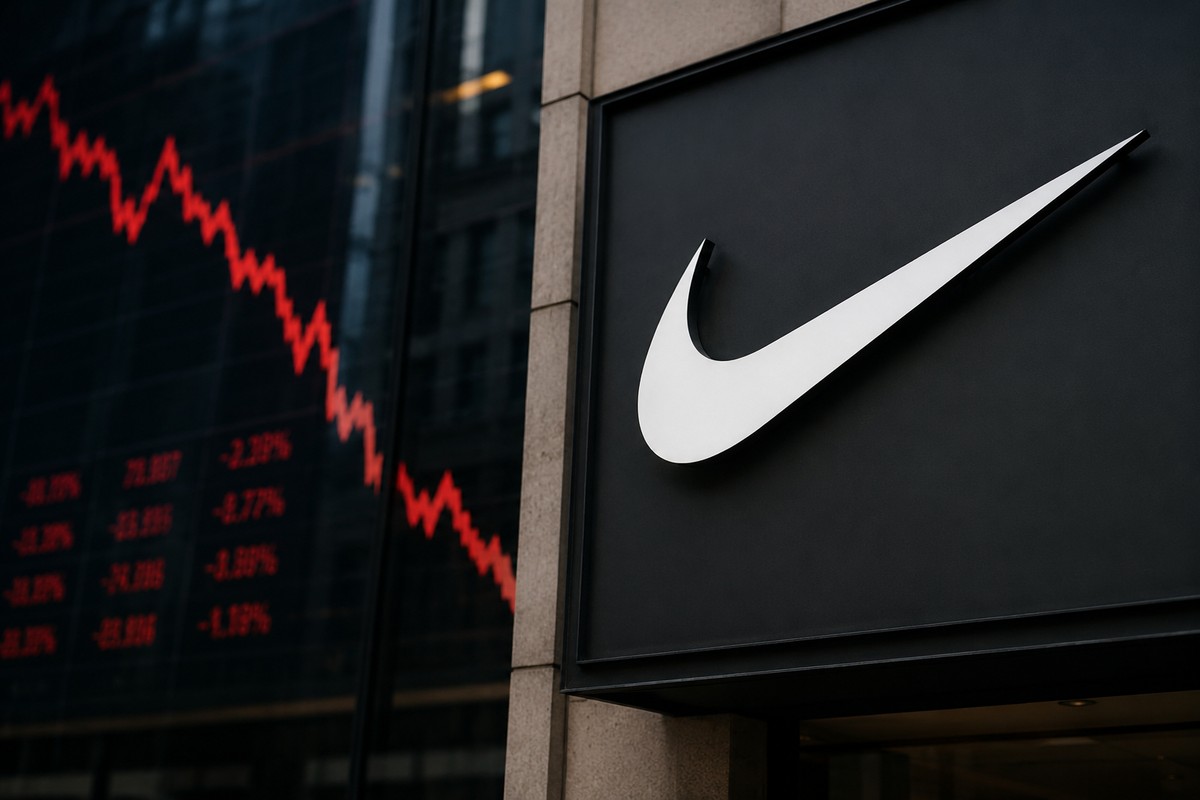
Nike shares are sending a message that goes beyond another bad day for the stock.
The athletic-wear giant fell to a new 52-week low on Monday, August 17, with shares trading around $39.17 around midday after falling below $40. The move leaves Nike roughly 51% below its $80.17 52-week high.
That decline creates an unusual picture.
Nike's latest financial results contain signs that parts of its turnaround are working. Wholesale sales have improved, North America has provided some growth, and management says it has strengthened the foundation of the business.
Yet investors continue to push the stock lower.
The reason may be less about whether Nike can sell sneakers and more about a harder question:
How long will investors have to wait before Nike's operational turnaround produces convincing, sustainable growth?
Quick Answer
Nike stock is trading at a fresh 52-week low as investors continue to question the speed and durability of the company's turnaround.
Nike generated $46.4 billion in fiscal 2026 revenue, roughly flat from the previous year on a reported basis, while currency-neutral revenue declined 2%. Wholesale revenue improved, but Nike Direct fell 6% for the year and Nike Brand Digital sales declined 12%. Greater China also remained a drag on the business.
The result is a company showing pockets of improvement without yet delivering the broad growth investors appear to want.
Nike's $80-to-$39 decline changes the story
Nike's latest decline is striking when viewed against where the stock traded less than a year ago.
Shares reached a 52-week high of $80.17 on August 25, 2025. On Monday, they traded as low as roughly $39.16, putting the stock at less than half that peak.
The weakness was already visible before Monday.
Nike closed Friday, August 14, at $40.73, down 1.21% for the session. That decline came while the S&P 500 fell only 0.17%, meaning Nike substantially underperformed the broader market that day.
Monday's move below $40 therefore represents more than a single-session reaction. It extends a much larger reassessment of what investors are willing to pay for Nike while its recovery remains incomplete.
The numbers show why investors are conflicted
Nike's fiscal 2026 results are not simply bad.
They are mixed.
Full-year revenue reached $46.4 billion, essentially flat on a reported basis and down 2% on a currency-neutral basis.
More importantly, Nike's wholesale business showed progress. Wholesale revenue increased 6% on a reported basis and 4% on a currency-neutral basis for the year.
But Nike Direct moved in the opposite direction.
Direct revenue fell 6% to $17.7 billion, including a 12% decline in Nike Brand Digital sales. That creates one of the most important tensions in the Nike turnaround.
The company is rebuilding relationships with wholesale partners and seeing improvement there, but its own direct-to-consumer operation—the business Nike spent years emphasizing—remains under pressure.
China remains one of Nike's biggest unanswered questions
Nike also hasn't produced a broad geographic recovery.
In its fiscal fourth quarter, Nike Brand revenue was approximately $10.7 billion, flat on a reported basis but down 3% on a currency-neutral basis.
Nike specifically said declines in Greater China and Europe, Middle East and Africa were partially offset by growth in North America.
Wholesale followed a similar pattern: North American growth was partially offset by declines in Greater China.
That matters because a sustainable Nike turnaround probably cannot depend on North America alone.
Investors need evidence that Nike can restore momentum across major international markets while competing with established rivals and newer athletic brands for consumer attention.
Until China stabilizes, one of Nike's largest geographic opportunities remains one of its most visible weaknesses.
Digital is another warning sign
There is another number that deserves attention: 12%.
Nike Brand Digital sales declined 12% for fiscal 2026. They also fell 12% in the fourth quarter.
That does not mean Nike's digital strategy has failed.
But it complicates the turnaround.
Nike spent years building a strategy around selling more directly to consumers. Now wholesale is one of the healthier pieces of the business while Nike Direct is shrinking.
The company is effectively trying to rebalance its distribution model while simultaneously improving products, rebuilding marketplace relationships and restoring consumer demand.
That is a more complicated turnaround than simply cutting costs.
One headline profit number needs context
Nike's fourth-quarter results contained an eye-catching improvement.
Gross margin increased 890 basis points to 49.2%, while net income jumped to approximately $1.1 billion and diluted earnings per share reached $0.72.
At first glance, that looks like a dramatic improvement.
But there is an important qualification.
Nike said its fourth-quarter gross margin included an approximately $986 million benefit from the expected recovery of International Emergency Economic Powers Act tariffs. That benefit added approximately 900 basis points to gross margin.
The same tariff recovery contributed approximately $0.52 to quarterly diluted EPS.
Investors therefore cannot simply take the fourth-quarter margin and earnings jump as evidence that Nike's underlying profitability suddenly returned to historical strength.
The more important question is what margins look like as the company moves beyond that unusual benefit.
Nike is changing financial leadership at a critical moment
The stock's latest low also arrives at an interesting moment inside the company.
David Denton is taking over as Nike's chief financial officer effective August 17, replacing Matthew Friend.
That puts new financial leadership in place while CEO Elliott Hill continues the broader turnaround.
Hill has described Nike's fiscal 2026 actions as strengthening the company's foundation, with the business focusing on product innovation, brand strength and serving consumers through what Nike calls its "Sport Offense."
The market, however, appears to be asking for something more measurable.
Investors have heard the turnaround strategy.
Now they need to see the turnaround in the numbers.
What could change the Nike story?
The next phase of Nike's recovery may depend on several indicators rather than one blockbuster quarter.
Watch whether Nike Direct and digital declines begin to moderate, whether Greater China stabilizes, whether wholesale growth remains durable and whether underlying margins improve without unusual tariff-related benefits.
Another important test will be whether Nike can translate stronger performance products and major sporting moments into broader consumer demand.
If those pieces begin moving together, the argument that Nike has reached an operational bottom becomes considerably stronger.
If North America and wholesale improve while China and digital continue shrinking, investors may continue questioning how complete the recovery really is.
TwikUp Insight
Nike's stock falling below $40 doesn't necessarily mean the company's turnaround has failed.
It may show that the market has stopped paying in advance for the turnaround.
There is already evidence of progress. Fiscal 2026 wholesale revenue increased, North America provided growth in the fourth quarter, and Nike says it is seeing progress in performance products.
But investors now appear to want proof that those improvements can spread across channels and geographies.
That makes the next stage of Nike's story fundamentally different from the first.
The question is no longer whether management has a turnaround plan.
The question is when that plan starts producing enough growth to change what investors see when they look at Nike's numbers.
At around $39, the stock market is making clear that patience has become much more expensive for Nike.
This article is for informational purposes only and does not constitute investment advice or a recommendation to buy or sell any security.