
Key Takeaways
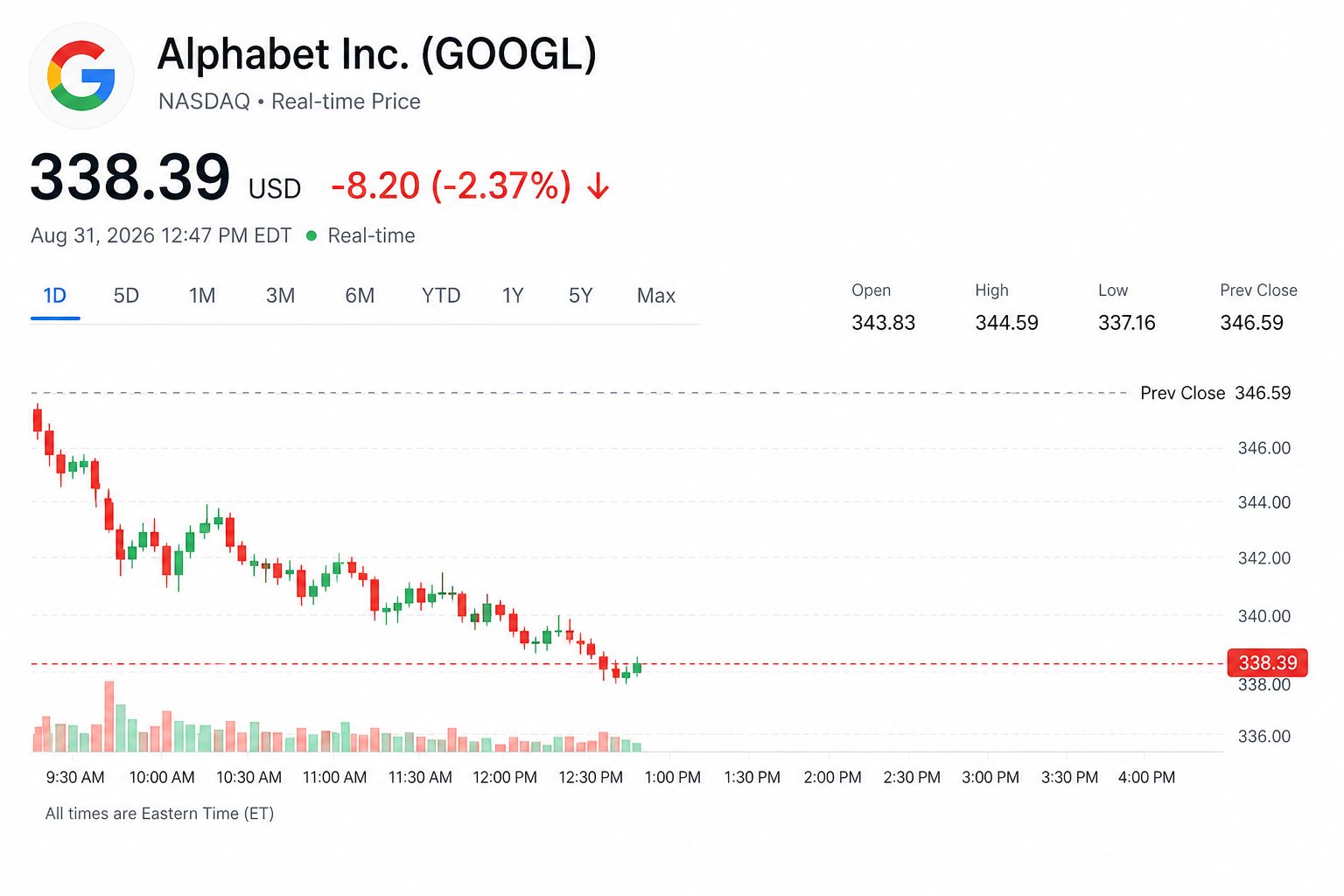
- Alphabet was down about 2.6% at midday, the largest percentage decline in TwikUp’s 20-stock mega-cap watchlist.
- Amazon also declined while Nvidia gained, showing major technology stocks were not moving as a single group.
- Alphabet’s planned AI infrastructure spending and Google Cloud growth remain central investor considerations.
Quick Answer
Among TwikUp's Top 20 mega-cap U.S. stock watchlist, Alphabet Class A was the biggest percentage loser at approximately 12:30 p.m. ET Monday, down around 2.6%.
Amazon was also among the weakest names at roughly -2.4%, while Nvidia was moving in the opposite direction at approximately +1.1%.
TwikUp's comparison uses the percentage move from the previous regular-session close across its 20-stock watchlist at approximately the same midday snapshot.
These are intraday figures, not closing prices. The ranking can change before the regular U.S. trading session ends at 4:00 p.m. ET.
Why Is Alphabet Falling?
This is where the story becomes less straightforward.
TwikUp did not identify a single new Alphabet corporate announcement Monday morning that, by itself, clearly explains the entire intraday decline.
And that's important.
When a major stock suddenly falls 2% or 3%, it's tempting to attach the move to one headline.
Markets aren't always that simple.
Alphabet is trading against a broader backdrop that includes geopolitical uncertainty, higher oil prices, interest-rate expectations and continuing questions about how quickly enormous investments in artificial intelligence will generate returns.
None of those factors, individually, proves why Alphabet was down approximately 2.6%.
But they help explain why investors may be particularly sensitive to valuation, spending and future earnings expectations.
Alphabet Is Preparing to Spend an Extraordinary Amount
One number deserves attention when looking at Alphabet:
$175 billion to $185 billion.
That's how much Alphabet expects to spend on capital expenditures in 2026.
The company has said most of the investment will support technical infrastructure required for its businesses and growing AI demand.
Alphabet also disclosed that approximately 60% of its 2025 capital expenditure went toward servers, while roughly 40% went toward data centres and networking equipment. Management indicated the 2026 mix should be fairly similar.
Those are enormous numbers even for one of the world's largest companies.
But there's another side to the equation.
The businesses Alphabet is investing in are growing rapidly.
Google Cloud Is Growing Fast
In Alphabet's most recently reported fourth quarter, Google Cloud revenue increased 48% year over year to $17.7 billion.
Cloud operating income reached $5.3 billion, more than double the level from a year earlier.
And Google Cloud's backlog climbed to approximately $240 billion.
That creates one of the most interesting debates surrounding Alphabet.
Investors aren't simply looking at an enormous AI spending bill.
They're looking at enormous spending alongside rapidly expanding cloud demand.
The question is how efficiently Alphabet can turn that infrastructure investment into future revenue, profits and cash flow.
Monday's stock decline doesn't answer that question.
But it helps explain why Alphabet's capital spending is likely to remain one of the numbers investors watch closely.
Then Look at Nvidia
Now compare Alphabet with Nvidia.
At approximately the same midday snapshot, Nvidia was around 1.1% higher.
Only days earlier, Nvidia had reported another huge quarter.
For its fiscal second quarter, Nvidia reported $96.2 billion in revenue, an increase of 106% from a year earlier.
Its Data Center business generated approximately $89 billion, up 117% year over year.
That's what makes Monday's divergence interesting.
Alphabet and Amazon — companies investing enormous sums into cloud and AI infrastructure — were under pressure.
Nvidia — one of the major suppliers of computing hardware powering the AI infrastructure boom — was moving higher.
That doesn't establish a new market trend.
One trading session isn't enough evidence for that.
But it creates an interesting question.
Could investors eventually value the companies supplying the AI infrastructure boom differently from the companies spending heavily to build AI capacity?
Monday's moves can't answer that.
They're simply something worth watching.
Amazon Is Near the Bottom Too
Amazon was approximately 2.4% lower around the same midday snapshot, placing it close behind Alphabet among the weakest companies in TwikUp's Top 20 group.
Amazon, like Alphabet, is investing heavily in infrastructure supporting cloud computing and artificial intelligence.
But investors should be careful about drawing a direct connection between the two declines.
Alphabet and Amazon have different businesses, valuations, revenue mixes and company-specific risks.
Their stocks moving lower on the same day does not prove investors are suddenly rejecting AI infrastructure spending.
What it does show is that Big Tech isn't trading as one single group Monday.
And Nvidia's move in the opposite direction makes that separation particularly visible.
Don't Confuse “Top 20 Loser” With the Market's Biggest Loser
There's an important distinction in this story.
Alphabet being the biggest percentage loser in TwikUp's Top 20 watchlist does not mean Alphabet is the biggest-declining stock in the S&P 500, Nasdaq or entire U.S. market.
Thousands of securities trade in the United States, and many can experience significantly larger daily moves.
This comparison is deliberately limited to 20 of the largest and most closely watched U.S. companies monitored by TwikUp.
Think of it as a mega-cap scoreboard, not a ranking of the entire stock market.
And the Scoreboard Isn't Finished
There's another reason not to overinterpret the ranking.
The clock.
Alphabet's approximately 2.6% decline was captured around 12:30 p.m. ET.
The regular trading session doesn't end until 4:00 p.m. ET.
Alphabet could recover.
Amazon could move lower.
Nvidia could give back its gain.
Another company could become the biggest decliner in TwikUp's Top 20 before the closing bell.
That's why this ranking should be viewed exactly as it is:
A midday snapshot — not the final score.
TwikUp Insight
The most interesting thing happening in TwikUp's Top 20 isn't simply that Alphabet is down.
It's the separation underneath the headline.
Alphabet and Amazon were among the weakest mega-cap names around midday while Nvidia was moving higher.
At the same time, Alphabet is preparing to spend as much as $185 billion this year, Google Cloud is growing rapidly, and Nvidia is reporting extraordinary demand from the infrastructure powering the AI expansion.
There isn't enough evidence from one trading session to declare that Wall Street has suddenly chosen AI “winners” and “losers.”
But Monday offers a useful reminder:
Being part of the same technological boom doesn't mean companies' stocks have to move together.
Sometimes the more interesting market signal isn't whether Big Tech is rising or falling.
It's which companies investors are treating differently — and why.
Disclosure
This article is for news, informational and educational purposes only. It does not constitute investment advice, financial advice, a recommendation, an offer or a solicitation to buy or sell any security. Intraday stock prices and percentage changes can change rapidly and may differ depending on data timing and source. Investors should conduct their own research and consider their individual financial circumstances and risk tolerance before making investment decisions.