
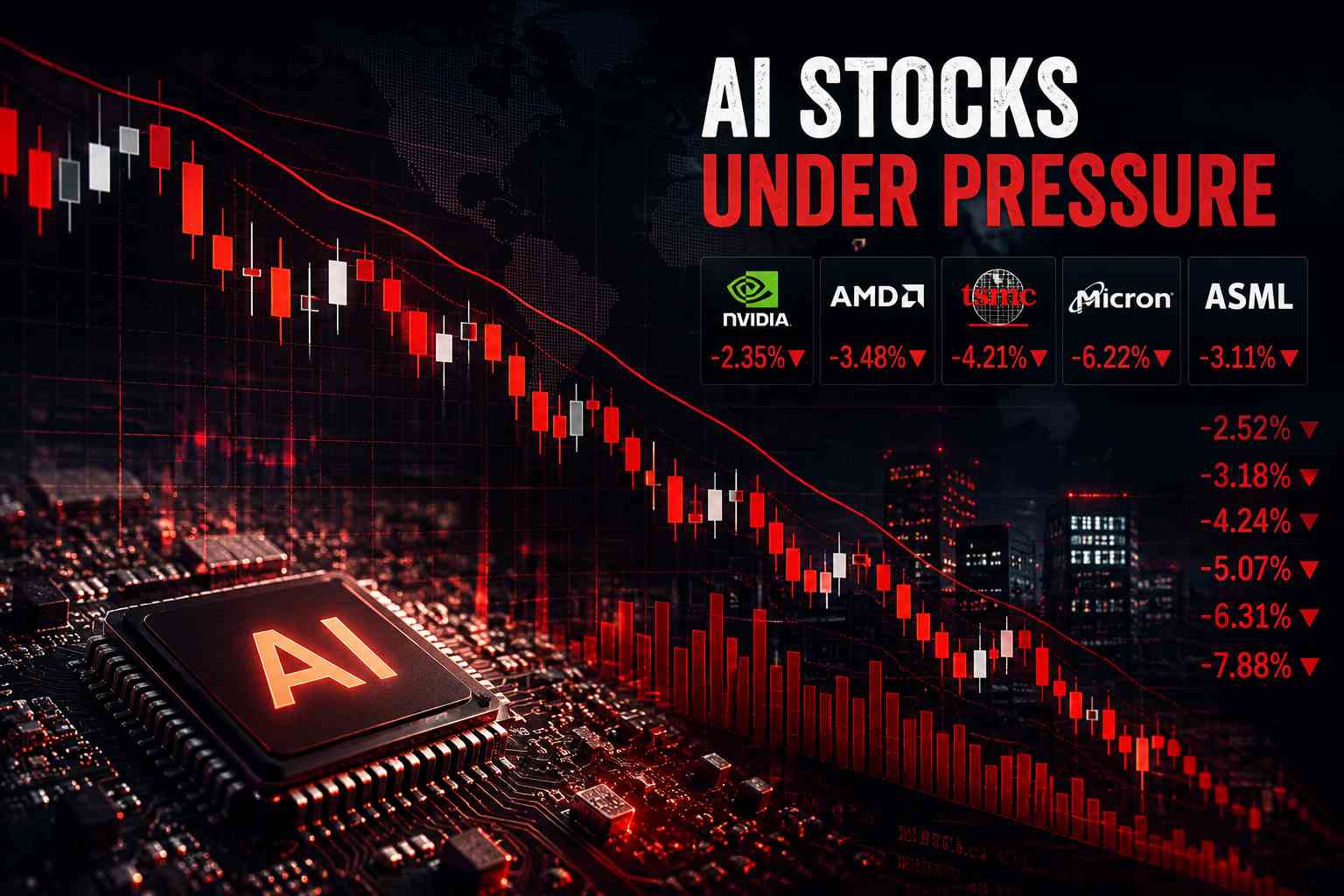
AI Stocks Are Falling — But the Real Test for the AI Boom May Be Just Beginning
Artificial intelligence has spent the past few years convincing Wall Street of one thing:
Demand is enormous.
Now investors may be moving toward a harder question.
Can enormous AI demand produce returns fast enough to justify the extraordinary amount of money being spent to satisfy it?
That question matters as technology and semiconductor stocks come under pressure on Tuesday, August 18, 2026.
It would be easy to treat today's decline as another bad day for technology stocks. But the more interesting story is what is happening underneath it.
AI companies are still expanding.
Data centres are still being built.
Demand for advanced computing remains enormous.
Nvidia's latest reported quarter provides perhaps the clearest evidence: quarterly revenue reached a record $81.6 billion, up 85% from a year earlier, while Data Center revenue surged 92% to $75.2 billion.
Those numbers hardly describe an industry suffering from disappearing demand.
Instead, the next stage of the AI boom may be creating a different challenge:
The bigger AI becomes, the more expensive it becomes to build.
Quick Answer
AI and semiconductor stocks are under pressure on August 18 as investors face a combination of higher long-term interest rates, expensive technology valuations and increasingly enormous AI infrastructure requirements.
But today's decline does not necessarily mean investors are abandoning artificial intelligence.
The bigger issue may be changing from AI demand to AI economics.
Companies are spending enormous amounts on GPUs, data centres, networking equipment, power infrastructure and new AI systems. As that investment grows, investors will increasingly want evidence that AI revenue and productivity can grow fast enough to produce attractive returns on all that capital.
That makes the next stage of the AI boom potentially very different from the first.
Nvidia Shows That AI Demand Is Still Extraordinary
Start with the strongest argument against calling today's weakness an AI collapse.
Nvidia's business continues to grow at extraordinary speed.
For its fiscal first quarter of 2027, Nvidia reported:
- $81.6 billion in total revenue, up 85% year over year.
- $75.2 billion in Data Center revenue, up 92%.
- GAAP gross margin of 74.9%.
- An additional $80 billion share-repurchase authorization.
Nvidia CEO Jensen Huang described the expansion of AI infrastructure as an accelerating buildout of what the company calls “AI factories.”
Whatever happens to Nvidia's share price on an individual trading day, those financial results demonstrate something important:
Companies are still spending enormous amounts of money on AI computing.
So today's bigger question isn't whether AI demand suddenly disappeared.
It hasn't.
The Problem With Success Is That Someone Has to Build It
Imagine AI demand doubles.
At first, that sounds overwhelmingly positive for the companies supplying the technology.
But doubling AI usage isn't as simple as selling twice as many software subscriptions.
More AI workloads can require more GPUs.
More GPUs require more servers.
More servers require more data-centre capacity.
Those facilities require networking equipment, cooling systems, land and enormous quantities of electricity.
And somebody has to finance all of it.
That means AI's extraordinary success creates an unusual challenge.
Every new wave of demand can require another wave of physical investment.
The AI revolution may therefore be moving from primarily a technology story toward an enormous infrastructure and capital-allocation story.
Wall Street's Question Could Be Changing
During the early generative-AI boom, investors primarily wanted evidence of adoption.
Can ChatGPT attract users?
Will businesses use generative AI?
Can AI improve search?
Will companies pay for AI assistants?
Will developers build AI applications?
Many of those questions now have much clearer answers.
AI products have spread rapidly across technology companies and corporate software.
But successful adoption creates the next question:
How much does it cost to serve all that demand?
That could become one of the defining investment questions of the next several years.
Consider two hypothetical AI companies.
Company A spends $100 billion building AI infrastructure and eventually generates $150 billion of additional economic value.
Company B spends the same $100 billion but produces only $110 billion.
Both companies can truthfully say AI generated growth.
But investors would view the economics very differently.
That is why the next AI race may not simply be about who has the biggest model or the largest data centre.
It may increasingly be about return on invested capital.
Higher Interest Rates Make That Question More Important
This debate becomes particularly significant when borrowing costs rise.
AI infrastructure is extraordinarily capital intensive.
Data centres can require billions of dollars before generating meaningful revenue. Power infrastructure may require additional investment. Advanced semiconductor systems themselves can be extremely expensive.
When financing is cheap, investors may be more willing to wait years for those projects to produce returns.
When long-term interest rates rise, the calculation changes.
Companies face a higher cost of capital.
Investors can earn more from comparatively lower-risk assets such as government bonds.
And future corporate earnings become less valuable when discounted at higher rates.
That combination can hit high-growth technology companies particularly hard.
It also means that an AI project that looked extremely attractive under cheaper financing can look less compelling when capital becomes more expensive.
AI Has Become a Physical-Infrastructure Story
This may be one of the most underappreciated changes in artificial intelligence.
Consumers experience AI as software.
They type a question.
An answer appears seconds later.
But behind that simple interaction sits an increasingly enormous physical system.
Semiconductors must be manufactured.
Servers must be assembled.
Data centres must be constructed.
Electricity must be generated and transmitted.
Cooling systems must operate continuously.
Networking equipment must connect thousands of processors.
AI therefore has an unusual characteristic.
The product feels digital, but its expansion increasingly depends on physical infrastructure.
And physical infrastructure requires capital.
Lots of it.
Nvidia Is Benefiting From That Buildout — For Now
Few companies illustrate the scale of the opportunity better than Nvidia.
Its Data Center business generated $75.2 billion in a single quarter in its latest reported results.
For perspective, Nvidia's entire quarterly company revenue was far smaller only a few years ago.
That transformation demonstrates how aggressively companies are expanding AI infrastructure.
But Nvidia's extraordinary success also creates a benchmark for the rest of the industry.
If companies continue buying enormous quantities of AI computing equipment, eventually investors will want to know what those customers are earning from those investments.
The first phase of the boom rewarded companies supplying the infrastructure.
The next phase could increasingly judge the companies purchasing it.
The AI Industry May Be Approaching Its Productivity Test
Every major technological transition eventually encounters a similar moment.
Building the technology is only the beginning.
Eventually businesses need to demonstrate that the technology creates enough economic value to justify what they spent.
The internet required telecommunications networks and data centres.
Cloud computing required enormous server infrastructure.
Smartphones required wireless networks and semiconductor supply chains.
Artificial intelligence could be much larger.
But the economic principle remains the same.
Infrastructure investment cannot expand indefinitely without eventually producing sufficient returns.
That does not mean AI spending is excessive today.
It means the burden of proof changes as the numbers become larger.
A company spending $1 billion experimenting with AI can justify that investment partly through strategic positioning.
A company committing tens of billions of dollars needs increasingly measurable results.
Watch What Happens After Nvidia Reports
The next major checkpoint arrives quickly.
Nvidia is scheduled to report its fiscal second-quarter 2027 results on Wednesday, August 26.
The company says results will be released at approximately 1:20 p.m. Pacific Time, followed by its earnings call at 5 p.m. Eastern Time.
Revenue growth will obviously matter.
Data Center revenue will matter.
Margins will matter.
Guidance will matter.
But investors should also pay attention to what Nvidia says about the broader infrastructure environment.
Is demand continuing to accelerate?
Are customers expanding AI capacity at the same pace?
Are new generations of chips translating into even larger infrastructure deployments?
Those answers could provide an important indication of whether today's technology weakness represents temporary market pressure or the beginning of greater scrutiny around AI spending.
The Most Important Number May Eventually Change
For the last few years, one of the most exciting numbers in technology has been capital expenditure.
Companies announcing bigger AI investments demonstrated confidence.
A larger data centre meant greater ambition.
More GPUs meant greater AI capacity.
But markets eventually demand another number:
return.
How much revenue did that infrastructure create?
How much operating profit?
How much productivity?
How much free cash flow?
And how long did it take to recover the original investment?
Those questions could determine which companies ultimately benefit most from the AI revolution.
Key Takeaways
- Today's weakness in AI and semiconductor stocks does not by itself demonstrate that AI demand is collapsing.
- Nvidia's latest quarter showed $81.6 billion in revenue, up 85% year over year, while Data Center revenue jumped 92% to $75.2 billion.
- AI expansion increasingly requires enormous physical infrastructure including chips, servers, data centres, networking and electricity.
- Higher financing costs can make capital-intensive AI projects more expensive and increase investor scrutiny of technology valuations.
- The next stage of the AI investment story may focus increasingly on how much economic return companies generate from every dollar spent on AI.
- Nvidia reports its next quarterly results on August 26, providing another important test of AI infrastructure demand.
TwikUp Insight
The most interesting thing about today's AI-stock weakness may be what it doesn't tell us.
It doesn't tell us that companies have stopped buying AI chips.
It doesn't tell us businesses have stopped adopting artificial intelligence.
And it doesn't tell us that the AI revolution is ending.
Instead, the market may be entering a more demanding stage.
The first question was:
Can AI become enormous?
Evidence increasingly suggests that it can.
The next question is harder:
Can companies turn enormous AI investment into equally enormous economic returns?
If investors begin focusing on that equation, the AI market could become much more selective.
Simply announcing another massive data centre or another multibillion-dollar AI budget may eventually stop being enough.
The companies that dominate the next stage may be those that can demonstrate something more valuable than spending:
that every new dollar going into artificial intelligence can eventually create significantly more than a dollar of economic value.
That would not represent the end of the AI boom.
It would represent the moment when the AI boom begins having to prove its economics.
Sources
NVIDIA Investor Relations — First Quarter Fiscal 2027 Results Nvidia reported $81.6 billion in quarterly revenue and $75.2 billion in Data Center revenue. https://investor.nvidia.com/news/press-release-details/2026/NVIDIA-Announces-Financial-Results-for-First-Quarter-Fiscal-2027/default.aspx
NVIDIA Investor Relations — Second Quarter Fiscal 2027 Earnings Schedule Nvidia's next quarterly results are scheduled for August 26, 2026. https://investor.nvidia.com/news/press-release-details/2026/NVIDIA-Sets-Conference-Call-for-Second-Quarter-Financial-Results/default.aspx
NVIDIA Investor Relations — Financial Reports Official Nvidia quarterly financial results and company disclosures. https://investor.nvidia.com/financial-info/financial-reports/default.aspx
U.S. Treasury — Treasury Securities and Market Information Official U.S. government source for Treasury securities and financing information. https://home.treasury.gov/
U.S. Energy Information Administration — Energy Data Official U.S. government data covering oil, electricity and energy markets. https://www.eia.gov/
Market movements can change throughout the trading session. This article is for informational purposes only and does not constitute investment advice.