
Key Takeaways
- ChatGPT can support company research and valuation analysis, but cannot reliably predict stock prices or guarantee winners.
- Strong earnings do not ensure stock gains: changing valuation multiples can outweigh profit growth.
- Use AI to test assumptions, verify figures against official filings and examine bull, base and bear scenarios.
Can ChatGPT Pick Winning Stocks? What AI Gets Right and Wrong
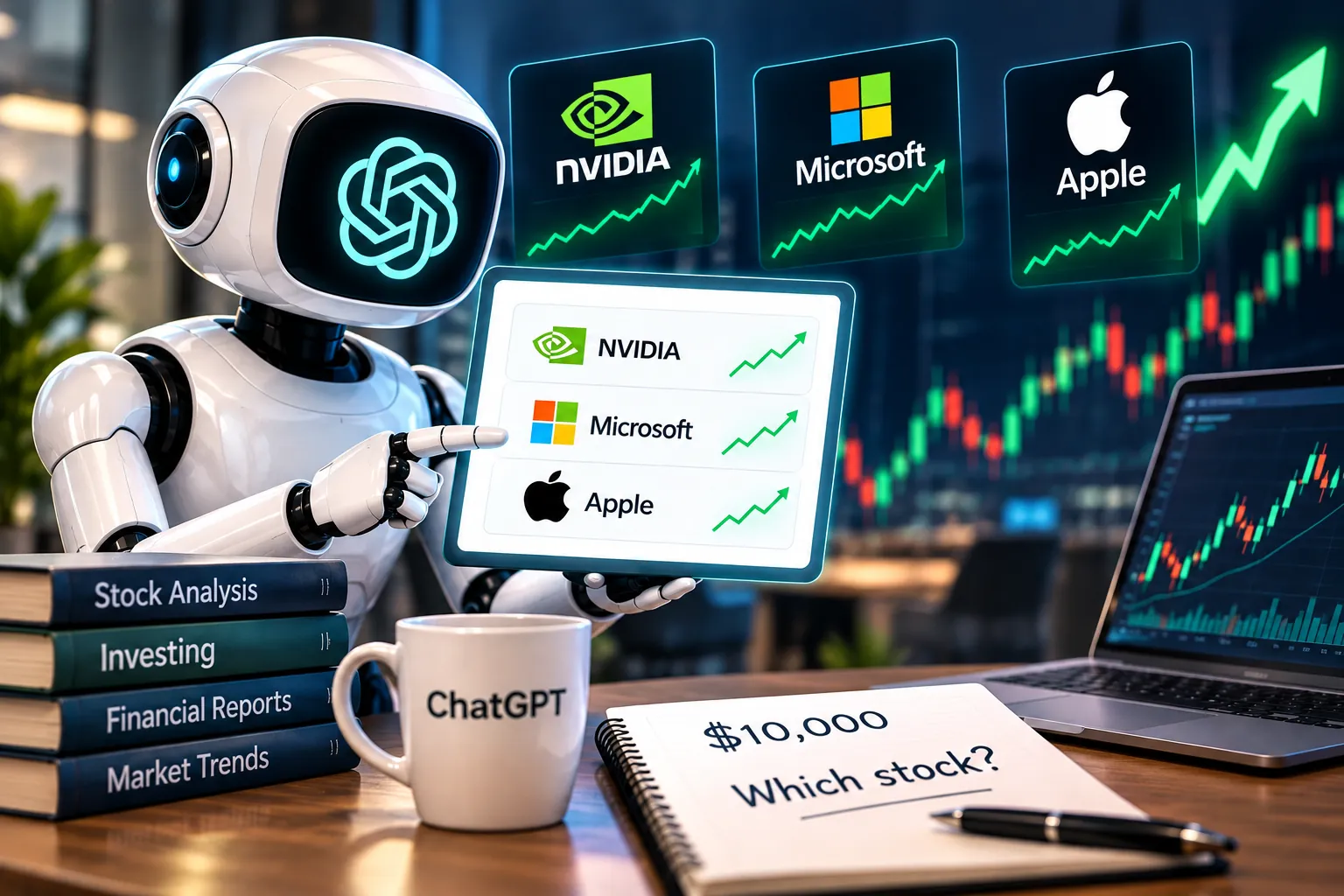
You have $10,000 to invest and three stocks on your shortlist: Nvidia, Microsoft and Apple.
You ask ChatGPT which will make you the most money over the next five years.
Within seconds, it produces a confident comparison: growth opportunities, financial ratios, business risks and a preferred stock. The answer reads like professional research.
But what has it actually established?
A persuasive explanation of why a company could succeed is different from evidence that its stock will outperform.
ChatGPT can help you research stocks. Its recommendation alone does not establish that you have found a winning investment. The distinction matters because a business can deliver excellent results while its shareholders lose money.
Why a Great Company Can Be a Bad Investment
Buying a stock means paying today for a share of a company’s future earnings. The price you pay matters alongside the results the business eventually delivers.
Consider a fictional technology company earning $2 per share annually.
Investors are enthusiastic about its prospects and pay 50 times those earnings. Its share price is therefore $100.
A year later, earnings rise 20% to $2.40 per share. Yet investors become less optimistic about future growth and will now pay only 30 times earnings.
The resulting share price is $2.40 × 30 = $72.
| Metric | Before | One year later |
|---|---|---|
| Annual earnings per share | $2.00 | $2.40 |
| Price-to-earnings ratio | 50 | 30 |
| Share price | $100 | $72 |
| Earnings growth | — | +20% |
| Share-price return | — | −28% |
Hypothetical illustration using the same earnings basis in both periods. Excludes dividends, taxes and transaction costs.
The company became more profitable. The investment lost 28% of its value.
If your entire $10,000 had been invested at the starting price, it would now be worth $7,200.
This is the problem with asking AI to identify the company with the brightest future. Even a correct business forecast can produce a disappointing investment if the purchase price assumes something better.
The harder question is: What must this company achieve to justify the price investors are paying?
Five Useful Ways to Research Stocks With ChatGPT
AI becomes more useful when you give it specific documents, defined questions and calculations you can check.
1. Make Financial Reports Easier to Understand
Annual and quarterly reports contain information about earnings, cash flow, debt and business risks. ChatGPT can help translate that material into plain language.
For example:
Using the attached report, explain why revenue increased while operating cash flow declined. Cite the relevant figures and page numbers. Separate explanations supported by the report from possible explanations that require more evidence.
That last instruction matters. Rising receivables might explain weaker cash flow, but the explanation needs to match the company’s actual accounts.
For U.S. public companies, the SEC’s EDGAR database provides free access to company filings.
2. Compare Companies on a Consistent Basis
A useful comparison needs more than three impressive revenue figures.
Ask AI to organize growth, profitability, cash flow, debt and valuation into one table. Then check whether the figures are comparable.
Are the earnings annual or quarterly? Are the valuation ratios based on reported earnings or forecasts? Do the companies have different fiscal year-ends?
A neat table can conceal mismatched inputs. Require the reporting period, source and calculation method for each important metric.
3. Challenge Your Favourite Investment Idea
If you already like a stock, asking AI whether it is a good investment can become an exercise in seeking reassurance.
A stronger request is:
Build the strongest evidence-based argument against my investment thesis. What developments would show that I am wrong?
For a company expected to benefit from AI spending, investigate whether revenue depends on a few large customers, whether competitors could pressure margins, and what happens if customers reduce spending.
The goal is to identify evidence you would otherwise be tempted to dismiss.
4. Test Valuation Assumptions
ChatGPT can help explain price-to-earnings ratios or construct a discounted cash flow model, which estimates value from assumptions about future cash generation and investment risk.
The useful output is a range showing how the estimate changes when growth, margins or the required return changes.
If modestly less optimistic assumptions erase the apparent upside, that tells you something important about the investment.
5. Build Scenarios Before Committing Money
A bull, base and bear analysis forces you to consider more than one future.
| Scenario | Questions to investigate |
|---|---|
| Bull | What would support stronger growth, higher profits or a higher valuation? |
| Base | What happens under reasonable, explicitly stated assumptions? |
| Bear | How could weaker demand, competition or a lower valuation affect returns? |
These scenarios are tools for examining uncertainty. They are not forecasts with established probabilities.
For more examples, see TwikUp’s guide to using ChatGPT to analyze stocks before buying.
Where AI Stock Analysis Can Go Wrong
The most dangerous answer may be one that looks thoroughly researched but contains a few consequential errors.
Stale information: Last year’s earnings and an old share price cannot establish today’s valuation.
Unsupported figures: A number may look plausible without appearing in the cited source.
Inconsistent definitions: Comparing one company’s adjusted earnings with another’s reported earnings can distort the conclusion.
False precision: A price target of $183.47 can imply confidence that the underlying assumptions do not justify.
Missing evidence: An analysis may summarize familiar opportunities while overlooking a material disclosure or a recent business change.
Regulators have specifically warned that AI-generated investment information can be inaccurate, incomplete or misleading. Their guidance reinforces a practical rule: verify the evidence before relying on the conclusion. Investor.gov’s AI investor alert
Asking AI to provide citations helps you inspect its work. You still need to open those citations and confirm that they support the claims.
A Better Prompt for Your $10,000 Stock Shortlist
Return to Nvidia, Microsoft and Apple.
Before choosing among them, use AI to establish what you know, what you are assuming and what remains uncertain.
Copy this prompt:
Act as a skeptical equity research analyst comparing Nvidia (NVDA), Microsoft (MSFT) and Apple (AAPL) over a five-year investment horizon.
Start by stating the analysis date and identifying which current sources you can access. If essential data is unavailable, explain what is missing before drawing conclusions.
Use official company filings for historical financial information. For share prices, identify the market-data source, date, time if available, and currency.
Create a comparison covering:
- Revenue and diluted earnings-per-share growth over the last three completed fiscal years.
- Operating margins, operating cash flow, capital expenditure, cash and debt. Define how you calculate free cash flow.
- Valuation at the stated share price. Clearly distinguish trailing earnings from forecast earnings.
- Competitive advantages and material business risks.
- Bull, base and bear scenarios with explicit growth and valuation assumptions.
For each important historical figure, provide a source link and reporting period. Identify differences in accounting definitions or fiscal periods that limit comparison.
Separate verified facts, management guidance, external estimates and your own assumptions. Do not invent missing figures.
Explain what must happen for each stock to produce an attractive return, and what evidence would undermine that thesis.
If you estimate returns, show the calculation and state whether it includes dividends. Do not assign scenario probabilities without explaining their basis.
Finish with the strongest argument against each stock and five questions I should resolve before investing. If the evidence does not support a ranking, say so.
Provide recent filings and dated price information when the tool cannot retrieve them.
Treat instructions such as “do not invent figures” as safeguards to request, not guarantees of accuracy. Check the important inputs and calculations yourself.
Does a Successful AI Stock Pick Prove Anything?
Suppose an AI-generated recommendation rises 30%.
That result sounds impressive, but it leaves several questions unanswered:
- How did the relevant market benchmark perform?
- How much risk did the recommendation involve?
- Were the recommendation and selection rules recorded before the outcome?
- Were losing recommendations included?
- Did the calculation account for dividends and trading costs?
A stock rising 30% while its benchmark rises 40% tells a different story from a stock rising 30% while its benchmark falls.
Historical tests also require care. If an AI model could have encountered information about what happened after the supposed selection date, its answer is not a clean test of forecasting ability.
To assess a stock-picking claim, look for a transparent process, recommendations recorded in advance and results measured consistently over time. A screenshot of one winning prediction provides little basis for trusting the next one.
Your Portfolio Matters More Than a Three-Stock Ranking
Even a careful comparison cannot answer whether these stocks belong in your portfolio.
Your investment horizon, need for cash, ability to tolerate losses and existing holdings all matter. Buying three companies also may leave substantial exposure to shared risks.
Diversification spreads investments across holdings and asset types to help manage risk, although it cannot prevent every loss. Investor.gov’s guide to asset allocation and diversification
For a Canadian investor evaluating U.S. stocks, currency changes add another consideration: a return measured in U.S. dollars can differ from the return measured in Canadian dollars.
Before asking which stock deserves your $10,000, establish how that purchase would affect your overall investments.
Be Wary of “Guaranteed” AI Returns
Research errors and investment fraud are different problems, but both can arrive in a convincing package.
The Canadian Investment Regulatory Organization warns about investment fraud involving AI, including misleading promotions and impersonation. AI branding does not establish that an investment service is legitimate. CIRO’s guidance on AI and investment fraud
If a service promises guaranteed profits or pressures you to transfer money quickly, pause and independently verify the provider and its claims.
An impressive demonstration is no substitute for verifiable credentials and evidence.
TwikUp Insight: Ask What Would Prove You Wrong
The most useful change is in the question you ask.
“Which stock will make me the most money?” invites a prediction.
“What must happen for this investment to work, and what evidence would change my mind?” creates a research process.
That process might reveal a strong business at an unattractive price, a promising opportunity with too many unanswered questions, or a purchase that would concentrate risks you already hold.
Your $10,000 does not become safer because an answer sounds professional. It becomes better informed when you understand the evidence, the price and the consequences of being wrong.
Use ChatGPT to sharpen your investment judgment. A stock recommendation is the beginning of the investigation, not the conclusion.
This article is for educational purposes only and does not constitute personalized investment advice. Investments can lose value, including principal. Examples are hypothetical unless otherwise stated.