
Key Takeaways
- The Bank has held its policy rate at 2.25% for a year, but October 28 is now a genuinely live rate decision.
- A September inflation reading around or above expectations of 3.0–3.2% would strengthen the case for a rate hike.
- A 0.25-point hike could lift prime to about 4.70% and add roughly $100 monthly interest on $500,000 of variable-rate debt.
The setup
For a full year, the Bank of Canada has left its policy interest rate untouched at 2.25% — seven straight holds since the last cut in October 2025. But the tone just changed. On Saturday, October 17, Governor Tiff Macklem said the Bank will “significantly” raise its quarterly inflation forecast, warning that surging oil prices could push inflation higher and keep it there.
The next rate decision lands on Wednesday, October 28 — and for the first time in a year, a hike is genuinely on the table.
What Macklem actually said
Speaking to journalists on a conference call from Bangkok on October 17, the Governor laid out the Bank’s dilemma:
- The Bank expects to raise its inflation forecast “significantly” this month because of persistently high crude oil and petroleum product prices.
- “With the conflict ongoing, shipments still curtailed and refinery capacity damage, the risk that inflation broadens and becomes more persistent has gone up.”
- “Our beacon is our 2% inflation target, and we are committed to keeping inflation close to target over time. We are prepared to adjust monetary policy as needed.”
- On the October 28 decision: “The question we are going to be asking ourselves is, ‘Is inflation likely to come back down towards our target on its own, or are we going to have to raise interest rates to influence the path, nudge the path for inflation back towards the target?’”
In plain English: the Bank is openly asking whether it needs to start raising rates again.
Where things stand right now
- Policy rate: 2.25% (held at seven consecutive decisions; last cut: October 2025)
- Big-bank prime rate: 4.45% — this is what your variable mortgage and line of credit are priced off
- Inflation: 3.0% in August, sitting right at the top of the Bank’s 1–3% control range; excluding gasoline it was about 2.4%, with core measures near 2%
- September inflation data: released Monday, October 19 — expectations sit around 3.0–3.2%, driven by gasoline prices
- The Bank’s own business and consumer surveys: also released October 19, showing whether companies plan to pass rising costs to shoppers
- Final 2026 decision: December 9
What markets are betting
Money markets are not pricing in a hike on October 28 or in December — but they are pricing in roughly a full percentage point of rate increases over the course of next year. Translation: investors believe the next move is up, the only question is when it starts.
What a hike would cost you
If the Bank raises its policy rate by 0.25 percentage points, the big banks typically lift their prime rate by the same amount — from 4.45% to about 4.70%. That flows straight into variable-rate mortgages, home equity lines of credit, and personal lines of credit.
As a rough illustration: on $500,000 of variable-rate debt, a 0.25-point increase adds about $100 a month in interest costs. Fixed mortgage rates, meanwhile, move more with Government of Canada bond yields — and those have already been climbing, pushing some fixed rates higher before the Bank has moved at all.
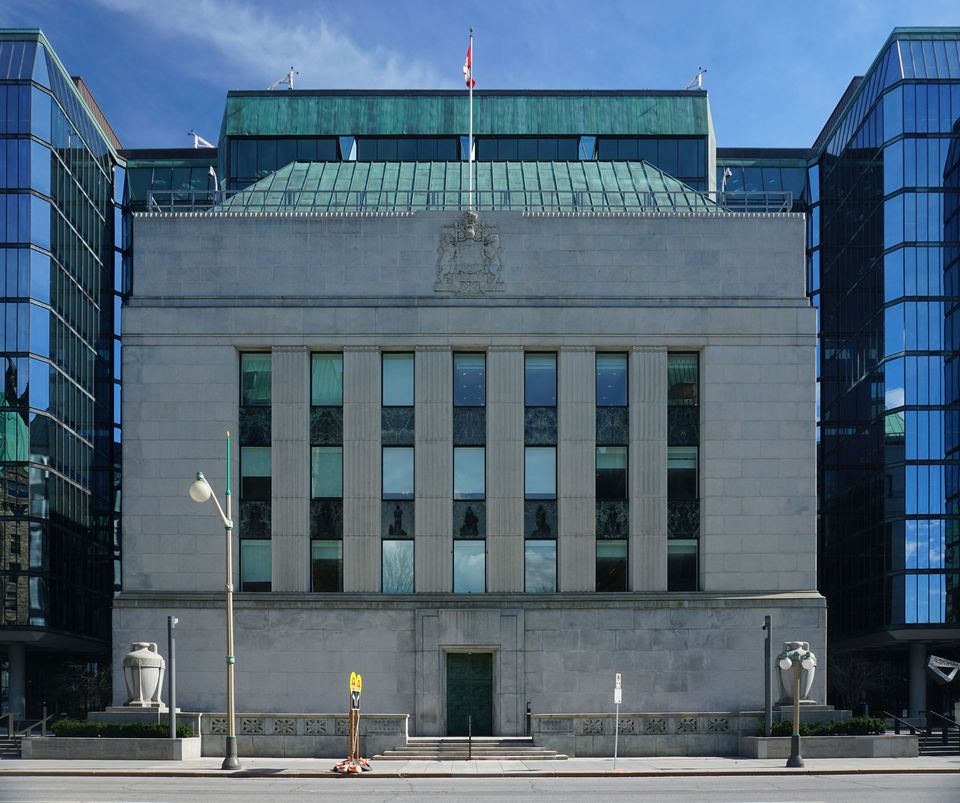
Photo: Bank of Canada head office, Wellington Street, Ottawa — by 方畢可, public domain (CC0) via Wikimedia Commons.