
Key Takeaways
- If your condo is affordable, meets your needs and you plan to stay, holding can be the most practical option.
- If housing costs are straining your finances, contact your lender before missed payments and assess whether selling is necessary.
- Investors should compare holding and selling using interest, principal repayment, operating costs, taxes and cash flow.
Your Condo Has Lost Value. Now What?
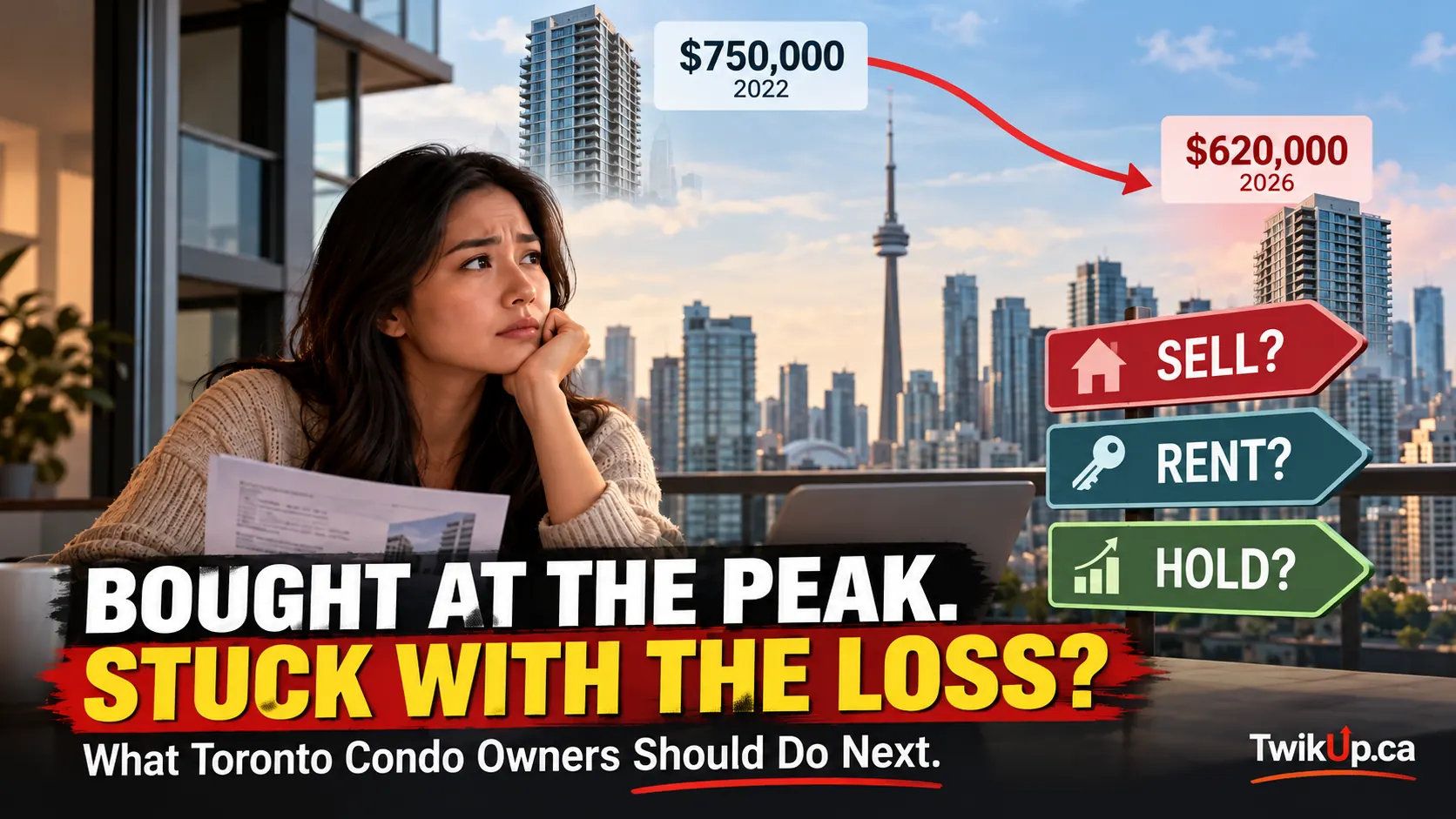
You bought a Toronto condo for $750,000 in 2022. You put down $150,000, took out a $600,000 mortgage, and imagined building equity while enjoying your new home.
Four years later, similar units in your building might be selling for $620,000.
That's a $130,000 decline in property value.
Meanwhile, your mortgage payments continue, maintenance fees have increased, and you keep hearing conflicting advice: sell before prices fall further, rent it out, or wait until the market recovers.
Here's the important part: the right decision depends less on what you paid and more on what the condo is costing you today.
Let's work through six situations and what you should actually do.
How Bad Is Toronto's Condo Market?
Toronto's condo market has faced significant pricing pressure. According to the Toronto Regional Real Estate Board (TRREB), the average condominium apartment selling price across the Greater Toronto Area was $634,972 in the second quarter of 2026, down 7.5% from the same quarter in 2025.
Within the City of Toronto, the average was $667,916.
These are market averages, not valuations of individual units. A downtown studio, a two-bedroom condo near a subway station, and a larger suburban unit can perform very differently.
For owners, that means one thing: don't estimate your property's value from headlines alone. Look at recently completed sales of genuinely comparable units.
Scenario 1: You Live There, Can Afford It, and Don't Need to Move
Recommended action: HOLD.
Suppose your household brings home $9,000 monthly, your total housing costs are $3,500, and you have stable employment.
Your condo might be worth less than you paid, but selling today would turn a decline in market value into a completed transaction with additional selling costs.
If the home still meets your needs and you expect to remain there for several years, holding is often the most practical choice.
Continue making mortgage payments, maintain an emergency fund, and review your mortgage before renewal. Don't empty your savings to make extra principal payments simply because property prices have fallen.
Also review your condo corporation's finances. A building with a weak reserve fund or major upcoming repairs could change the decision.
The takeaway: If your home remains affordable and suitable, you don't need a market recovery to justify living in it.
Scenario 2: Your Mortgage Payments Are Becoming Unaffordable
Recommended action: CONTACT YOUR LENDER NOW. SELL IF THE NUMBERS CANNOT BE FIXED.
Imagine your household earns $7,000 monthly after tax, but mortgage payments, condo fees, property taxes, and insurance total $4,300.
That's more than 61% of your take-home income going toward housing.
You may be able to manage temporarily, but if you're using credit cards or personal loans to cover ordinary living expenses, waiting for prices to recover can make the problem worse.
Contact your lender before missing payments. Ask about available mortgage relief, refinancing options, payment adjustments, and amortization changes.
Extending amortization may reduce monthly payments but increase total interest costs. Relief is not automatically available, and eligibility depends on your circumstances.
Give yourself a realistic period to assess whether the situation can be stabilized through lower expenses, additional income, or lender assistance.
If it cannot, calculate what selling would cost and whether you can fund any shortfall.
The takeaway: Protecting your financial stability is more important than waiting to recover your original purchase price.
Scenario 3: You Bought the Condo as an Investment, but Rent Doesn't Cover the Costs
Recommended action: COMPARE THE COST OF HOLDING WITH SELLING TODAY.
Consider this hypothetical monthly budget:
| Item | Monthly amount |
|---|---|
| Mortgage payment | $3,200 |
| Condo maintenance fees | $650 |
| Property taxes | $300 |
| Insurance and repair reserve | $150 |
| Total cash outflow | $4,300 |
| Rental income | $2,700 |
| Monthly cash shortfall | $1,600 |
That's $19,200 leaving your bank account annually beyond what rent covers.
Over three years, it could mean $57,600 in cumulative cash shortfalls if those figures remained unchanged.
But there's an important distinction: part of your mortgage payment reduces principal. That portion builds equity rather than representing a pure expense.
Before selling, calculate your mortgage interest, principal repayment, operating costs, vacancy risk, taxes, and potential selling proceeds.
If you can comfortably fund the shortfall and the investment still makes sense compared with alternatives, holding may be reasonable.
If the property continually drains money you need elsewhere, selling may be financially smarter even at a loss.
The takeaway: Don't keep a bad investment simply because selling would force you to acknowledge an earlier mistake.
Scenario 4: Your Family Has Outgrown the Condo
Recommended action: SELL IF THE MOVE IS NECESSARY AND FINANCIALLY POSSIBLE.
Maybe you bought a one-bedroom condo before having children. Now you need another bedroom, a home office, or more space.
Waiting five years for the condo to return to its purchase price might not fit your family's life.
First, calculate how much money you'd receive after selling costs and paying off the mortgage.
Then compare two options: selling and moving, or renting out the condo while renting or buying a larger home yourself.
Keeping the condo as a rental isn't automatically the better financial decision. You could end up supporting two properties while earning less rent than expected.
If selling allows you to move without creating unmanageable debt, it may be worth accepting the loss.
The takeaway: A home is supposed to support your life, not force your life to revolve around its purchase price.
Scenario 5: Your Condo Is Worth Less Than Your Mortgage
Recommended action: SPEAK TO YOUR LENDER AND A REAL ESTATE LAWYER BEFORE LISTING.
Suppose your situation looks like this:
| Item | Amount |
|---|---|
| Expected selling price | $620,000 |
| Remaining mortgage | $640,000 |
| Estimated selling costs | $30,000 |
| Cash needed to close | $50,000 |
You would need approximately $50,000 from other funds to complete the sale, potentially more if mortgage penalties or other adjustments apply.
Selling does not automatically eliminate your mortgage obligations.
If you can still afford your payments, holding may give you time to reduce the balance and improve your position.
If payments are unaffordable, ask your lender about available solutions before defaulting. A lawyer can help explain your obligations and the implications of a sale with insufficient proceeds.
The takeaway: Negative equity is a serious financial problem, but selling without a plan can create another one.
Scenario 6: You Can Afford the Condo but Want to Wait Until You Break Even
Recommended action: SET A FINANCIAL REVIEW DATE, NOT AN EMOTIONAL PRICE TARGET.
A condo purchased for $750,000 and now worth $620,000 has fallen approximately 17.3%.
But getting back to $750,000 requires a gain of nearly 21% from today's value.
Even if prices increase by 3% annually, reaching $750,000 would take approximately six and a half years, assuming uninterrupted compounded growth. That is a mathematical illustration, not a market forecast.
During that time, you will continue paying mortgage interest, condo fees, property taxes, insurance, and maintenance.
You may also build equity through principal repayment.
Review your decision every 12 months. Compare the expected cost of holding with the amount you could receive from selling and what that money could accomplish elsewhere.
The takeaway: Your original purchase price should not dictate every future financial decision.
What If Selling Today Is Actually Cheaper Than Waiting Five Years?
Imagine an investor expects to contribute $1,600 monthly to keep a condo rented out.
Over five years, that is $96,000 in cash contributions, assuming the shortfall never changes.
If the property appreciates by $60,000 over the same period, the investor might initially believe waiting was worthwhile.
But that calculation is incomplete.
Some mortgage payments reduce principal, while interest and operating expenses are genuine costs. Selling later also involves transaction costs, and an investment property may have tax consequences.
The investor must compare after-tax wealth under both choices, including the value of mortgage principal repaid and the return that money could have earned elsewhere.
In some cases, selling now will be better. In others, holding will win.
The mistake is assuming that higher future property prices automatically make waiting profitable.
Before You Decide, Check These Three Toronto Condo Risks
Mortgage renewal: Ask your lender for realistic payment estimates at renewal rather than assuming your existing payment will continue unchanged.
Building finances: Review your condo corporation's reserve fund, financial statements, status certificate, and planned repairs. Special assessments can create unexpected expenses for owners.
Rental and tax consequences: If you're converting your principal residence into a rental, understand the Canada Revenue Agency's change-in-use rules. In certain circumstances, a subsection 45(2) election may be available, but the requirements and future tax implications deserve professional review.
Your 7-Day Action Plan
Don't make a six-figure decision based on one disappointing listing in your building.
Day 1–2: Get two realistic estimates of your condo's selling price based on completed comparable sales.
Day 3: Request your mortgage payout balance, potential prepayment penalties, and renewal options.
Day 4: Calculate your true monthly ownership costs, separating mortgage principal from interest.
Day 5: If you're considering renting, research achievable rent, vacancy, landlord obligations, and after-tax cash flow.
Day 6: Review the condo corporation's financial health and upcoming major expenses.
Day 7: Compare selling, renting, and holding over a realistic three-to-five-year period using conservative assumptions.
If your finances are strained, contact your lender immediately rather than waiting until Day 7.
The Bottom Line: You Don't Need to Recover Your Purchase Price to Make the Right Decision
If you can comfortably afford your condo, it meets your needs, and you plan to stay, holding may be the simplest and strongest choice.
If the property is consuming your savings, creating expensive debt, or preventing an important life change, selling deserves serious consideration.
And if you're an investor, judge the condo by its expected future returns, not by how much you paid four years ago.
The most expensive mistake may not be buying at the peak. It may be allowing that purchase price to control every decision you make afterward.
Could Canada's Foreign Buyer Ban Change the Housing Market in 2027?
Canada's foreign homebuyer ban is currently scheduled to expire on January 1, 2027. But could changes to foreign-buyer restrictions affect Toronto's housing market, and what might that mean for condo owners deciding whether to sell or hold?
Related reading: Canada Foreign Buyer Ban Ends in 2027: Could Home Buyers Return Before Foreign Investors Do?
The potential expiry of the ban is worth watching, but condo owners should not base their financial decisions on an assumption that foreign investment will automatically drive prices higher.
Disclaimer: This article provides general financial information, not personalized investment, mortgage, tax, or legal advice. All household and property examples are hypothetical. Actual outcomes depend on individual finances, mortgage terms, market conditions, and applicable rules.