
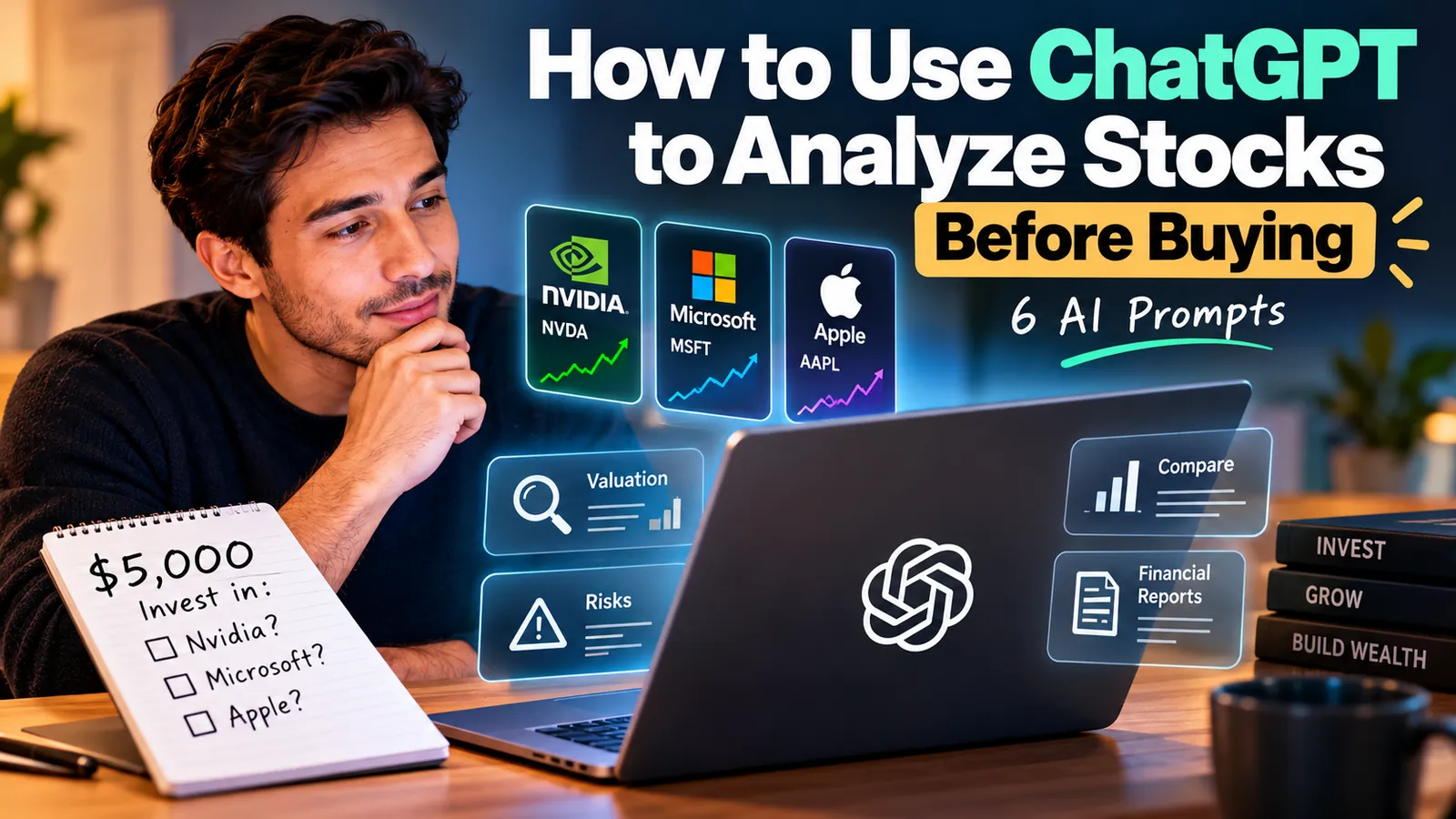
Key Takeaways
- Use ChatGPT to compare revenue growth, margins, cash flow, debt and valuation using current official filings.
- Ask AI to challenge a stock thesis by identifying risks, unsupported claims and inconsistent reporting periods.
- AI can model investment scenarios, but it cannot reliably predict stock prices or guarantee outperformance.
You have $5,000 to invest.
Nvidia looks exciting. Microsoft looks established. Apple has millions of loyal customers.
You open ChatGPT and ask a simple question:
“Which stock should I buy?”
Within seconds, AI can produce a convincing recommendation.
But here’s the catch: What if ChatGPT recommends a great company at a terrible price?
Instead of blindly trusting its answer, you can use AI to investigate the numbers, challenge its assumptions and uncover risks you might otherwise miss.
Here are six copy-and-paste prompts that can turn ChatGPT into a useful stock-research assistant.
The $5,000 Challenge: Can AI Help You Choose?
Imagine you’re comparing Nvidia, Microsoft and Apple for a long-term investment.
Rather than asking AI to pick a winner, you’re going to put these companies through six tests.
Before starting, enable web search in ChatGPT or provide recent company reports. Ask it to identify the reporting period and sources for every important financial figure.
You can find official U.S. company reports through the SEC’s EDGAR database.
1. Make AI Compare the Companies
Start by forcing ChatGPT to look beyond brand popularity.
Copy this prompt:
Compare Nvidia (NVDA), Microsoft (MSFT) and Apple (AAPL) as potential five-year investments. Using their latest available official filings, compare revenue growth, profit margins, free cash flow, debt and valuation. Present the findings in a table with reporting dates and source links. Explain the trade-offs without automatically picking a winner.
Why this works: You’re asking AI to compare businesses using measurable factors rather than headlines.
A fast-growing company may look attractive, but its stock price could already reflect extraordinarily high expectations.
2. Ask AI Whether You’re Overpaying
Imagine two businesses earning identical profits.
One trades at 15 times annual earnings. The other trades at 40 times.
Which one is the better investment?
Not so fast. The second company might grow much faster, while the first could be facing declining sales.
Copy this prompt:
Is [STOCK] expensive relative to its earnings, growth and competitors? Calculate its trailing P/E ratio, price-to-sales ratio and free-cash-flow yield using verified figures. Explain what future growth expectations might justify the current valuation and what could cause the valuation to fall.
The most important question isn’t necessarily whether a company is successful.
It’s how much you’re paying for that success.
3. Ask AI to Find Reasons NOT to Buy
Here’s where the experiment becomes interesting.
You’ve found a company with impressive growth, strong profits and an exciting future.
Now tell ChatGPT to destroy your investment argument.
Copy this prompt:
Act as a skeptical investment analyst. Build the strongest evidence-based argument against buying [STOCK] today. Identify five significant risks, including competition, valuation, regulation, debt and business disruption where relevant. Rank them by potential impact and explain which are supported by the company’s disclosures.
This can reveal weaknesses that disappear in enthusiastic stock discussions.
AI should challenge your assumptions, not simply agree with your favourite investment idea.
4. Upload the Company’s Financial Report
You don’t have to understand every accounting term to begin researching a business.
Download its latest annual or quarterly report and upload it into ChatGPT.
Copy this prompt:
Analyze this financial report as if I were a beginner investor. Identify the three most important positive developments and three warning signs. Compare revenue, profits, cash flow and debt with the previous comparable period. Reference the relevant pages and explain any figures that require verification.
This is particularly useful during earnings season.
A company might announce record revenue while margins decline or debt increases. AI can help you find those details, although you should verify the numbers in the original document.
5. Ask AI What Could Happen to Your $5,000
Let’s say you’re considering a stock trading at $100 per share.
You invest $5,000 and purchase 50 shares.
What happens if the stock rises 40% or drops 30%?
Illustrative example — not a forecast
| Scenario | Share price | Investment value |
|---|---|---|
| Stock rises 40% | $140 | $7,000 |
| Stock stays unchanged | $100 | $5,000 |
| Stock falls 30% | $70 | $3,500 |
The numbers are straightforward. The difficult part is understanding which business conditions could produce each outcome.
Copy this prompt:
Build bull, base and bear scenarios for [STOCK] over five years using explicit assumptions for revenue growth, margins and valuation. Calculate the potential value of a hypothetical $5,000 investment in each scenario, including relevant assumptions about dividends and share splits. Identify what would need to happen for each scenario to become plausible. Do not present these scenarios as predictions.
This helps you evaluate possible outcomes instead of chasing a single target price.
The example above excludes fees, taxes, dividends and currency movements.
6. Make AI Challenge Its Own Conclusion
You’ve compared the companies, examined valuations, reviewed financial reports and explored possible outcomes.
Now comes perhaps the most important prompt.
Copy this prompt:
Review your entire analysis as an independent financial fact-checker. Identify unsupported claims, outdated information, inconsistent reporting periods, calculation errors and overly optimistic assumptions. Verify material figures against original company filings. List the questions that remain unanswered before making an investment decision.
This final step matters because ChatGPT can provide incorrect information with surprising confidence.
A confident recommendation means very little if its underlying assumptions are wrong.
The AI Stock Valuation Trap: A Simple Experiment
Consider two fictional companies.
Both earn $5 per share annually, but their stocks trade at different prices.
| Metric | Company A | Company B |
|---|---|---|
| Share price | $100 | $200 |
| Earnings per share | $5 | $5 |
| P/E ratio | 20 | 40 |
Company B costs twice as much relative to its current earnings.
Does that automatically make Company A the better buy?
No.
Company B might justify its premium through faster growth, stronger competitive advantages or better future cash flow.
But what if that growth disappoints?
Suppose Company B’s earnings stay at $5 per share while investors become willing to pay only 25 times earnings.
Its hypothetical share price would fall from $200 to $125 — a 37.5% decline, even though its earnings hadn’t decreased.
This is a simplified example, not an actual stock analysis.
It demonstrates something valuable: a business doesn’t have to fail for its stock to become a disappointing investment.
Ask AI to run this kind of valuation-sensitivity test before deciding whether a stock looks cheap or expensive.
Can ChatGPT Actually Predict Winning Stocks?
ChatGPT can analyze financial information, summarize reports and compare investment scenarios.
It cannot reliably predict tomorrow’s stock prices or guarantee that a particular company will outperform.
The U.S. Securities and Exchange Commission, FINRA and North American Securities Administrators Association have warned investors against relying solely on AI-generated investment information.
Their concerns include inaccurate figures, fabricated information and fraudulent services promising extraordinary AI-powered returns.
A sensible approach is to verify important numbers, check the dates of market prices and question unusually confident conclusions.
Conclusion: Don’t Ask AI What to Buy. Ask It What You’re Missing.
The real advantage of ChatGPT isn’t getting a stock recommendation in seconds.
It’s being able to challenge an investment idea from several directions before putting money at risk.
Use AI to compare companies, examine valuations, investigate risks and understand what could go wrong.
Anyone can ask ChatGPT for the next winning stock. A better investor asks ChatGPT to prove why the investment makes sense — and then checks the evidence.
Disclaimer: This article is for educational purposes and does not constitute personalized investment advice. Investing in stocks involves risk, including the possible loss of principal.