
Key Takeaways
- A JAMA cohort of 3,704,860 children (US and Ontario) found brain tumour risk rose with cumulative imaging radiation dose to the brain
- One head CT averages 66.2 mGy to the brain; at 150 mGy or more, risk was nearly four times that of unexposed children (HR 3.85)
- The absolute risk stays small: about one excess tumour per 1,266 head CTs by age 21
The scan takes ten seconds. The question lasts for years.
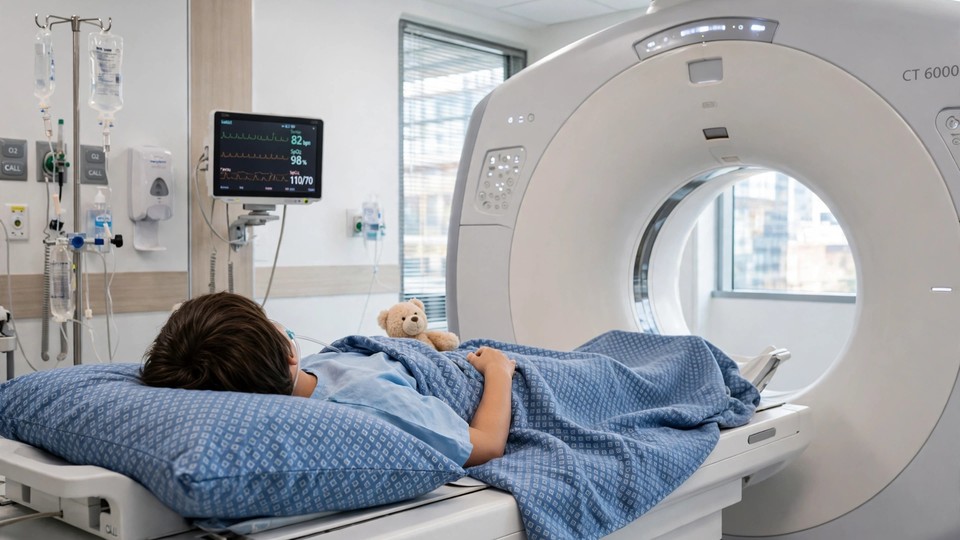
A child hits her head, the emergency department orders a CT, and the image rules out bleeding in minutes. What parents quietly wonder afterward — did the scan itself carry a risk? — now has the largest answer ever assembled.
Researchers followed 3,704,860 children born between 1996 and 2016 in six US health systems and in Ontario, tracking the radiation dose each child received to the brain from medical imaging. Over the follow-up, 1,536 brain tumours were diagnosed. The study was published in JAMA on November 19, 2026.
One head CT delivers an average of 66.2 mGy of radiation to a child's brain. The risk climbed steadily with cumulative dose: children who accumulated 150 mGy or more had nearly four times the brain tumour risk of unexposed children (hazard ratio 3.85). About 4.3% of children had one head CT, 0.9% had two, and 0.4% had three or more.
Here is the number that keeps the finding in proportion. Exposure comparable to one head CT worked out to roughly 7.9 excess brain tumours per 10,000 children by age 21 — about one excess tumour for every 1,266 head CTs. "The risk of a brain tumor remains small in children exposed to ionizing radiation from medical imaging," said first author Diana Miglioretti of UC Davis. "However, risk increased with higher radiation exposure."
The honest caveats matter. This is an observational study: children who receive CT scans are not random children — they are scanned because something is already wrong, and this design cannot fully separate the scan's effect from the reasons behind it. The dose-response pattern — risk rising step by step with dose — is what makes the association harder to dismiss. The authors estimate 10.1% of the brain tumours in this population were attributable to imaging radiation.
Health note: A CT scan your child's doctor recommends is usually the right call — an undiagnosed head injury is far more dangerous than the scan. This study supports what radiologists already practise: justify every scan, use the lowest dose that answers the question, and consider ultrasound or MRI where they can do the job.
The Twikup Take
Both halves of this study deserve to survive the headline: the risk is real, dose-dependent and worth minimizing — and for a single scan it is roughly one in 1,266. The children to think about are not the one-scan children; they are the small group accumulating scan after scan, where the dose, and the risk, quietly add up.
Image: Illustrative image.