
Key Takeaways
- In the OptimPacing trial,pacing the heart's left bundle branch instead of the standard spot cut the combined risk of death,heart-failure hospitalization,pacing-induced heart-muscle
- The clearest gap was heart-muscle damage caused by pacing itself: 0% with the new technique versus 11.7% with standard pacing; deaths alone were nearly identical in both groups.
- The trial was stopped early for efficacy after a planned interim check&most patients had normal heart function,so authors caution that the size of the benefit needs confirmation.
The Wire Goes in a Different Place — and the Heart Notices
A pacemaker is supposed to keep your heart beating properly. But where its wire delivers the electrical signal matters more than many patients might realise.
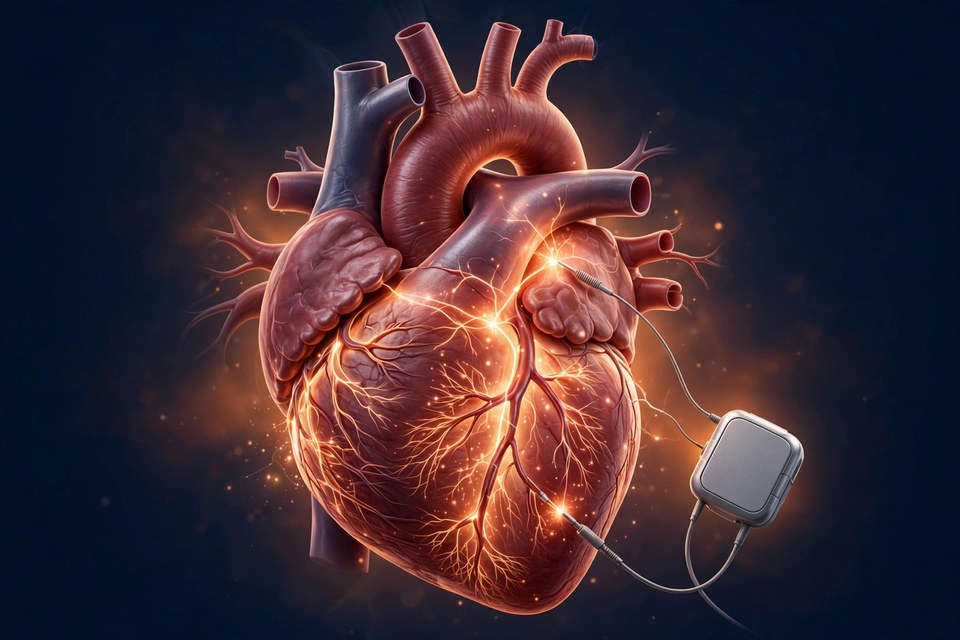
A conventional pacemaker paces the right ventricle, and the electrical signal spreads slowly and unevenly from there. Over years, that unnatural pattern can itself weaken the heart muscle — a condition called pacing-induced cardiomyopathy. The OptimPacing trial, published November 8 in the New England Journal of Medicine, tested a fix: placing the lead so it paces the left bundle branch, the heart's own fast wiring, helping keep every beat synchronized.
The trial randomized 702 patients who needed a pacemaker for heart block across 17 centres in China, Hong Kong, Poland, the United Kingdom and the United States; 685 were analyzed. These were not severely ill patients — the average age was about 68 and most had normal heart pumping function.
The Numbers That Stopped the Trial
At the four-year estimated mark, the combined rate of death from any cause, hospitalization for heart failure, or pacing-induced cardiomyopathy was 8.5% with left bundle-branch pacing versus 19.2% with standard pacing. The hazard ratio was 0.41 — a 59% lower risk of the combined outcome.
The driver was the complication the technique was designed to prevent: pacing-induced cardiomyopathy struck 0% of the new-technique group versus 11.7% of the standard group. Heart-failure hospitalizations were also fewer, 1.5% versus 2.9%.
But one key honesty point needs to be clear: deaths alone were essentially identical — 7.4% versus 7.7%. The technique did not cut mortality in this trial; it prevented the heart damage that standard pacing can cause.
The trial was stopped early, in July 2026, after a planned interim analysis crossed its strict pre-set threshold for superiority. The result was compelling enough for researchers to stop the study before its planned completion.
The authors add cautions: stopping a trial early can exaggerate the apparent size of a benefit. Most participants had normal heart function, and patients were recruited predominantly in China. The findings therefore need testing in patients with weaker hearts and in other settings.
The Twikup Take
A pacemaker's job is to keep the heart beating. But this trial highlights a question that deserves more attention: could the way a pacemaker delivers each electrical signal also affect the heart over time?
Left bundle-branch pacing produced a striking reduction in the combined risk of death, heart-failure hospitalization and pacing-induced cardiomyopathy, driven largely by preventing the heart-muscle damage seen with standard pacing. It did not reduce deaths in this trial.
The wire's position may make a major difference to long-term heart health — but further studies must establish how widely these results apply.
Image: Illustrative image.