
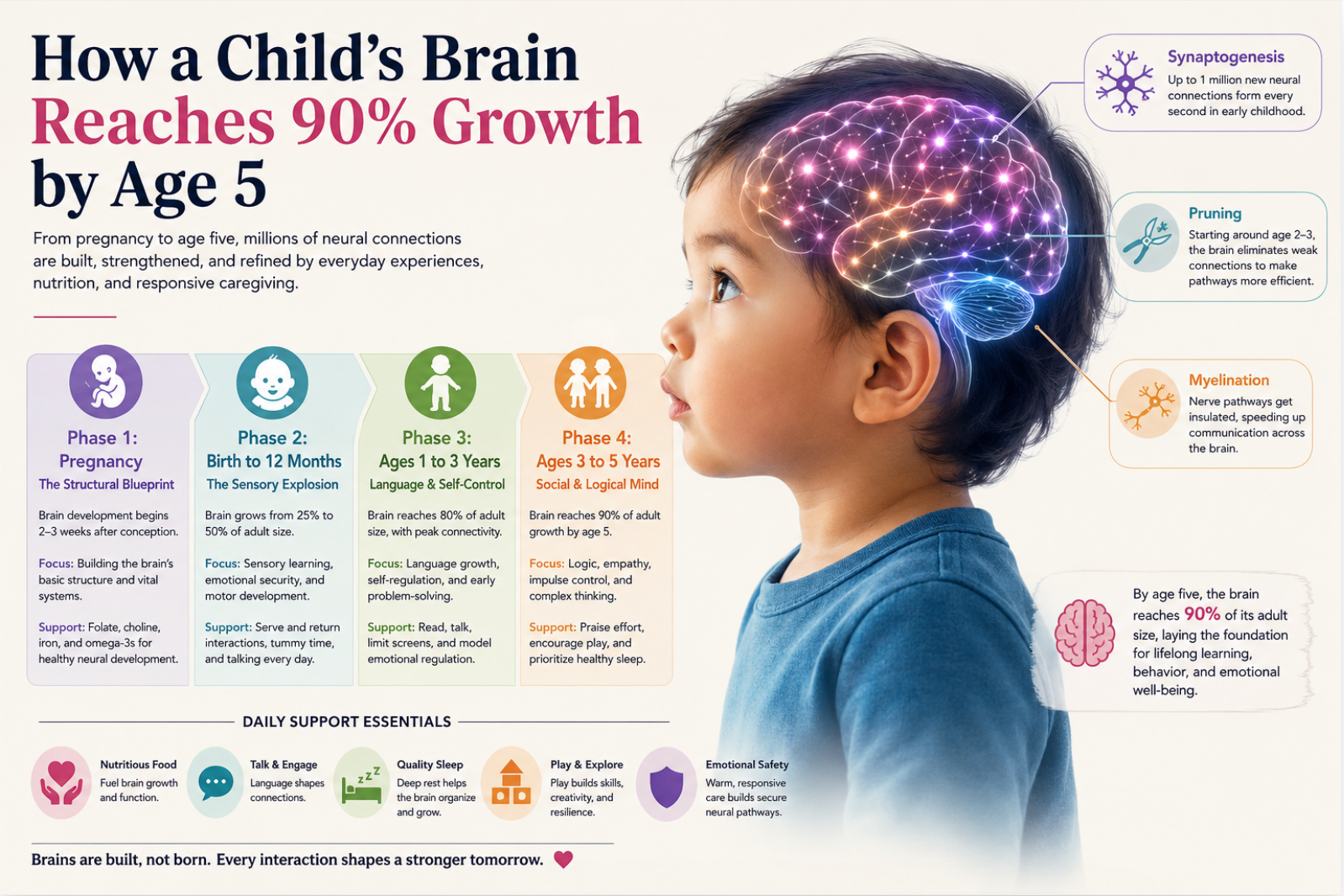
A child's brain undergoes one of the most dramatic transformations in human life during its first five years. While genes establish the initial framework, everyday experiences, nutrition, emotional security, and responsive caregiving help determine which neural pathways strengthen and which disappear.
The process is remarkably dynamic. The brain creates up to one million new neural connections every second during early development, then later refines those networks through selective pruning. By age five, nearly 90% of brain growth has already occurred.
From Pregnancy to Birth: Building the Brain's Foundation
Brain development begins just two to three weeks after conception, long before many parents realize a pregnancy has started. This prenatal period establishes the structural groundwork that supports all future learning, movement, and emotional development.
During the first trimester:
- The neural tube forms and closes by weeks six to seven.
- The forebrain, midbrain, and hindbrain begin separating into distinct regions.
- Neurons multiply at an extraordinary pace of approximately 250,000 cells every minute.
During the second trimester:
- Basic wiring of the brain stem takes shape.
- Systems responsible for breathing and heart rate regulation develop.
- The temporal lobes advance, allowing the fetus to detect sounds.
During the third trimester:
- The brain surface expands rapidly.
- Characteristic folds and grooves begin to emerge.
- The left and right hemispheres become more clearly defined.
Parents can support this stage by prioritizing key nutrients such as folate, iron, choline, and omega-3 fatty acids, all of which contribute to healthy neural development.
The First Year: When Senses Begin Mapping the World
At birth, a baby's brain represents roughly one-quarter of its eventual adult weight. Within just twelve months, that size doubles.
This period is dominated by sensory learning. The right hemisphere and limbic system take center stage, helping infants process sights, sounds, emotions, and environmental cues. Every interaction contributes to the formation of new synaptic connections.
Key developmental milestones include:
- 0–3 months: Tracking moving objects and responding to sounds.
- 3–6 months: Smiling socially, babbling, and recognizing familiar people.
- 6–12 months: Grasping objects, understanding simple words, and beginning movements such as crawling or pulling up.
Parents can strengthen development through simple but powerful practices:
- Respond consistently to babbles and facial expressions using "serve and return" interactions.
- Narrate everyday activities to expose babies to language.
- Incorporate tummy time to support motor development and physical coordination.
Why Ages One to Three Are Critical for Language and Self-Control
By the third birthday, the brain has already reached around 80% of its adult size. Remarkably, it contains roughly twice as many neural pathways as a mature adult brain.
This is also when the prefrontal cortex begins assuming a larger role. Functions such as planning, attention, self-regulation, and problem-solving start developing more rapidly. At the same time, synaptic pruning begins removing weaker connections, strengthening pathways that receive frequent use.
Typical milestones include:
- 12–24 months: Rapid vocabulary growth, imitation of adult behaviors, and simple problem-solving.
- 2–3 years: Greater independence, emotional expression, running, and naming familiar objects.
Parents can support this stage by:
- Using point-and-label reading techniques during story time.
- Encouraging conversation throughout the day.
- Limiting background television and passive screen exposure.
- Remaining calm during tantrums to model emotional regulation.
The experiences children repeatedly encounter during these years help determine which neural circuits become permanent.
How Ages Three to Five Shape Social Thinking and Logic
As children approach school age, the brain enters another major refinement phase. Pruning accelerates, helping strengthen networks linked to reasoning, empathy, impulse control, and complex problem-solving.
The two hemispheres begin working together more efficiently, allowing children to manage increasingly sophisticated cognitive and social tasks.
Common milestones include:
- 3–4 years: Speaking in full sentences, sharing with peers, expressing emotions clearly, and following multi-step instructions.
- 4–5 years: Distinguishing fantasy from reality, demonstrating early counting skills, and showing empathy toward others.
Several everyday practices can reinforce these developmental gains:
- Praise effort and persistence rather than labeling children as naturally "smart."
- Encourage imaginative and cooperative play.
- Maintain consistent sleep routines that allow the brain to consolidate learning.
By age five, the foundational architecture supporting future learning, behavior, and emotional regulation is largely in place.
The Science Behind Growth: Building, Strengthening, and Refining Connections
Three biological processes drive early brain development:
- Synaptogenesis: The creation of new neural connections between brain cells. Early childhood is marked by explosive growth in these connections.
- Pruning: The elimination of weaker pathways that receive little use, improving efficiency and strengthening frequently used networks.
- Myelination: The coating of nerve pathways with a protective fatty layer that increases processing speed and communication efficiency.
Together, these mechanisms help transform a newborn's rapidly growing brain into a more efficient and specialized thinking system.
Future Outlook: Why the First Five Years Matter So Much
The first five years do not determine a child's entire future, but they establish a powerful developmental foundation. Nutrition, emotional security, responsive caregiving, sleep, language exposure, and play all influence how neural pathways develop during this highly sensitive period.
The takeaway is surprisingly simple: many of the most effective brain-building activities are ordinary interactions repeated consistently over time.
FAQ: Brief Insights on Early Brain Development
Why are the first five years considered so important?
Because the brain experiences its fastest period of growth, reaching approximately 90% of its adult size while forming and refining critical neural networks.
What is synaptic pruning and why does it matter?
Pruning removes underused neural connections, allowing the brain to become more efficient by strengthening pathways that are frequently used.
Can parents influence brain development?
Yes. Responsive communication, emotional support, proper nutrition, sleep, reading, and play all contribute to healthy neural development.
Why is "serve and return" interaction recommended?
It strengthens communication pathways by teaching the brain how social interaction, language, and emotional responses work together.
Related Perspectives
- Early Childhood Nutrition
- Language Development in Toddlers
- Emotional Regulation and Parenting
Medical Disclaimer
This article is intended for informational and educational purposes only and should not be considered medical advice. Research on child brain development describes general developmental patterns and milestones and does not predict individual outcomes.
Every child develops at their own pace. Brain growth, cognitive abilities, language acquisition, emotional development, and behavioral milestones can vary considerably between children. Parents and caregivers should consult qualified healthcare professionals regarding developmental concerns, diagnosis, treatment decisions, or individualized guidance.
References
-
Center on the Developing Child, Harvard University – Brain Architecture
-
National Institute of Child Health and Human Development (NICHD) – Child Development Research
-
Centers for Disease Control and Prevention (CDC) – Developmental Milestones
-
World Health Organization (WHO) – Early Childhood Development