
Key Takeaways
- A light-day is how far light travels in 24 hours.
- That is 25.9 billion kilometres.
- Voyager 1 crosses it on Nov. 18.
The unit: distance measured in time
A light-day is the distance light travels in 24 hours. Light moves at about 300,000 kilometres per second, so one light-day is roughly 25.9 billion kilometres — the distance Voyager 1 will have covered, one way, by November 18, 2026.
The scale ladder works like this: light from the Sun takes about 8 minutes to reach Earth (one light-"8-minutes," roughly). The Moon is about 1.3 light-seconds away. Voyager 1, at one light-day, is about 173 times farther than the Sun is from us — 25.9 billion kilometres against the Sun's ~150 million.
Why it changes how NASA works
At one light-day, conversation is impossible. A radio command sent to Voyager 1 arrives 24 hours later; the spacecraft's reply takes another 24 hours to come back. Every instruction is written, checked and sent like a letter, not a phone call — and by the time engineers learn something went wrong, it went wrong two days ago.
That is also why nothing aboard Voyager will "feel" the crossing on Wednesday. There is no line in space, no event on the spacecraft — just the moment the arithmetic of its distance reaches a number humans find meaningful.
What Voyager 1 is still doing
Launched in 1977, Voyager 1 entered interstellar space in 2012 — the space between the stars, beyond the bubble of the Sun's influence — and still returns science data from there, relayed through NASA's Deep Space Network. Its twin, Voyager 2, followed into interstellar space in 2018. The mission is managed by NASA's Jet Propulsion Laboratory, and a NASA+ documentary is planned for 2027, the mission's 50th anniversary.
The Twikup Take
We built a machine in 1977 that now lives a full day away at the fastest speed physics allows anything to travel. A light-day isn't just a big number — it's the moment a human-made object becomes, in communication terms, genuinely unreachable in real time. Everything we get from Voyager from here on is history by the time it arrives.
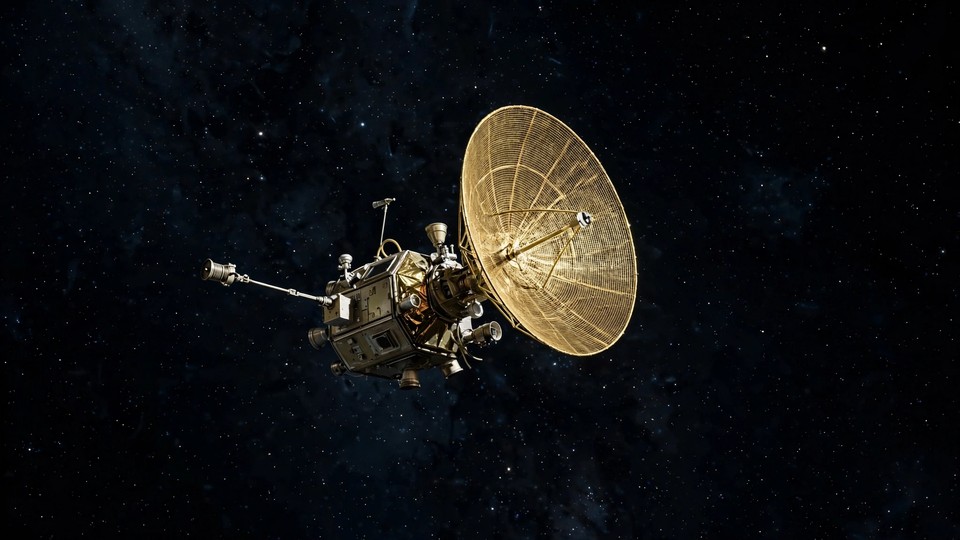
Image: Illustrative image.