
Key Takeaways
- The Internet is networks of networks.
- Data travels in packets, reassembled on arrival.
- DNS is its phone book.
First, Unlearn the Cloud
You tap a button. A photo appears. A video starts playing. An email reaches someone halfway around the world.
It feels like magic. But behind that instant experience is a remarkably organised system of networks, cables, computers and tiny packets of data.
The Internet is not a place, a company or a cloud. As Cloudflare's engineers put it, it is "a vast, sprawling collection of networks that connect to each other" — inter-connected networks — and "there is no control center for the Internet." Your home network, your provider's network, a university's, a bank's: millions of them, stitched together by agreement, speaking one shared language of protocols. And the data travelling between them? Just bits — pulses of light in fibre, electricity in copper, radio waves in the air.
Everything you send is chopped into packets
Whether it is an email, a photo or a livestream, your device first breaks the data into small segments called packets.
Think of each packet as a tiny parcel. It carries a piece of the actual data, called the payload, plus a header — its shipping label, containing the destination address, its place in the sequence and how big it is.
This technique is called packet switching, and it is the Internet's founding genius.
Routers can process each packet independently, without reserving a connection end-to-end, so no single conversation can dominate the network.
Your video call's packets might even take three different routes across the city. When they arrive, your receiving device puts them back together in order, like numbered pages of a letter mailed one page per envelope.
The cast of characters
Behind every successful connection is a team of specialised players.
- IP (Internet Protocol) is the addressing system: it moves packets from network to network. Every connected device has a unique IP address — the destination written on each packet's label.
- Routers are, in Cloudflare's phrase, "the traffic cops of the Internet" — forwarding each packet toward the network it belongs to, hop by hop. Switches do the same job inside a single network.
- TCP is the careful courier layered on top: it makes sure packets arrive successfully, in order, resending any that go missing. UDP is its faster, looser sibling — no guarantees, no resends. That's why live streaming video often uses it: a dropped frame beats a frozen stream.
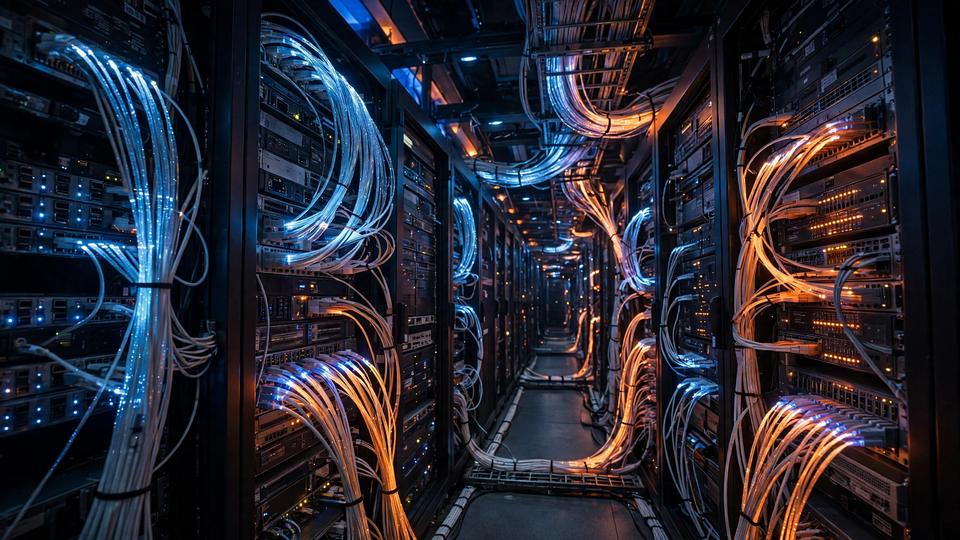
- Servers are specialised, high-powered computers that store and serve content. Most live in data centres — facilities full of networked machines processing, storing and sharing data around the clock.
DNS: the phone book you use a thousand times a day
You type a website's name. Your computer needs an address.
That's where the Domain Name System (DNS) comes in. Often called "the phonebook of the Internet", it translates the name you typed into the IP address of the server holding the website.
Behind that seemingly simple lookup, four kinds of DNS servers cooperate in a fraction of a second:
The recursive resolver (your librarian), the root, the TLD server (.com, .ca) and the authoritative nameserver that actually knows the answer.
Four players. One question. An answer before you have time to notice.
So what happens when you load a page?
Now put everything together.
You click a link. A relay race begins:
A DNS query finds the website's IP address.
A TCP handshake opens the connection: "hello — hello — let's talk".
A TLS handshake agrees on encryption.
Your browser sends an HTTP request.
The server answers with the page, broken into packets that your device reassembles into the screen in front of you.
And here's something worth remembering: the long-haul segments of that journey, including between continents, ride overwhelmingly on fibre-optic cables under the oceans.
Not satellites. Physical glass threads carrying pulses of light beneath the sea.
The Twikup Take
The Internet feels instant and immaterial, but it is neither. It is chopped-up light, forwarded by traffic cops, indexed by a phone book and rebuilt on arrival — billions of times a day, with nobody in charge.
That it works at all is the miracle; that it works this well is engineering's quietest triumph.
Image: Illustrative image.