
Key Takeaways
- María Corina Machado announced her return to Venezuela on October 25, 2026, after nearly 10 months abroad.
- Her return comes amid uncertainty over Venezuela's political transition following Nicolás Maduro's removal from power.
- Machado and opposition allies are pressing for credible elections, while the timing and conditions of a future vote remain unresolved.
A four-word announcement, then a caravan to Caracas
Venezuela's opposition leader María Corina Machado announced her return home on Sunday, October 25, in a four-word post on X: "Estoy aquí. Con ustedes" — "I am here. With you."
Her first public appearance came at Mass in Santa Rosa, in Barquisimeto, Lara state, where worshippers surrounded her. She then travelled overland toward Caracas in a caravan greeted by crowds of supporters, after crossing from neighbouring Colombia, according to NPR reporting.
Ten months out, seven failed attempts to get back
Machado had been away for ten months. She went into hiding in January 2025 after a brief detention, then slipped out of Venezuela in December to collect the Nobel Peace Prize in Oslo. Her party says she made at least seven earlier attempts to return and was blocked each time.
She was barred from running in the 2024 presidential election; her stand-in, Edmundo González, won by a landslide on the opposition's tally, but Nicolás Maduro claimed victory and held on to power. González, now in exile in Spain, confirmed her return on X and said he expects to join her soon.
A transition negotiated without her
Machado returns to a country transformed in her absence. In January, U.S. forces captured Maduro, and Washington backed his vice-president, Delcy Rodríguez, as interim president. Rodríguez has since signed oil and mineral deals with the United States, and U.S. officials had discouraged Machado from coming home.
President Donald Trump, asked about the return on Sunday, said he did not know anything about it, but added: "I think she's a very nice woman. She gave me her Nobel Prize, so how can I say anything else?" Secretary of State Marco Rubio, in a statement posted on social media the same day, credited U.S.-backed reconciliation talks with creating the conditions for her safe return and for the release of hundreds of political prisoners, calling the process the best opportunity in three decades for a peaceful democratic transition through free and fair elections.
Machado is demanding elections soon. Washington's position is that Venezuela must stabilise first — Trump said in September that it was too soon to vote.
The Twikup Take
Machado is the most popular politician in Venezuela and the one person the transition was designed to sideline. Her return puts a crowd-drawing rival back inside the country — and forces Washington and the interim government to decide whether the elections they keep promising are actually going to happen.
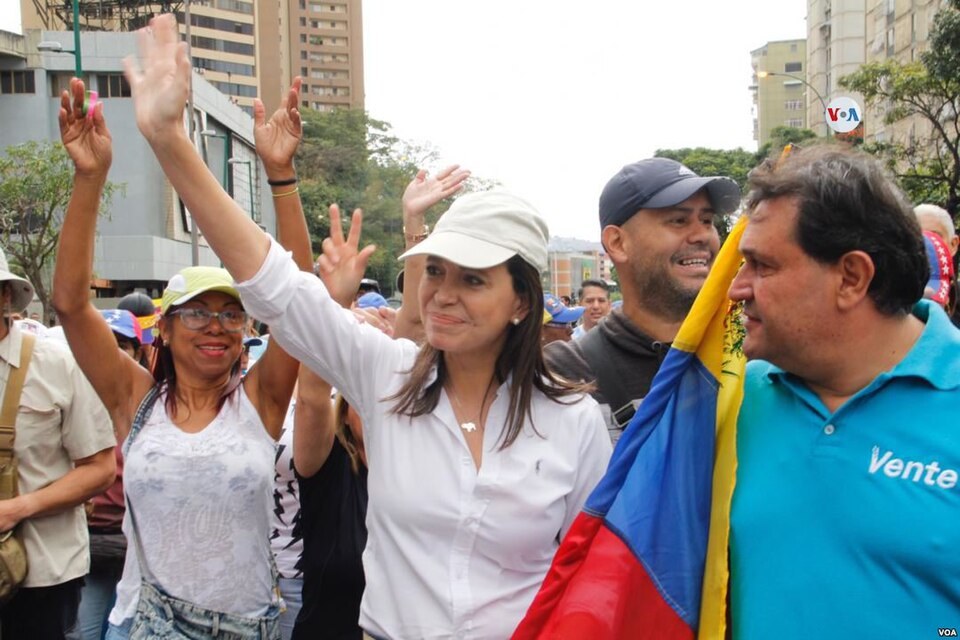
Photo: VOA / Wikimedia Commons (Public domain) — María Corina Machado heading one of the protests, surrounded by supporters.